 Add to Chrome
 Add to Firefox
 Add to Edge
Intern-S2-Preview: Scientific Agentic Foundation Model
Aug 13, 2026
Scientific discovery increasingly requires AI systems that can reason over scientific evidence of heterogeneous modalities, interact with scientific tools and environments, and sustain progress across long task horizons. We present Intern-S2-Preview, a series of scientific agentic foundation models designed to support multimodal scientific understanding, reasoning, generation, and long-horizon tasks. The training pipeline begins with scientific multimodal pre-training over rendered scientific documents, interleaved image-text data, and diverse scientific corpora. Starting from the pretrained checkpoint, we apply a unified post-training pipeline consisting of supervised fine-tuning, scalable multi-task reinforcement learning (RL), black- and white-box agentic RL, and on-policy distillation. This pipeline is supported by practical techniques that improve rollout and training stability and efficiency, including partial rollout with off-policy correction, adaptive length regularization, online speculative decoding, robust multi-task optimization, and trace-aware experience assembly for agentic tasks. At the architecture level, Intern-S2-Preview-397B extends time series modelling from efficient long-sequence understanding to numerical forecasting, while Memory Decoder is studied as a separate memory-augmented path for rapid scientific specialization without modifying the frozen 397B backbone. Evaluations across scientific, multimodal, agentic, and general-purpose benchmarks show that Intern-S2-Preview-397B achieves competitive or leading results in multiple settings. The time series modules improve scientific signal understanding and forecasting on SciTS, while the separate Intern-MemDec-4B extension improves the Biology-Instructions average score from 56.92 to 60.32 without modifying the frozen 397B backbone.

Memory Decoder at Scale: A Pretrained, Parametric Long-Term Memory
Jul 30, 2026Decoder-only language models entangle long-term memory and reasoning in a single parameter set, making it difficult to scale memory capacity independently. Memory Decoder introduces a parametric long-term memory module but only studies it at a relatively small scale. In this work, we present Memory Decoder at Scale, scaling memory models up to 6.9B parameters and pretraining them on 300B tokens. At this data scale, the combined cost of indexing and search makes a standard Faiss pipeline infeasible. We address this bottleneck with a distributed pipeline for Faiss indexing and retrieval, together with sparse, batch-wise loading of kNN distributions. Across model scales, we find that allocating more parameters to memory yields a better parameter-performance tradeoff than scaling the base model alone. On 17 benchmarks, pairing a 6.9B general memory with Pythia-410M raises its average score from 29.86 to 37.34, surpassing Pythia-12B (37.24) with 39% fewer total parameters. For Qwen3 Base models ranging from 0.6B to 14B, 1.7B domain memories improve the average score across the three domains by more than 9 points at every scale. Overall, our results demonstrate that independently scaling pretrained memory offers a more parameter efficient path to improving language model performance.
MemSFT: Mitigating Alignment Tax with an External Parametric Memory
Jul 28, 2026Adapting Large Language Models (LLMs) to specialized domains often incurs an alignment tax, as fine-tuning on domain-specific tasks can cause catastrophic forgetting and substantially degrade performance on general tasks. We propose MemSFT, which mitigates the alignment tax by decoupling domain specialization from backbone parameter updates through a plug-and-play parametric memory. The memory is trained to imitate the behavior of a non-parametric retriever operating over domain data, thereby memorizing knowledge and patterns that would otherwise be accessed through retrieval. Once trained on a specific domain, the memory can be reused across LLMs of different sizes. During generation, a learned router dynamically fuses the output distributions of the memory and backbone at each decoding step, allowing domain expertise to be invoked selectively. Across biology, geoscience, and law, evaluations with models ranging from Qwen3-8B to Qwen3-235B-A22B show that MemSFT consistently improves domain performance with negligible degradation in general performance, whereas full SFT suffers severe forgetting on general tasks. Overall, our results demonstrate a practical path to decoupling general model capabilities from domain-specific knowledge at the parameter level, thereby equipping LLMs with new specialized capabilities without compromising their general capabilities.
Nanbeige4.2-3B: Unlocking Agentic Capabilities in a Compact Model
Jul 27, 2026We present Nanbeige4.2-3B, a compact general agentic model with 3B non-embedding parameters. It delivers strong performance across code-agent, office-agent, and complex tool-use tasks while maintaining highly competitive reasoning capabilities in mathematics, coding, and science. Nanbeige4.2-3B is pretrained from scratch on 28T tokens with a Looped Transformer that reuses the layer stack to increase capacity without adding parameters. For SFT data and trajectory construction, we expand the diversity of executable environments, task assets, and agentic scaffolds through real-world deployment and large-scale synthesis. Our RL pipeline applies mixed-mode RLHF over Think and Non-Think responses to improve overall model quality and reduce failure cases, length-controlled reasoning RL to balance accuracy and reasoning efficiency, and agentic RL with outcome and process rewards to stabilize long-horizon training. Extensive evaluations show that Nanbeige4.2-3B outperforms larger models, including Qwen3.5-9B and Gemma4-12B, across diverse agentic benchmarks while remaining competitive on reasoning and alignment tasks. Performance with OpenClaw further supports its use as a compact local personal assistant.
Information-Preserving CSI Feedback: Invertible Networks with Endogenous Quantization and Channel Error Mitigation
Jul 27, 2025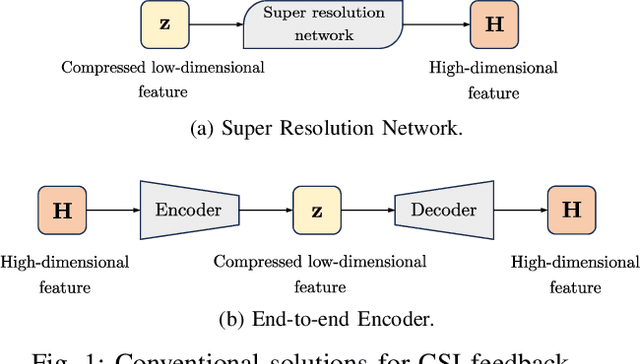
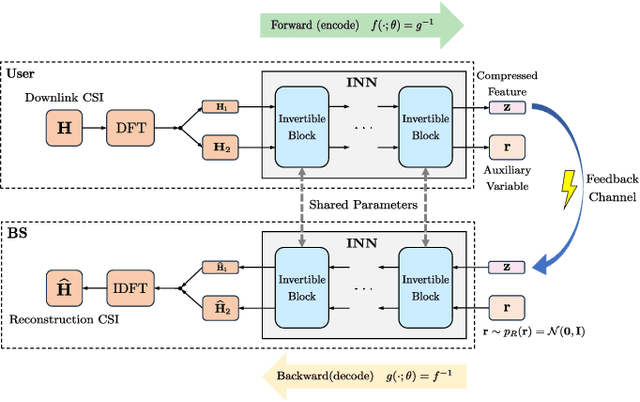
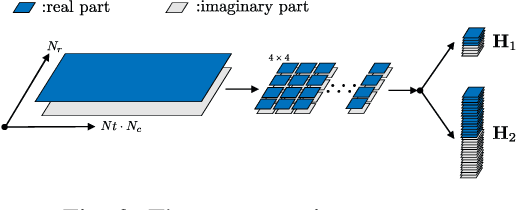
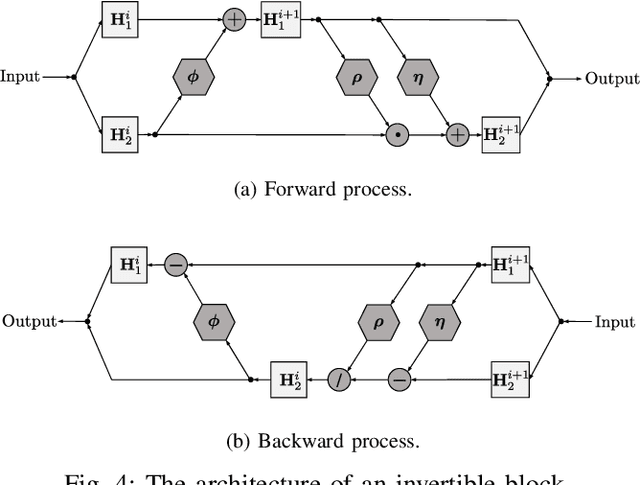
Deep learning has emerged as a promising solution for efficient channel state information (CSI) feedback in frequency division duplex (FDD) massive MIMO systems. Conventional deep learning-based methods typically rely on a deep autoencoder to compress the CSI, which leads to irreversible information loss and degrades reconstruction accuracy. This paper introduces InvCSINet, an information-preserving CSI feedback framework based on invertible neural networks (INNs). By leveraging the bijective nature of INNs, the model ensures information-preserving compression and reconstruction with shared model parameters. To address practical challenges such as quantization and channel-induced errors, we endogenously integrate an adaptive quantization module, a differentiable bit-channel distortion module and an information compensation module into the INN architecture. This design enables the network to learn and compensate the information loss during CSI compression, quantization, and noisy transmission, thereby preserving the CSI integrity throughout the feedback process. Simulation results validate the effectiveness of the proposed scheme, demonstrating superior CSI recovery performance and robustness to practical impairments with a lightweight architecture.
UAV-VisLoc: A Large-scale Dataset for UAV Visual Localization
May 20, 2024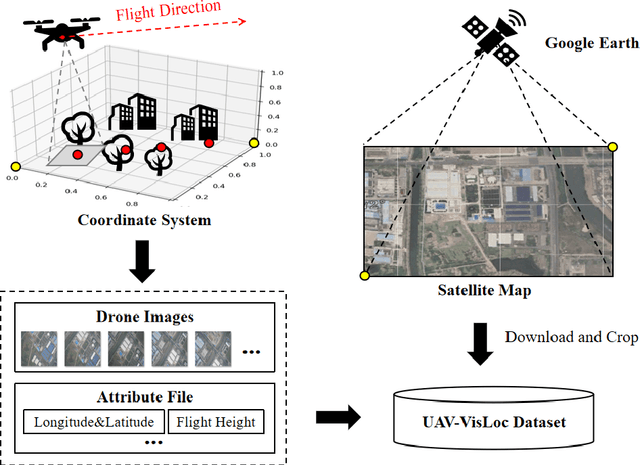
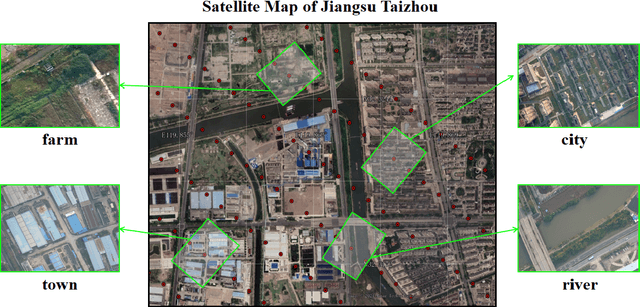
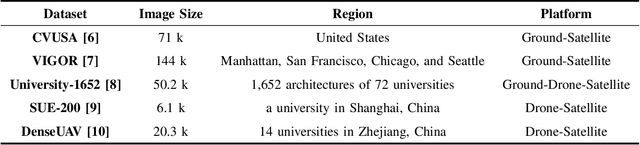
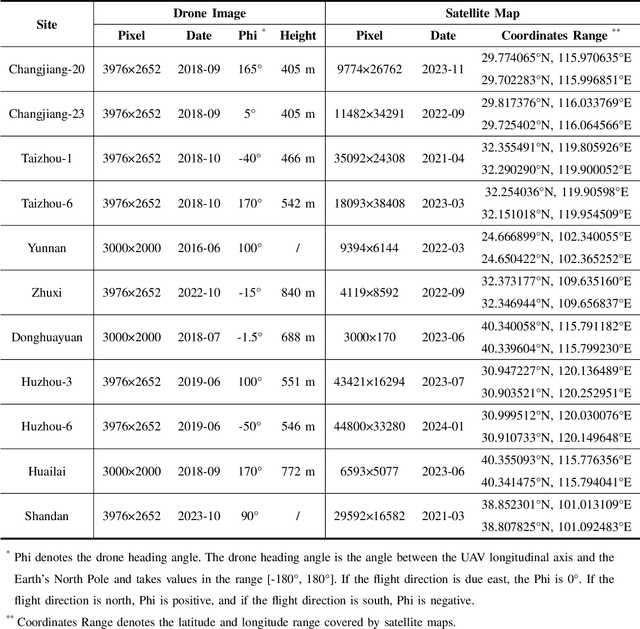
The application of unmanned aerial vehicles (UAV) has been widely extended recently. It is crucial to ensure accurate latitude and longitude coordinates for UAVs, especially when the global navigation satellite systems (GNSS) are disrupted and unreliable. Existing visual localization methods achieve autonomous visual localization without error accumulation by matching the ground-down view image of UAV with the ortho satellite maps. However, collecting UAV ground-down view images across diverse locations is costly, leading to a scarcity of large-scale datasets for real-world scenarios. Existing datasets for UAV visual localization are often limited to small geographic areas or are focused only on urban regions with distinct textures. To address this, we define the UAV visual localization task by determining the UAV's real position coordinates on a large-scale satellite map based on the captured ground-down view. In this paper, we present a large-scale dataset, UAV-VisLoc, to facilitate the UAV visual localization task. This dataset comprises images from diverse drones across 11 locations in China, capturing a range of topographical features. The dataset features images from fixed-wing drones and multi-terrain drones, captured at different altitudes and orientations. Our dataset includes 6,742 drone images and 11 satellite maps, with metadata such as latitude, longitude, altitude, and capture date. Our dataset is tailored to support both the training and testing of models by providing a diverse and extensive data.
Brain Computer Interface Technology for Future Battlefield
Dec 13, 2023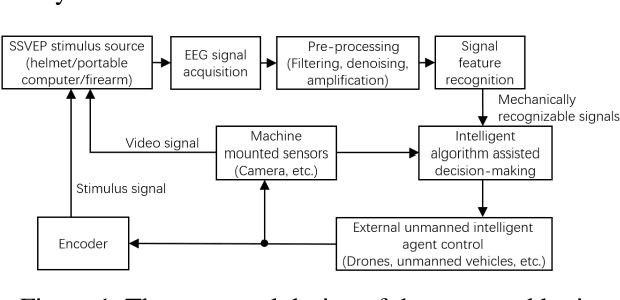
With the development of artificial intelligence and unmanned equipment, human-machine hybrid formations will be the main focus in future combat formations. With the development of big data and various situational awareness technologies, while enhancing the breadth and depth of information, decision-making has also become more complex. The operation mode of existing unmanned equipment often requires complex manual input, which is not conducive to the battlefield environment. How to reduce the cognitive load of information exchange between soldiers and various unmanned equipment is an important issue in future intelligent warfare. This paper proposes a brain computer interface communication system for soldier combat, which takes into account the characteristics of soldier combat scenarios in design. The stimulation paradigm is combined with helmets, portable computers, and firearms, and brain computer interface technology is used to achieve fast, barrier free, and hands-free communication between humans and machines. Intelligent algorithms are combined to assist decision-making in fully perceiving and fusing situational information on the battlefield, and a large amount of data is processed quickly, understanding and integrating a large amount of data from human and machine networks, achieving real-time perception of battlefield information, making intelligent decisions, and achieving the effect of direct control of drone swarms and other equipment by the human brain to assist in soldier scenarios.
Adaptive Task Offloading for Space Missions: A State-Graph-Based Approach
Nov 16, 2022Advances in space exploration have led to an explosion of tasks. Conventionally, these tasks are offloaded to ground servers for enhanced computing capability, or to adjacent low-earth-orbit satellites for reduced transmission delay. However, the overall delay is determined by both computation and transmission costs. The existing offloading schemes, while being highly-optimized for either costs, can be abysmal for the overall performance. The computation-transmission cost dilemma is yet to be solved. In this paper, we propose an adaptive offloading scheme to reduce the overall delay. The core idea is to jointly model and optimize the transmission-computation process over the entire network. Specifically, to represent the computation state migrations, we generalize graph nodes with multiple states. In this way, the joint optimization problem is transformed into a shortest path problem over the state graph. We further provide an extended Dijkstra's algorithm for efficient path finding. Simulation results show that the proposed scheme outperforms the ground and one-hop offloading schemes by up to 37.56% and 39.35% respectively on SpaceCube v2.0.