 Add to Chrome
 Add to Firefox
 Add to Edge
A 32-Channel 3.53-μW Per Channel Brain-Machine Interface SoC Featuring Dual-Threshold Delta-modulation, In-Memory Spike Detection and Bi-SNN Based Motor Decoding
Jun 01, 2026
With the scaling of sensor channel counts, systems confront challenges in frontend data sensing and on-implant data processing. This work presents a 32-channel fully event-based iBMI SoC in 65nm CMOS for an efficient neuromorphic signal processing pipeline. The SoC integrates a 32-channel dual-threshold delta modulation (DTDM) frontend array that provides up to 26x data compression at the frontend, an in-memory computing (IMC) spike detector (SPD) for efficient in-pixel spike detection, and a bipolar LIF-based spiking neural network (Bi-SNN) decoder for on-chip motor intention decoding (MID). Consuming only 3.53 μW per channel and achieving ~0.62 decoding R2 with a compact 0.034 mm2 per-channel area, the chip enables high-efficiency signal recording, processing, and decoding for implantable devices.

cuPilot: A Strategy-Coordinated Multi-agent Framework for CUDA Kernel Evolution
Dec 23, 2025Optimizing CUDA kernels is a challenging and labor-intensive task, given the need for hardware-software co-design expertise and the proprietary nature of high-performance kernel libraries. While recent large language models (LLMs) combined with evolutionary algorithms show promise in automatic kernel optimization, existing approaches often fall short in performance due to their suboptimal agent designs and mismatched evolution representations. This work identifies these mismatches and proposes cuPilot, a strategy-coordinated multi-agent framework that introduces strategy as an intermediate semantic representation for kernel evolution. Key contributions include a strategy-coordinated evolution algorithm, roofline-guided prompting, and strategy-level population initialization. Experimental results show that the generated kernels by cuPilot achieve an average speed up of 3.09$\times$ over PyTorch on a benchmark of 100 kernels. On the GEMM tasks, cuPilot showcases sophisticated optimizations and achieves high utilization of critical hardware units. The generated kernels are open-sourced at https://github.com/champloo2878/cuPilot-Kernels.git.
AIM: Software and Hardware Co-design for Architecture-level IR-drop Mitigation in High-performance PIM
Nov 06, 2025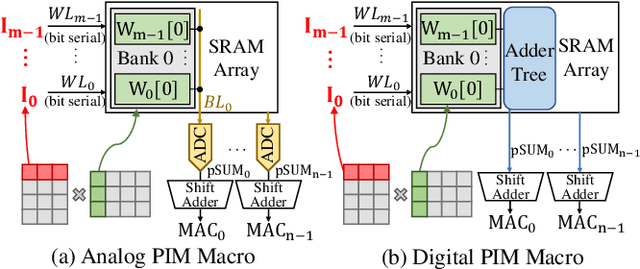
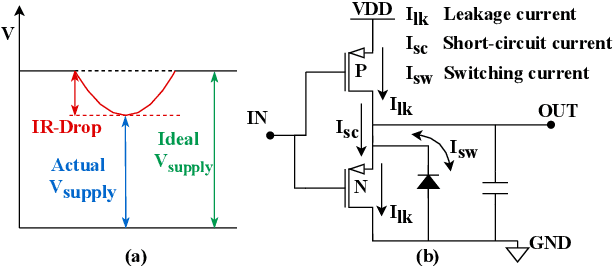
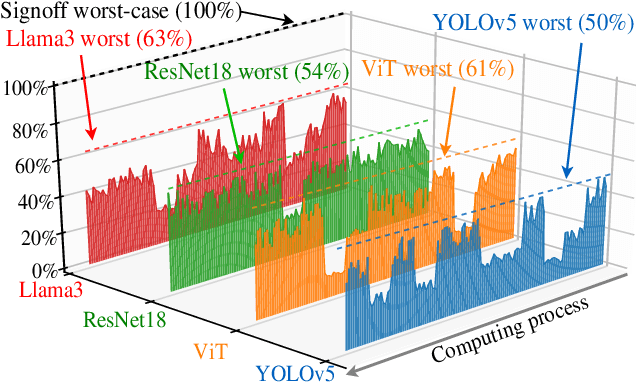
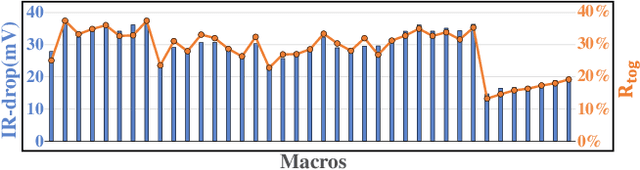
SRAM Processing-in-Memory (PIM) has emerged as the most promising implementation for high-performance PIM, delivering superior computing density, energy efficiency, and computational precision. However, the pursuit of higher performance necessitates more complex circuit designs and increased operating frequencies, which exacerbate IR-drop issues. Severe IR-drop can significantly degrade chip performance and even threaten reliability. Conventional circuit-level IR-drop mitigation methods, such as back-end optimizations, are resource-intensive and often compromise power, performance, and area (PPA). To address these challenges, we propose AIM, comprehensive software and hardware co-design for architecture-level IR-drop mitigation in high-performance PIM. Initially, leveraging the bit-serial and in-situ dataflow processing properties of PIM, we introduce Rtog and HR, which establish a direct correlation between PIM workloads and IR-drop. Building on this foundation, we propose LHR and WDS, enabling extensive exploration of architecture-level IR-drop mitigation while maintaining computational accuracy through software optimization. Subsequently, we develop IR-Booster, a dynamic adjustment mechanism that integrates software-level HR information with hardware-based IR-drop monitoring to adapt the V-f pairs of the PIM macro, achieving enhanced energy efficiency and performance. Finally, we propose the HR-aware task mapping method, bridging software and hardware designs to achieve optimal improvement. Post-layout simulation results on a 7nm 256-TOPS PIM chip demonstrate that AIM achieves up to 69.2% IR-drop mitigation, resulting in 2.29x energy efficiency improvement and 1.152x speedup.