 Add to Chrome
 Add to Firefox
 Add to Edge
E-S2Feat:Semantic-Guided Spiking Local Feature Detection and Description for Event Cameras
Aug 14, 2026
Benefiting from high temporal resolution and dynamic range, event-based local feature methods have attracted increasing attention. However, event sparsity, noise, and limited texture still hinder robust local feature learning. Deploying such methods on resource-constrained platforms such as unmanned aerial vehicles also requires balancing accuracy and energy efficiency. To address these challenges, this paper proposes \textbf{E-S2Feat}, a spiking neural network framework for event-based local feature detection and description. The framework jointly optimizes local feature learning from the perspectives of feature representation and selection. First, a module-specific spiking activation mechanism preserves fine-grained structural cues and discriminative information under low-bit, energy-efficient inference, thereby improving overall representation fidelity. Furthermore, a semantic-guided feature modulation mechanism leverages semantic priors to refine keypoint response distributions and enhance local descriptor discriminability, thereby guiding the model to extract local features with greater geometric stability and stronger discriminative capability. Experiments on the ECD and EDS datasets show that the proposed method significantly outperforms baseline methods such as SuperEvent in pose estimation accuracy. It also achieves accuracy comparable to its artificial neural network counterpart while delivering an approximately 4.8-fold improvement in theoretical computational energy efficiency. Visual-inertial odometry experiments on the TUM-VIE dataset further verify the effectiveness and practical application potential of the proposed method in complete SLAM systems.

Reinforcement learning in linear embedding space unlocks generalizable control across soft robot configurations
Jun 06, 2026Soft-bodied organisms such as octopuses and elephant trunks exhibit remarkable morphological adaptability, dynamically reconfiguring body shape and stiffness, and flexibly adjusting their control strategies to enable versatile behaviors. Inspired by these biological systems, various soft robots have emerged in recent decades, featuring diverse materials, stiffnesses, and morphologies tailored to specific tasks. Despite substantial advances in the materials and structural designs of soft robots, developing a generalizable control framework capable of rapid adaptation across diverse configurations remains a long-standing challenge. Existing controllers are limited to fixed configurations, demanding laborious configuration-specific remodelling and policy redesign for new configurations. Here, we introduce a generalizable control system that enables rapid adaptation across diverse soft robot configurations via reinforcement learning in a shared linear Koopman embedding space. By encoding robot dynamics into this embedding space, our method decouples control policies from specific morphologies, allowing real-time, model-free policy adaptation across diverse configurations without retraining from scratch. We validate our system across 33 distinct robot configurations. Our system achieves a 75 times reduction in transfer samples across configurations, while sustaining robust performance under high-speed motion, heavy payloads, and multiactuator faults, and achieving real-world skills previously unattainable in soft robotics. This work establishes a unified and adaptable control paradigm for diverse soft robot configurations, bridging mechanical reconfigurability with control flexibility, and may offer broader insights for generalizable control in complex physical systems.
Gaussian-Voxel Duet: A Dual-Scaffolding Hybrid Representation for Fast and Accurate Monocular Surface Reconstruction
May 26, 2026While 3D Gaussian Splatting has achieved remarkable success in photorealistic novel view synthesis, its pursuit of fast and high-fidelity 3D reconstruction has long been constrained by a trade-off between geometric accuracy and optimization efficiency. Methods specialized in image rendering converge quickly at the cost of imperfect geometry caused by superfluous primitives overfitting training views, while methods integrating neural signed-distance field (SDF) for better geometry incur prohibitive training costs. In this paper, we attempt to strike a better trade-off by tethering scaffold-anchored Gaussians to a jointly optimized sparse voxel scaffold. This hybrid Gaussian-Voxel representation explicitly confines anchored Gaussians to a narrow band around surfaces defined by voxelized SDFs, which effectively improves representation efficiency and condenses floating Gaussians without sacrificing geometry quality. An implicit surface tethering loss further pulls individual Gaussian primitives closer to SDF-induced surfaces in a mutually regularized manner for improved reconstruction accuracy. Extensive experiments on diverse real-world indoor scenes from ScanNet++, ScanNetv2, and DeepBlending datasets demonstrate that our method achieves state-of-the-art surface reconstruction quality as well as superior novel view synthesis against leading baselines, while maintaining fast training convergence and real-time rendering. Code will be available at https://github.com/duzh11/VoxelGS.
ConFi-GS Confidence-Guided High-Frequency Injection for 3D Gaussian Splatting Super-Resolution
May 24, 2026Reconstructing high-quality 3D scenes from low-resolution multi-view images remains challenging for 3D Gaussian Splatting (3DGS), because insufficient high-frequency observations often lead to blurred textures, weak boundaries, and view-inconsistent details. Existing approaches either apply super-resolution guidance uniformly or localize enhancement regions based mainly on geometric sampling. However, they typically do not distinguish between two fundamentally different questions: where additional detail is needed, and whether the corresponding candidate high-frequency content is reliable enough to be internalized into a multi-view consistent 3D representation. In this paper, we propose a reliability-aware frequency modeling framework for low-resolution 3DGS reconstruction. The framework first estimates a geometry-guided detail-demand prior to locate regions that are likely under-detailed under low-resolution supervision. It then computes a frequency-aware reliability map to determine whether candidate high-frequency details are structurally supported, spectrally unresolved, and cross-view stable. Combining these signals yields a detail-injection map that guides where super-resolved details should be introduced during optimization. Based on this map, we design a unified optimization scheme comprising spatially selective supervision, coarse-to-fine frequency regularization, and reliability-aware Gaussian densification. This scheme controls where reliable details are injected, when high-frequency supervision is activated, and how unresolved yet reliable details are internalized into the Gaussian representation. Experiments on multiple benchmarks show improved fidelity and perceptual quality while suppressing unstable or view-inconsistent details.
Event-based SLAM Benchmark for High-Speed Maneuvers
Apr 27, 2026Event-based cameras are bio-inspired sensors with pixels that independently and asynchronously respond to brightness changes at microsecond resolution, offering the potential to handle visual tasks in high-speed maneuvering scenarios. Existing event-based approaches, although successful in mitigating motion blur caused by high-speed maneuvers, suffer from many limitations. Some of them highlight a success of pose tracking for a fronto-parallel fast shaking camera closed to the structure, while others assume pure (optionally aggressive) three-degree-of-freedom rotations. The former requires persistent local map visibility within the field of view (FOV), whereas the latter fails to generalize to six-degree-of-freedom (6-DoF) motions where both linear and angular velocities may be large. Consequently, current successes do not fully demonstrate that event-based state estimation under arbitrary aggressive maneuvers is a fully solved problem. To quantitatively assess the extent to which the potential of event cameras has been unlocked, we conduct a thorough analysis of state-of-the-art (SOTA) event-based visual odometry (VO)/visual-inertial odometry (VIO) methods and report shortcomings in current public datasets. Furthermore, we introduce a benchmarking framework for event-based state estimation, called EvSLAM, characterized by sufficient variation in data collection platforms, diverse extreme lighting scenarios, and a wide scope of challenging motion patterns under a clear and rigorous definition of high-speed maneuvers for mobile robots, along with a novel evaluation metric designed to fairly assess the operational limits of event-based solutions. This framework benchmarks state-of-the-art methods, yielding insights into optimal architectures and persistent challenges.
GESS: Multi-cue Guided Local Feature Learning via Geometric and Semantic Synergy
Apr 07, 2026Robust local feature detection and description are foundational tasks in computer vision. Existing methods primarily rely on single appearance cues for modeling, leading to unstable keypoints and insufficient descriptor discriminability. In this paper, we propose a multi-cue guided local feature learning framework that leverages semantic and geometric cues to synergistically enhance detection robustness and descriptor discriminability. Specifically, we construct a joint semantic-normal prediction head and a depth stability prediction head atop a lightweight backbone. The former leverages a shared 3D vector field to deeply couple semantic and normal cues, thereby resolving optimization interference from heterogeneous inconsistencies. The latter quantifies the reliability of local regions from a geometric consistency perspective, providing deterministic guidance for robust keypoint selection. Based on these predictions, we introduce the Semantic-Depth Aware Keypoint (SDAK) mechanism for feature detection. By coupling semantic reliability with depth stability, SDAK reweights keypoint responses to suppress spurious features in unreliable regions. For descriptor construction, we design a Unified Triple-Cue Fusion (UTCF) module, which employs a semantic-scheduled gating mechanism to adaptively inject multi-attribute features, improving descriptor discriminability. Extensive experiments on four benchmarks validate the effectiveness of the proposed framework. The source code and pre-trained model will be available at: https://github.com/yiyscut/GESS.git.
TAPFormer: Robust Arbitrary Point Tracking via Transient Asynchronous Fusion of Frames and Events
Mar 05, 2026Tracking any point (TAP) is a fundamental yet challenging task in computer vision, requiring high precision and long-term motion reasoning. Recent attempts to combine RGB frames and event streams have shown promise, yet they typically rely on synchronous or non-adaptive fusion, leading to temporal misalignment and severe degradation when one modality fails. We introduce TAPFormer, a transformer-based framework that performs asynchronous temporal-consistent fusion of frames and events for robust and high-frequency arbitrary point tracking. Our key innovation is a Transient Asynchronous Fusion (TAF) mechanism, which explicitly models the temporal evolution between discrete frames through continuous event updates, bridging the gap between low-rate frames and high-rate events. In addition, a Cross-modal Locally Weighted Fusion (CLWF) module adaptively adjusts spatial attention according to modality reliability, yielding stable and discriminative features even under blur or low light. To evaluate our approach under realistic conditions, we construct a novel real-world frame-event TAP dataset under diverse illumination and motion conditions. Our method outperforms existing point trackers, achieving a 28.2% improvement in average pixel error within threshold. Moreover, on standard point tracking benchmarks, our tracker consistently achieves the best performance. Project website: tapformer.github.io
Grasp Like Humans: Learning Generalizable Multi-Fingered Grasping from Human Proprioceptive Sensorimotor Integration
Sep 10, 2025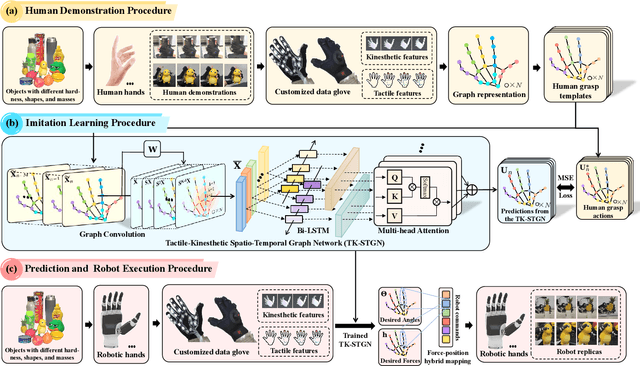
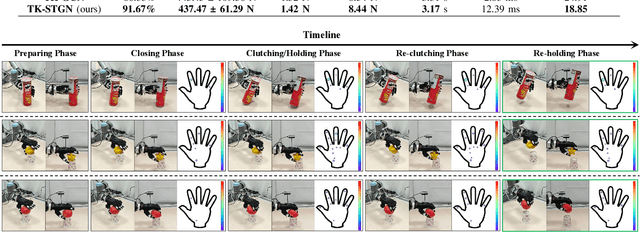
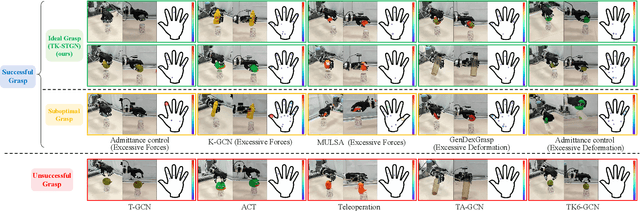
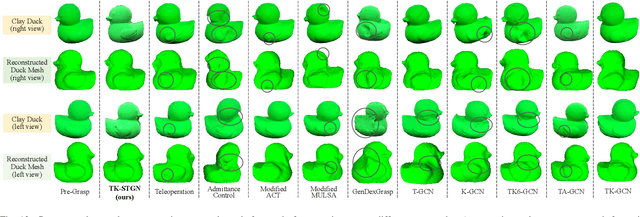
Tactile and kinesthetic perceptions are crucial for human dexterous manipulation, enabling reliable grasping of objects via proprioceptive sensorimotor integration. For robotic hands, even though acquiring such tactile and kinesthetic feedback is feasible, establishing a direct mapping from this sensory feedback to motor actions remains challenging. In this paper, we propose a novel glove-mediated tactile-kinematic perception-prediction framework for grasp skill transfer from human intuitive and natural operation to robotic execution based on imitation learning, and its effectiveness is validated through generalized grasping tasks, including those involving deformable objects. Firstly, we integrate a data glove to capture tactile and kinesthetic data at the joint level. The glove is adaptable for both human and robotic hands, allowing data collection from natural human hand demonstrations across different scenarios. It ensures consistency in the raw data format, enabling evaluation of grasping for both human and robotic hands. Secondly, we establish a unified representation of multi-modal inputs based on graph structures with polar coordinates. We explicitly integrate the morphological differences into the designed representation, enhancing the compatibility across different demonstrators and robotic hands. Furthermore, we introduce the Tactile-Kinesthetic Spatio-Temporal Graph Networks (TK-STGN), which leverage multidimensional subgraph convolutions and attention-based LSTM layers to extract spatio-temporal features from graph inputs to predict node-based states for each hand joint. These predictions are then mapped to final commands through a force-position hybrid mapping.
Fully Spiking Neural Networks for Unified Frame-Event Object Tracking
May 27, 2025The integration of image and event streams offers a promising approach for achieving robust visual object tracking in complex environments. However, current fusion methods achieve high performance at the cost of significant computational overhead and struggle to efficiently extract the sparse, asynchronous information from event streams, failing to leverage the energy-efficient advantages of event-driven spiking paradigms. To address this challenge, we propose the first fully Spiking Frame-Event Tracking framework called SpikeFET. This network achieves synergistic integration of convolutional local feature extraction and Transformer-based global modeling within the spiking paradigm, effectively fusing frame and event data. To overcome the degradation of translation invariance caused by convolutional padding, we introduce a Random Patchwork Module (RPM) that eliminates positional bias through randomized spatial reorganization and learnable type encoding while preserving residual structures. Furthermore, we propose a Spatial-Temporal Regularization (STR) strategy that overcomes similarity metric degradation from asymmetric features by enforcing spatio-temporal consistency among temporal template features in latent space. Extensive experiments across multiple benchmarks demonstrate that the proposed framework achieves superior tracking accuracy over existing methods while significantly reducing power consumption, attaining an optimal balance between performance and efficiency. The code will be released.
A Plug-and-Play Learning-based IMU Bias Factor for Robust Visual-Inertial Odometry
Mar 16, 2025
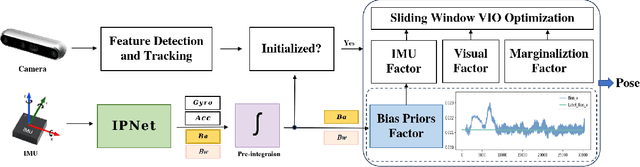
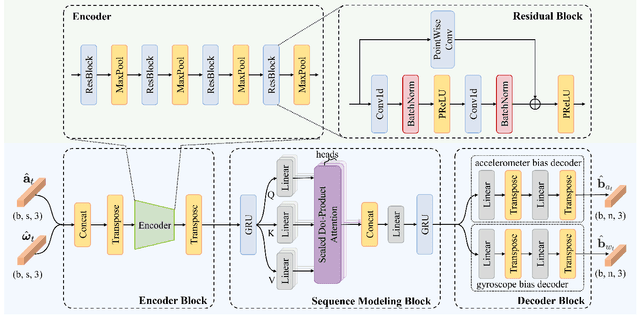
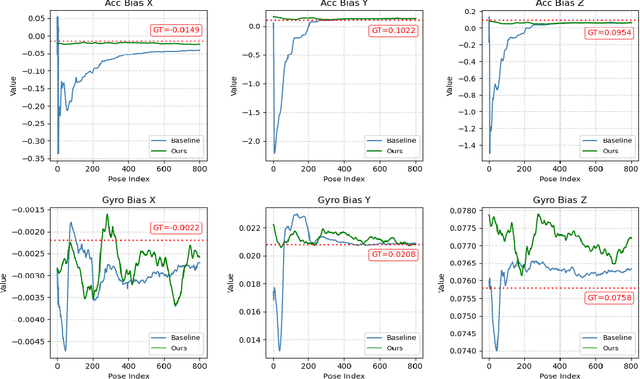
The bias of low-cost Inertial Measurement Units (IMU) is a critical factor affecting the performance of Visual-Inertial Odometry (VIO). In particular, when visual tracking encounters errors, the optimized bias results may deviate significantly from the true values, adversely impacting the system's stability and localization precision. In this paper, we propose a novel plug-and-play framework featuring the Inertial Prior Network (IPNet), which is designed to accurately estimate IMU bias. Recognizing the substantial impact of initial bias errors in low-cost inertial devices on system performance, our network directly leverages raw IMU data to estimate the mean bias, eliminating the dependency on historical estimates in traditional recursive predictions and effectively preventing error propagation. Furthermore, we introduce an iterative approach to calculate the mean value of the bias for network training, addressing the lack of bias labels in many visual-inertial datasets. The framework is evaluated on two public datasets and one self-collected dataset. Extensive experiments demonstrate that our method significantly enhances both localization precision and robustness, with the ATE-RMSE metric improving on average by 46\%. The source code and video will be available at \textcolor{red}{https://github.com/yiyscut/VIO-IPNet.git}.