 Add to Chrome
 Add to Firefox
 Add to Edge
SocialGPT: Prompting LLMs for Social Relation Reasoning via Greedy Segment Optimization
Oct 28, 2024
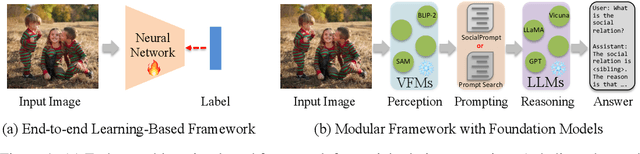
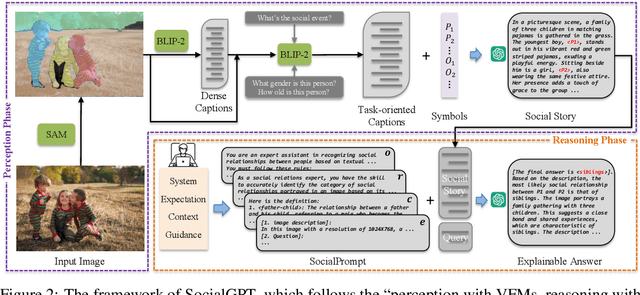

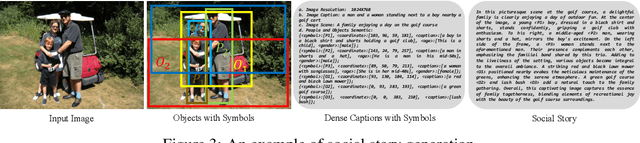
Social relation reasoning aims to identify relation categories such as friends, spouses, and colleagues from images. While current methods adopt the paradigm of training a dedicated network end-to-end using labeled image data, they are limited in terms of generalizability and interpretability. To address these issues, we first present a simple yet well-crafted framework named {\name}, which combines the perception capability of Vision Foundation Models (VFMs) and the reasoning capability of Large Language Models (LLMs) within a modular framework, providing a strong baseline for social relation recognition. Specifically, we instruct VFMs to translate image content into a textual social story, and then utilize LLMs for text-based reasoning. {\name} introduces systematic design principles to adapt VFMs and LLMs separately and bridge their gaps. Without additional model training, it achieves competitive zero-shot results on two databases while offering interpretable answers, as LLMs can generate language-based explanations for the decisions. The manual prompt design process for LLMs at the reasoning phase is tedious and an automated prompt optimization method is desired. As we essentially convert a visual classification task into a generative task of LLMs, automatic prompt optimization encounters a unique long prompt optimization issue. To address this issue, we further propose the Greedy Segment Prompt Optimization (GSPO), which performs a greedy search by utilizing gradient information at the segment level. Experimental results show that GSPO significantly improves performance, and our method also generalizes to different image styles. The code is available at https://github.com/Mengzibin/SocialGPT.

UniMuMo: Unified Text, Music and Motion Generation
Oct 06, 2024
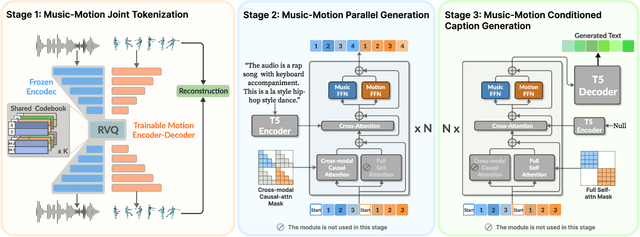


We introduce UniMuMo, a unified multimodal model capable of taking arbitrary text, music, and motion data as input conditions to generate outputs across all three modalities. To address the lack of time-synchronized data, we align unpaired music and motion data based on rhythmic patterns to leverage existing large-scale music-only and motion-only datasets. By converting music, motion, and text into token-based representation, our model bridges these modalities through a unified encoder-decoder transformer architecture. To support multiple generation tasks within a single framework, we introduce several architectural improvements. We propose encoding motion with a music codebook, mapping motion into the same feature space as music. We introduce a music-motion parallel generation scheme that unifies all music and motion generation tasks into a single transformer decoder architecture with a single training task of music-motion joint generation. Moreover, the model is designed by fine-tuning existing pre-trained single-modality models, significantly reducing computational demands. Extensive experiments demonstrate that UniMuMo achieves competitive results on all unidirectional generation benchmarks across music, motion, and text modalities. Quantitative results are available in the \href{https://hanyangclarence.github.io/unimumo_demo/}{project page}.
Compositional Physical Reasoning of Objects and Events from Videos
Aug 02, 2024Understanding and reasoning about objects' physical properties in the natural world is a fundamental challenge in artificial intelligence. While some properties like colors and shapes can be directly observed, others, such as mass and electric charge, are hidden from the objects' visual appearance. This paper addresses the unique challenge of inferring these hidden physical properties from objects' motion and interactions and predicting corresponding dynamics based on the inferred physical properties. We first introduce the Compositional Physical Reasoning (ComPhy) dataset. For a given set of objects, ComPhy includes limited videos of them moving and interacting under different initial conditions. The model is evaluated based on its capability to unravel the compositional hidden properties, such as mass and charge, and use this knowledge to answer a set of questions. Besides the synthetic videos from simulators, we also collect a real-world dataset to show further test physical reasoning abilities of different models. We evaluate state-of-the-art video reasoning models on ComPhy and reveal their limited ability to capture these hidden properties, which leads to inferior performance. We also propose a novel neuro-symbolic framework, Physical Concept Reasoner (PCR), that learns and reasons about both visible and hidden physical properties from question answering. After training, PCR demonstrates remarkable capabilities. It can detect and associate objects across frames, ground visible and hidden physical properties, make future and counterfactual predictions, and utilize these extracted representations to answer challenging questions.
FlexAttention for Efficient High-Resolution Vision-Language Models
Jul 29, 2024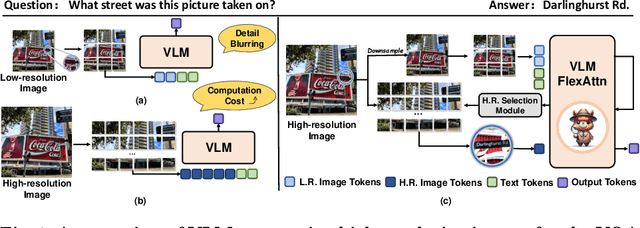

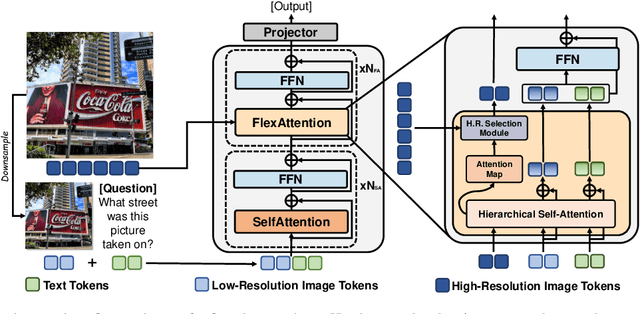
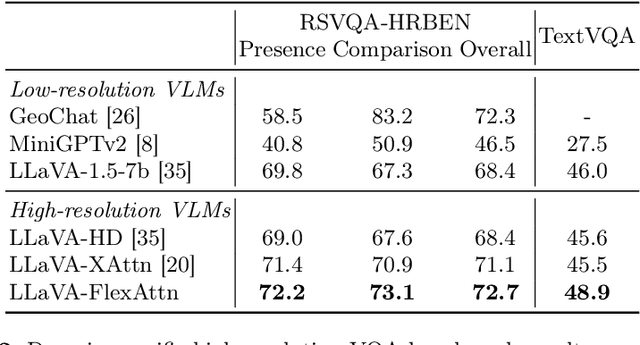
Current high-resolution vision-language models encode images as high-resolution image tokens and exhaustively take all these tokens to compute attention, which significantly increases the computational cost. To address this problem, we propose FlexAttention, a flexible attention mechanism for efficient high-resolution vision-language models. Specifically, a high-resolution image is encoded both as high-resolution tokens and low-resolution tokens, where only the low-resolution tokens and a few selected high-resolution tokens are utilized to calculate the attention map, which greatly shrinks the computational cost. The high-resolution tokens are selected via a high-resolution selection module which could retrieve tokens of relevant regions based on an input attention map. The selected high-resolution tokens are then concatenated to the low-resolution tokens and text tokens, and input to a hierarchical self-attention layer which produces an attention map that could be used for the next-step high-resolution token selection. The hierarchical self-attention process and high-resolution token selection process are performed iteratively for each attention layer. Experiments on multimodal benchmarks prove that our FlexAttention outperforms existing high-resolution VLMs (e.g., relatively ~9% in V* Bench, ~7% in TextVQA), while also significantly reducing the computational cost by nearly 40%.
Disentangled Acoustic Fields For Multimodal Physical Scene Understanding
Jul 16, 2024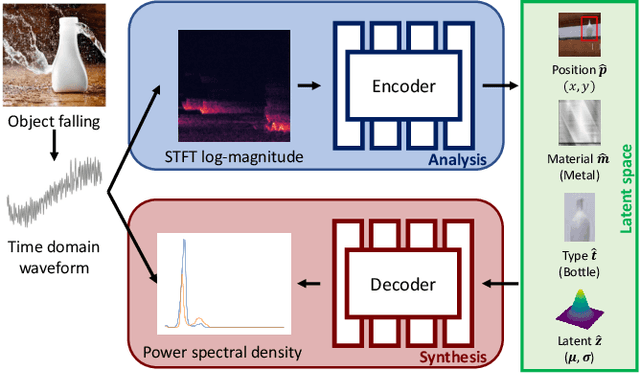
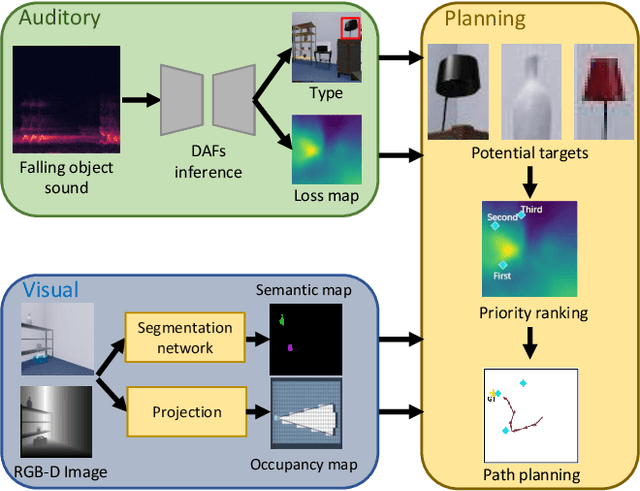
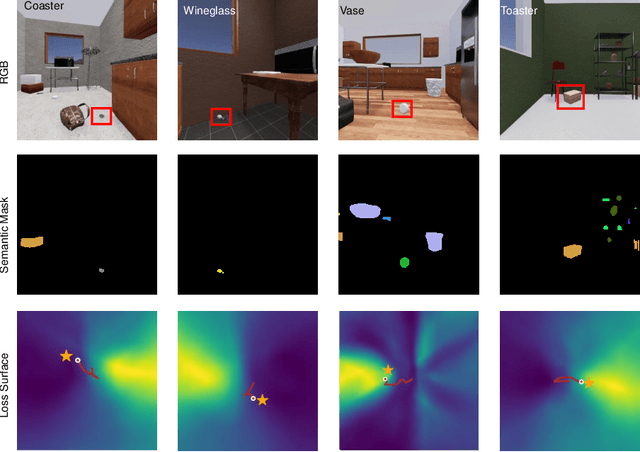
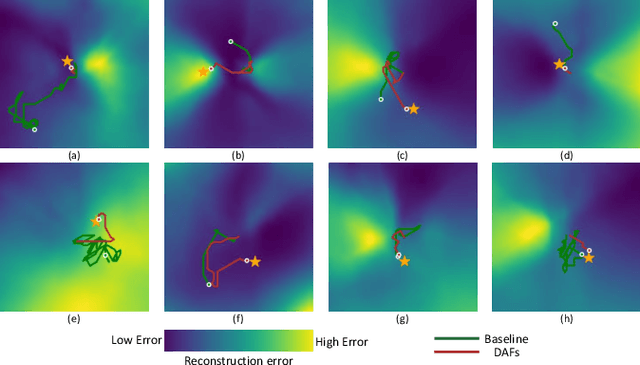
We study the problem of multimodal physical scene understanding, where an embodied agent needs to find fallen objects by inferring object properties, direction, and distance of an impact sound source. Previous works adopt feed-forward neural networks to directly regress the variables from sound, leading to poor generalization and domain adaptation issues. In this paper, we illustrate that learning a disentangled model of acoustic formation, referred to as disentangled acoustic field (DAF), to capture the sound generation and propagation process, enables the embodied agent to construct a spatial uncertainty map over where the objects may have fallen. We demonstrate that our analysis-by-synthesis framework can jointly infer sound properties by explicitly decomposing and factorizing the latent space of the disentangled model. We further show that the spatial uncertainty map can significantly improve the success rate for the localization of fallen objects by proposing multiple plausible exploration locations.
ConMe: Rethinking Evaluation of Compositional Reasoning for Modern VLMs
Jun 12, 2024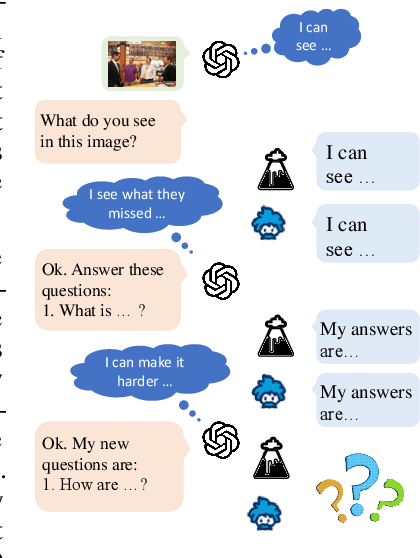
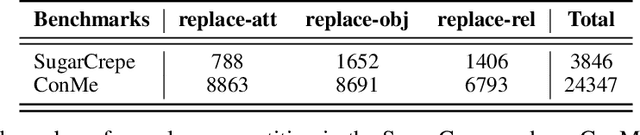
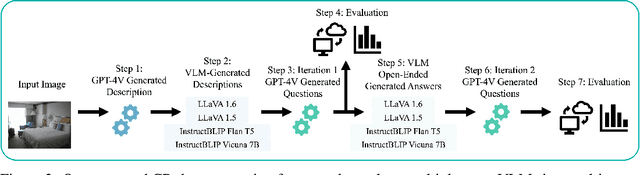

Compositional Reasoning (CR) entails grasping the significance of attributes, relations, and word order. Recent Vision-Language Models (VLMs), comprising a visual encoder and a Large Language Model (LLM) decoder, have demonstrated remarkable proficiency in such reasoning tasks. This prompts a crucial question: have VLMs effectively tackled the CR challenge? We conjecture that existing CR benchmarks may not adequately push the boundaries of modern VLMs due to the reliance on an LLM-only negative text generation pipeline. Consequently, the negatives produced either appear as outliers from the natural language distribution learned by VLMs' LLM decoders or as improbable within the corresponding image context. To address these limitations, we introduce ConMe -- a compositional reasoning benchmark and a novel data generation pipeline leveraging VLMs to produce `hard CR Q&A'. Through a new concept of VLMs conversing with each other to collaboratively expose their weaknesses, our pipeline autonomously generates, evaluates, and selects challenging compositional reasoning questions, establishing a robust CR benchmark, also subsequently validated manually. Our benchmark provokes a noteworthy, up to 33%, decrease in CR performance compared to preceding benchmarks, reinstating the CR challenge even for state-of-the-art VLMs.
CoNav: A Benchmark for Human-Centered Collaborative Navigation
Jun 04, 2024Human-robot collaboration, in which the robot intelligently assists the human with the upcoming task, is an appealing objective. To achieve this goal, the agent needs to be equipped with a fundamental collaborative navigation ability, where the agent should reason human intention by observing human activities and then navigate to the human's intended destination in advance of the human. However, this vital ability has not been well studied in previous literature. To fill this gap, we propose a collaborative navigation (CoNav) benchmark. Our CoNav tackles the critical challenge of constructing a 3D navigation environment with realistic and diverse human activities. To achieve this, we design a novel LLM-based humanoid animation generation framework, which is conditioned on both text descriptions and environmental context. The generated humanoid trajectory obeys the environmental context and can be easily integrated into popular simulators. We empirically find that the existing navigation methods struggle in CoNav task since they neglect the perception of human intention. To solve this problem, we propose an intention-aware agent for reasoning both long-term and short-term human intention. The agent predicts navigation action based on the predicted intention and panoramic observation. The emergent agent behavior including observing humans, avoiding human collision, and navigation reveals the efficiency of the proposed datasets and agents.
Physically Compatible 3D Object Modeling from a Single Image
Jun 03, 2024We present a computational framework that transforms single images into 3D physical objects. The visual geometry of a physical object in an image is determined by three orthogonal attributes: mechanical properties, external forces, and rest-shape geometry. Existing single-view 3D reconstruction methods often overlook this underlying composition, presuming rigidity or neglecting external forces. Consequently, the reconstructed objects fail to withstand real-world physical forces, resulting in instability or undesirable deformation -- diverging from their intended designs as depicted in the image. Our optimization framework addresses this by embedding physical compatibility into the reconstruction process. We explicitly decompose the three physical attributes and link them through static equilibrium, which serves as a hard constraint, ensuring that the optimized physical shapes exhibit desired physical behaviors. Evaluations on a dataset collected from Objaverse demonstrate that our framework consistently enhances the physical realism of 3D models over existing methods. The utility of our framework extends to practical applications in dynamic simulations and 3D printing, where adherence to physical compatibility is paramount.
RapVerse: Coherent Vocals and Whole-Body Motions Generations from Text
May 30, 2024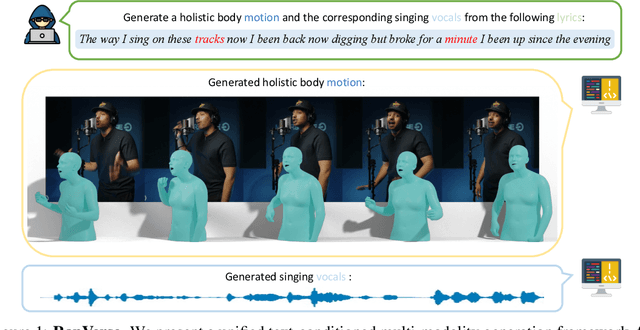
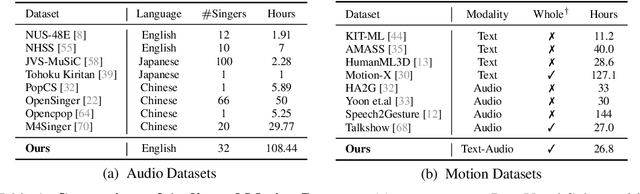

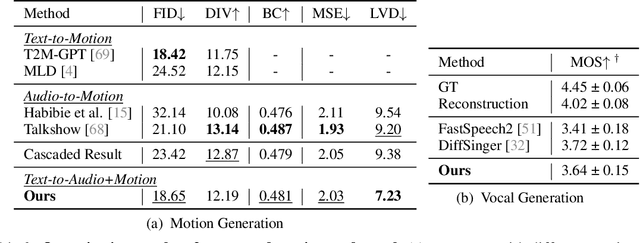
In this work, we introduce a challenging task for simultaneously generating 3D holistic body motions and singing vocals directly from textual lyrics inputs, advancing beyond existing works that typically address these two modalities in isolation. To facilitate this, we first collect the RapVerse dataset, a large dataset containing synchronous rapping vocals, lyrics, and high-quality 3D holistic body meshes. With the RapVerse dataset, we investigate the extent to which scaling autoregressive multimodal transformers across language, audio, and motion can enhance the coherent and realistic generation of vocals and whole-body human motions. For modality unification, a vector-quantized variational autoencoder is employed to encode whole-body motion sequences into discrete motion tokens, while a vocal-to-unit model is leveraged to obtain quantized audio tokens preserving content, prosodic information, and singer identity. By jointly performing transformer modeling on these three modalities in a unified way, our framework ensures a seamless and realistic blend of vocals and human motions. Extensive experiments demonstrate that our unified generation framework not only produces coherent and realistic singing vocals alongside human motions directly from textual inputs but also rivals the performance of specialized single-modality generation systems, establishing new benchmarks for joint vocal-motion generation. The project page is available for research purposes at https://vis-www.cs.umass.edu/RapVerse.
SOK-Bench: A Situated Video Reasoning Benchmark with Aligned Open-World Knowledge
May 17, 2024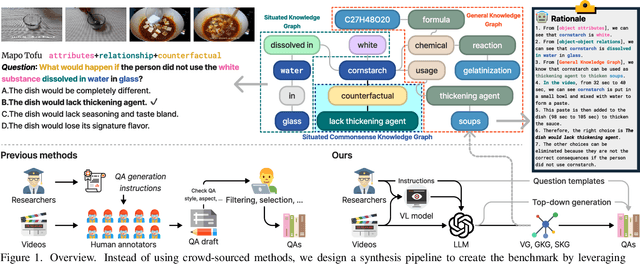

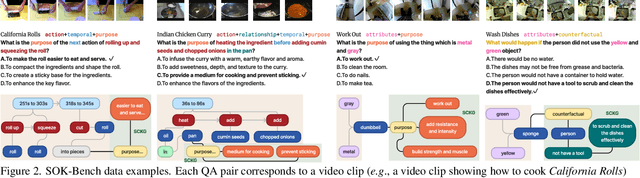

Learning commonsense reasoning from visual contexts and scenes in real-world is a crucial step toward advanced artificial intelligence. However, existing video reasoning benchmarks are still inadequate since they were mainly designed for factual or situated reasoning and rarely involve broader knowledge in the real world. Our work aims to delve deeper into reasoning evaluations, specifically within dynamic, open-world, and structured context knowledge. We propose a new benchmark (SOK-Bench), consisting of 44K questions and 10K situations with instance-level annotations depicted in the videos. The reasoning process is required to understand and apply situated knowledge and general knowledge for problem-solving. To create such a dataset, we propose an automatic and scalable generation method to generate question-answer pairs, knowledge graphs, and rationales by instructing the combinations of LLMs and MLLMs. Concretely, we first extract observable situated entities, relations, and processes from videos for situated knowledge and then extend to open-world knowledge beyond the visible content. The task generation is facilitated through multiple dialogues as iterations and subsequently corrected and refined by our designed self-promptings and demonstrations. With a corpus of both explicit situated facts and implicit commonsense, we generate associated question-answer pairs and reasoning processes, finally followed by manual reviews for quality assurance. We evaluated recent mainstream large vision-language models on the benchmark and found several insightful conclusions. For more information, please refer to our benchmark at www.bobbywu.com/SOKBench.