 Add to Chrome
 Add to Firefox
 Add to Edge
Playful Agentic Robot Learning
Jun 17, 2026
Current agentic robot systems can write executable Code-as-Policy programs, observe feedback, and revise behavior across multiple attempts, but they remain largely task-driven: reusable skills are acquired only after explicit instructions. We study Playful Agentic Robot Learning, where an embodied coding agent uses self-directed play as a continual skill-learning stage before downstream tasks arrive. We introduce RATs, Robotics Agent Teams designed for play-time skill acquisition. During play, RATs proposes novel yet learnable exploratory tasks, plans and executes robot-code policies, verifies intermediate progress, diagnoses failures, retries with dense, step-level feedback, and distills successful executions into a persistent code skill library. At test time, the agent reuses relevant skills from this frozen library to help solve new tasks. Experiments in LIBERO-PRO and MolmoSpaces show that play-learned skills improve held-out downstream tasks over no-play and random-play baselines, with 20.6 and 17.0 percentage-point gains over CaP-Agent0 on LIBERO-PRO and MolmoSpaces, respectively. Moreover, the learned skills can be plugged into other inference-time Code-as-Policy agents by simply retrieving them into the context, improving RoboSuite and real-world transfer by 8.9 and 8.8 points, respectively, without finetuning the underlying model.

T-Rex: Tactile-Reactive Dexterous Manipulation
Jun 15, 2026The ability to react dynamically to tactile signals has long been considered crucial to agile human-level dexterity. Yet contemporary learning-based Vision-Language-Action (VLA) models for robotic manipulation generally either overlook the tactile modality or are limited to encoders with static cues, due in part to the scarcity of diverse training data and standardized evaluation, architectural constraints in current VLA models, and limitations of static tactile encoders. In this paper, we push the frontier of tactile-reactive manipulation by addressing all of these limitations. We propose a large-scale, 100-hour tactile-rich dataset collected via a novel, data-efficient recipe that prioritizes elementary motor primitives. To effectively exploit naturally high-frequency touch signals without sacrificing the existing capabilities of existing VLAs, we introduce a variable-rate Mixture-of-Transformers (MoT) architecture equipped with a novel temporal tactile VQ-VAE encoder. We demonstrate the effectiveness of tactile-reactive policies on 12 manipulation tasks requiring delicate force control and deformable object manipulation, achieving over 30% higher average success rate than the strongest baseline.
Contrastive Action-Image Pre-training for Visuomotor Control
Jun 15, 2026Existing vision encoders for robotics face a fundamental bottleneck: robotic datasets lack the scale necessary for large-scale pre-training. Prior work circumvents this data scarcity by turning to internet-scale image and language data or egocentric human video. While these models show promise, neither paradigm learns from paired vision and action data, which downstream visuomotor control policies require. However, robot trajectories, the most direct source of this paired signal, are not available at pre-training scale, motivating us to extract action signals from abundant human video instead. To this end, we introduce CAIP (Contrastive Action-Image Pre-training), a vision encoder that treats human hand poses from large-scale egocentric video as a proxy for end-effector actions. By extracting 3D hand keypoints, a representation that aligns naturally with downstream robot action spaces, CAIP learns a unified action-image representation through a contrastive objective. Leveraging 32,041 hours of egocentric human video and only 88 hours of robotic manipulation data, CAIP outperforms state-of-the-art vision encoders including DINOv2, SigLIP, MVP, and R3M. Evaluated on a challenging real-world dexterous manipulation setup using Dexmate Vega and Sharpa Wave hands, CAIP yields performance gains of more than 30% on tasks involving folding, pouring, and fine-grained manipulation. Our results show that our method of contrastive action-centric pre-training yields a scalable path to achieving robust visual representations better suited for physical interaction.
ChartNet: A Million-Scale, High-Quality Multimodal Dataset for Robust Chart Understanding
Mar 28, 2026Understanding charts requires models to jointly reason over geometric visual patterns, structured numerical data, and natural language -- a capability where current vision-language models (VLMs) remain limited. We introduce ChartNet, a high-quality, million-scale multimodal dataset designed to advance chart interpretation and reasoning. ChartNet leverages a novel code-guided synthesis pipeline to generate 1.5 million diverse chart samples spanning 24 chart types and 6 plotting libraries. Each sample consists of five aligned components: plotting code, rendered chart image, data table, natural language summary, and question-answering with reasoning, providing fine-grained cross-modal alignment. To capture the full spectrum of chart comprehension, ChartNet additionally includes specialized subsets encompassing human annotated data, real-world data, safety, and grounding. Moreover, a rigorous quality-filtering pipeline ensures visual fidelity, semantic accuracy, and diversity across chart representations. Fine-tuning on ChartNet consistently improves results across benchmarks, demonstrating its utility as large-scale supervision for multimodal models. As the largest open-source dataset of its kind, ChartNet aims to support the development of foundation models with robust and generalizable capabilities for data visualization understanding. The dataset is publicly available at https://huggingface.co/datasets/ibm-granite/ChartNet
Latent Implicit Visual Reasoning
Dec 24, 2025While Large Multimodal Models (LMMs) have made significant progress, they remain largely text-centric, relying on language as their core reasoning modality. As a result, they are limited in their ability to handle reasoning tasks that are predominantly visual. Recent approaches have sought to address this by supervising intermediate visual steps with helper images, depth maps, or image crops. However, these strategies impose restrictive priors on what "useful" visual abstractions look like, add heavy annotation costs, and struggle to generalize across tasks. To address this critical limitation, we propose a task-agnostic mechanism that trains LMMs to discover and use visual reasoning tokens without explicit supervision. These tokens attend globally and re-encode the image in a task-adaptive way, enabling the model to extract relevant visual information without hand-crafted supervision. Our approach outperforms direct fine-tuning and achieves state-of-the-art results on a diverse range of vision-centric tasks -- including those where intermediate abstractions are hard to specify -- while also generalizing to multi-task instruction tuning.
DAVE: A VLM Vision Encoder for Document Understanding and Web Agents
Dec 19, 2025While Vision-language models (VLMs) have demonstrated remarkable performance across multi-modal tasks, their choice of vision encoders presents a fundamental weakness: their low-level features lack the robust structural and spatial information essential for document understanding and web agents. To bridge this gap, we introduce DAVE, a vision encoder purpose-built for VLMs and tailored for these tasks. Our training pipeline is designed to leverage abundant unlabeled data to bypass the need for costly large-scale annotations for document and web images. We begin with a self-supervised pretraining stage on unlabeled images, followed by a supervised autoregressive pretraining stage, where the model learns tasks like parsing and localization from limited, high-quality data. Within the supervised stage, we adopt two strategies to improve our encoder's alignment with both general visual knowledge and diverse document and web agentic tasks: (i) We introduce a novel model-merging scheme, combining encoders trained with different text decoders to ensure broad compatibility with different web agentic architectures. (ii) We use ensemble training to fuse features from pretrained generalist encoders (e.g., SigLIP2) with our own document and web-specific representations. Extensive experiments on classic document tasks, VQAs, web localization, and agent-based benchmarks validate the effectiveness of our approach, establishing DAVE as a strong vision encoder for document and web applications.
Activation Reward Models for Few-Shot Model Alignment
Jul 02, 2025Aligning Large Language Models (LLMs) and Large Multimodal Models (LMMs) to human preferences is a central challenge in improving the quality of the models' generative outputs for real-world applications. A common approach is to use reward modeling to encode preferences, enabling alignment via post-training using reinforcement learning. However, traditional reward modeling is not easily adaptable to new preferences because it requires a separate reward model, commonly trained on large preference datasets. To address this, we introduce Activation Reward Models (Activation RMs) -- a novel few-shot reward modeling method that leverages activation steering to construct well-aligned reward signals using minimal supervision and no additional model finetuning. Activation RMs outperform existing few-shot reward modeling approaches such as LLM-as-a-judge with in-context learning, voting-based scoring, and token probability scoring on standard reward modeling benchmarks. Furthermore, we demonstrate the effectiveness of Activation RMs in mitigating reward hacking behaviors, highlighting their utility for safety-critical applications. Toward this end, we propose PreferenceHack, a novel few-shot setting benchmark, the first to test reward models on reward hacking in a paired preference format. Finally, we show that Activation RM achieves state-of-the-art performance on this benchmark, surpassing even GPT-4o.
TULIP: Towards Unified Language-Image Pretraining
Mar 19, 2025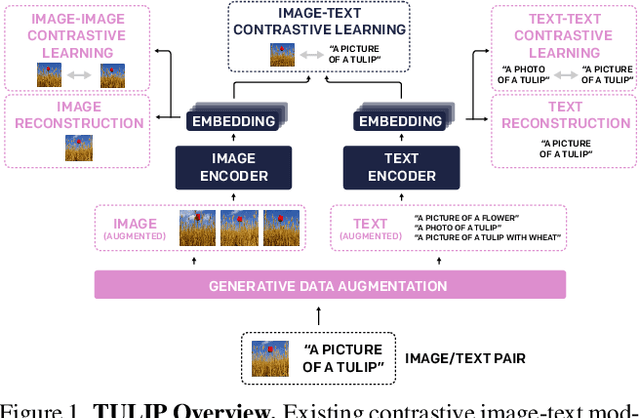
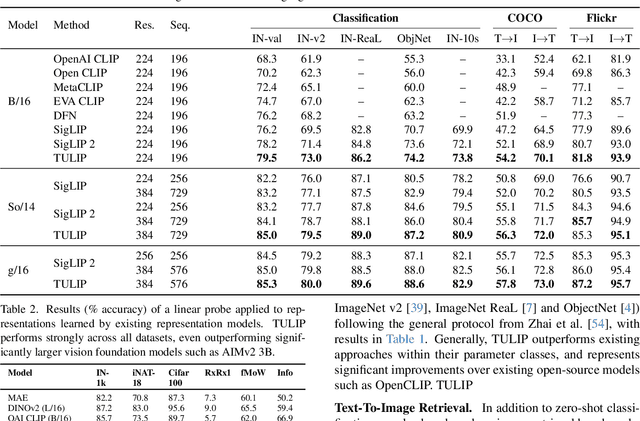
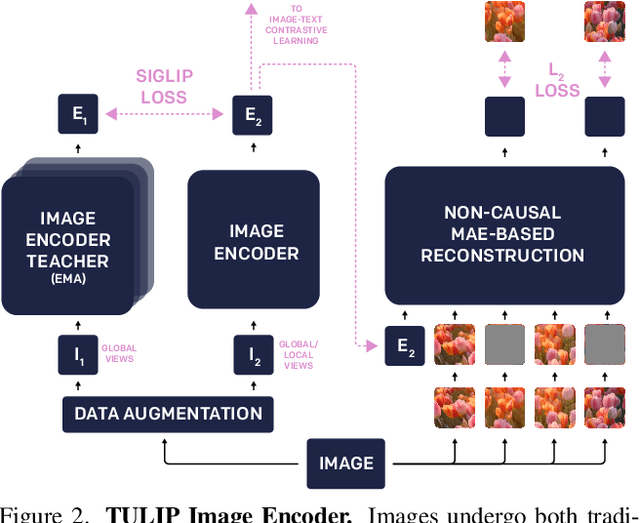
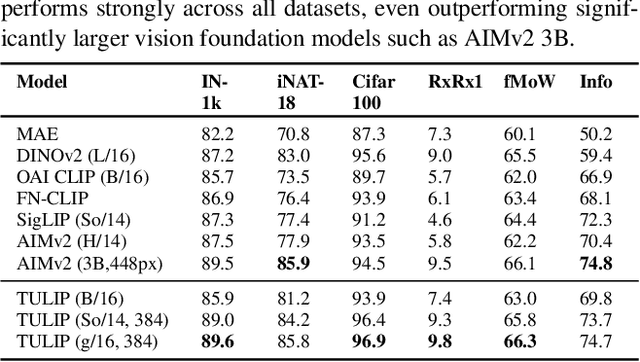
Despite the recent success of image-text contrastive models like CLIP and SigLIP, these models often struggle with vision-centric tasks that demand high-fidelity image understanding, such as counting, depth estimation, and fine-grained object recognition. These models, by performing language alignment, tend to prioritize high-level semantics over visual understanding, weakening their image understanding. On the other hand, vision-focused models are great at processing visual information but struggle to understand language, limiting their flexibility for language-driven tasks. In this work, we introduce TULIP, an open-source, drop-in replacement for existing CLIP-like models. Our method leverages generative data augmentation, enhanced image-image and text-text contrastive learning, and image/text reconstruction regularization to learn fine-grained visual features while preserving global semantic alignment. Our approach, scaling to over 1B parameters, outperforms existing state-of-the-art (SOTA) models across multiple benchmarks, establishing a new SOTA zero-shot performance on ImageNet-1K, delivering up to a $2\times$ enhancement over SigLIP on RxRx1 in linear probing for few-shot classification, and improving vision-language models, achieving over $3\times$ higher scores than SigLIP on MMVP. Our code/checkpoints are available at https://tulip-berkeley.github.io
Visualizing Thought: Conceptual Diagrams Enable Robust Planning in LMMs
Mar 14, 2025Human reasoning relies on constructing and manipulating mental models-simplified internal representations of situations that we use to understand and solve problems. Conceptual diagrams (for example, sketches drawn by humans to aid reasoning) externalize these mental models, abstracting irrelevant details to efficiently capture relational and spatial information. In contrast, Large Language Models (LLMs) and Large Multimodal Models (LMMs) predominantly reason through textual representations, limiting their effectiveness in complex multi-step combinatorial and planning tasks. In this paper, we propose a zero-shot fully automatic framework that enables LMMs to reason through multiple chains of self-generated intermediate conceptual diagrams, significantly enhancing their combinatorial planning capabilities. Our approach does not require any human initialization beyond a natural language description of the task. It integrates both textual and diagrammatic reasoning within an optimized graph-of-thought inference framework, enhanced by beam search and depth-wise backtracking. Evaluated on multiple challenging PDDL planning domains, our method substantially improves GPT-4o's performance (for example, from 35.5% to 90.2% in Blocksworld). On more difficult planning domains with solution depths up to 40, our approach outperforms even the o1-preview reasoning model (for example, over 13% improvement in Parking). These results highlight the value of conceptual diagrams as a complementary reasoning medium in LMMs.
Pre-training Auto-regressive Robotic Models with 4D Representations
Feb 18, 2025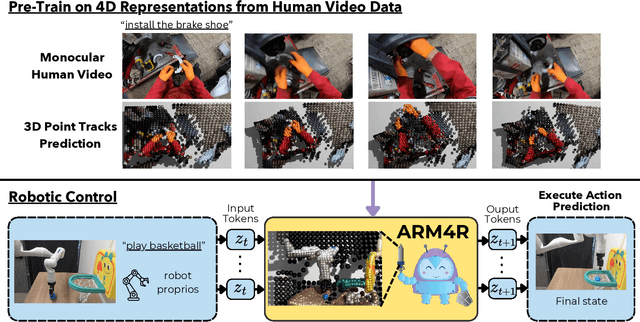
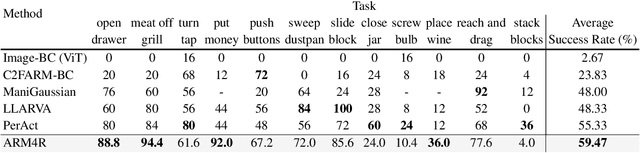
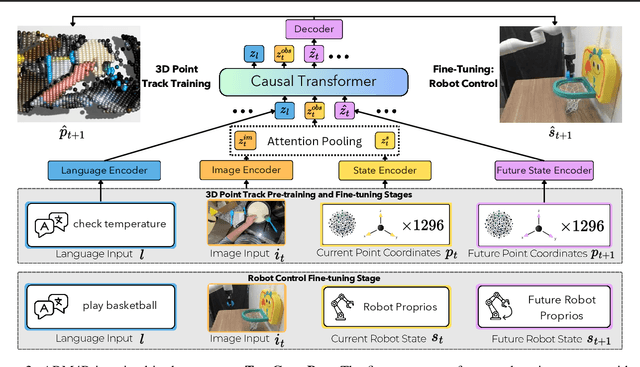
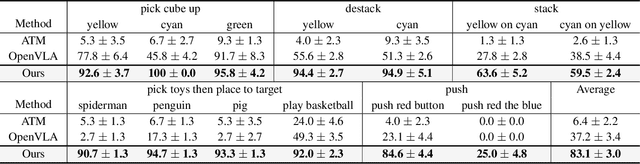
Foundation models pre-trained on massive unlabeled datasets have revolutionized natural language and computer vision, exhibiting remarkable generalization capabilities, thus highlighting the importance of pre-training. Yet, efforts in robotics have struggled to achieve similar success, limited by either the need for costly robotic annotations or the lack of representations that effectively model the physical world. In this paper, we introduce ARM4R, an Auto-regressive Robotic Model that leverages low-level 4D Representations learned from human video data to yield a better pre-trained robotic model. Specifically, we focus on utilizing 3D point tracking representations from videos derived by lifting 2D representations into 3D space via monocular depth estimation across time. These 4D representations maintain a shared geometric structure between the points and robot state representations up to a linear transformation, enabling efficient transfer learning from human video data to low-level robotic control. Our experiments show that ARM4R can transfer efficiently from human video data to robotics and consistently improves performance on tasks across various robot environments and configurations.