 Add to Chrome
 Add to Firefox
 Add to Edge
SafeGen: Goal-Conditioned Video Diffusion of Safety-Critical Scenarios for VLM-Based Autonomous Driving
Jul 22, 2026
VLMs are increasingly deployed in AD systems, creating an urgent need for rigorous safety evaluation under rare yet safety-critical scenarios. Among these, interactions with vulnerable road users represent a major source of real-world failures. However, existing safety-critical scenario generation methods predominantly rely on simulator-based pipelines, which suffer from a substantial sim-to-real gap and often fail to capture realistic, diverse, and unforeseen human-vehicle interaction dynamics. We present SafeGen, a goal-conditioned diffusion framework for safety-critical scenario generation in VLMADs. Our key insight is to formulate scenario generation as a goal-conditioned diffusion process, where a predefined catastrophic end-state serves as a strong supervisory signal, guiding the generation of temporally coherent video trajectories that naturally evolve toward safety-critical outcomes. Building on this formulation, we introduce Context Grounded End State Reasoning, which leverages VLMs to analyze benign driving contexts and infer latent vulnerabilities in human-vehicle interactions, producing structured end-state specifications that induce high-risk scenarios. Conditioned on these targets, we further propose End State Conditioned Video Evolution, which grounds semantic threats into physically plausible visual dynamics. Specifically, we instantiate high-risk agents within the scene via depth-aware geometric projection, followed by boundary-conditioned diffusion to generate intermediate frames with consistent motion patterns and temporal coherence. Extensive experiments across 3 VLMADs demonstrate that SafeGen increases the Judge Overall Score, a metric using a VLM judge to evaluate VLMADs' understanding and decision-making, by 24.25% on average compared to SoTA baselines. Furthermore, fine-tuning a VLMAD improves performance in real-world driving scenes by an average of 15.9%.

Technical Report on the CVPR 2026@AdvML Workshop Challenge
Jul 13, 2026Vision-language agents (VLAs) are increasingly used to interpret complex driving scenes and support safety-critical reasoning. This report presents the CVPR 2026@AdvML Workshop Challenge on adversarial multimodal attacks against autonomous-driving VLAs. Built on DriveLM-style multi-view visual question answering, the challenge represents each scene with six synchronized camera images and a structured collection of driving-related question-answer pairs. Participants generate adversarial images and suffix-only textual perturbations that induce model responses to deviate from reference answers while preserving image fidelity and limiting textual cost. The competition comprises two phases, with Phase II adding a hidden black-box model to assess transferability. We describe the task design, submission rules, evaluation protocol, and leaderboard results, and then examine five leading submissions for which technical reports were available. Across these reports, several recurring patterns emerge: image-side attacks are favored by the suffix penalty; scene-level, multi-view optimization is more effective than treating views in isolation; QA types and graph structure provide useful priors for allocating attack budget; feature-space objectives can improve black-box transfer; and typographic content embedded in camera images exposes a persistent vulnerability in driving VLAs. These findings provide a practical reference for future robustness evaluation and defense design in multimodal autonomous-driving systems.
Benchmarking the Robustness of Autonomous Driving to Environmental Illusions: A Lane Perception Perspective
Jul 07, 2026Environmental illusions (eg., shadows, reflections, and tire marks) are naturally existing yet overlooked phenomena in real-world driving environments. They can disturb visual perception, leading to misinterpretation of the scene and posing serious safety risks to autonomous driving (AD) systems. However, existing researches largely overlook these phenomena, leaving a critical gap. To address this issue, we study AD robustness through the lane perception perspective, a fundamental task supporting core functions like cruise control and lane centering. We focus on two representative models: conventional lane detection (LD) and vision-language model-based systems (ADVLMs). In this work, we introduce the first benchmark, LanEvil++, for evaluating the robustness of lane perception under environmental illusions. LanEvil++ encompasses 14 types of illusions and leverages the CARLA simulator to generate 94 high-fidelity, fully controllable 3D scenes, yielding a dataset of 90,292 annotated images, 1,596 video clips, and 41,855 visual question answering pairs. Extensive evaluations demonstrate that environmental illusions substantially degrade the performance of state-of-the-art LD methods. On average, LD models experience a 5.27% drop in Accuracy and a 10.49% decline in F1-score, while ADVLMs show a 2.03% reduction in GPT-score and a 0.75% drop in Language-score. Among all illusions, shadows emerge as the most disruptive factor, reducing accuracy by up to 7.20%. Furthermore, closed-loop simulations reveal that these illusions can lead to incorrect driving decisions. Complementary real-world case studies highlight safety-critical failures in actual traffic scenes. To enhance robustness, we propose the Multimodal Illusion Defense Approach (MIDA). MIDA achieves substantial gains under challenging conditions, boosting robustness by 4.23% on LD models and 3.82% on ADVLMs.
GuardAD: Safeguarding Autonomous Driving MLLMs via Markovian Safety Logic
May 11, 2026Multimodal large language models (MLLMs) are increasingly integrated into autonomous driving (AD) systems; however, they remain vulnerable to diverse safety threats, particularly in accident-prone scenarios. Recent safeguard mechanisms have shown promise by incorporating logical constraints, yet most rely on static formulations that lack temporally grounded safety reasoning over evolving traffic interactions, resulting in limited robustness in dynamic driving environments. To address these limitations, we propose GuardAD, a model-agnostic safeguard that formulates AD safety as an evolving Markovian logical state. GuardAD introduces Neuro-Symbolic Logic Formalization, which represents safety predicates over heterogeneous traffic participants and continuously induces them via n-th order Markovian Logic Induction. This design enables the inference of emerging and latent hazards beyond single-step observations. Rather than simply vetoing unsafe actions, GuardAD performs Logic-Driven Action Revision, where inferred safety states actively guide action refinement without modifying the underlying MLLM. Extensive experiments on multiple benchmarks and AD-MLLMs demonstrate that GuardAD substantially reduces accident rates (-32.07%) while slightly improving task performance (+6.85%). Moreover, closed-loop simulation evaluations, together with physical-world vehicle studies, further validate the effectiveness and potential of GuardAD.
ZipMap: Linear-Time Stateful 3D Reconstruction with Test-Time Training
Mar 04, 2026Feed-forward transformer models have driven rapid progress in 3D vision, but state-of-the-art methods such as VGGT and $π^3$ have a computational cost that scales quadratically with the number of input images, making them inefficient when applied to large image collections. Sequential-reconstruction approaches reduce this cost but sacrifice reconstruction quality. We introduce ZipMap, a stateful feed-forward model that achieves linear-time, bidirectional 3D reconstruction while matching or surpassing the accuracy of quadratic-time methods. ZipMap employs test-time training layers to zip an entire image collection into a compact hidden scene state in a single forward pass, enabling reconstruction of over 700 frames in under 10 seconds on a single H100 GPU, more than $20\times$ faster than state-of-the-art methods such as VGGT. Moreover, we demonstrate the benefits of having a stateful representation in real-time scene-state querying and its extension to sequential streaming reconstruction.
Large Video Planner Enables Generalizable Robot Control
Dec 17, 2025


General-purpose robots require decision-making models that generalize across diverse tasks and environments. Recent works build robot foundation models by extending multimodal large language models (MLLMs) with action outputs, creating vision-language-action (VLA) systems. These efforts are motivated by the intuition that MLLMs' large-scale language and image pretraining can be effectively transferred to the action output modality. In this work, we explore an alternative paradigm of using large-scale video pretraining as a primary modality for building robot foundation models. Unlike static images and language, videos capture spatio-temporal sequences of states and actions in the physical world that are naturally aligned with robotic behavior. We curate an internet-scale video dataset of human activities and task demonstrations, and train, for the first time at a foundation-model scale, an open video model for generative robotics planning. The model produces zero-shot video plans for novel scenes and tasks, which we post-process to extract executable robot actions. We evaluate task-level generalization through third-party selected tasks in the wild and real-robot experiments, demonstrating successful physical execution. Together, these results show robust instruction following, strong generalization, and real-world feasibility. We release both the model and dataset to support open, reproducible video-based robot learning. Our website is available at https://www.boyuan.space/large-video-planner/.
Adversarial Generation and Collaborative Evolution of Safety-Critical Scenarios for Autonomous Vehicles
Aug 20, 2025The generation of safety-critical scenarios in simulation has become increasingly crucial for safety evaluation in autonomous vehicles prior to road deployment in society. However, current approaches largely rely on predefined threat patterns or rule-based strategies, which limit their ability to expose diverse and unforeseen failure modes. To overcome these, we propose ScenGE, a framework that can generate plentiful safety-critical scenarios by reasoning novel adversarial cases and then amplifying them with complex traffic flows. Given a simple prompt of a benign scene, it first performs Meta-Scenario Generation, where a large language model, grounded in structured driving knowledge, infers an adversarial agent whose behavior poses a threat that is both plausible and deliberately challenging. This meta-scenario is then specified in executable code for precise in-simulator control. Subsequently, Complex Scenario Evolution uses background vehicles to amplify the core threat introduced by Meta-Scenario. It builds an adversarial collaborator graph to identify key agent trajectories for optimization. These perturbations are designed to simultaneously reduce the ego vehicle's maneuvering space and create critical occlusions. Extensive experiments conducted on multiple reinforcement learning based AV models show that ScenGE uncovers more severe collision cases (+31.96%) on average than SoTA baselines. Additionally, our ScenGE can be applied to large model based AV systems and deployed on different simulators; we further observe that adversarial training on our scenarios improves the model robustness. Finally, we validate our framework through real-world vehicle tests and human evaluation, confirming that the generated scenarios are both plausible and critical. We hope our paper can build up a critical step towards building public trust and ensuring their safe deployment.
Pushing the Limits of Safety: A Technical Report on the ATLAS Challenge 2025
Jun 14, 2025Multimodal Large Language Models (MLLMs) have enabled transformative advancements across diverse applications but remain susceptible to safety threats, especially jailbreak attacks that induce harmful outputs. To systematically evaluate and improve their safety, we organized the Adversarial Testing & Large-model Alignment Safety Grand Challenge (ATLAS) 2025}. This technical report presents findings from the competition, which involved 86 teams testing MLLM vulnerabilities via adversarial image-text attacks in two phases: white-box and black-box evaluations. The competition results highlight ongoing challenges in securing MLLMs and provide valuable guidance for developing stronger defense mechanisms. The challenge establishes new benchmarks for MLLM safety evaluation and lays groundwork for advancing safer multimodal AI systems. The code and data for this challenge are openly available at https://github.com/NY1024/ATLAS_Challenge_2025.
Test-Time Training Done Right
May 29, 2025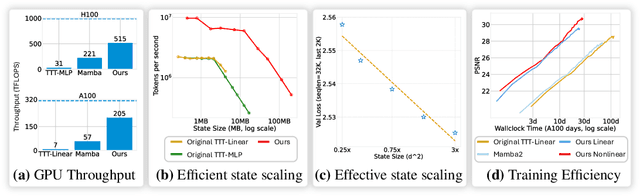

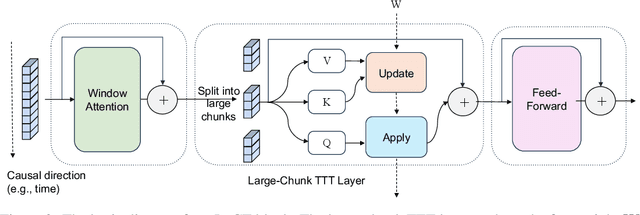
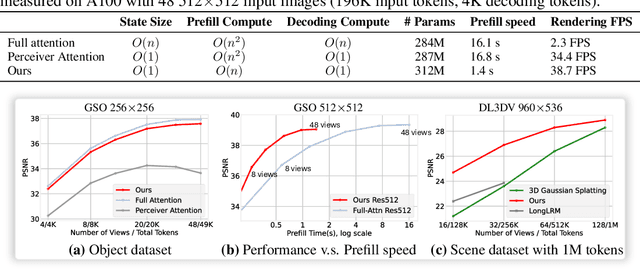
Test-Time Training (TTT) models context dependencies by adapting part of the model's weights (referred to as fast weights) during inference. This fast weight, akin to recurrent states in RNNs, stores temporary memories of past tokens in the current sequence. Existing TTT methods struggled to show effectiveness in handling long-context data, due to their inefficiency on modern GPUs. The TTT layers in many of these approaches operate with extremely low FLOPs utilization (often <5%) because they deliberately apply small online minibatch sizes (e.g., updating fast weights every 16 or 64 tokens). Moreover, a small minibatch implies fine-grained block-wise causal dependencies in the data, unsuitable for data beyond 1D ordered sequences, like sets or N-dimensional grids such as images or videos. In contrast, we pursue the opposite direction by using an extremely large chunk update, ranging from 2K to 1M tokens across tasks of varying modalities, which we refer to as Large Chunk Test-Time Training (LaCT). It improves hardware utilization by orders of magnitude, and more importantly, facilitates scaling of nonlinear state size (up to 40% of model parameters), hence substantially improving state capacity, all without requiring cumbersome and error-prone kernel implementations. It also allows easy integration of sophisticated optimizers, e.g. Muon for online updates. We validate our approach across diverse modalities and tasks, including novel view synthesis with image set, language models, and auto-regressive video diffusion. Our approach can scale up to 14B-parameter AR video diffusion model on sequences up to 56K tokens. In our longest sequence experiment, we perform novel view synthesis with 1 million context length. We hope this work will inspire and accelerate new research in the field of long-context modeling and test-time training. Website: https://tianyuanzhang.com/projects/ttt-done-right
Manipulating Multimodal Agents via Cross-Modal Prompt Injection
Apr 22, 2025The emergence of multimodal large language models has redefined the agent paradigm by integrating language and vision modalities with external data sources, enabling agents to better interpret human instructions and execute increasingly complex tasks. However, in this work, we identify a critical yet previously overlooked security vulnerability in multimodal agents: cross-modal prompt injection attacks. To exploit this vulnerability, we propose CrossInject, a novel attack framework in which attackers embed adversarial perturbations across multiple modalities to align with target malicious content, allowing external instructions to hijack the agent's decision-making process and execute unauthorized tasks. Our approach consists of two key components. First, we introduce Visual Latent Alignment, where we optimize adversarial features to the malicious instructions in the visual embedding space based on a text-to-image generative model, ensuring that adversarial images subtly encode cues for malicious task execution. Subsequently, we present Textual Guidance Enhancement, where a large language model is leveraged to infer the black-box defensive system prompt through adversarial meta prompting and generate an malicious textual command that steers the agent's output toward better compliance with attackers' requests. Extensive experiments demonstrate that our method outperforms existing injection attacks, achieving at least a +26.4% increase in attack success rates across diverse tasks. Furthermore, we validate our attack's effectiveness in real-world multimodal autonomous agents, highlighting its potential implications for safety-critical applications.