 Add to Chrome
 Add to Firefox
 Add to Edge
CRAFT: Counterfactual Credit Assignment from Free Sibling Rollouts for Self-Distilled Agentic Reinforcement Learning
Jun 28, 2026
Self-distilled agentic reinforcement learning augments trajectory-level reward with a token-level distillation loss, using as its teacher the same policy conditioned on privileged context. The prevailing recipe gates this loss by a single scalar, the teacher-student log-probability gap. This signal is doubly limited: it is retrospective, scoring only the realised rollout and never the counterfactual ones, and it is sign-blind, never signalling when a teacher-preferred action would have harmed the trajectory. We introduce CRAFT, a three-pillar credit-assignment scheme that addresses both limitations. Pillar 1, Counterfactual Token Importance, reuses the G-1 sibling rollouts that GRPO already samples and importance-weights them by the log-probability gap to form a self-normalised estimate of the group-level counterfactual change in advantage from up-weighting teacher-preferred actions at each step; this yields a signed per-token credit at near-zero extra compute. Pillar 2 is an asymmetric controller that raises the distillation weight as it lowers the reference-KL weight along an exponential moving average of gate activity, and conversely. Pillar 3 polarises the KL penalty token by token, switching between a mode-seeking and a mode-covering update according to the sign of the credit. Each pillar has an independent switch that, when disabled, renders the loss and gradient byte-identical to the baseline in IEEE-754 arithmetic, so any measured gain is attributable to algorithmic change rather than implementation drift. We prove the estimator's consistency and a variance bound, give structural and bit-exact reproducibility guarantees, and evaluate CRAFT across three agentic environments, four model scales, and five end-to-end methods, plus two tabulated prior-work baselines. Among these is Adaptive-CRINGE, a comparator sharing Pillar 2 with CRAFT, isolating the counterfactual contribution.

SocialGPT: Prompting LLMs for Social Relation Reasoning via Greedy Segment Optimization
Oct 28, 2024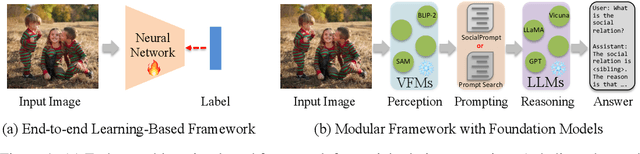
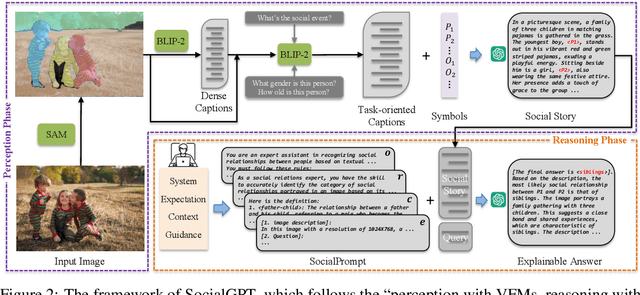

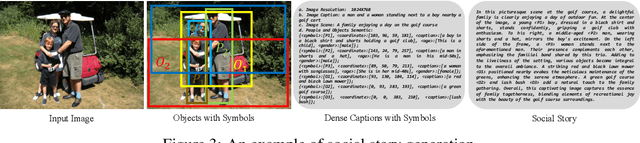
Social relation reasoning aims to identify relation categories such as friends, spouses, and colleagues from images. While current methods adopt the paradigm of training a dedicated network end-to-end using labeled image data, they are limited in terms of generalizability and interpretability. To address these issues, we first present a simple yet well-crafted framework named {\name}, which combines the perception capability of Vision Foundation Models (VFMs) and the reasoning capability of Large Language Models (LLMs) within a modular framework, providing a strong baseline for social relation recognition. Specifically, we instruct VFMs to translate image content into a textual social story, and then utilize LLMs for text-based reasoning. {\name} introduces systematic design principles to adapt VFMs and LLMs separately and bridge their gaps. Without additional model training, it achieves competitive zero-shot results on two databases while offering interpretable answers, as LLMs can generate language-based explanations for the decisions. The manual prompt design process for LLMs at the reasoning phase is tedious and an automated prompt optimization method is desired. As we essentially convert a visual classification task into a generative task of LLMs, automatic prompt optimization encounters a unique long prompt optimization issue. To address this issue, we further propose the Greedy Segment Prompt Optimization (GSPO), which performs a greedy search by utilizing gradient information at the segment level. Experimental results show that GSPO significantly improves performance, and our method also generalizes to different image styles. The code is available at https://github.com/Mengzibin/SocialGPT.
DiffTalk: Crafting Diffusion Models for Generalized Talking Head Synthesis
Jan 10, 2023Talking head synthesis is a promising approach for the video production industry. Recently, a lot of effort has been devoted in this research area to improve the generation quality or enhance the model generalization. However, there are few works able to address both issues simultaneously, which is essential for practical applications. To this end, in this paper, we turn attention to the emerging powerful Latent Diffusion Models, and model the Talking head generation as an audio-driven temporally coherent denoising process (DiffTalk). More specifically, instead of employing audio signals as the single driving factor, we investigate the control mechanism of the talking face, and incorporate reference face images and landmarks as conditions for personality-aware generalized synthesis. In this way, the proposed DiffTalk is capable of producing high-quality talking head videos in synchronization with the source audio, and more importantly, it can be naturally generalized across different identities without any further fine-tuning. Additionally, our DiffTalk can be gracefully tailored for higher-resolution synthesis with negligible extra computational cost. Extensive experiments show that the proposed DiffTalk efficiently synthesizes high-fidelity audio-driven talking head videos for generalized novel identities. For more video results, please refer to this demonstration \url{https://cloud.tsinghua.edu.cn/f/e13f5aad2f4c4f898ae7/}.