 Add to Chrome
 Add to Firefox
 Add to Edge
APT: Atomic Physical Transitions for Causal Video-Language Understanding
Jun 17, 2026
Physical events are not understood by their names alone, but by the causal state changes that compose them. A clip-level label such as "bounce" can be correct while hiding the process that makes the event physically valid, from support loss and contact onset to rebound and settling. To make this hidden process explicit, we introduce Atomic Physical Transitions (APTs): minimal, temporally localized state changes that bind a visible cue to an active physical mechanism and before/after dynamical regimes. An APT chain represents a video as an ordered causal transition sequence rather than a single aggregate event label: event labels tell what happened; APT chains explain why it happened. To make APTs learnable by VLMs, we construct mixed-source APT data from human annotations and simulator ground truth, covering 14 transition types across contact, gravity, friction, and rotation/stability, with 27,303 timed instances over 1,246 trials. Using this data, we find that current VLMs miss transition-level physics, with zero-shot recall at most 14% and errors dominated by missed transitions. Direct fine-tuning on APT chains improves transition detection but causes event-level forgetting, indicating that the model learns a specialized answer format rather than a reusable physical representation. We therefore propose APT-Tune, a parameter-efficient recipe that teaches VLMs to use causal transitions without forgetting how to answer video questions. It combines image-pad-aware supervision, format-conditional co-training, and mechanism-conditioned domain-to-type decoding to make APT learning format-robust and physically grounded. With only 11 M LoRA parameters on Qwen3-VL-2B, APT-Tune substantially improves APT recall while also improving event-level video transfer. These results show that APTs are not a new answer format, but a human-aligned causal supervision signal for physical video understanding.

A robust PPG foundation model using multimodal physiological supervision
Jun 05, 2026Photoplethysmography (PPG), a non-invasive measure of changes in blood volume, is widely used in both wearable devices and clinical settings. Recent PPG foundation models either use open-source ICU datasets with pretraining paradigms that require curated data and thus complicate generalization to field-like data, or use closed-source field-like PPG data. In contrast, we propose a PPG foundation model that does not require high-quality or field-like pretraining data, and instead leverages accompanying electrocardiogram and respiratory signals in ICU datasets to select contrastive samples during pretraining. Our approach allows the model to retain and learn from noisy PPG segments, improving robustness at inference. Our model, pretrained on 3x fewer subjects than existing state-of-the-art approaches, achieves performance improvements on 14 out of 15 diverse downstream tasks, including field-like daily activity and heart rate prediction. Our results demonstrate that multimodal supervision can integrate complementary physiological information to improve the robustness of PPG foundation models and enhance their generalization to consumer-grade data.
Video-Robin: Autoregressive Diffusion Planning for Intent-Grounded Video-to-Music Generation
Apr 19, 2026Video-to-music (V2M) is the fundamental task of creating background music for an input video. Recent V2M models achieve audiovisual alignment by typically relying on visual conditioning alone and provide limited semantic and stylistic controllability to the end user. In this paper, we present Video-Robin, a novel text-conditioned video-to-music generation model that enables fast, high-quality, semantically aligned music generation for video content. To balance musical fidelity and semantic understanding, Video-Robin integrates autoregressive planning with diffusion-based synthesis. Specifically, an autoregressive module models global structure by semantically aligning visual and textual inputs to produce high-level music latents. These latents are subsequently refined into coherent, high-fidelity music using local Diffusion Transformers. By factoring semantically driven planning into diffusion-based synthesis, Video-Robin enables fine-grained creator control without sacrificing audio realism. Our proposed model outperforms baselines that solely accept video input and additional feature conditioned baselines on both in-distribution and out-of-distribution benchmarks with a 2.21x speed in inference compared to SOTA. We will open-source everything upon paper acceptance.
Variable-Length Audio Fingerprinting
Mar 25, 2026Audio fingerprinting converts audio to much lower-dimensional representations, allowing distorted recordings to still be recognized as their originals through similar fingerprints. Existing deep learning approaches rigidly fingerprint fixed-length audio segments, thereby neglecting temporal dynamics during segmentation. To address limitations due to this rigidity, we propose Variable-Length Audio FingerPrinting (VLAFP), a novel method that supports variable-length fingerprinting. To the best of our knowledge, VLAFP is the first deep audio fingerprinting model capable of processing audio of variable length, for both training and testing. Our experiments show that VLAFP outperforms existing state-of-the-arts in live audio identification and audio retrieval across three real-world datasets.
Phys4D: Fine-Grained Physics-Consistent 4D Modeling from Video Diffusion
Mar 03, 2026Recent video diffusion models have achieved impressive capabilities as large-scale generative world models. However, these models often struggle with fine-grained physical consistency, exhibiting physically implausible dynamics over time. In this work, we present \textbf{Phys4D}, a pipeline for learning physics-consistent 4D world representations from video diffusion models. Phys4D adopts \textbf{a three-stage training paradigm} that progressively lifts appearance-driven video diffusion models into physics-consistent 4D world representations. We first bootstrap robust geometry and motion representations through large-scale pseudo-supervised pretraining, establishing a foundation for 4D scene modeling. We then perform physics-grounded supervised fine-tuning using simulation-generated data, enforcing temporally consistent 4D dynamics. Finally, we apply simulation-grounded reinforcement learning to correct residual physical violations that are difficult to capture through explicit supervision. To evaluate fine-grained physical consistency beyond appearance-based metrics, we introduce a set of \textbf{4D world consistency evaluation} that probe geometric coherence, motion stability, and long-horizon physical plausibility. Experimental results demonstrate that Phys4D substantially improves fine-grained spatiotemporal and physical consistency compared to appearance-driven baselines, while maintaining strong generative performance. Our project page is available at https://sensational-brioche-7657e7.netlify.app/
PhyPrompt: RL-based Prompt Refinement for Physically Plausible Text-to-Video Generation
Mar 03, 2026State-of-the-art text-to-video (T2V) generators frequently violate physical laws despite high visual quality. We show this stems from insufficient physical constraints in prompts rather than model limitations: manually adding physics details reliably produces physically plausible videos, but requires expertise and does not scale. We present PhyPrompt, a two-stage reinforcement learning framework that automatically refines prompts for physically realistic generation. First, we fine-tune a large language model on a physics-focused Chain-of-Thought dataset to integrate principles like object motion and force interactions while preserving user intent. Second, we apply Group Relative Policy Optimization with a dynamic reward curriculum that initially prioritizes semantic fidelity, then progressively shifts toward physical commonsense. This curriculum achieves synergistic optimization: PhyPrompt-7B reaches 40.8\% joint success on VideoPhy2 (8.6pp gain), improving physical commonsense by 11pp (55.8\% to 66.8\%) while simultaneously increasing semantic adherence by 4.4pp (43.4\% to 47.8\%). Remarkably, our curriculum exceeds single-objective training on both metrics, demonstrating compositional prompt discovery beyond conventional multi-objective trade-offs. PhyPrompt outperforms GPT-4o (+3.8\% joint) and DeepSeek-V3 (+2.2\%, 100$\times$ larger) using only 7B parameters. The approach transfers zero-shot across diverse T2V architectures (Lavie, VideoCrafter2, CogVideoX-5B) with up to 16.8\% improvement, establishing that domain-specialized reinforcement learning with compositional curricula surpasses general-purpose scaling for physics-aware generation.
Towards Sparse Video Understanding and Reasoning
Feb 14, 2026We present \revise (\underline{Re}asoning with \underline{Vi}deo \underline{S}parsity), a multi-round agent for video question answering (VQA). Instead of uniformly sampling frames, \revise selects a small set of informative frames, maintains a summary-as-state across rounds, and stops early when confident. It supports proprietary vision-language models (VLMs) in a ``plug-and-play'' setting and enables reinforcement fine-tuning for open-source models. For fine-tuning, we introduce EAGER (Evidence-Adjusted Gain for Efficient Reasoning), an annotation-free reward with three terms: (1) Confidence gain: after new frames are added, we reward the increase in the log-odds gap between the correct option and the strongest alternative; (2) Summary sufficiency: at answer time we re-ask using only the last committed summary and reward success; (3) Correct-and-early stop: answering correctly within a small turn budget is rewarded. Across multiple VQA benchmarks, \revise improves accuracy while reducing frames, rounds, and prompt tokens, demonstrating practical sparse video reasoning.
SPUR: A Plug-and-Play Framework for Integrating Spatial Audio Understanding and Reasoning into Large Audio-Language Models
Nov 13, 2025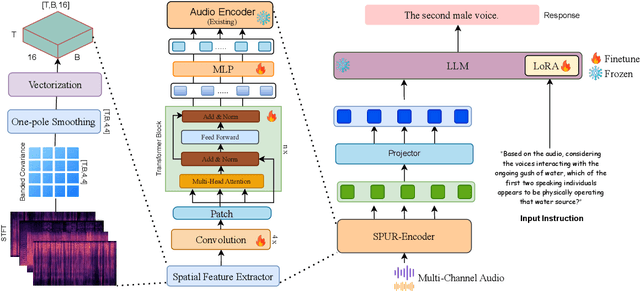
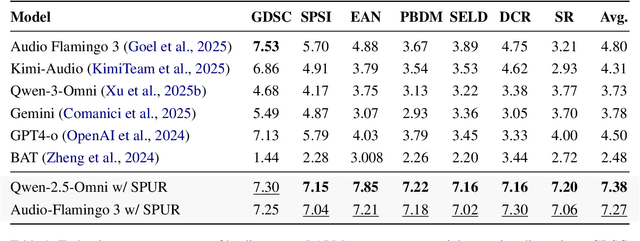
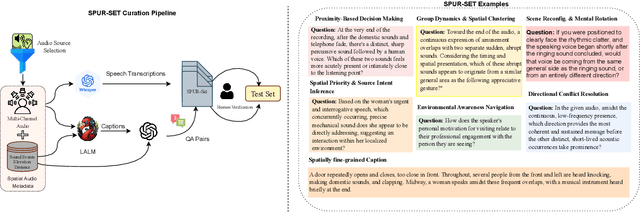
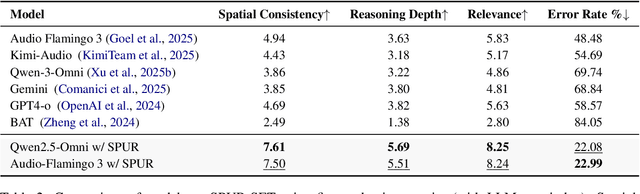
Spatial perception is central to auditory intelligence, enabling accurate understanding of real-world acoustic scenes and advancing human-level perception of the world around us. While recent large audio-language models (LALMs) show strong reasoning over complex audios, most operate on monaural inputs and lack the ability to capture spatial cues such as direction, elevation, and distance. We introduce SPUR, a lightweight, plug-in approach that equips LALMs with spatial perception through minimal architectural changes. SPUR consists of: (i) a First-Order Ambisonics (FOA) encoder that maps (W, X, Y, Z) channels to rotation-aware, listener-centric spatial features, integrated into target LALMs via a multimodal adapter; and (ii) SPUR-Set, a spatial QA dataset combining open-source FOA recordings with controlled simulations, emphasizing relative direction, elevation, distance, and overlap for supervised spatial reasoning. Fine-tuning our model on the SPUR-Set consistently improves spatial QA and multi-speaker attribution while preserving general audio understanding. SPUR provides a simple recipe that transforms monaural LALMs into spatially aware models. Extensive ablations validate the effectiveness of our approach.
Transformation of audio embeddings into interpretable, concept-based representations
Apr 18, 2025Advancements in audio neural networks have established state-of-the-art results on downstream audio tasks. However, the black-box structure of these models makes it difficult to interpret the information encoded in their internal audio representations. In this work, we explore the semantic interpretability of audio embeddings extracted from these neural networks by leveraging CLAP, a contrastive learning model that brings audio and text into a shared embedding space. We implement a post-hoc method to transform CLAP embeddings into concept-based, sparse representations with semantic interpretability. Qualitative and quantitative evaluations show that the concept-based representations outperform or match the performance of original audio embeddings on downstream tasks while providing interpretability. Additionally, we demonstrate that fine-tuning the concept-based representations can further improve their performance on downstream tasks. Lastly, we publish three audio-specific vocabularies for concept-based interpretability of audio embeddings.
XAttnMark: Learning Robust Audio Watermarking with Cross-Attention
Feb 07, 2025
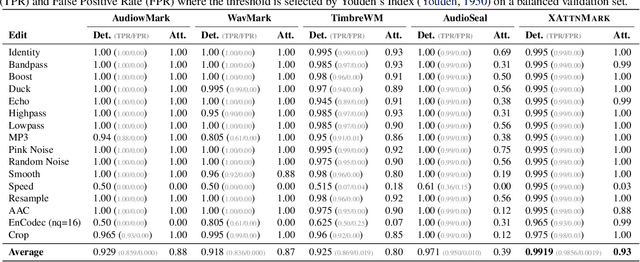


The rapid proliferation of generative audio synthesis and editing technologies has raised significant concerns about copyright infringement, data provenance, and the spread of misinformation through deepfake audio. Watermarking offers a proactive solution by embedding imperceptible, identifiable, and traceable marks into audio content. While recent neural network-based watermarking methods like WavMark and AudioSeal have improved robustness and quality, they struggle to achieve both robust detection and accurate attribution simultaneously. This paper introduces Cross-Attention Robust Audio Watermark (XAttnMark), which bridges this gap by leveraging partial parameter sharing between the generator and the detector, a cross-attention mechanism for efficient message retrieval, and a temporal conditioning module for improved message distribution. Additionally, we propose a psychoacoustic-aligned temporal-frequency masking loss that captures fine-grained auditory masking effects, enhancing watermark imperceptibility. Our approach achieves state-of-the-art performance in both detection and attribution, demonstrating superior robustness against a wide range of audio transformations, including challenging generative editing with strong editing strength. The project webpage is available at https://liuyixin-louis.github.io/xattnmark/.