 Add to Chrome
 Add to Firefox
 Add to Edge
Z-Code++: A Pre-trained Language Model Optimized for Abstractive Summarization
Aug 21, 2022
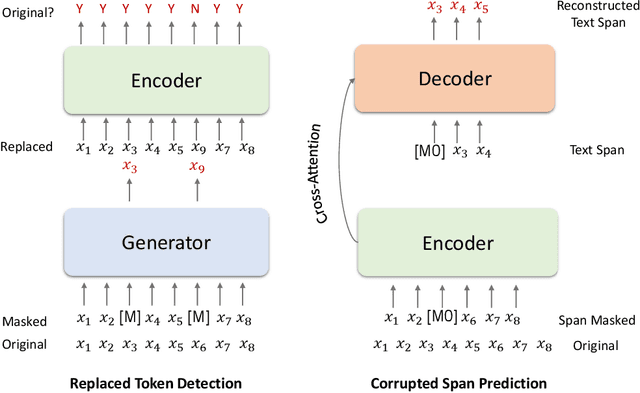
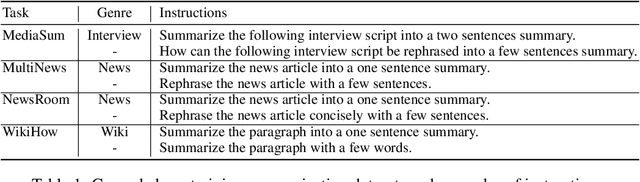
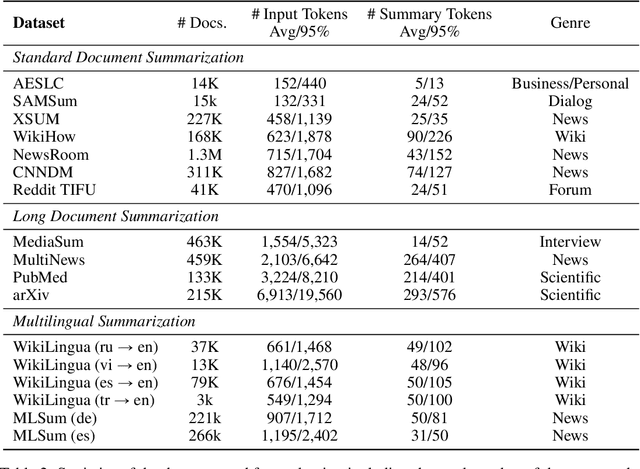
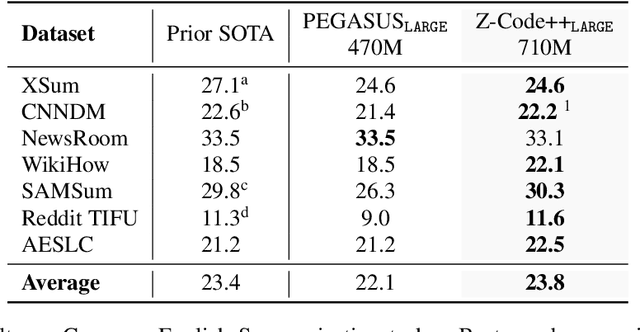
This paper presents Z-Code++, a new pre-trained language model optimized for abstractive text summarization. The model extends the state of the art encoder-decoder model using three techniques. First, we use a two-phase pre-training process to improve model's performance on low-resource summarization tasks. The model is first pre-trained using text corpora for language understanding, and then is continually pre-trained on summarization corpora for grounded text generation. Second, we replace self-attention layers in the encoder with disentangled attention layers, where each word is represented using two vectors that encode its content and position, respectively. Third, we use fusion-in-encoder, a simple yet effective method of encoding long sequences in a hierarchical manner. Z-Code++ creates new state of the art on 9 out of 13 text summarization tasks across 5 languages. Our model is parameter-efficient in that it outperforms the 600x larger PaLM-540B on XSum, and the finetuned 200x larger GPT3-175B on SAMSum. In zero-shot and few-shot settings, our model substantially outperforms the competing models.

REVIVE: Regional Visual Representation Matters in Knowledge-Based Visual Question Answering
Jun 02, 2022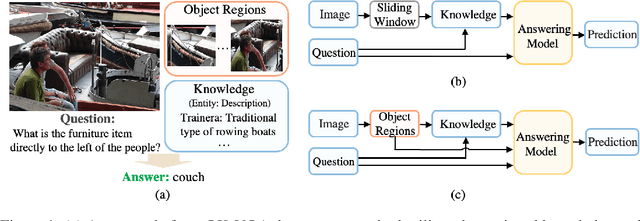
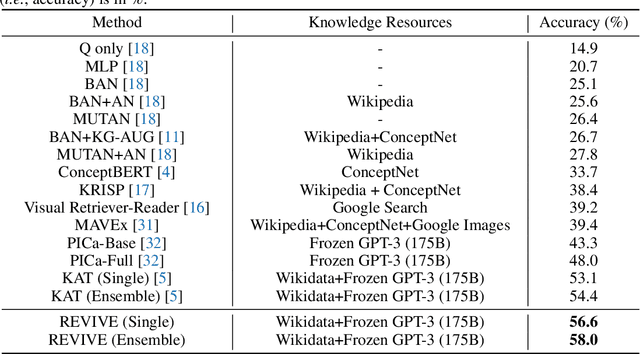
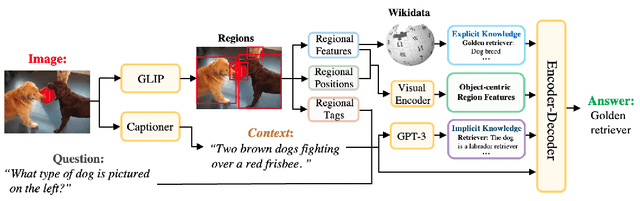
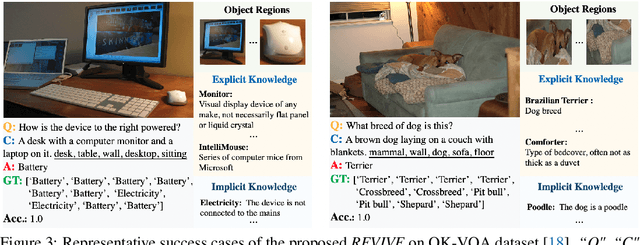
This paper revisits visual representation in knowledge-based visual question answering (VQA) and demonstrates that using regional information in a better way can significantly improve the performance. While visual representation is extensively studied in traditional VQA, it is under-explored in knowledge-based VQA even though these two tasks share the common spirit, i.e., rely on visual input to answer the question. Specifically, we observe that in most state-of-the-art knowledge-based VQA methods: 1) visual features are extracted either from the whole image or in a sliding window manner for retrieving knowledge, and the important relationship within/among object regions is neglected; 2) visual features are not well utilized in the final answering model, which is counter-intuitive to some extent. Based on these observations, we propose a new knowledge-based VQA method REVIVE, which tries to utilize the explicit information of object regions not only in the knowledge retrieval stage but also in the answering model. The key motivation is that object regions and inherent relationships are important for knowledge-based VQA. We perform extensive experiments on the standard OK-VQA dataset and achieve new state-of-the-art performance, i.e., 58.0% accuracy, surpassing previous state-of-the-art method by a large margin (+3.6%). We also conduct detailed analysis and show the necessity of regional information in different framework components for knowledge-based VQA.
Language Models with Image Descriptors are Strong Few-Shot Video-Language Learners
May 29, 2022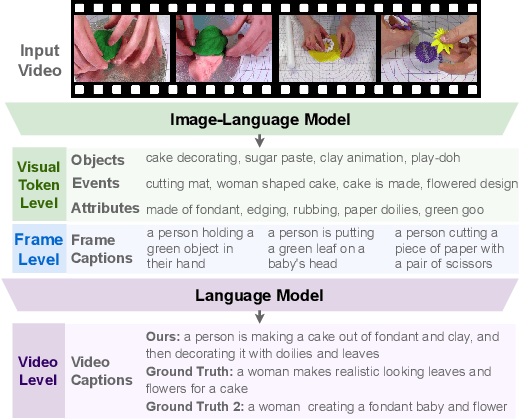
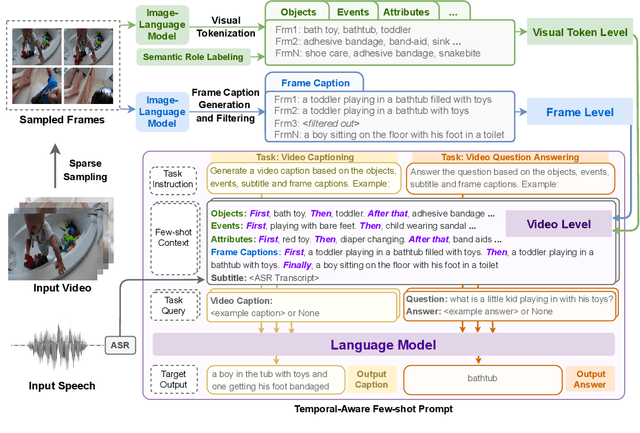
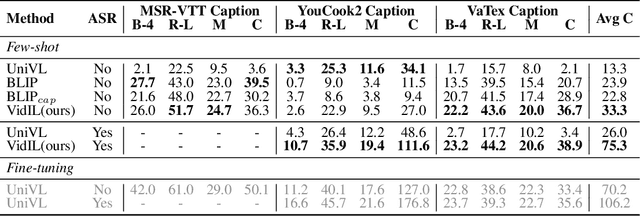
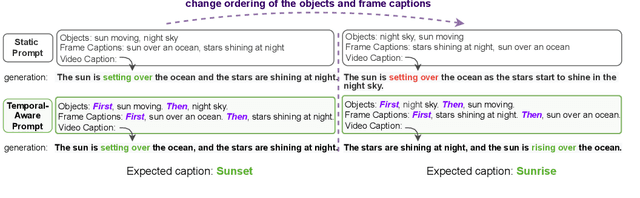
The goal of this work is to build flexible video-language models that can generalize to various video-to-text tasks from few examples, such as domain-specific captioning, question answering, and future event prediction. Existing few-shot video-language learners focus exclusively on the encoder, resulting in the absence of a video-to-text decoder to handle generative tasks. Video captioners have been pretrained on large-scale video-language datasets, but they rely heavily on finetuning and lack the ability to generate text for unseen tasks in a few-shot setting. We propose VidIL, a few-shot Video-language Learner via Image and Language models, which demonstrates strong performance on few-shot video-to-text tasks without the necessity of pretraining or finetuning on any video datasets. We use the image-language models to translate the video content into frame captions, object, attribute, and event phrases, and compose them into a temporal structure template. We then instruct a language model, with a prompt containing a few in-context examples, to generate a target output from the composed content. The flexibility of prompting allows the model to capture any form of text input, such as automatic speech recognition (ASR) transcripts. Our experiments demonstrate the power of language models in understanding videos on a wide variety of video-language tasks, including video captioning, video question answering, video caption retrieval, and video future event prediction. Especially, on video future event prediction, our few-shot model significantly outperforms state-of-the-art supervised models trained on large-scale video datasets. Code and resources are publicly available for research purposes at https://github.com/MikeWangWZHL/VidIL .
Leveraging Locality in Abstractive Text Summarization
May 25, 2022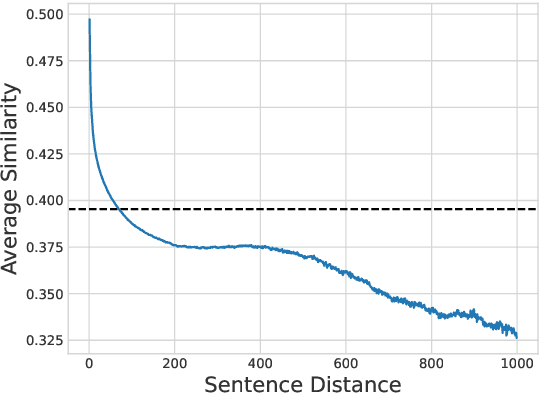
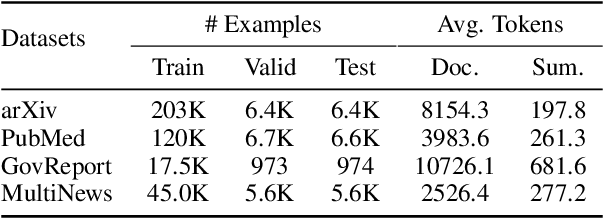
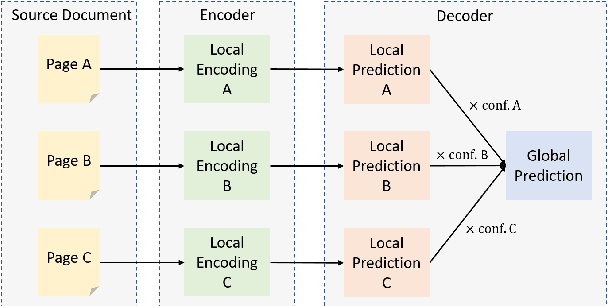
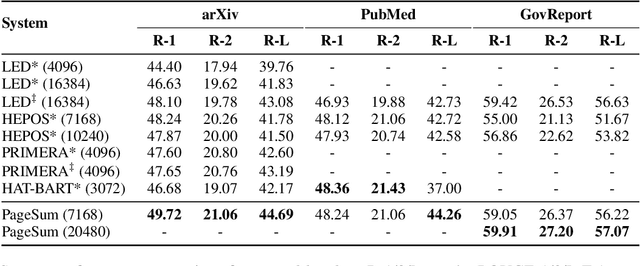
Despite the successes of neural attention models for natural language generation tasks, the quadratic memory complexity of the self-attention module with respect to the input length hinders their applications in long text summarization. Instead of designing more efficient attention modules, we approach this problem by investigating if models with a restricted context can have competitive performance compared with the memory-efficient attention models that maintain a global context by treating the input as an entire sequence. Our model is applied to individual pages, which contain parts of inputs grouped by the principle of locality, during both encoding and decoding stages. We empirically investigated three kinds of localities in text summarization at different levels, ranging from sentences to documents. Our experimental results show that our model can have better performance compared with strong baseline models with efficient attention modules, and our analysis provides further insights of our locality-aware modeling strategy.
Automatic Rule Induction for Efficient Semi-Supervised Learning
May 20, 2022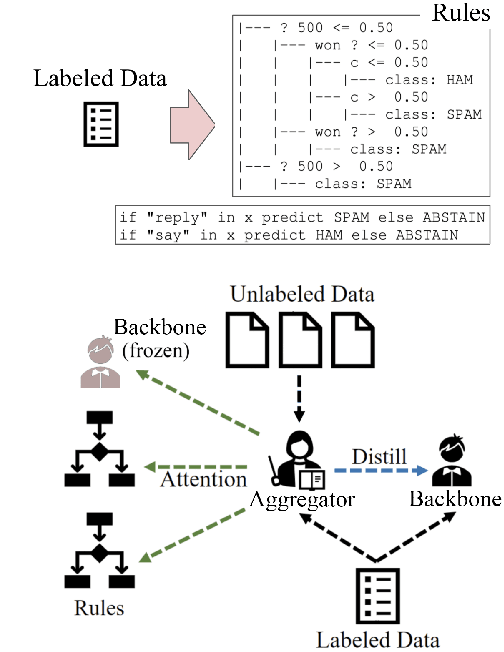
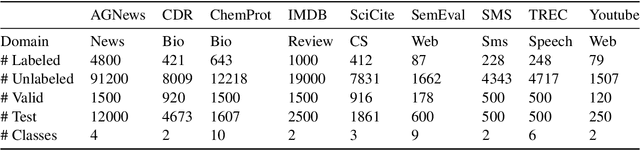
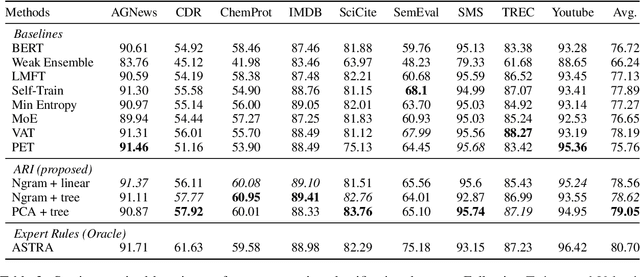
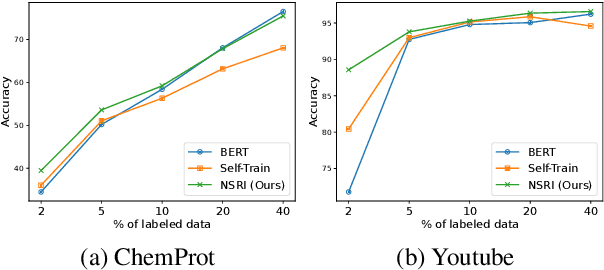
Semi-supervised learning has shown promise in allowing NLP models to generalize from small amounts of labeled data. Meanwhile, pretrained transformer models act as black-box correlation engines that are difficult to explain and sometimes behave unreliably. In this paper, we propose tackling both of these challenges via Automatic Rule Induction (ARI), a simple and general-purpose framework for the automatic discovery and integration of symbolic rules into pretrained transformer models. First, we extract weak symbolic rules from low-capacity machine learning models trained on small amounts of labeled data. Next, we use an attention mechanism to integrate these rules into high-capacity pretrained transformer models. Last, the rule-augmented system becomes part of a self-training framework to boost supervision signal on unlabeled data. These steps can be layered beneath a variety of existing weak supervision and semi-supervised NLP algorithms in order to improve performance and interpretability. Experiments across nine sequence classification and relation extraction tasks suggest that ARI can improve state-of-the-art methods with no manual effort and minimal computational overhead.
i-Code: An Integrative and Composable Multimodal Learning Framework
May 05, 2022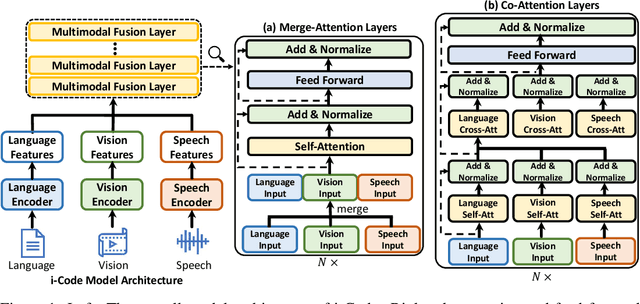
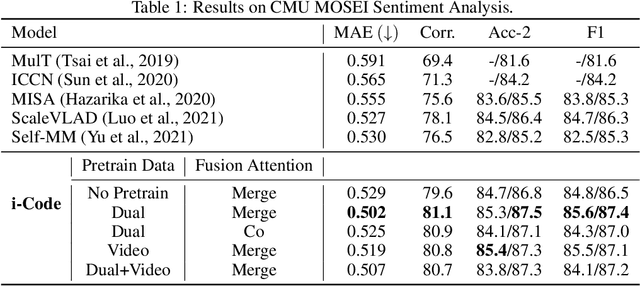
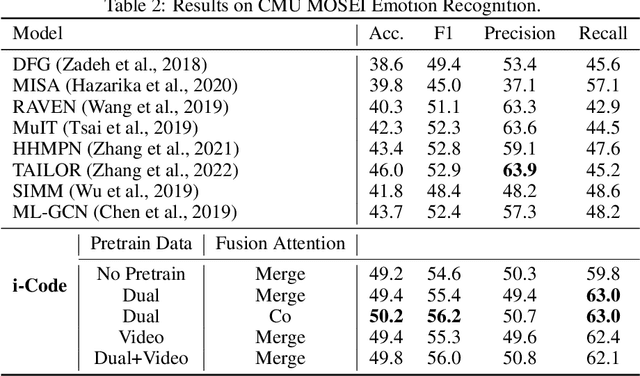

Human intelligence is multimodal; we integrate visual, linguistic, and acoustic signals to maintain a holistic worldview. Most current pretraining methods, however, are limited to one or two modalities. We present i-Code, a self-supervised pretraining framework where users may flexibly combine the modalities of vision, speech, and language into unified and general-purpose vector representations. In this framework, data from each modality are first given to pretrained single-modality encoders. The encoder outputs are then integrated with a multimodal fusion network, which uses novel attention mechanisms and other architectural innovations to effectively combine information from the different modalities. The entire system is pretrained end-to-end with new objectives including masked modality unit modeling and cross-modality contrastive learning. Unlike previous research using only video for pretraining, the i-Code framework can dynamically process single, dual, and triple-modality data during training and inference, flexibly projecting different combinations of modalities into a single representation space. Experimental results demonstrate how i-Code can outperform state-of-the-art techniques on five video understanding tasks and the GLUE NLP benchmark, improving by as much as 11% and demonstrating the power of integrative multimodal pretraining.
Impossible Triangle: What's Next for Pre-trained Language Models?
Apr 20, 2022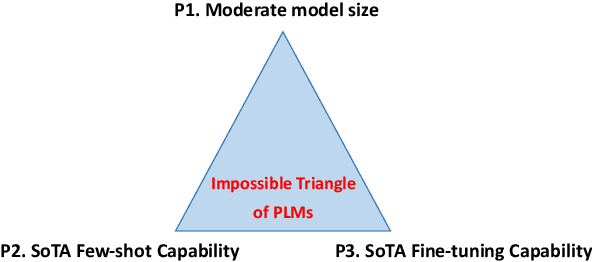
Recent development of large-scale pre-trained language models (PLM) have significantly improved the capability of models in various NLP tasks, in terms of performance after task-specific fine-tuning and zero-shot / few-shot learning. However, many of such models come with a dauntingly huge size that few institutions can afford to pre-train, fine-tune or even deploy, while moderate-sized models usually lack strong generalized few-shot learning capabilities. In this paper, we first elaborate the current obstacles of using PLM models in terms of the Impossible Triangle: 1) moderate model size, 2) state-of-the-art few-shot learning capability, and 3) state-of-the-art fine-tuning capability. We argue that all existing PLM models lack one or more properties from the Impossible Triangle. To remedy these missing properties of PLMs, various techniques have been proposed, such as knowledge distillation, data augmentation and prompt learning, which inevitably brings additional work to the application of PLMs in real scenarios. We then offer insights into future research directions of PLMs to achieve the Impossible Triangle, and break down the task into several key phases.
Leveraging Visual Knowledge in Language Tasks: An Empirical Study on Intermediate Pre-training for Cross-modal Knowledge Transfer
Mar 17, 2022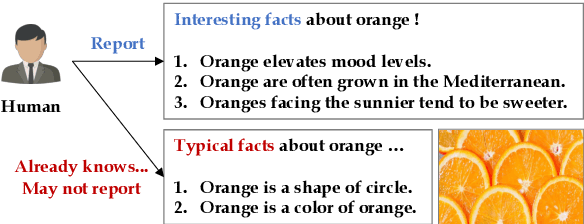
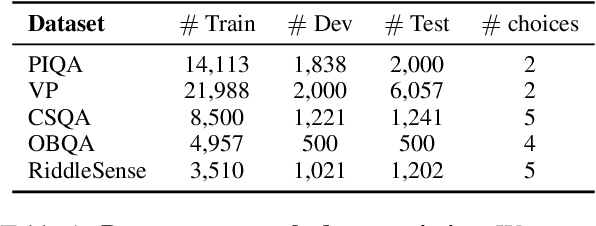
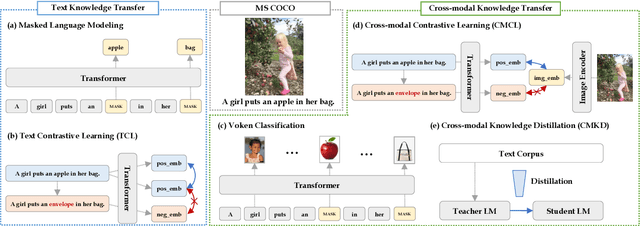
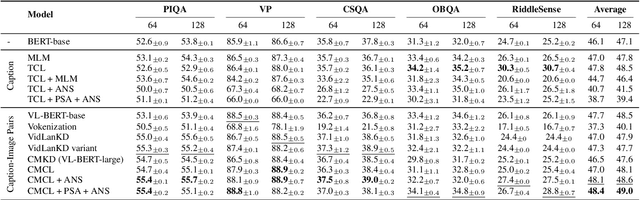
Pre-trained language models are still far from human performance in tasks that need understanding of properties (e.g. appearance, measurable quantity) and affordances of everyday objects in the real world since the text lacks such information due to reporting bias. In this work, we study whether integrating visual knowledge into a language model can fill the gap. We investigate two types of knowledge transfer: (1) text knowledge transfer using image captions that may contain enriched visual knowledge and (2) cross-modal knowledge transfer using both images and captions with vision-language training objectives. On 5 downstream tasks that may need visual knowledge to solve the problem, we perform extensive empirical comparisons over the presented objectives. Our experiments show that visual knowledge transfer can improve performance in both low-resource and fully supervised settings.
Training Data is More Valuable than You Think: A Simple and Effective Method by Retrieving from Training Data
Mar 16, 2022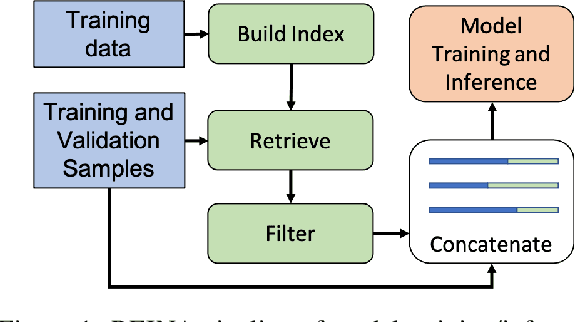
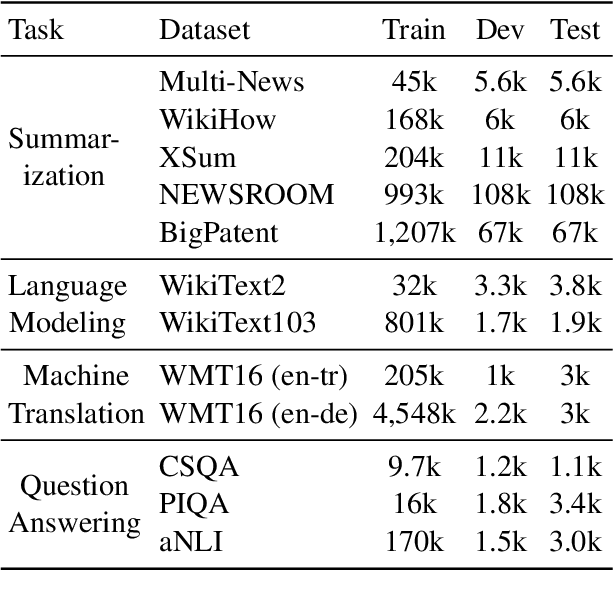
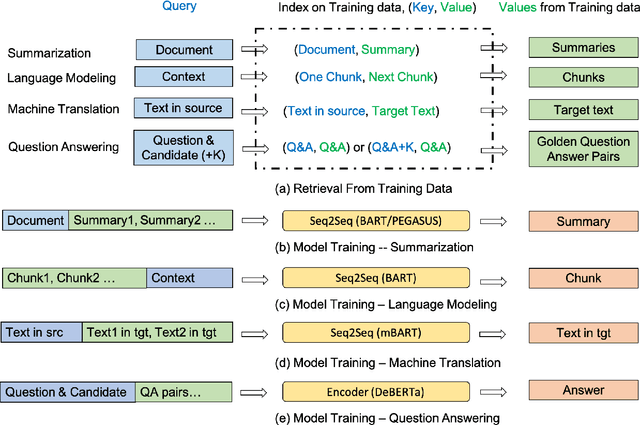
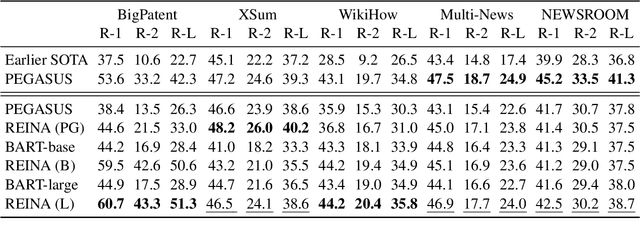
Retrieval-based methods have been shown to be effective in NLP tasks via introducing external knowledge. However, the indexing and retrieving of large-scale corpora bring considerable computational cost. Surprisingly, we found that REtrieving from the traINing datA (REINA) only can lead to significant gains on multiple NLG and NLU tasks. We retrieve the labeled training instances most similar to the input text and then concatenate them with the input to feed into the model to generate the output. Experimental results show that this simple method can achieve significantly better performance on a variety of NLU and NLG tasks, including summarization, machine translation, language modeling, and question answering tasks. For instance, our proposed method achieved state-of-the-art results on XSum, BigPatent, and CommonsenseQA. Our code is released, https://github.com/microsoft/REINA .
Diversifying Content Generation for Commonsense Reasoning with Mixture of Knowledge Graph Experts
Mar 14, 2022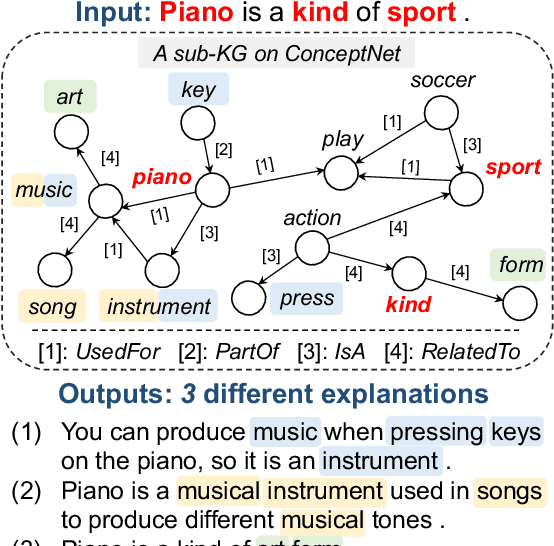
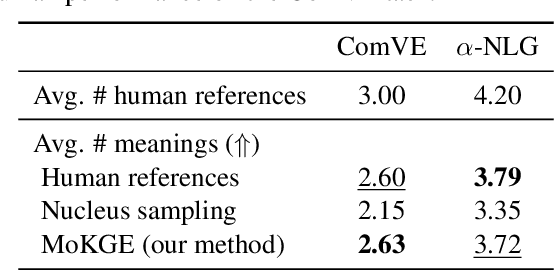
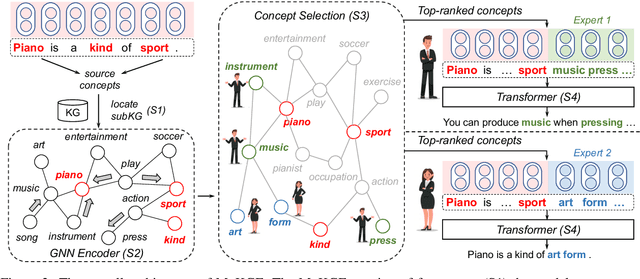
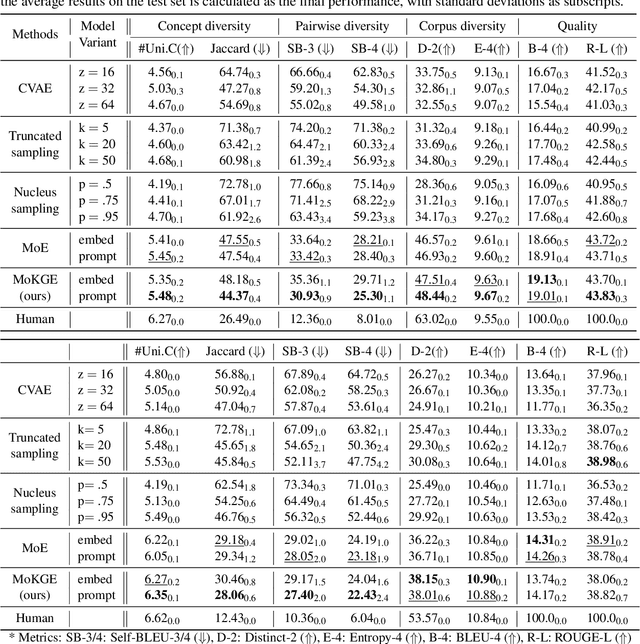
Generative commonsense reasoning (GCR) in natural language is to reason about the commonsense while generating coherent text. Recent years have seen a surge of interest in improving the generation quality of commonsense reasoning tasks. Nevertheless, these approaches have seldom investigated diversity in the GCR tasks, which aims to generate alternative explanations for a real-world situation or predict all possible outcomes. Diversifying GCR is challenging as it expects to generate multiple outputs that are not only semantically different but also grounded in commonsense knowledge. In this paper, we propose MoKGE, a novel method that diversifies the generative reasoning by a mixture of expert (MoE) strategy on commonsense knowledge graphs (KG). A set of knowledge experts seek diverse reasoning on KG to encourage various generation outputs. Empirical experiments demonstrated that MoKGE can significantly improve the diversity while achieving on par performance on accuracy on two GCR benchmarks, based on both automatic and human evaluations.