 Add to Chrome
 Add to Firefox
 Add to Edge
TQA-Bench: Evaluating LLMs for Multi-Table Question Answering with Scalable Context and Symbolic Extension
Nov 29, 2024
The advent of large language models (LLMs) has unlocked great opportunities in complex data management tasks, particularly in question answering (QA) over complicated multi-table relational data. Despite significant progress, systematically evaluating LLMs on multi-table QA remains a critical challenge due to the inherent complexity of analyzing heterogeneous table structures and potential large scale of serialized relational data. Existing benchmarks primarily focus on single-table QA, failing to capture the intricacies of reasoning across multiple relational tables, as required in real-world domains such as finance, healthcare, and e-commerce. To address this gap, we present TQA-Bench, a new multi-table QA benchmark designed to evaluate the capabilities of LLMs in tackling complex QA tasks over relational data. Our benchmark incorporates diverse relational database instances sourced from real-world public datasets and introduces a flexible sampling mechanism to create tasks with varying multi-table context lengths, ranging from 8K to 64K tokens. To ensure robustness and reliability, we integrate symbolic extensions into the evaluation framework, enabling the assessment of LLM reasoning capabilities beyond simple data retrieval or probabilistic pattern matching. We systematically evaluate a range of LLMs, both open-source and closed-source, spanning model scales from 7 billion to 70 billion parameters. Our extensive experiments reveal critical insights into the performance of LLMs in multi-table QA, highlighting both challenges and opportunities for advancing their application in complex, data-driven environments. Our benchmark implementation and results are available at https://github.com/Relaxed-System-Lab/TQA-Bench.

Zero-Indexing Internet Search Augmented Generation for Large Language Models
Nov 29, 2024Retrieval augmented generation has emerged as an effective method to enhance large language model performance. This approach typically relies on an internal retrieval module that uses various indexing mechanisms to manage a static pre-processed corpus. However, such a paradigm often falls short when it is necessary to integrate the most up-to-date information that has not been updated into the corpus during generative inference time. In this paper, we explore an alternative approach that leverages standard search engine APIs to dynamically integrate the latest online information (without maintaining any index for any fixed corpus), thereby improving the quality of generated content. We design a collaborative LLM-based paradigm, where we include: (i) a parser-LLM that determines if the Internet augmented generation is demanded and extracts the search keywords if so with a single inference; (ii) a mixed ranking strategy that re-ranks the retrieved HTML files to eliminate bias introduced from the search engine API; and (iii) an extractor-LLM that can accurately and efficiently extract relevant information from the fresh content in each HTML file. We conduct extensive empirical studies to evaluate the performance of this Internet search augmented generation paradigm. The experimental results demonstrate that our method generates content with significantly improved quality. Our system has been successfully deployed in a production environment to serve 01.AI's generative inference requests.
PCDreamer: Point Cloud Completion Through Multi-view Diffusion Priors
Nov 28, 2024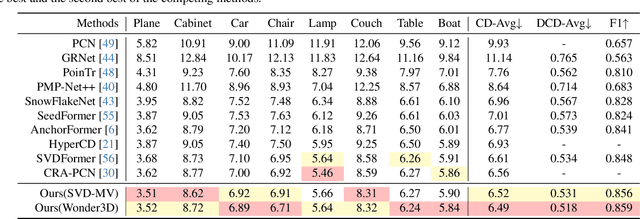
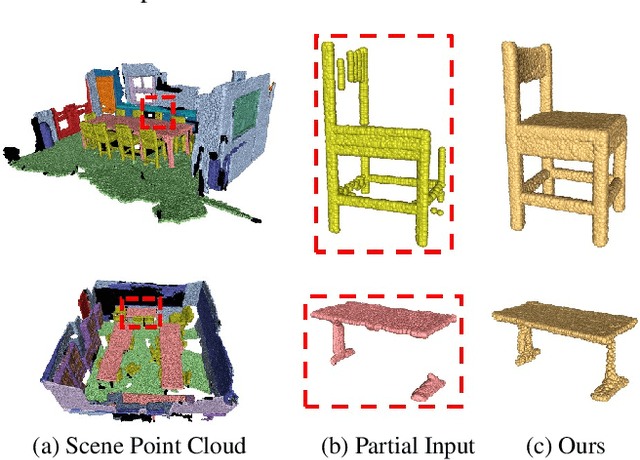
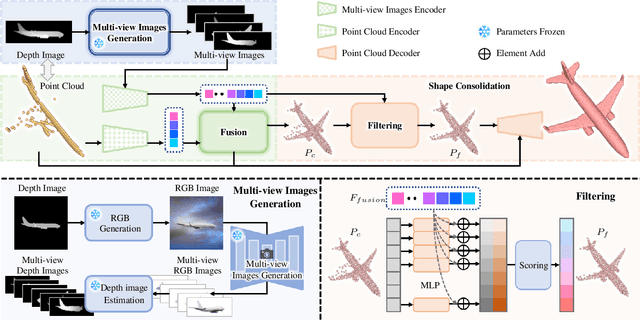
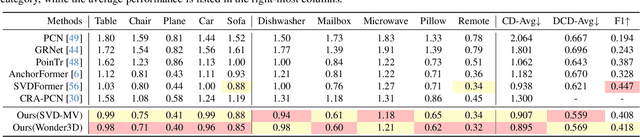
This paper presents PCDreamer, a novel method for point cloud completion. Traditional methods typically extract features from partial point clouds to predict missing regions, but the large solution space often leads to unsatisfactory results. More recent approaches have started to use images as extra guidance, effectively improving performance, but obtaining paired data of images and partial point clouds is challenging in practice. To overcome these limitations, we harness the relatively view-consistent multi-view diffusion priors within large models, to generate novel views of the desired shape. The resulting image set encodes both global and local shape cues, which is especially beneficial for shape completion. To fully exploit the priors, we have designed a shape fusion module for producing an initial complete shape from multi-modality input (\ie, images and point clouds), and a follow-up shape consolidation module to obtain the final complete shape by discarding unreliable points introduced by the inconsistency from diffusion priors. Extensive experimental results demonstrate our superior performance, especially in recovering fine details.
A Layered Architecture for Developing and Enhancing Capabilities in Large Language Model-based Software Systems
Nov 19, 2024

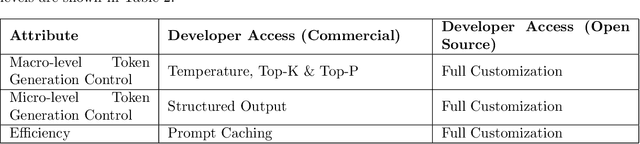
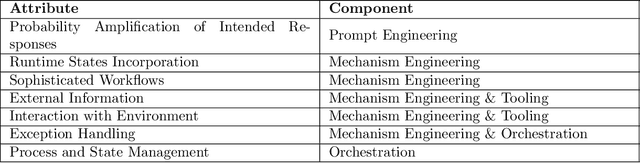
Significant efforts has been made to expand the use of Large Language Models (LLMs) beyond basic language tasks. While the generalizability and versatility of LLMs have enabled widespread adoption, evolving demands in application development often exceed their native capabilities. Meeting these demands may involve a diverse set of methods, such as enhancing creativity through either inference temperature adjustments or creativity-provoking prompts. Selecting the right approach is critical, as different methods lead to trade-offs in engineering complexity, scalability, and operational costs. This paper introduces a layered architecture that organizes LLM software system development into distinct layers, each characterized by specific attributes. By aligning capabilities with these layers, the framework encourages the systematic implementation of capabilities in effective and efficient ways that ultimately supports desired functionalities and qualities. Through practical case studies, we illustrate the utility of the framework. This work offers developers actionable insights for selecting suitable technologies in LLM-based software system development, promoting robustness and scalability.
Membership Inference Attack against Long-Context Large Language Models
Nov 18, 2024Recent advances in Large Language Models (LLMs) have enabled them to overcome their context window limitations, and demonstrate exceptional retrieval and reasoning capacities on longer context. Quesion-answering systems augmented with Long-Context Language Models (LCLMs) can automatically search massive external data and incorporate it into their contexts, enabling faithful predictions and reducing issues such as hallucinations and knowledge staleness. Existing studies targeting LCLMs mainly concentrate on addressing the so-called lost-in-the-middle problem or improving the inference effiencicy, leaving their privacy risks largely unexplored. In this paper, we aim to bridge this gap and argue that integrating all information into the long context makes it a repository of sensitive information, which often contains private data such as medical records or personal identities. We further investigate the membership privacy within LCLMs external context, with the aim of determining whether a given document or sequence is included in the LCLMs context. Our basic idea is that if a document lies in the context, it will exhibit a low generation loss or a high degree of semantic similarity to the contents generated by LCLMs. We for the first time propose six membership inference attack (MIA) strategies tailored for LCLMs and conduct extensive experiments on various popular models. Empirical results demonstrate that our attacks can accurately infer membership status in most cases, e.g., 90.66% attack F1-score on Multi-document QA datasets with LongChat-7b-v1.5-32k, highlighting significant risks of membership leakage within LCLMs input contexts. Furthermore, we examine the underlying reasons why LCLMs are susceptible to revealing such membership information.
V2X-Radar: A Multi-modal Dataset with 4D Radar for Cooperative Perception
Nov 17, 2024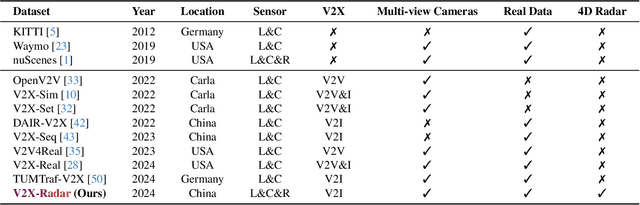
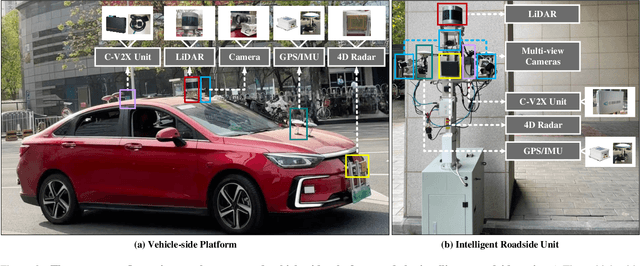
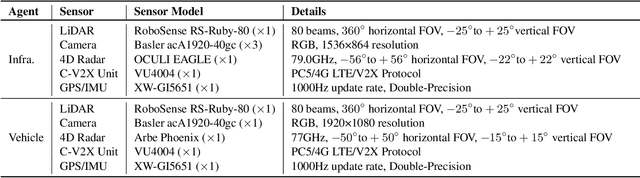
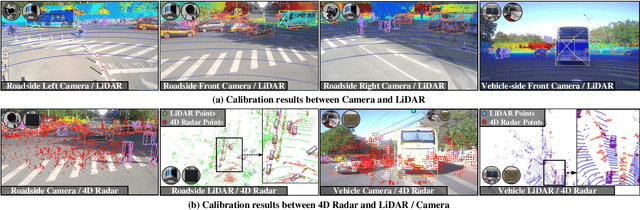
Modern autonomous vehicle perception systems often struggle with occlusions and limited perception range. Previous studies have demonstrated the effectiveness of cooperative perception in extending the perception range and overcoming occlusions, thereby improving the safety of autonomous driving. In recent years, a series of cooperative perception datasets have emerged. However, these datasets only focus on camera and LiDAR, overlooking 4D Radar, a sensor employed in single-vehicle autonomous driving for robust perception in adverse weather conditions. In this paper, to bridge the gap of missing 4D Radar datasets in cooperative perception, we present V2X-Radar, the first large real-world multi-modal dataset featuring 4D Radar. Our V2X-Radar dataset is collected using a connected vehicle platform and an intelligent roadside unit equipped with 4D Radar, LiDAR, and multi-view cameras. The collected data includes sunny and rainy weather conditions, spanning daytime, dusk, and nighttime, as well as typical challenging scenarios. The dataset comprises 20K LiDAR frames, 40K camera images, and 20K 4D Radar data, with 350K annotated bounding boxes across five categories. To facilitate diverse research domains, we establish V2X-Radar-C for cooperative perception, V2X-Radar-I for roadside perception, and V2X-Radar-V for single-vehicle perception. We further provide comprehensive benchmarks of recent perception algorithms on the above three sub-datasets. The dataset and benchmark codebase will be available at \url{http://openmpd.com/column/V2X-Radar}.
Fully Dynamic Adversarially Robust Correlation Clustering in Polylogarithmic Update Time
Nov 15, 2024
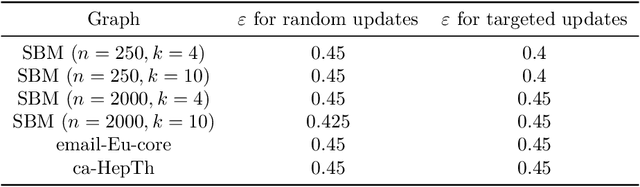


We study the dynamic correlation clustering problem with $\textit{adaptive}$ edge label flips. In correlation clustering, we are given a $n$-vertex complete graph whose edges are labeled either $(+)$ or $(-)$, and the goal is to minimize the total number of $(+)$ edges between clusters and the number of $(-)$ edges within clusters. We consider the dynamic setting with adversarial robustness, in which the $\textit{adaptive}$ adversary could flip the label of an edge based on the current output of the algorithm. Our main result is a randomized algorithm that always maintains an $O(1)$-approximation to the optimal correlation clustering with $O(\log^{2}{n})$ amortized update time. Prior to our work, no algorithm with $O(1)$-approximation and $\text{polylog}{(n)}$ update time for the adversarially robust setting was known. We further validate our theoretical results with experiments on synthetic and real-world datasets with competitive empirical performances. Our main technical ingredient is an algorithm that maintains $\textit{sparse-dense decomposition}$ with $\text{polylog}{(n)}$ update time, which could be of independent interest.
Object-Centric Dexterous Manipulation from Human Motion Data
Nov 06, 2024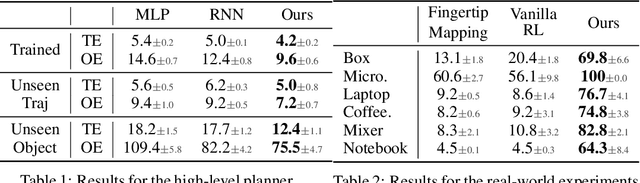
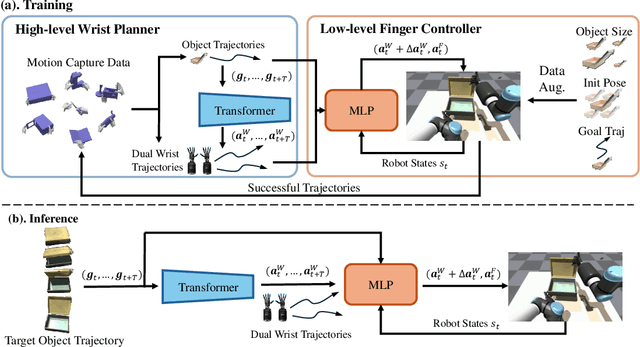

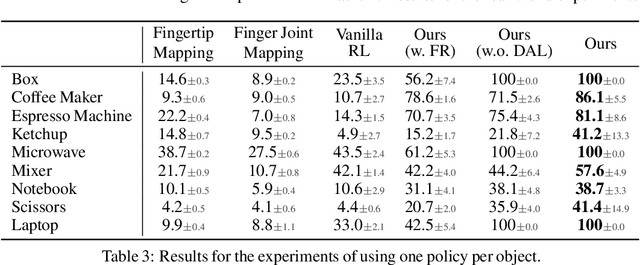
Manipulating objects to achieve desired goal states is a basic but important skill for dexterous manipulation. Human hand motions demonstrate proficient manipulation capability, providing valuable data for training robots with multi-finger hands. Despite this potential, substantial challenges arise due to the embodiment gap between human and robot hands. In this work, we introduce a hierarchical policy learning framework that uses human hand motion data for training object-centric dexterous robot manipulation. At the core of our method is a high-level trajectory generative model, learned with a large-scale human hand motion capture dataset, to synthesize human-like wrist motions conditioned on the desired object goal states. Guided by the generated wrist motions, deep reinforcement learning is further used to train a low-level finger controller that is grounded in the robot's embodiment to physically interact with the object to achieve the goal. Through extensive evaluation across 10 household objects, our approach not only demonstrates superior performance but also showcases generalization capability to novel object geometries and goal states. Furthermore, we transfer the learned policies from simulation to a real-world bimanual dexterous robot system, further demonstrating its applicability in real-world scenarios. Project website: https://cypypccpy.github.io/obj-dex.github.io/.
LogiCity: Advancing Neuro-Symbolic AI with Abstract Urban Simulation
Nov 01, 2024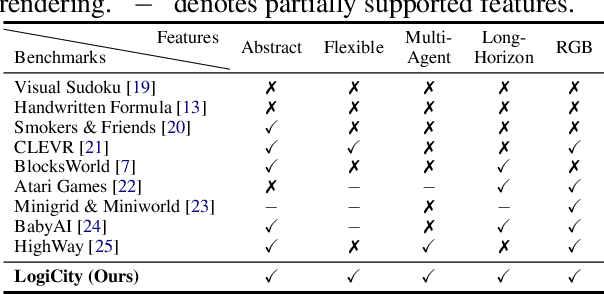

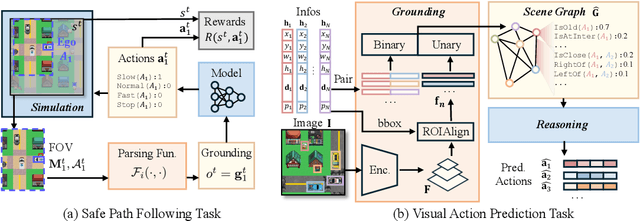
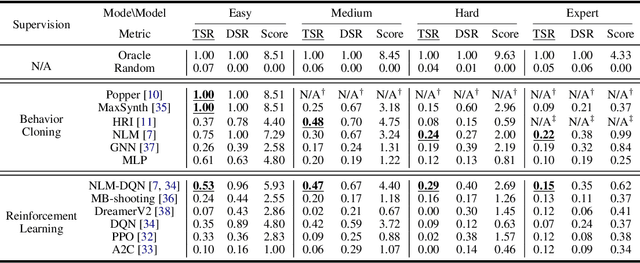
Recent years have witnessed the rapid development of Neuro-Symbolic (NeSy) AI systems, which integrate symbolic reasoning into deep neural networks. However, most of the existing benchmarks for NeSy AI fail to provide long-horizon reasoning tasks with complex multi-agent interactions. Furthermore, they are usually constrained by fixed and simplistic logical rules over limited entities, making them far from real-world complexities. To address these crucial gaps, we introduce LogiCity, the first simulator based on customizable first-order logic (FOL) for an urban-like environment with multiple dynamic agents. LogiCity models diverse urban elements using semantic and spatial concepts, such as IsAmbulance(X) and IsClose(X, Y). These concepts are used to define FOL rules that govern the behavior of various agents. Since the concepts and rules are abstractions, they can be universally applied to cities with any agent compositions, facilitating the instantiation of diverse scenarios. Besides, a key feature of LogiCity is its support for user-configurable abstractions, enabling customizable simulation complexities for logical reasoning. To explore various aspects of NeSy AI, LogiCity introduces two tasks, one features long-horizon sequential decision-making, and the other focuses on one-step visual reasoning, varying in difficulty and agent behaviors. Our extensive evaluation reveals the advantage of NeSy frameworks in abstract reasoning. Moreover, we highlight the significant challenges of handling more complex abstractions in long-horizon multi-agent scenarios or under high-dimensional, imbalanced data. With its flexible design, various features, and newly raised challenges, we believe LogiCity represents a pivotal step forward in advancing the next generation of NeSy AI. All the code and data are open-sourced at our website.
EgoMimic: Scaling Imitation Learning via Egocentric Video
Oct 31, 2024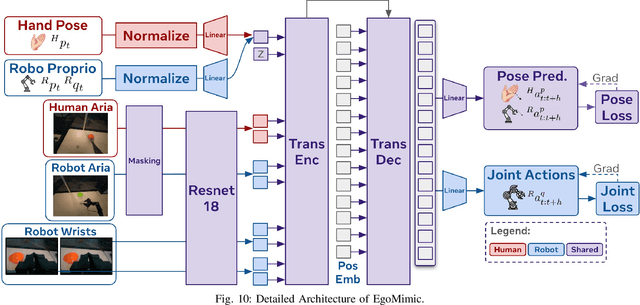
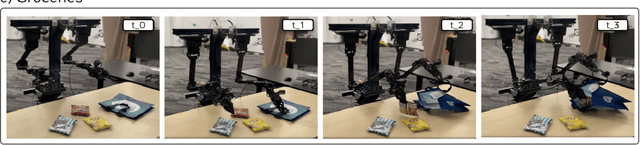
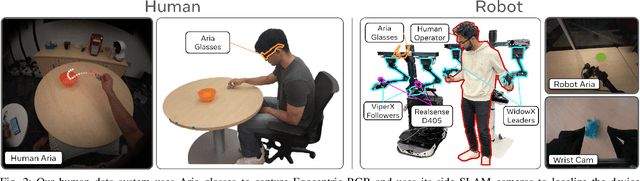
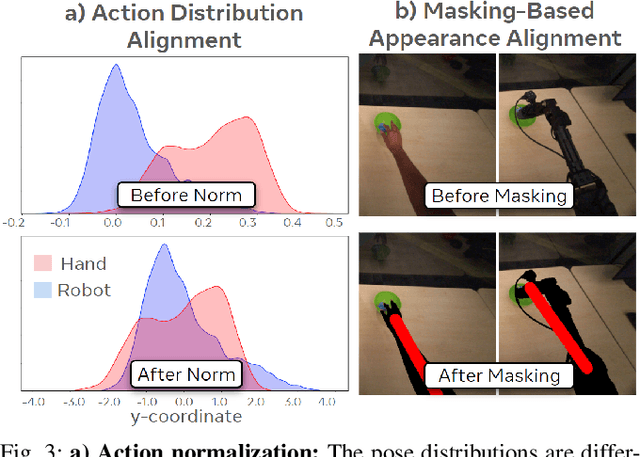
The scale and diversity of demonstration data required for imitation learning is a significant challenge. We present EgoMimic, a full-stack framework which scales manipulation via human embodiment data, specifically egocentric human videos paired with 3D hand tracking. EgoMimic achieves this through: (1) a system to capture human embodiment data using the ergonomic Project Aria glasses, (2) a low-cost bimanual manipulator that minimizes the kinematic gap to human data, (3) cross-domain data alignment techniques, and (4) an imitation learning architecture that co-trains on human and robot data. Compared to prior works that only extract high-level intent from human videos, our approach treats human and robot data equally as embodied demonstration data and learns a unified policy from both data sources. EgoMimic achieves significant improvement on a diverse set of long-horizon, single-arm and bimanual manipulation tasks over state-of-the-art imitation learning methods and enables generalization to entirely new scenes. Finally, we show a favorable scaling trend for EgoMimic, where adding 1 hour of additional hand data is significantly more valuable than 1 hour of additional robot data. Videos and additional information can be found at https://egomimic.github.io/