 Add to Chrome
 Add to Firefox
 Add to Edge
2D or 3D: Who Governs Salience in VLA Models? -- Tri-Stage Token Pruning Framework with Modality Salience Awareness
Apr 10, 2026
Vision-Language-Action (VLA) models have emerged as the mainstream of embodied intelligence. Recent VLA models have expanded their input modalities from 2D-only to 2D+3D paradigms, forming multi-visual-modal VLA (MVLA) models. Despite achieving improved spatial perception, MVLA faces a greater acceleration demand due to the increased number of input tokens caused by modal expansion. Token pruning is an effective optimization methods tailored to MVLA models. However, existing token pruning schemes are designed for 2D-only VLA models, ignoring 2D/3D modality salience differences. In this paper, we follow the application process of multi-modal data in MVLA models and develop a tri-stage analysis to capture the discrepancy and dynamics of 2D/3D modality salience. Based on these, we propose a corresponding tri-stage token pruning framework for MVLA models to achieve optimal 2D/3D token selection and efficient pruning. Experiments show that our framework achieves up to a 2.55x inference speedup with minimal accuracy loss, while only costing 5.8% overhead. Our Code is coming soon.

RoboECC: Multi-Factor-Aware Edge-Cloud Collaborative Deployment for VLA Models
Mar 21, 2026Vision-Language-Action (VLA) models are mainstream in embodied intelligence but face high inference costs. Edge-Cloud Collaborative (ECC) deployment offers an effective fix by easing edge-device computing pressure to meet real-time needs. However, existing ECC frameworks are suboptimal for VLA models due to two challenges: (1) Diverse model structures hinder optimal ECC segmentation point identification; (2) Even if the optimal split point is determined, changes in network bandwidth can cause performance drift. To address these issues, we propose a novel ECC deployment framework for various VLA models, termed RoboECC. Specifically, we propose a model-hardware co-aware segmentation strategy to help find the optimal segmentation point for various VLA models. Moreover, we propose a network-aware deployment adjustment approach to adapt to the network fluctuations for maintaining optimal performance. Experiments demonstrate that RoboECC achieves a speedup of up to 3.28x with only 2.55x~2.62x overhead.
RAPID: Redundancy-Aware and Compatibility-Optimal Edge-Cloud Partitioned Inference for Diverse VLA Models
Mar 12, 2026Vision Language Action (VLA) models are mainstream in embodied intelligence but face high inference costs. Edge-Cloud Collaborative (ECC) inference offers an effective fix by easing edge-device computing pressure to meet real-time needs. However, existing ECC frameworks are suboptimal for VLA models due to two challenges: (1) Mainstream environment-oriented edge-cloud partitioning methods are susceptible to interference from visual noise; (2) Existing edge-cloud partitioning methods overlook the step-wise redundancy unique to embodied tasks, thereby disrupting the physical continuity of motion. To address these issues, we propose a novel ECC inference framework, termed RAPID. Specifically, we developed an implementation tailored to the proposed framework. Experiments demonstrate this achieves a speedup of up to 1.73x with only 5%~7% overhead.
S2SServiceBench: A Multimodal Benchmark for Last-Mile S2S Climate Services
Feb 15, 2026Subseasonal-to-seasonal (S2S) forecasts play an essential role in providing a decision-critical weeks-to-months planning window for climate resilience and sustainability, yet a growing bottleneck is the last-mile gap: translating scientific forecasts into trusted, actionable climate services, requiring reliable multimodal understanding and decision-facing reasoning under uncertainty. Meanwhile, multimodal large language models (MLLMs) and corresponding agentic paradigms have made rapid progress in supporting various workflows, but it remains unclear whether they can reliably generate decision-making deliverables from operational service products (e.g., actionable signal comprehension, decision-making handoff, and decision analysis & planning) under uncertainty. We introduce S2SServiceBench, a multimodal benchmark for last-mile S2S climate services curated from an operational climate-service system to evaluate this capability. S2SServiceBenchcovers 10 service products with about 150+ expert-selected cases in total, spanning six application domains - Agriculture, Disasters, Energy, Finance, Health, and Shipping. Each case is instantiated at three service levels, yielding around 500 tasks and 1,000+ evaluation items across climate resilience and sustainability applications. Using S2SServiceBench, we benchmark state-of-the-art MLLMs and agents, and analyze performance across products and service levels, revealing persistent challenges in S2S service plot understanding and reasoning - namely, actionable signal comprehension, operationalizing uncertainty into executable handoffs, and stable, evidence-grounded analysis and planning for dynamic hazards-while offering actionable guidance for building future climate-service agents.
MemAdapter: Fast Alignment across Agent Memory Paradigms via Generative Subgraph Retrieval
Feb 09, 2026Memory mechanism is a core component of LLM-based agents, enabling reasoning and knowledge discovery over long-horizon contexts. Existing agent memory systems are typically designed within isolated paradigms (e.g., explicit, parametric, or latent memory) with tightly coupled retrieval methods that hinder cross-paradigm generalization and fusion. In this work, we take a first step toward unifying heterogeneous memory paradigms within a single memory system. We propose MemAdapter, a memory retrieval framework that enables fast alignment across agent memory paradigms. MemAdapter adopts a two-stage training strategy: (1) training a generative subgraph retriever from the unified memory space, and (2) adapting the retriever to unseen memory paradigms by training a lightweight alignment module through contrastive learning. This design improves the flexibility for memory retrieval and substantially reduces alignment cost across paradigms. Comprehensive experiments on three public evaluation benchmarks demonstrate that the generative subgraph retriever consistently outperforms five strong agent memory systems across three memory paradigms and agent model scales. Notably, MemAdapter completes cross-paradigm alignment within 13 minutes on a single GPU, achieving superior performance over original memory retrievers with less than 5% of training compute. Furthermore, MemAdapter enables effective zero-shot fusion across memory paradigms, highlighting its potential as a plug-and-play solution for agent memory systems.
Implicit Graph, Explicit Retrieval: Towards Efficient and Interpretable Long-horizon Memory for Large Language Models
Jan 06, 2026Long-horizon applications increasingly require large language models (LLMs) to answer queries when relevant evidence is sparse and dispersed across very long contexts. Existing memory systems largely follow two paradigms: explicit structured memories offer interpretability but often become brittle under long-context overload, while latent memory mechanisms are efficient and stable yet difficult to inspect. We propose LatentGraphMem, a memory framework that combines implicit graph memory with explicit subgraph retrieval. LatentGraphMem stores a graph-structured memory in latent space for stability and efficiency, and exposes a task-specific subgraph retrieval interface that returns a compact symbolic subgraph under a fixed budget for downstream reasoning and human inspection. During training, an explicit graph view is materialized to interface with a frozen reasoner for question-answering supervision. At inference time, retrieval is performed in latent space and only the retrieved subgraph is externalized. Experiments on long-horizon benchmarks across multiple model scales show that LatentGraphMem consistently outperforms representative explicit-graph and latent-memory baselines, while enabling parameter-efficient adaptation and flexible scaling to larger reasoners without introducing large symbolic artifacts.
AtmosSci-Bench: Evaluating the Recent Advance of Large Language Model for Atmospheric Science
Feb 03, 2025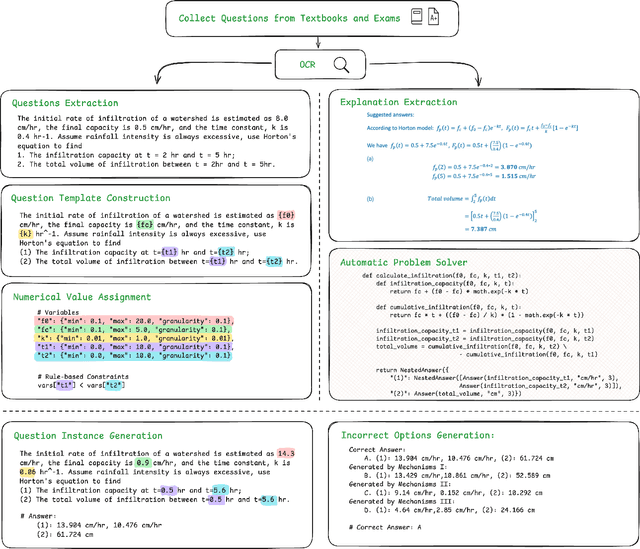
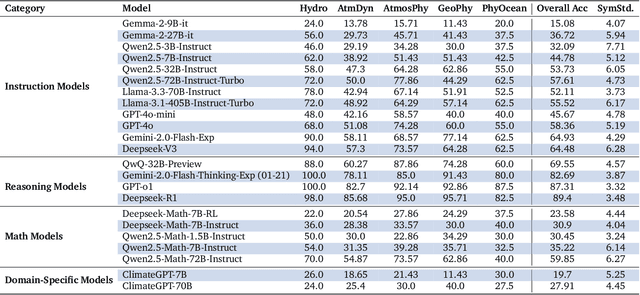
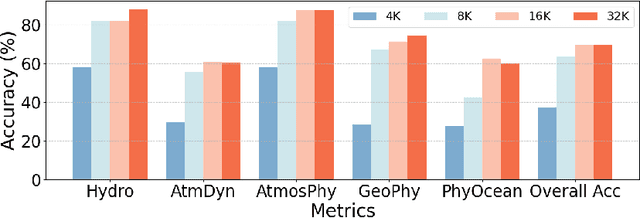
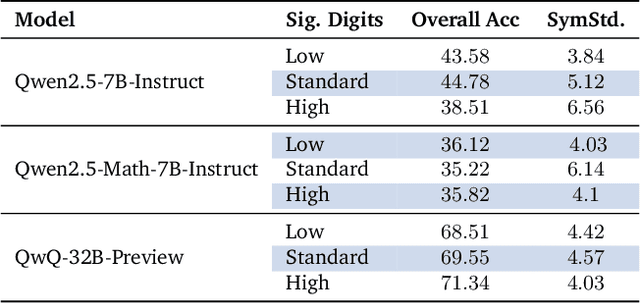
The rapid advancements in large language models (LLMs), particularly in their reasoning capabilities, hold transformative potential for addressing complex challenges in atmospheric science. However, leveraging LLMs effectively in this domain requires a robust and comprehensive evaluation benchmark. To address this need, we present AtmosSci-Bench, a novel benchmark designed to systematically assess LLM performance across five core categories of atmospheric science problems: hydrology, atmospheric dynamics, atmospheric physics, geophysics, and physical oceanography. We employ a template-based question generation framework, enabling scalable and diverse multiple-choice questions curated from graduate-level atmospheric science problems. We conduct a comprehensive evaluation of representative LLMs, categorized into four groups: instruction-tuned models, advanced reasoning models, math-augmented models, and domain-specific climate models. Our analysis provides some interesting insights into the reasoning and problem-solving capabilities of LLMs in atmospheric science. We believe AtmosSci-Bench can serve as a critical step toward advancing LLM applications in climate service by offering a standard and rigorous evaluation framework. Our source codes are currently available at https://github.com/Relaxed-System-Lab/AtmosSci-Bench.
Zero-Indexing Internet Search Augmented Generation for Large Language Models
Nov 29, 2024Retrieval augmented generation has emerged as an effective method to enhance large language model performance. This approach typically relies on an internal retrieval module that uses various indexing mechanisms to manage a static pre-processed corpus. However, such a paradigm often falls short when it is necessary to integrate the most up-to-date information that has not been updated into the corpus during generative inference time. In this paper, we explore an alternative approach that leverages standard search engine APIs to dynamically integrate the latest online information (without maintaining any index for any fixed corpus), thereby improving the quality of generated content. We design a collaborative LLM-based paradigm, where we include: (i) a parser-LLM that determines if the Internet augmented generation is demanded and extracts the search keywords if so with a single inference; (ii) a mixed ranking strategy that re-ranks the retrieved HTML files to eliminate bias introduced from the search engine API; and (iii) an extractor-LLM that can accurately and efficiently extract relevant information from the fresh content in each HTML file. We conduct extensive empirical studies to evaluate the performance of this Internet search augmented generation paradigm. The experimental results demonstrate that our method generates content with significantly improved quality. Our system has been successfully deployed in a production environment to serve 01.AI's generative inference requests.
Adaptive High-Frequency Transformer for Diverse Wildlife Re-Identification
Oct 09, 2024Wildlife ReID involves utilizing visual technology to identify specific individuals of wild animals in different scenarios, holding significant importance for wildlife conservation, ecological research, and environmental monitoring. Existing wildlife ReID methods are predominantly tailored to specific species, exhibiting limited applicability. Although some approaches leverage extensively studied person ReID techniques, they struggle to address the unique challenges posed by wildlife. Therefore, in this paper, we present a unified, multi-species general framework for wildlife ReID. Given that high-frequency information is a consistent representation of unique features in various species, significantly aiding in identifying contours and details such as fur textures, we propose the Adaptive High-Frequency Transformer model with the goal of enhancing high-frequency information learning. To mitigate the inevitable high-frequency interference in the wilderness environment, we introduce an object-aware high-frequency selection strategy to adaptively capture more valuable high-frequency components. Notably, we unify the experimental settings of multiple wildlife datasets for ReID, achieving superior performance over state-of-the-art ReID methods. In domain generalization scenarios, our approach demonstrates robust generalization to unknown species.
On the Opportunities of (Re)-Exploring Atmospheric Science by Foundation Models: A Case Study
Jul 25, 2024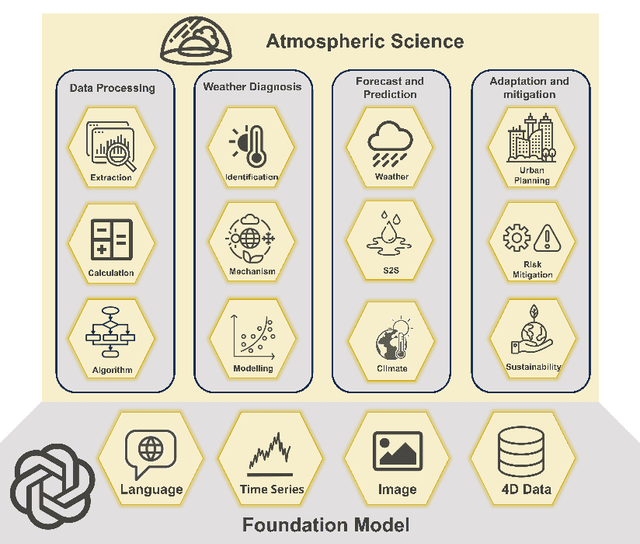
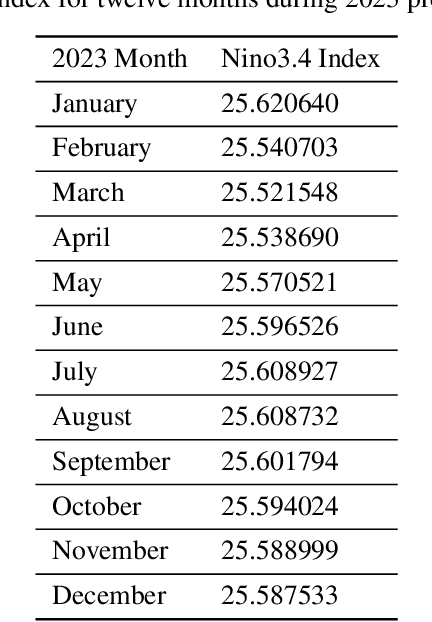
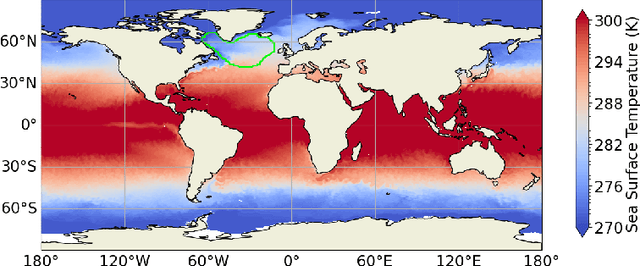
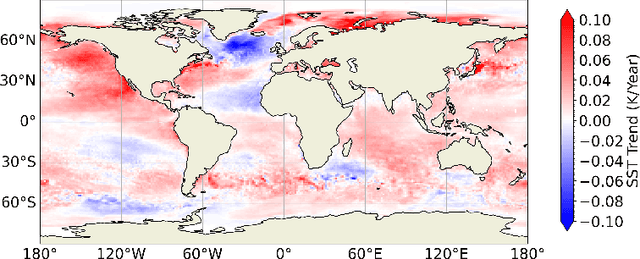
Most state-of-the-art AI applications in atmospheric science are based on classic deep learning approaches. However, such approaches cannot automatically integrate multiple complicated procedures to construct an intelligent agent, since each functionality is enabled by a separate model learned from independent climate datasets. The emergence of foundation models, especially multimodal foundation models, with their ability to process heterogeneous input data and execute complex tasks, offers a substantial opportunity to overcome this challenge. In this report, we want to explore a central question - how the state-of-the-art foundation model, i.e., GPT-4o, performs various atmospheric scientific tasks. Toward this end, we conduct a case study by categorizing the tasks into four main classes, including climate data processing, physical diagnosis, forecast and prediction, and adaptation and mitigation. For each task, we comprehensively evaluate the GPT-4o's performance along with a concrete discussion. We hope that this report may shed new light on future AI applications and research in atmospheric science.