 Add to Chrome
 Add to Firefox
 Add to Edge
Adaptive Volumetric Mechanical Property Fields Invariant to Resolution
Jun 16, 2026
Accurate mechanical properties (or materials) Young's modulus ($E$), Poisson's ratio ($ν$) and density ($ρ$) are essential for reliable physics simulation of digital worlds, but most 3D assets lack this information. We propose AdaVoMP, a method for predicting accurate dense spatially-varying ($E$, $ν$, $ρ$) for input 3D objects across representations, improving the resolution, accuracy, and memory efficiency over the state-of-the-art. The foundation of our technique is a sparse and adaptive voxel structure SAV that efficiently represents both the input 3D shape and the material field output. We replace the fixed-voxel model of the most accurate prior method, VoMP, with a novel sparse transformer encoder-decoder model that learns to generate a unique SAV autoregressively for every input shape to represent its materials, achieving a resolution $16^3\times$ higher than prior art. Experiments show that AdaVoMP estimates more accurate volumetric properties, even with lesser test-time compute than all prior art. This allows us to convert high-resolution complex 3D objects into simulation-ready assets, resulting in realistic deformable simulations.

PaperMentor: A Human-Centered Multi-Agent Writing Tutor for AI Research Papers on Overleaf
Jun 07, 2026Expert writing feedback from experienced researchers is critical for early-career scholars to improve their manuscripts, yet high-quality feedback often remains scarce because reviewing research papers is labor-intensive. Emerging AI-powered writing assistants largely focus on grammar fixes or simulating peer review with final scores, yet they fall short of providing concrete, actionable suggestions that help students improve their papers during drafting. We present PaperMentor, a human-centered writing assistant system that delivers actionable suggestions as Overleaf-native inline comments while leaving the actual writing entirely to human authors. PaperMentor integrates an expert skill library carefully curated from established researchers' writing advice with 12 specialized agents covering different aspects of paper writing, such as formatting compliance, phrasing accuracy, and terminology consistency. In a user study (n=14), 90.6% of the generated comments were rated actionable and 67.5% were rated valid, significantly outperforming a GPT-5.2 baseline uswithout the skill library. We release PaperMentor as open source for public use. Our code is publicly available under the AGPL-3.0 license at https://github.com/jiarui-liu/overleaf
STRIDE: Training Data Attribution via Sparse Recovery from Subset Perturbations
Jun 03, 2026Training Data Attribution (TDA) seeks to trace a model's predictions back to its training data. The gold standard for TDA relies on causal interventions, observing how a model changes when data is added or removed, but repeated retraining is computationally challenging for Large Language Models (LLMs). Consequently, most approaches approximate this effect in the parameter space using gradients. However, tracking gradients across billions of parameters is not only prohibitively expensive but relies on local approximations. In this work, we propose a shift: rather than estimating parameter changes, we model the functional effect of training data in the activation space. We introduce STRIDE (Steering-based Training Data Influence Decomposition), a framework that formulates TDA as a sparse recovery problem in the spirit of compressive sensing. STRIDE learns lightweight "steering operators" that mimic the behavioral shift caused by training on data subsets. By measuring how these operators perturb test predictions, we recover individual training example influences via sparse linear decomposition. STRIDE achieves state-of-the-art for LLM pre-training attribution while being an order of magnitude ($13\times$) faster than previous art. We further validate its practical utility through downstream applications including data selection, data contamination, and qualitative analysis.
FreeForm: Reduced-Order Deformable Simulation from Particle-Based Skinning Eigenmodes
May 28, 2026We present a novel formulation for mesh-free, reduced-order simulation of deformable hyperelastic objects. Existing work in reduced-order elastodynamic simulation represents the input geometry by either meshes, which can be difficult to obtain due to challenges in scanning and triangulating complex shapes, or by neural fields that require per-shape optimization. We propose to adopt a Reproducing Kernel Particle Method (RKPM) representation, which enables the construction of reduced-order skinning weights by solving a generalized eigensystem on the Hessian matrix of the elastic energy. We demonstrate that this formulation not only leads to a 40x training speedup compared with the per-shape optimization of neural fields, but also achieves lower simulation error when evaluated against the converged results of finite element method. We show our simulation results on a wide variety of objects in different representations including meshes and Gaussian splats, as well as the application of our method in the downstream task of robot simulation.
RoboLab: A High-Fidelity Simulation Benchmark for Analysis of Task Generalist Policies
Apr 10, 2026The pursuit of general-purpose robotics has yielded impressive foundation models, yet simulation-based benchmarking remains a bottleneck due to rapid performance saturation and a lack of true generalization testing. Existing benchmarks often exhibit significant domain overlap between training and evaluation, trivializing success rates and obscuring insights into robustness. We introduce RoboLab, a simulation benchmarking framework designed to address these challenges. Concretely, our framework is designed to answer two questions: (1) to what extent can we understand the performance of a real-world policy by analyzing its behavior in simulation, and (2) which external factors most strongly affect that behavior under controlled perturbations. First, RoboLab enables human-authored and LLM-enabled generation of scenes and tasks in a robot- and policy-agnostic manner within a physically realistic and photorealistic simulation. With this, we propose the RoboLab-120 benchmark, consisting of 120 tasks categorized into three competency axes: visual, procedural, relational competency, across three difficulty levels. Second, we introduce a systematic analysis of real-world policies that quantify both their performance and the sensitivity of their behavior to controlled perturbations, indicating that high-fidelity simulation can serve as a proxy for analyzing performance and its dependence on external factors. Evaluation with RoboLab exposes significant performance gap in current state-of-the-art models. By providing granular metrics and a scalable toolset, RoboLab offers a scalable framework for evaluating the true generalization capabilities of task-generalist robotic policies.
VoMP: Predicting Volumetric Mechanical Property Fields
Oct 27, 2025Physical simulation relies on spatially-varying mechanical properties, often laboriously hand-crafted. VoMP is a feed-forward method trained to predict Young's modulus ($E$), Poisson's ratio ($\nu$), and density ($\rho$) throughout the volume of 3D objects, in any representation that can be rendered and voxelized. VoMP aggregates per-voxel multi-view features and passes them to our trained Geometry Transformer to predict per-voxel material latent codes. These latents reside on a manifold of physically plausible materials, which we learn from a real-world dataset, guaranteeing the validity of decoded per-voxel materials. To obtain object-level training data, we propose an annotation pipeline combining knowledge from segmented 3D datasets, material databases, and a vision-language model, along with a new benchmark. Experiments show that VoMP estimates accurate volumetric properties, far outperforming prior art in accuracy and speed.
Squeeze3D: Your 3D Generation Model is Secretly an Extreme Neural Compressor
Jun 09, 2025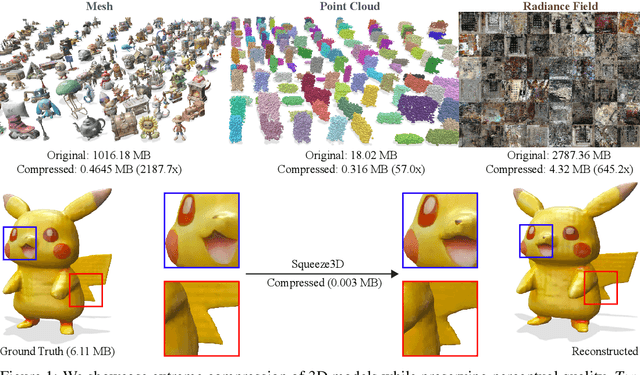
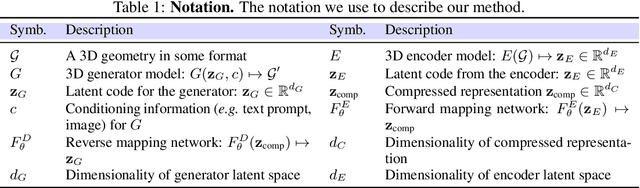
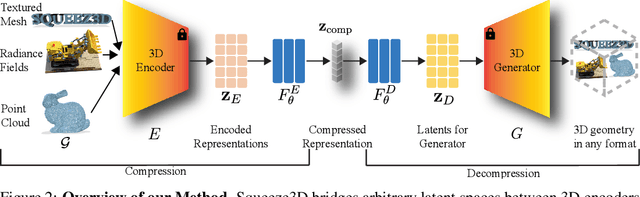
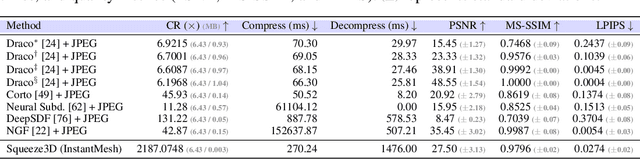
We propose Squeeze3D, a novel framework that leverages implicit prior knowledge learnt by existing pre-trained 3D generative models to compress 3D data at extremely high compression ratios. Our approach bridges the latent spaces between a pre-trained encoder and a pre-trained generation model through trainable mapping networks. Any 3D model represented as a mesh, point cloud, or a radiance field is first encoded by the pre-trained encoder and then transformed (i.e. compressed) into a highly compact latent code. This latent code can effectively be used as an extremely compressed representation of the mesh or point cloud. A mapping network transforms the compressed latent code into the latent space of a powerful generative model, which is then conditioned to recreate the original 3D model (i.e. decompression). Squeeze3D is trained entirely on generated synthetic data and does not require any 3D datasets. The Squeeze3D architecture can be flexibly used with existing pre-trained 3D encoders and existing generative models. It can flexibly support different formats, including meshes, point clouds, and radiance fields. Our experiments demonstrate that Squeeze3D achieves compression ratios of up to 2187x for textured meshes, 55x for point clouds, and 619x for radiance fields while maintaining visual quality comparable to many existing methods. Squeeze3D only incurs a small compression and decompression latency since it does not involve training object-specific networks to compress an object.
Can Vision-Language Models Answer Face to Face Questions in the Real-World?
Mar 25, 2025AI models have made significant strides in recent years in their ability to describe and answer questions about real-world images. They have also made progress in the ability to converse with users in real-time using audio input. This raises the question: have we reached the point where AI models, connected to a camera and microphone, can converse with users in real-time about scenes and events that are unfolding live in front of the camera? This has been a long-standing goal in AI and is a prerequisite for real-world AI assistants and humanoid robots to interact with humans in everyday situations. In this work, we introduce a new dataset and benchmark, the Qualcomm Interactive Video Dataset (IVD), which allows us to assess the extent to which existing models can support these abilities, and to what degree these capabilities can be instilled through fine-tuning. The dataset is based on a simple question-answering setup, where users ask questions that the system has to answer, in real-time, based on the camera and audio input. We show that existing models fall far behind human performance on this task, and we identify the main sources for the performance gap. However, we also show that for many of the required perceptual skills, fine-tuning on this form of data can significantly reduce this gap.
AirLetters: An Open Video Dataset of Characters Drawn in the Air
Oct 03, 2024


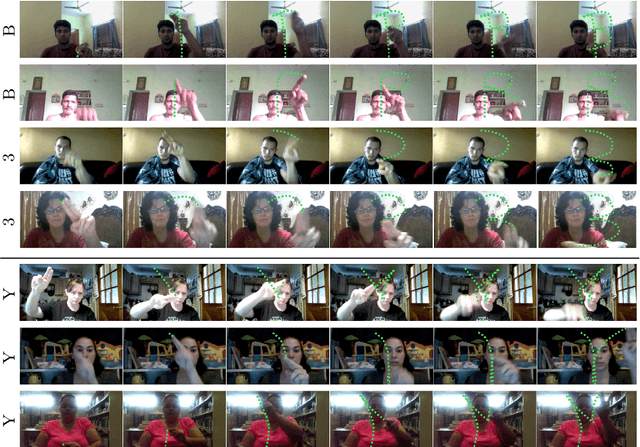
We introduce AirLetters, a new video dataset consisting of real-world videos of human-generated, articulated motions. Specifically, our dataset requires a vision model to predict letters that humans draw in the air. Unlike existing video datasets, accurate classification predictions for AirLetters rely critically on discerning motion patterns and on integrating long-range information in the video over time. An extensive evaluation of state-of-the-art image and video understanding models on AirLetters shows that these methods perform poorly and fall far behind a human baseline. Our work shows that, despite recent progress in end-to-end video understanding, accurate representations of complex articulated motions -- a task that is trivial for humans -- remains an open problem for end-to-end learning.
NeRF-US: Removing Ultrasound Imaging Artifacts from Neural Radiance Fields in the Wild
Aug 21, 2024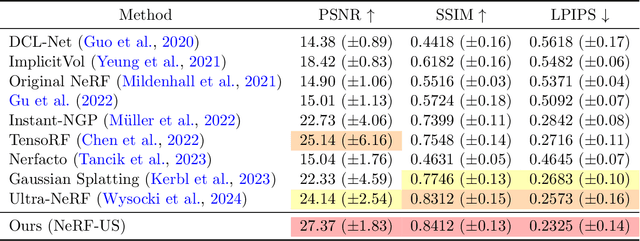
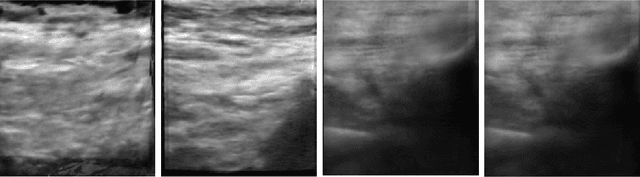
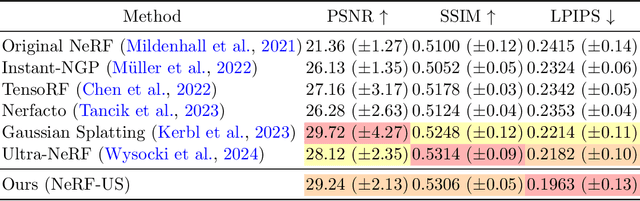
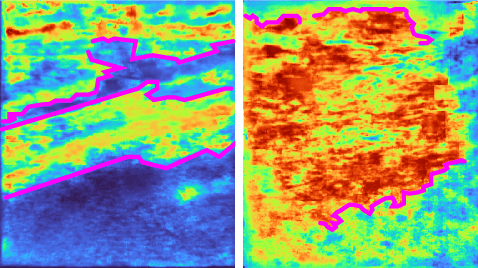
Current methods for performing 3D reconstruction and novel view synthesis (NVS) in ultrasound imaging data often face severe artifacts when training NeRF-based approaches. The artifacts produced by current approaches differ from NeRF floaters in general scenes because of the unique nature of ultrasound capture. Furthermore, existing models fail to produce reasonable 3D reconstructions when ultrasound data is captured or obtained casually in uncontrolled environments, which is common in clinical settings. Consequently, existing reconstruction and NVS methods struggle to handle ultrasound motion, fail to capture intricate details, and cannot model transparent and reflective surfaces. In this work, we introduced NeRF-US, which incorporates 3D-geometry guidance for border probability and scattering density into NeRF training, while also utilizing ultrasound-specific rendering over traditional volume rendering. These 3D priors are learned through a diffusion model. Through experiments conducted on our new "Ultrasound in the Wild" dataset, we observed accurate, clinically plausible, artifact-free reconstructions.