 Add to Chrome
 Add to Firefox
 Add to Edge
Cosmos 3: Omnimodal World Models for Physical AI
Jun 01, 2026
We introduce Cosmos 3, a family of omnimodal world models designed to jointly process and generate language, image, video, audio, and action sequences within a unified mixture-of-transformers architecture. By supporting highly flexible input-output configurations, Cosmos 3 seamlessly unifies critical modalities for Physical AI -- effectively subsuming vision-language models, video generators, world simulators, and world-action models into a single framework. Our evaluation demonstrates that Cosmos 3 establishes a new state-of-the-art across a diverse suite of understanding and generation tasks, demonstrating omnimodal world models as scalable, general-purpose backbones for embodied agents. Our post-trained Cosmos 3 models were ranked as the best open-source Text-to-Image and Image-to-Video models by Artificial Analysis, and the best policy model by RoboArena at the time the technical report was written. To accelerate open research and deployment in Physical AI, we make our code, model checkpoints, curated synthetic datasets, and evaluation benchmark available under the Linux Foundation's OpenMDW-1.1 https://openmdw.ai/license/1-1/ License at https://github.com/nvidia/cosmos}{github.com/nvidia/cosmos and https://huggingface.co/collections/nvidia/cosmos3 . The project website is available at https://research.nvidia.com/labs/cosmos-lab/cosmos3 .

World Action Models are Zero-shot Policies
Feb 17, 2026State-of-the-art Vision-Language-Action (VLA) models excel at semantic generalization but struggle to generalize to unseen physical motions in novel environments. We introduce DreamZero, a World Action Model (WAM) built upon a pretrained video diffusion backbone. Unlike VLAs, WAMs learn physical dynamics by predicting future world states and actions, using video as a dense representation of how the world evolves. By jointly modeling video and action, DreamZero learns diverse skills effectively from heterogeneous robot data without relying on repetitive demonstrations. This results in over 2x improvement in generalization to new tasks and environments compared to state-of-the-art VLAs in real robot experiments. Crucially, through model and system optimizations, we enable a 14B autoregressive video diffusion model to perform real-time closed-loop control at 7Hz. Finally, we demonstrate two forms of cross-embodiment transfer: video-only demonstrations from other robots or humans yield a relative improvement of over 42% on unseen task performance with just 10-20 minutes of data. More surprisingly, DreamZero enables few-shot embodiment adaptation, transferring to a new embodiment with only 30 minutes of play data while retaining zero-shot generalization.
DreamDojo: A Generalist Robot World Model from Large-Scale Human Videos
Feb 06, 2026Being able to simulate the outcomes of actions in varied environments will revolutionize the development of generalist agents at scale. However, modeling these world dynamics, especially for dexterous robotics tasks, poses significant challenges due to limited data coverage and scarce action labels. As an endeavor towards this end, we introduce DreamDojo, a foundation world model that learns diverse interactions and dexterous controls from 44k hours of egocentric human videos. Our data mixture represents the largest video dataset to date for world model pretraining, spanning a wide range of daily scenarios with diverse objects and skills. To address the scarcity of action labels, we introduce continuous latent actions as unified proxy actions, enhancing interaction knowledge transfer from unlabeled videos. After post-training on small-scale target robot data, DreamDojo demonstrates a strong understanding of physics and precise action controllability. We also devise a distillation pipeline that accelerates DreamDojo to a real-time speed of 10.81 FPS and further improves context consistency. Our work enables several important applications based on generative world models, including live teleoperation, policy evaluation, and model-based planning. Systematic evaluation on multiple challenging out-of-distribution (OOD) benchmarks verifies the significance of our method for simulating open-world, contact-rich tasks, paving the way for general-purpose robot world models.
FLARE: Robot Learning with Implicit World Modeling
May 21, 2025We introduce $\textbf{F}$uture $\textbf{LA}$tent $\textbf{RE}$presentation Alignment ($\textbf{FLARE}$), a novel framework that integrates predictive latent world modeling into robot policy learning. By aligning features from a diffusion transformer with latent embeddings of future observations, $\textbf{FLARE}$ enables a diffusion transformer policy to anticipate latent representations of future observations, allowing it to reason about long-term consequences while generating actions. Remarkably lightweight, $\textbf{FLARE}$ requires only minimal architectural modifications -- adding a few tokens to standard vision-language-action (VLA) models -- yet delivers substantial performance gains. Across two challenging multitask simulation imitation learning benchmarks spanning single-arm and humanoid tabletop manipulation, $\textbf{FLARE}$ achieves state-of-the-art performance, outperforming prior policy learning baselines by up to 26%. Moreover, $\textbf{FLARE}$ unlocks the ability to co-train with human egocentric video demonstrations without action labels, significantly boosting policy generalization to a novel object with unseen geometry with as few as a single robot demonstration. Our results establish $\textbf{FLARE}$ as a general and scalable approach for combining implicit world modeling with high-frequency robotic control.
DreamGen: Unlocking Generalization in Robot Learning through Neural Trajectories
May 19, 2025We introduce DreamGen, a simple yet highly effective 4-stage pipeline for training robot policies that generalize across behaviors and environments through neural trajectories - synthetic robot data generated from video world models. DreamGen leverages state-of-the-art image-to-video generative models, adapting them to the target robot embodiment to produce photorealistic synthetic videos of familiar or novel tasks in diverse environments. Since these models generate only videos, we recover pseudo-action sequences using either a latent action model or an inverse-dynamics model (IDM). Despite its simplicity, DreamGen unlocks strong behavior and environment generalization: a humanoid robot can perform 22 new behaviors in both seen and unseen environments, while requiring teleoperation data from only a single pick-and-place task in one environment. To evaluate the pipeline systematically, we introduce DreamGen Bench, a video generation benchmark that shows a strong correlation between benchmark performance and downstream policy success. Our work establishes a promising new axis for scaling robot learning well beyond manual data collection.
GR00T N1: An Open Foundation Model for Generalist Humanoid Robots
Mar 18, 2025General-purpose robots need a versatile body and an intelligent mind. Recent advancements in humanoid robots have shown great promise as a hardware platform for building generalist autonomy in the human world. A robot foundation model, trained on massive and diverse data sources, is essential for enabling the robots to reason about novel situations, robustly handle real-world variability, and rapidly learn new tasks. To this end, we introduce GR00T N1, an open foundation model for humanoid robots. GR00T N1 is a Vision-Language-Action (VLA) model with a dual-system architecture. The vision-language module (System 2) interprets the environment through vision and language instructions. The subsequent diffusion transformer module (System 1) generates fluid motor actions in real time. Both modules are tightly coupled and jointly trained end-to-end. We train GR00T N1 with a heterogeneous mixture of real-robot trajectories, human videos, and synthetically generated datasets. We show that our generalist robot model GR00T N1 outperforms the state-of-the-art imitation learning baselines on standard simulation benchmarks across multiple robot embodiments. Furthermore, we deploy our model on the Fourier GR-1 humanoid robot for language-conditioned bimanual manipulation tasks, achieving strong performance with high data efficiency.
Magma: A Foundation Model for Multimodal AI Agents
Feb 18, 2025We present Magma, a foundation model that serves multimodal AI agentic tasks in both the digital and physical worlds. Magma is a significant extension of vision-language (VL) models in that it not only retains the VL understanding ability (verbal intelligence) of the latter, but is also equipped with the ability to plan and act in the visual-spatial world (spatial-temporal intelligence) and complete agentic tasks ranging from UI navigation to robot manipulation. To endow the agentic capabilities, Magma is pretrained on large amounts of heterogeneous datasets spanning from images, videos to robotics data, where the actionable visual objects (e.g., clickable buttons in GUI) in images are labeled by Set-of-Mark (SoM) for action grounding, and the object movements (e.g., the trace of human hands or robotic arms) in videos are labeled by Trace-of-Mark (ToM) for action planning. Extensive experiments show that SoM and ToM reach great synergy and facilitate the acquisition of spatial-temporal intelligence for our Magma model, which is fundamental to a wide range of tasks as shown in Fig.1. In particular, Magma creates new state-of-the-art results on UI navigation and robotic manipulation tasks, outperforming previous models that are specifically tailored to these tasks. On image and video-related multimodal tasks, Magma also compares favorably to popular large multimodal models that are trained on much larger datasets. We make our model and code public for reproducibility at https://microsoft.github.io/Magma.
HAMSTER: Hierarchical Action Models For Open-World Robot Manipulation
Feb 08, 2025


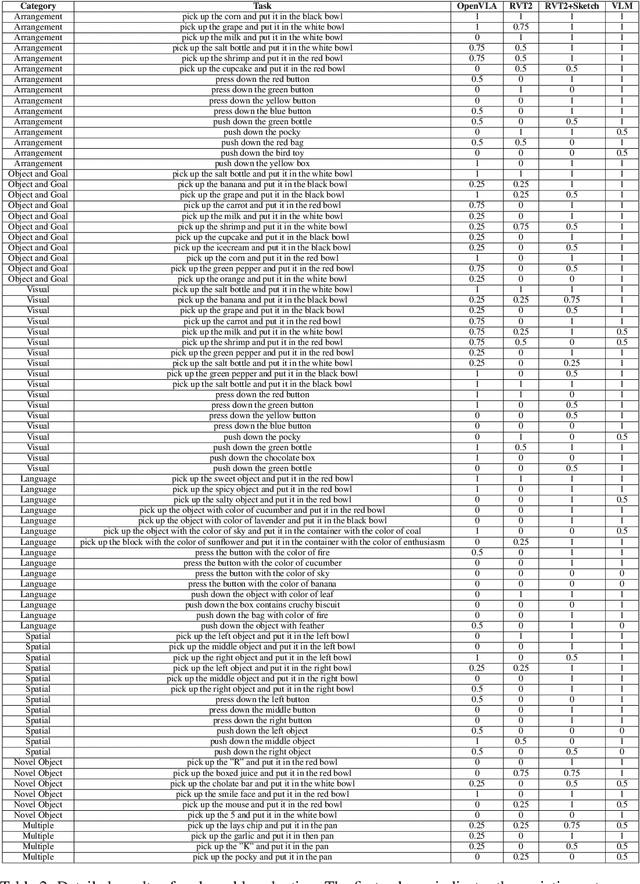
Large foundation models have shown strong open-world generalization to complex problems in vision and language, but similar levels of generalization have yet to be achieved in robotics. One fundamental challenge is the lack of robotic data, which are typically obtained through expensive on-robot operation. A promising remedy is to leverage cheaper, off-domain data such as action-free videos, hand-drawn sketches or simulation data. In this work, we posit that hierarchical vision-language-action (VLA) models can be more effective in utilizing off-domain data than standard monolithic VLA models that directly finetune vision-language models (VLMs) to predict actions. In particular, we study a class of hierarchical VLA models, where the high-level VLM is finetuned to produce a coarse 2D path indicating the desired robot end-effector trajectory given an RGB image and a task description. The intermediate 2D path prediction is then served as guidance to the low-level, 3D-aware control policy capable of precise manipulation. Doing so alleviates the high-level VLM from fine-grained action prediction, while reducing the low-level policy's burden on complex task-level reasoning. We show that, with the hierarchical design, the high-level VLM can transfer across significant domain gaps between the off-domain finetuning data and real-robot testing scenarios, including differences on embodiments, dynamics, visual appearances and task semantics, etc. In the real-robot experiments, we observe an average of 20% improvement in success rate across seven different axes of generalization over OpenVLA, representing a 50% relative gain. Visual results are provided at: https://hamster-robot.github.io/
GRAPE: Generalizing Robot Policy via Preference Alignment
Nov 28, 2024

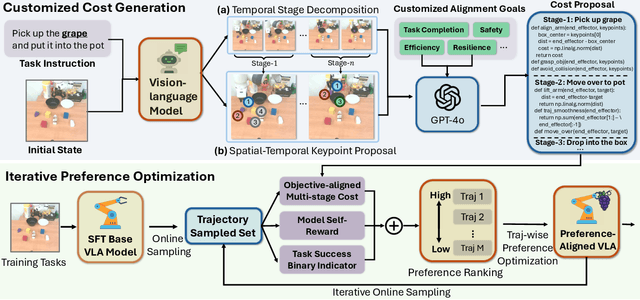
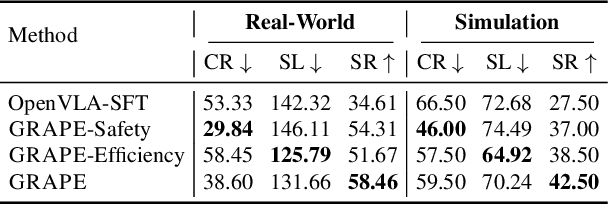
Despite the recent advancements of vision-language-action (VLA) models on a variety of robotics tasks, they suffer from critical issues such as poor generalizability to unseen tasks, due to their reliance on behavior cloning exclusively from successful rollouts. Furthermore, they are typically fine-tuned to replicate demonstrations collected by experts under different settings, thus introducing distribution bias and limiting their adaptability to diverse manipulation objectives, such as efficiency, safety, and task completion. To bridge this gap, we introduce GRAPE: Generalizing Robot Policy via Preference Alignment. Specifically, GRAPE aligns VLAs on a trajectory level and implicitly models reward from both successful and failure trials to boost generalizability to diverse tasks. Moreover, GRAPE breaks down complex manipulation tasks to independent stages and automatically guides preference modeling through customized spatiotemporal constraints with keypoints proposed by a large vision-language model. Notably, these constraints are flexible and can be customized to align the model with varying objectives, such as safety, efficiency, or task success. We evaluate GRAPE across a diverse array of tasks in both real-world and simulated environments. Experimental results demonstrate that GRAPE enhances the performance of state-of-the-art VLA models, increasing success rates on in-domain and unseen manipulation tasks by 51.79% and 60.36%, respectively. Additionally, GRAPE can be aligned with various objectives, such as safety and efficiency, reducing collision rates by 44.31% and rollout step-length by 11.15%, respectively. All code, models, and data are available at https://grape-vla.github.io/
Latent Action Pretraining from Videos
Oct 15, 2024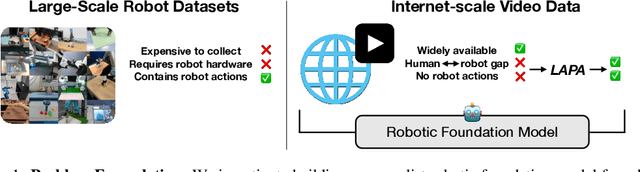


We introduce Latent Action Pretraining for general Action models (LAPA), an unsupervised method for pretraining Vision-Language-Action (VLA) models without ground-truth robot action labels. Existing Vision-Language-Action models require action labels typically collected by human teleoperators during pretraining, which significantly limits possible data sources and scale. In this work, we propose a method to learn from internet-scale videos that do not have robot action labels. We first train an action quantization model leveraging VQ-VAE-based objective to learn discrete latent actions between image frames, then pretrain a latent VLA model to predict these latent actions from observations and task descriptions, and finally finetune the VLA on small-scale robot manipulation data to map from latent to robot actions. Experimental results demonstrate that our method significantly outperforms existing techniques that train robot manipulation policies from large-scale videos. Furthermore, it outperforms the state-of-the-art VLA model trained with robotic action labels on real-world manipulation tasks that require language conditioning, generalization to unseen objects, and semantic generalization to unseen instructions. Training only on human manipulation videos also shows positive transfer, opening up the potential for leveraging web-scale data for robotics foundation model.