 Add to Chrome
 Add to Firefox
 Add to Edge
SVR-R1: Bootstrapping Multi-modal Reasoning with Self-verification in Reinforcement Learning
Jul 13, 2026
We introduce Self-Verified Reasoner (SVR-R1), a multi-turn RL framework that turns a model's own verification into a learning signal for multimodal reasoning. For each query, the model proposes an answer using the same weights, and issues a binary self-verdict (Yes/No). A 'No' triggers a second-chance rethink; a 'Yes,' or a turn cap, finalizes the output for computing the outcome-based reward. SVR-R1 is implemented with GRPO and an asynchronous multi-turn rollout framework and needs no external supervision or auxiliary critics. We evaluate SVR-R1 on vision-language reasoning benchmarks and show that it improves accuracy by a large margin over strong standard GRPO baselines. Training dynamics show decreasing reliance on verification-fewer verification turns, yet higher test accuracy-indicating that the gap between verification and generation narrows as the policy internalizes self-correction and chooses the most confident answer via our framework. SVR-R1 bridges the less explored intersection of inference-time self-refinement and RL training for VLMs, offering a simple yet effective recipe for bootstrapping multimodal reasoning. We will open-source \textbf{SVR-R1} to facilitate future research in VLMs.

Beyond 3D VQAs: Injecting 3D Spatial Priors into Vision-Language Models for Enhanced Geometric Reasoning
May 28, 2026Vision-Language Models (VLMs) often struggle with robust 3D spatial reasoning. Prevailing methods that rely on fine-tuning with 3D visual question-answering (VQA) datasets may overfit dataset-specific biases, while integrating specialized 3D visual encoders is often inflexible and cumbersome. In this paper, we argue that genuine spatial understanding should emerge from learning fundamental geometric priors, not only from high-level VQA supervision. We propose GASP (Geometric-Aware Spatial Priors), a framework that injects these priors directly into the LLM's transformer layers. GASP employs a small correspondence head, applied as a deep supervision signal across all layers, and is trained with a dual objective leveraging ground-truth geometry from large-scale video scenes: a contrastive loss on ground-truth point correspondences enforces 2D view-invariance, while a depth consistency supervision resolves 3D geometric ambiguities. Our analysis first provides a diagnostic showing that standard VLMs' internal correspondence matching accuracy is very low (often below 5%). We then demonstrate that our training substantially improves this behavior, boosting peak layer-wise correspondence to over 70% and maintaining over 85% temporal robustness while baselines remain below 5%. These internal improvements translate to significant gains on downstream spatial benchmarks including +18.2% on All-Angles Bench and +29.0% on VSI-Bench, all without training on any 3D VQA data. Our findings indicate that learning from fundamental geometric priors is a promising and generalizable pathway towards VLMs with more reliable 3D spatial reasoning.
Spreadsheet-RL: Advancing Large Language Model Agents on Realistic Spreadsheet Tasks via Reinforcement Learning
May 21, 2026Spreadsheet systems (e.g., Microsoft Excel, Google Sheets) play a central role in modern data-centric workflows. As AI agents grow increasingly capable of automating complex tasks, such as controlling computers and generating presentations, building an AI-driven spreadsheet agent has emerged as a promising research direction. Most existing spreadsheet agents rely on specialized prompting over general-purpose LLMs; while this design has potentials on simple spreadsheet operations, it struggles to manage the complex, multi-step workflows typical of real-world applications. We introduce Spreadsheet-RL, a reinforcement learning (RL) fine-tuning framework designed to train specialized spreadsheet agents within a realistic Microsoft Excel environment. Spreadsheet-RL features an automated pipeline for scalable collection of paired start-goal spreadsheets from online forums, as well as domain-specific evaluation tasks in areas such as finance and supply chain management, which we compile into the new Domain-Spreadsheet benchmark dataset. It also includes a Spreadsheet Gym environment designed for multi-turn RL: Spreadsheet Gym exposes extensive Excel functionality through a Python sandbox, along with a refined harness that incorporates a comprehensive tool set and carefully designed tool-routing rules for spreadsheet tasks. Through comprehensive experiments, we show that Spreadsheet-RL substantially enhances AI agent's performance on both general and domain-specific spreadsheet tasks: it improves Qwen3-4B-Thinking-2507's Pass@1 on SpreadsheetBench from 12.0% to 23.4%, and raises Pass@1 from 8.4% to 17.2% on our curated Domain-Spreadsheet dataset. These results highlight Spreadsheet-RL's strong potential for generalization and real-world adoption in spreadsheet automation, and broadly, its promise for advancing LLM-based interactions with data interfaces in everyday work.
Beyond Language Modeling: An Exploration of Multimodal Pretraining
Mar 03, 2026The visual world offers a critical axis for advancing foundation models beyond language. Despite growing interest in this direction, the design space for native multimodal models remains opaque. We provide empirical clarity through controlled, from-scratch pretraining experiments, isolating the factors that govern multimodal pretraining without interference from language pretraining. We adopt the Transfusion framework, using next-token prediction for language and diffusion for vision, to train on diverse data including text, video, image-text pairs, and even action-conditioned video. Our experiments yield four key insights: (i) Representation Autoencoder (RAE) provides an optimal unified visual representation by excelling at both visual understanding and generation; (ii) visual and language data are complementary and yield synergy for downstream capabilities; (iii) unified multimodal pretraining leads naturally to world modeling, with capabilities emerging from general training; and (iv) Mixture-of-Experts (MoE) enables efficient and effective multimodal scaling while naturally inducing modality specialization. Through IsoFLOP analysis, we compute scaling laws for both modalities and uncover a scaling asymmetry: vision is significantly more data-hungry than language. We demonstrate that the MoE architecture harmonizes this scaling asymmetry by providing the high model capacity required by language while accommodating the data-intensive nature of vision, paving the way for truly unified multimodal models.
Circuit Tracing in Vision-Language Models: Understanding the Internal Mechanisms of Multimodal Thinking
Feb 23, 2026Vision-language models (VLMs) are powerful but remain opaque black boxes. We introduce the first framework for transparent circuit tracing in VLMs to systematically analyze multimodal reasoning. By utilizing transcoders, attribution graphs, and attention-based methods, we uncover how VLMs hierarchically integrate visual and semantic concepts. We reveal that distinct visual feature circuits can handle mathematical reasoning and support cross-modal associations. Validated through feature steering and circuit patching, our framework proves these circuits are causal and controllable, laying the groundwork for more explainable and reliable VLMs.
Learning Personalized Agents from Human Feedback
Feb 18, 2026Modern AI agents are powerful but often fail to align with the idiosyncratic, evolving preferences of individual users. Prior approaches typically rely on static datasets, either training implicit preference models on interaction history or encoding user profiles in external memory. However, these approaches struggle with new users and with preferences that change over time. We introduce Personalized Agents from Human Feedback (PAHF), a framework for continual personalization in which agents learn online from live interaction using explicit per-user memory. PAHF operationalizes a three-step loop: (1) seeking pre-action clarification to resolve ambiguity, (2) grounding actions in preferences retrieved from memory, and (3) integrating post-action feedback to update memory when preferences drift. To evaluate this capability, we develop a four-phase protocol and two benchmarks in embodied manipulation and online shopping. These benchmarks quantify an agent's ability to learn initial preferences from scratch and subsequently adapt to persona shifts. Our theoretical analysis and empirical results show that integrating explicit memory with dual feedback channels is critical: PAHF learns substantially faster and consistently outperforms both no-memory and single-channel baselines, reducing initial personalization error and enabling rapid adaptation to preference shifts.
The Llama 4 Herd: Architecture, Training, Evaluation, and Deployment Notes
Jan 15, 2026This document consolidates publicly reported technical details about Metas Llama 4 model family. It summarizes (i) released variants (Scout and Maverick) and the broader herd context including the previewed Behemoth teacher model, (ii) architectural characteristics beyond a high-level MoE description covering routed/shared-expert structure, early-fusion multimodality, and long-context design elements reported for Scout (iRoPE and length generalization strategies), (iii) training disclosures spanning pre-training, mid-training for long-context extension, and post-training methodology (lightweight SFT, online RL, and lightweight DPO) as described in release materials, (iv) developer-reported benchmark results for both base and instruction-tuned checkpoints, and (v) practical deployment constraints observed across major serving environments, including provider-specific context limits and quantization packaging. The manuscript also summarizes licensing obligations relevant to redistribution and derivative naming, and reviews publicly described safeguards and evaluation practices. The goal is to provide a compact technical reference for researchers and practitioners who need precise, source-backed facts about Llama 4.
DigiData: Training and Evaluating General-Purpose Mobile Control Agents
Nov 11, 2025AI agents capable of controlling user interfaces have the potential to transform human interaction with digital devices. To accelerate this transformation, two fundamental building blocks are essential: high-quality datasets that enable agents to achieve complex and human-relevant goals, and robust evaluation methods that allow researchers and practitioners to rapidly enhance agent performance. In this paper, we introduce DigiData, a large-scale, high-quality, diverse, multi-modal dataset designed for training mobile control agents. Unlike existing datasets, which derive goals from unstructured interactions, DigiData is meticulously constructed through comprehensive exploration of app features, resulting in greater diversity and higher goal complexity. Additionally, we present DigiData-Bench, a benchmark for evaluating mobile control agents on real-world complex tasks. We demonstrate that the commonly used step-accuracy metric falls short in reliably assessing mobile control agents and, to address this, we propose dynamic evaluation protocols and AI-powered evaluations as rigorous alternatives for agent assessment. Our contributions aim to significantly advance the development of mobile control agents, paving the way for more intuitive and effective human-device interactions.
DISCO Balances the Scales: Adaptive Domain- and Difficulty-Aware Reinforcement Learning on Imbalanced Data
May 21, 2025Large Language Models (LLMs) are increasingly aligned with human preferences through Reinforcement Learning from Human Feedback (RLHF). Among RLHF methods, Group Relative Policy Optimization (GRPO) has gained attention for its simplicity and strong performance, notably eliminating the need for a learned value function. However, GRPO implicitly assumes a balanced domain distribution and uniform semantic alignment across groups - assumptions that rarely hold in real-world datasets. When applied to multi-domain, imbalanced data, GRPO disproportionately optimizes for dominant domains, neglecting underrepresented ones and resulting in poor generalization and fairness. We propose Domain-Informed Self-Consistency Policy Optimization (DISCO), a principled extension to GRPO that addresses inter-group imbalance with two key innovations. Domain-aware reward scaling counteracts frequency bias by reweighting optimization based on domain prevalence. Difficulty-aware reward scaling leverages prompt-level self-consistency to identify and prioritize uncertain prompts that offer greater learning value. Together, these strategies promote more equitable and effective policy learning across domains. Extensive experiments across multiple LLMs and skewed training distributions show that DISCO improves generalization, outperforms existing GRPO variants by 5% on Qwen3 models, and sets new state-of-the-art results on multi-domain alignment benchmarks.
Multi-Object Hallucination in Vision-Language Models
Jul 08, 2024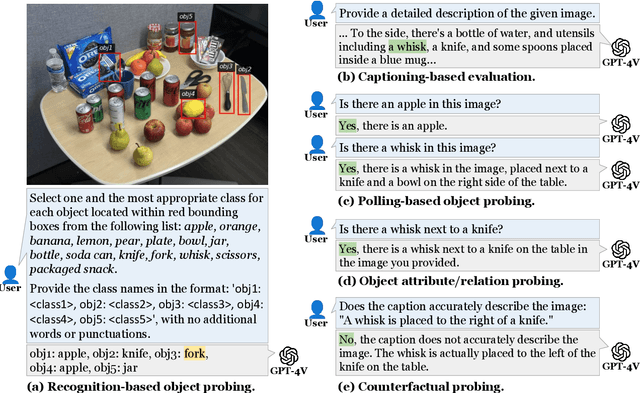
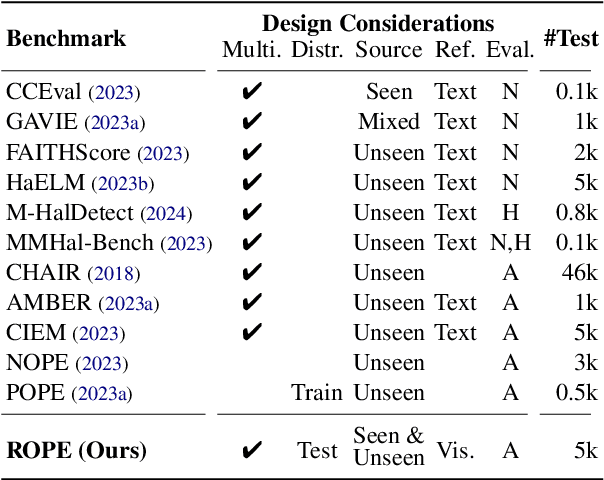
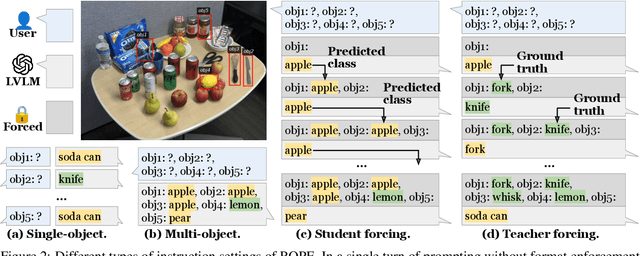
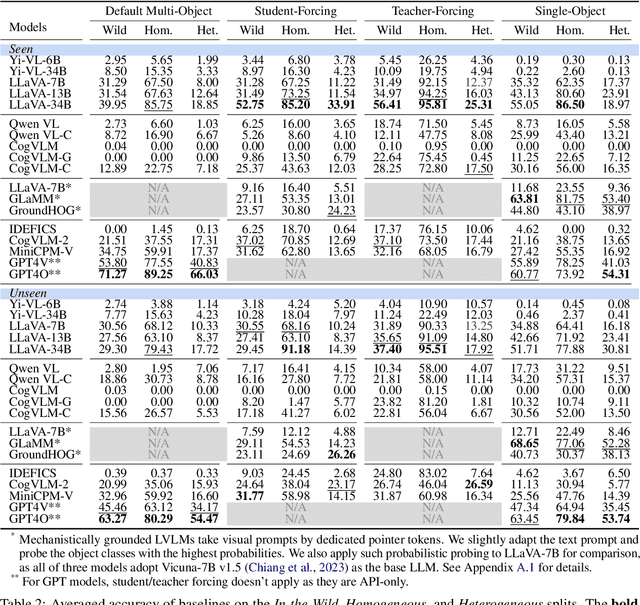
Large vision language models (LVLMs) often suffer from object hallucination, producing objects not present in the given images. While current benchmarks for object hallucination primarily concentrate on the presence of a single object class rather than individual entities, this work systematically investigates multi-object hallucination, examining how models misperceive (e.g., invent nonexistent objects or become distracted) when tasked with focusing on multiple objects simultaneously. We introduce Recognition-based Object Probing Evaluation (ROPE), an automated evaluation protocol that considers the distribution of object classes within a single image during testing and uses visual referring prompts to eliminate ambiguity. With comprehensive empirical studies and analysis of potential factors leading to multi-object hallucination, we found that (1) LVLMs suffer more hallucinations when focusing on multiple objects compared to a single object. (2) The tested object class distribution affects hallucination behaviors, indicating that LVLMs may follow shortcuts and spurious correlations.(3) Hallucinatory behaviors are influenced by data-specific factors, salience and frequency, and model intrinsic behaviors. We hope to enable LVLMs to recognize and reason about multiple objects that often occur in realistic visual scenes, provide insights, and quantify our progress towards mitigating the issues.