 Add to Chrome
 Add to Firefox
 Add to Edge
Social Media Image Understanding
Papers and Code
Towards Automated Community Notes Generation with Large Vision Language Models for Combating Contextual Deception
Mar 23, 2026
Community Notes have emerged as an effective crowd-sourced mechanism for combating online deception on social media platforms. However, its reliance on human contributors limits both the timeliness and scalability. In this work, we study the automated Community Notes generation method for image-based contextual deception, where an authentic image is paired with misleading context (e.g., time, entity, and event). Unlike prior work that primarily focuses on deception detection (i.e., judging whether a post is true or false in a binary manner), Community Notes-style systems need to generate concise and grounded notes that help users recover the missing or corrected context. This problem remains underexplored due to three reasons: (i) datasets that support the research are scarce; (ii) methods must handle the dynamic nature of contextual deception; (iii) evaluation is difficult because standard metrics do not capture whether notes actually improve user understanding. To address these gaps, we curate a real-world dataset, XCheck, comprising X posts with associated Community Notes and external contexts. We further propose the Automated Context-Corrective Note generation method, named ACCNote, which is a retrieval-augmented, multi-agent collaboration framework built on large vision-language models. Finally, we introduce a new evaluation metric, Context Helpfulness Score (CHS), that aligns with user study outcomes rather than relying on lexical overlap. Experiments on our XCheck dataset show that the proposed ACCNote improves both deception detection and note generation performance over baselines, and exceeds a commercial tool GPT5-mini. Together, our dataset, method, and metric advance practical automated generation of context-corrective notes toward more responsible online social networks.

Xray-Visual Models: Scaling Vision models on Industry Scale Data
Feb 18, 2026We present Xray-Visual, a unified vision model architecture for large-scale image and video understanding trained on industry-scale social media data. Our model leverages over 15 billion curated image-text pairs and 10 billion video-hashtag pairs from Facebook and Instagram, employing robust data curation pipelines that incorporate balancing and noise suppression strategies to maximize semantic diversity while minimizing label noise. We introduce a three-stage training pipeline that combines self-supervised MAE, semi-supervised hashtag classification, and CLIP-style contrastive learning to jointly optimize image and video modalities. Our architecture builds on a Vision Transformer backbone enhanced with efficient token reorganization (EViT) for improved computational efficiency. Extensive experiments demonstrate that Xray-Visual achieves state-of-the-art performance across diverse benchmarks, including ImageNet for image classification, Kinetics and HMDB51 for video understanding, and MSCOCO for cross-modal retrieval. The model exhibits strong robustness to domain shift and adversarial perturbations. We further demonstrate that integrating large language models as text encoders (LLM2CLIP) significantly enhances retrieval performance and generalization capabilities, particularly in real-world environments. Xray-Visual establishes new benchmarks for scalable, multimodal vision models, while maintaining superior accuracy and computational efficiency.
Multimodal Climate Disinformation Detection: Integrating Vision-Language Models with External Knowledge Sources
Jan 22, 2026Climate disinformation has become a major challenge in today digital world, especially with the rise of misleading images and videos shared widely on social media. These false claims are often convincing and difficult to detect, which can delay actions on climate change. While vision-language models (VLMs) have been used to identify visual disinformation, they rely only on the knowledge available at the time of training. This limits their ability to reason about recent events or updates. The main goal of this paper is to overcome that limitation by combining VLMs with external knowledge. By retrieving up-to-date information such as reverse image results, online fact-checks, and trusted expert content, the system can better assess whether an image and its claim are accurate, misleading, false, or unverifiable. This approach improves the model ability to handle real-world climate disinformation and supports efforts to protect public understanding of science in a rapidly changing information landscape.
Enhancing Meme Emotion Understanding with Multi-Level Modality Enhancement and Dual-Stage Modal Fusion
Nov 14, 2025With the rapid rise of social media and Internet culture, memes have become a popular medium for expressing emotional tendencies. This has sparked growing interest in Meme Emotion Understanding (MEU), which aims to classify the emotional intent behind memes by leveraging their multimodal contents. While existing efforts have achieved promising results, two major challenges remain: (1) a lack of fine-grained multimodal fusion strategies, and (2) insufficient mining of memes' implicit meanings and background knowledge. To address these challenges, we propose MemoDetector, a novel framework for advancing MEU. First, we introduce a four-step textual enhancement module that utilizes the rich knowledge and reasoning capabilities of Multimodal Large Language Models (MLLMs) to progressively infer and extract implicit and contextual insights from memes. These enhanced texts significantly enrich the original meme contents and provide valuable guidance for downstream classification. Next, we design a dual-stage modal fusion strategy: the first stage performs shallow fusion on raw meme image and text, while the second stage deeply integrates the enhanced visual and textual features. This hierarchical fusion enables the model to better capture nuanced cross-modal emotional cues. Experiments on two datasets, MET-MEME and MOOD, demonstrate that our method consistently outperforms state-of-the-art baselines. Specifically, MemoDetector improves F1 scores by 4.3\% on MET-MEME and 3.4\% on MOOD. Further ablation studies and in-depth analyses validate the effectiveness and robustness of our approach, highlighting its strong potential for advancing MEU. Our code is available at https://github.com/singing-cat/MemoDetector.
Do Multimodal LLMs See Sentiment?
Aug 23, 2025Understanding how visual content communicates sentiment is critical in an era where online interaction is increasingly dominated by this kind of media on social platforms. However, this remains a challenging problem, as sentiment perception is closely tied to complex, scene-level semantics. In this paper, we propose an original framework, MLLMsent, to investigate the sentiment reasoning capabilities of Multimodal Large Language Models (MLLMs) through three perspectives: (1) using those MLLMs for direct sentiment classification from images; (2) associating them with pre-trained LLMs for sentiment analysis on automatically generated image descriptions; and (3) fine-tuning the LLMs on sentiment-labeled image descriptions. Experiments on a recent and established benchmark demonstrate that our proposal, particularly the fine-tuned approach, achieves state-of-the-art results outperforming Lexicon-, CNN-, and Transformer-based baselines by up to 30.9%, 64.8%, and 42.4%, respectively, across different levels of evaluators' agreement and sentiment polarity categories. Remarkably, in a cross-dataset test, without any training on these new data, our model still outperforms, by up to 8.26%, the best runner-up, which has been trained directly on them. These results highlight the potential of the proposed visual reasoning scheme for advancing affective computing, while also establishing new benchmarks for future research.
From Pixels to Damage Severity: Estimating Earthquake Impacts Using Semantic Segmentation of Social Media Images
Jul 03, 2025In the aftermath of earthquakes, social media images have become a crucial resource for disaster reconnaissance, providing immediate insights into the extent of damage. Traditional approaches to damage severity assessment in post-earthquake social media images often rely on classification methods, which are inherently subjective and incapable of accounting for the varying extents of damage within an image. Addressing these limitations, this study proposes a novel approach by framing damage severity assessment as a semantic segmentation problem, aiming for a more objective analysis of damage in earthquake-affected areas. The methodology involves the construction of a segmented damage severity dataset, categorizing damage into three degrees: undamaged structures, damaged structures, and debris. Utilizing this dataset, the study fine-tunes a SegFormer model to generate damage severity segmentations for post-earthquake social media images. Furthermore, a new damage severity scoring system is introduced, quantifying damage by considering the varying degrees of damage across different areas within images, adjusted for depth estimation. The application of this approach allows for the quantification of damage severity in social media images in a more objective and comprehensive manner. By providing a nuanced understanding of damage, this study enhances the ability to offer precise guidance to disaster reconnaissance teams, facilitating more effective and targeted response efforts in the aftermath of earthquakes.
KEVER^2: Knowledge-Enhanced Visual Emotion Reasoning and Retrieval
May 30, 2025Understanding what emotions images evoke in their viewers is a foundational goal in human-centric visual computing. While recent advances in vision-language models (VLMs) have shown promise for visual emotion analysis (VEA), several key challenges remain unresolved. Emotional cues in images are often abstract, overlapping, and entangled, making them difficult to model and interpret. Moreover, VLMs struggle to align these complex visual patterns with emotional semantics due to limited supervision and sparse emotional grounding. Finally, existing approaches lack structured affective knowledge to resolve ambiguity and ensure consistent emotional reasoning across diverse visual domains. To address these limitations, we propose \textbf{K-EVER\textsuperscript{2}}, a knowledge-enhanced framework for emotion reasoning and retrieval. Our approach introduces a semantically structured formulation of visual emotion cues and integrates external affective knowledge through multimodal alignment. Without relying on handcrafted labels or direct emotion supervision, K-EVER\textsuperscript{2} achieves robust and interpretable emotion predictions across heterogeneous image types. We validate our framework on three representative benchmarks, Emotion6, EmoSet, and M-Disaster, covering social media imagery, human-centric scenes, and disaster contexts. K-EVER\textsuperscript{2} consistently outperforms strong CNN and VLM baselines, achieving up to a \textbf{19\% accuracy gain} for specific emotions and a \textbf{12.3\% average accuracy gain} across all emotion categories. Our results demonstrate a scalable and generalizable solution for advancing emotional understanding of visual content.
SNS-Bench-VL: Benchmarking Multimodal Large Language Models in Social Networking Services
May 29, 2025With the increasing integration of visual and textual content in Social Networking Services (SNS), evaluating the multimodal capabilities of Large Language Models (LLMs) is crucial for enhancing user experience, content understanding, and platform intelligence. Existing benchmarks primarily focus on text-centric tasks, lacking coverage of the multimodal contexts prevalent in modern SNS ecosystems. In this paper, we introduce SNS-Bench-VL, a comprehensive multimodal benchmark designed to assess the performance of Vision-Language LLMs in real-world social media scenarios. SNS-Bench-VL incorporates images and text across 8 multimodal tasks, including note comprehension, user engagement analysis, information retrieval, and personalized recommendation. It comprises 4,001 carefully curated multimodal question-answer pairs, covering single-choice, multiple-choice, and open-ended tasks. We evaluate over 25 state-of-the-art multimodal LLMs, analyzing their performance across tasks. Our findings highlight persistent challenges in multimodal social context comprehension. We hope SNS-Bench-VL will inspire future research towards robust, context-aware, and human-aligned multimodal intelligence for next-generation social networking services.
LENS: Multi-level Evaluation of Multimodal Reasoning with Large Language Models
May 21, 2025Multimodal Large Language Models (MLLMs) have achieved significant advances in integrating visual and linguistic information, yet their ability to reason about complex and real-world scenarios remains limited. The existing benchmarks are usually constructed in the task-oriented manner without guarantee that different task samples come from the same data distribution, thus they often fall short in evaluating the synergistic effects of lower-level perceptual capabilities on higher-order reasoning. To lift this limitation, we contribute Lens, a multi-level benchmark with 3.4K contemporary images and 60K+ human-authored questions covering eight tasks and 12 daily scenarios, forming three progressive task tiers, i.e., perception, understanding, and reasoning. One feature is that each image is equipped with rich annotations for all tasks. Thus, this dataset intrinsically supports to evaluate MLLMs to handle image-invariable prompts, from basic perception to compositional reasoning. In addition, our images are manully collected from the social media, in which 53% were published later than Jan. 2025. We evaluate 15+ frontier MLLMs such as Qwen2.5-VL-72B, InternVL3-78B, GPT-4o and two reasoning models QVQ-72B-preview and Kimi-VL. These models are released later than Dec. 2024, and none of them achieve an accuracy greater than 60% in the reasoning tasks. Project page: https://github.com/Lens4MLLMs/lens. ICCV 2025 workshop page: https://lens4mllms.github.io/mars2-workshop-iccv2025/
MT$^{3}$: Scaling MLLM-based Text Image Machine Translation via Multi-Task Reinforcement Learning
May 26, 2025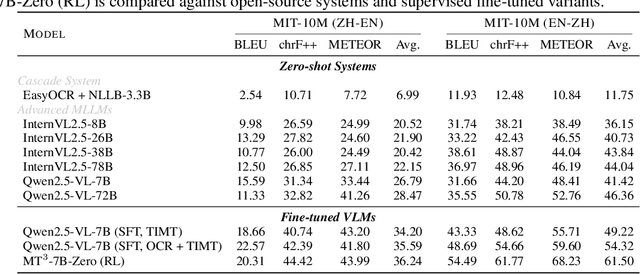
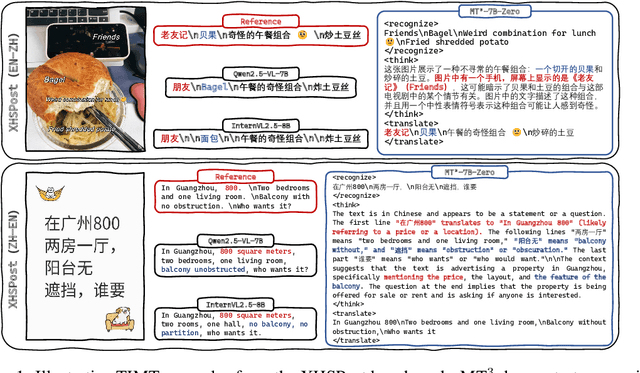
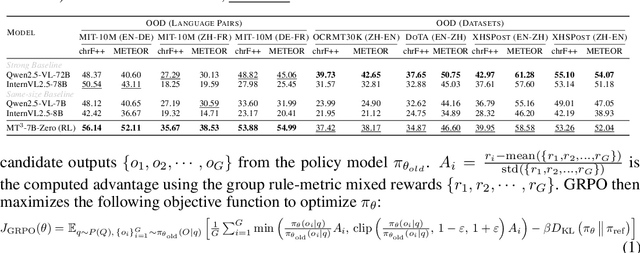
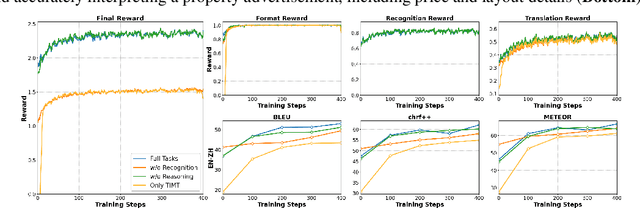
Text Image Machine Translation (TIMT)-the task of translating textual content embedded in images-is critical for applications in accessibility, cross-lingual information access, and real-world document understanding. However, TIMT remains a complex challenge due to the need for accurate optical character recognition (OCR), robust visual-text reasoning, and high-quality translation, often requiring cascading multi-stage pipelines. Recent advances in large-scale Reinforcement Learning (RL) have improved reasoning in Large Language Models (LLMs) and Multimodal LLMs (MLLMs), but their application to end-to-end TIMT is still underexplored. To bridge this gap, we introduce MT$^{3}$, the first framework to apply Multi-Task RL to MLLMs for end-to-end TIMT. MT$^{3}$ adopts a multi-task optimization paradigm targeting three key sub-skills: text recognition, context-aware reasoning, and translation. It is trained using a novel multi-mixed reward mechanism that adapts rule-based RL strategies to TIMT's intricacies, offering fine-grained, non-binary feedback across tasks. Furthermore, to facilitate the evaluation of TIMT in authentic cross-cultural and real-world social media contexts, we introduced XHSPost, the first social media TIMT benchmark. Our MT$^{3}$-7B-Zero achieves state-of-the-art results on the latest in-domain MIT-10M benchmark, outperforming strong baselines such as Qwen2.5-VL-72B and InternVL2.5-78B by notable margins across multiple metrics. Additionally, the model shows strong generalization to out-of-distribution language pairs and datasets. In-depth analyses reveal how multi-task synergy, reinforcement learning initialization, curriculum design, and reward formulation contribute to advancing MLLM-driven TIMT.