 Add to Chrome
 Add to Firefox
 Add to Edge
A Synergistic CNN-Transformer Network with Pooling Attention Fusion for Hyperspectral Image Classification
Apr 26, 2026
In the hyperspectral image (HSI) classification task, each pixel is categorized into a specific land-cover category or material. Convolutional neural networks (CNNs) and transformers have been widely used to extract local and non-local features in HSI classification. Recent works have utilized a multi-scale vision transformer (ViT) to enhance spectral feature capture and yield promising results. However, most existing methods still face challenges in the effective joint use of spatial-spectral information and in preserving information across layers during the propagation process. To address these issues, we propose a synergistic CNN-Transformer network with pooling attention fusion for HSI classification, which collaboratively utilizes CNNs and ViT to process spatial and spectral features separately. Specifically, we propose a Twin-Branch Feature Extraction (TBFE) module, which employs 3D and 2D convolution in parallel to comprehensively extract spectral and spatial features from HSI. A hybrid pooling attention (HPA) module is designed to aggregate spatial attention. Moreover, a cascade transformer encoder is employed for global spectral feature extraction, and a simple yet efficient cross-layer feature fusion (CFF) module is designed to reduce the loss of crucial information in the previous network layers. Extensive experiments are conducted on several representative datasets to demonstrate the superior performance of our proposed method compared to the state-of-the-art works. Code is available at https://github.com/chenpeng052/SCT-Net.git.

Towards Automated Community Notes Generation with Large Vision Language Models for Combating Contextual Deception
Mar 23, 2026Community Notes have emerged as an effective crowd-sourced mechanism for combating online deception on social media platforms. However, its reliance on human contributors limits both the timeliness and scalability. In this work, we study the automated Community Notes generation method for image-based contextual deception, where an authentic image is paired with misleading context (e.g., time, entity, and event). Unlike prior work that primarily focuses on deception detection (i.e., judging whether a post is true or false in a binary manner), Community Notes-style systems need to generate concise and grounded notes that help users recover the missing or corrected context. This problem remains underexplored due to three reasons: (i) datasets that support the research are scarce; (ii) methods must handle the dynamic nature of contextual deception; (iii) evaluation is difficult because standard metrics do not capture whether notes actually improve user understanding. To address these gaps, we curate a real-world dataset, XCheck, comprising X posts with associated Community Notes and external contexts. We further propose the Automated Context-Corrective Note generation method, named ACCNote, which is a retrieval-augmented, multi-agent collaboration framework built on large vision-language models. Finally, we introduce a new evaluation metric, Context Helpfulness Score (CHS), that aligns with user study outcomes rather than relying on lexical overlap. Experiments on our XCheck dataset show that the proposed ACCNote improves both deception detection and note generation performance over baselines, and exceeds a commercial tool GPT5-mini. Together, our dataset, method, and metric advance practical automated generation of context-corrective notes toward more responsible online social networks.
Learning the irreversible progression trajectory of Alzheimer's disease
Mar 10, 2024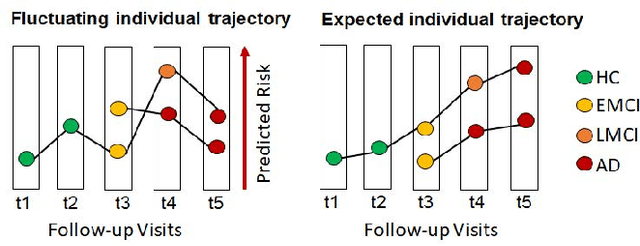
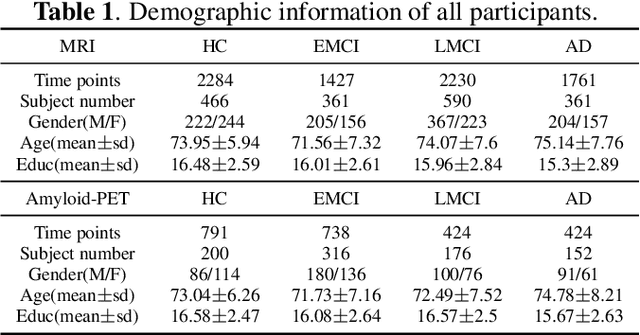
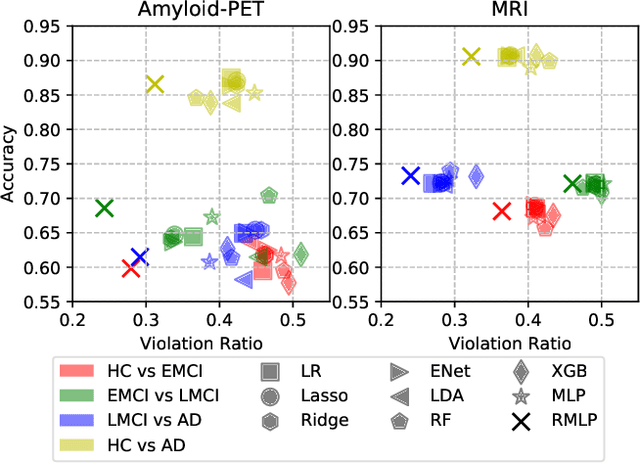
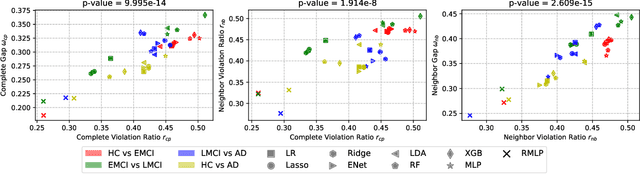
Alzheimer's disease (AD) is a progressive and irreversible brain disorder that unfolds over the course of 30 years. Therefore, it is critical to capture the disease progression in an early stage such that intervention can be applied before the onset of symptoms. Machine learning (ML) models have been shown effective in predicting the onset of AD. Yet for subjects with follow-up visits, existing techniques for AD classification only aim for accurate group assignment, where the monotonically increasing risk across follow-up visits is usually ignored. Resulted fluctuating risk scores across visits violate the irreversibility of AD, hampering the trustworthiness of models and also providing little value to understanding the disease progression. To address this issue, we propose a novel regularization approach to predict AD longitudinally. Our technique aims to maintain the expected monotonicity of increasing disease risk during progression while preserving expressiveness. Specifically, we introduce a monotonicity constraint that encourages the model to predict disease risk in a consistent and ordered manner across follow-up visits. We evaluate our method using the longitudinal structural MRI and amyloid-PET imaging data from the Alzheimer's Disease Neuroimaging Initiative (ADNI). Our model outperforms existing techniques in capturing the progressiveness of disease risk, and at the same time preserves prediction accuracy.
Hyperspectral Image Classification Based on Adaptive Sparse Deep Network
Oct 21, 2019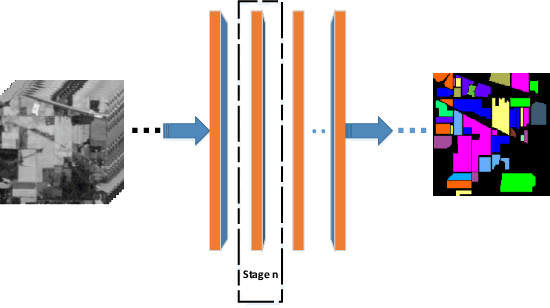
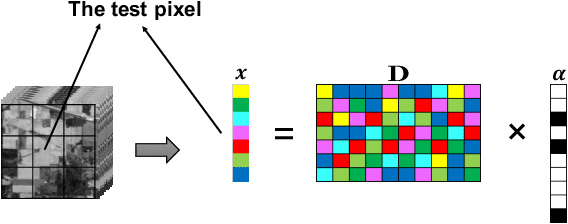
Sparse model is widely used in hyperspectral image classification.However, different of sparsity and regularization parameters has great influence on the classification results.In this paper, a novel adaptive sparse deep network based on deep architecture is proposed, which can construct the optimal sparse representation and regularization parameters by deep network.Firstly, a data flow graph is designed to represent each update iteration based on Alternating Direction Method of Multipliers (ADMM) algorithm.Forward network and Back-Propagation network are deduced.All parameters are updated by gradient descent in Back-Propagation.Then we proposed an Adaptive Sparse Deep Network.Comparing with several traditional classifiers or other algorithm for sparse model, experiment results indicate that our method achieves great improvement in HSI classification.