 Add to Chrome
 Add to Firefox
 Add to Edge
Development of Vision-Language Model-based GNSS Spoofing Detection for Autonomous Vehicle Navigation
Jul 27, 2026
Autonomous vehicles (AVs) depend on Global Navigation Satellite Systems (GNSS) for localization and navigation, making them vulnerable to spoofing attacks that can covertly redirect vehicles or induce unsafe maneuvers. In this paper, we develop the first Vision-Language Model (VLM)-based framework for GNSS spoofing detection for autonomous vehicles by fusing front-camera visual data with in-vehicle sensor readings (e.g., speed, acceleration, yaw rate) against GNSS-derived maneuvers. Our approach introduces a three-stage fine-tuning process that first grounds visual cues, and then calibrates sensor data within a shared semantic space to detect discrepancies between predicted and GNSS-derived maneuvers across three attack scenarios. We also generated an independent real-world dataset by driving an instrumented vehicle on public roads in Tuscaloosa, Alabama, equipped with time-synchronized GNSS, IMU, and camera logs to validate cross-regional generalization of our fine-tuned model on unseen data from training data. On this dataset, we then generated intelligent spoofing attacks, including trajectory mirroring with road-network snapping for wrong-turn attacks, position freezing for overshoot scenarios, and drift generation for stop attacks. On this validation dataset, the zero-shot VLMs baseline F1-score ranges from 23% to 32%, whereas our fine-tuned model achieves an F1-score ranging from 94% to 95%. Results show that our VLM-based approach correctly classified every wrong-turn and stop attacks, and attains 88%-93% accuracy for overshoot attacks. Furthermore, we introduce an adaptive inference policy that reduces VLM invocations to 14% (~86% computational reduction) and yields 65ms-73ms per 4s window. These results point to a practical, on-road layer of defense that complements signal-level integrity checks with the use of VLMs.

Towards Automated Community Notes Generation with Large Vision Language Models for Combating Contextual Deception
Mar 23, 2026Community Notes have emerged as an effective crowd-sourced mechanism for combating online deception on social media platforms. However, its reliance on human contributors limits both the timeliness and scalability. In this work, we study the automated Community Notes generation method for image-based contextual deception, where an authentic image is paired with misleading context (e.g., time, entity, and event). Unlike prior work that primarily focuses on deception detection (i.e., judging whether a post is true or false in a binary manner), Community Notes-style systems need to generate concise and grounded notes that help users recover the missing or corrected context. This problem remains underexplored due to three reasons: (i) datasets that support the research are scarce; (ii) methods must handle the dynamic nature of contextual deception; (iii) evaluation is difficult because standard metrics do not capture whether notes actually improve user understanding. To address these gaps, we curate a real-world dataset, XCheck, comprising X posts with associated Community Notes and external contexts. We further propose the Automated Context-Corrective Note generation method, named ACCNote, which is a retrieval-augmented, multi-agent collaboration framework built on large vision-language models. Finally, we introduce a new evaluation metric, Context Helpfulness Score (CHS), that aligns with user study outcomes rather than relying on lexical overlap. Experiments on our XCheck dataset show that the proposed ACCNote improves both deception detection and note generation performance over baselines, and exceeds a commercial tool GPT5-mini. Together, our dataset, method, and metric advance practical automated generation of context-corrective notes toward more responsible online social networks.
DisPatch: Disarming Adversarial Patches in Object Detection with Diffusion Models
Sep 04, 2025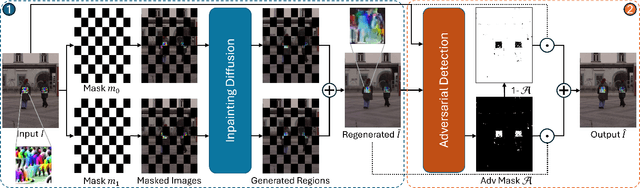
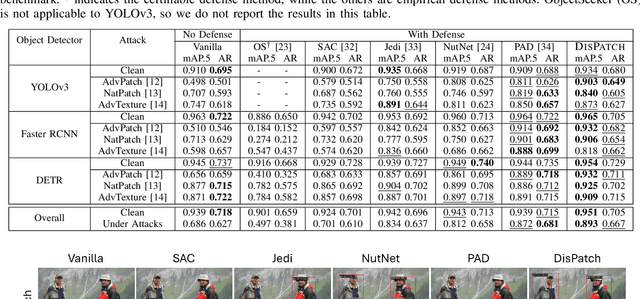
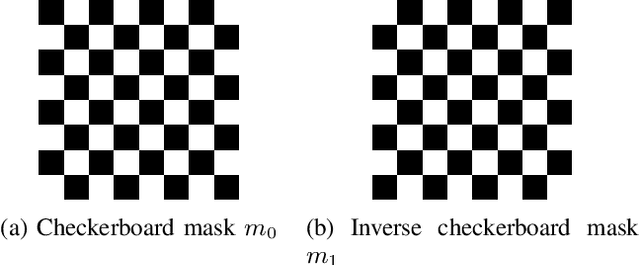
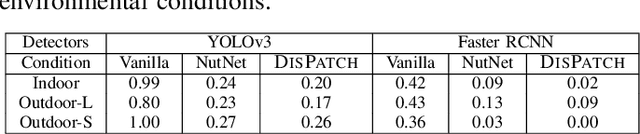
Object detection is fundamental to various real-world applications, such as security monitoring and surveillance video analysis. Despite their advancements, state-of-theart object detectors are still vulnerable to adversarial patch attacks, which can be easily applied to real-world objects to either conceal actual items or create non-existent ones, leading to severe consequences. Given the current diversity of adversarial patch attacks and potential unknown threats, an ideal defense method should be effective, generalizable, and robust against adaptive attacks. In this work, we introduce DISPATCH, the first diffusion-based defense framework for object detection. Unlike previous works that aim to "detect and remove" adversarial patches, DISPATCH adopts a "regenerate and rectify" strategy, leveraging generative models to disarm attack effects while preserving the integrity of the input image. Specifically, we utilize the in-distribution generative power of diffusion models to regenerate the entire image, aligning it with benign data. A rectification process is then employed to identify and replace adversarial regions with their regenerated benign counterparts. DISPATCH is attack-agnostic and requires no prior knowledge of the existing patches. Extensive experiments across multiple detectors and attacks demonstrate that DISPATCH consistently outperforms state-of-the-art defenses on both hiding attacks and creating attacks, achieving the best overall mAP.5 score of 89.3% on hiding attacks, and lowering the attack success rate to 24.8% on untargeted creating attacks. Moreover, it maintains strong robustness against adaptive attacks, making it a practical and reliable defense for object detection systems.