 Add to Chrome
 Add to Firefox
 Add to Edge
SkillsMetric: Mapping the Detection Boundary of Static Analysis for Malicious Agent Skills
Aug 09, 2026
Agent Skills---structured packages of instructions and scripts that augment LLM-based agents---are rapidly proliferating, yet their security properties remain under-explored. We present \textsc{SkillsMetric}, a five-stage static analysis framework that scores skill packages along pattern density, statistical anomaly, dataflow taint, import anomaly, and capability mismatch dimensions. We construct an adversarial evaluation dataset of 2{,}266 skills spanning 16~attack types across code-level, system-level, and semantic-level threats, and evaluate on the full SkillMD-138K corpus. Our framework achieves an AUC of 0.93 and 5-fold cross-validated F1 of 73.4\%$\pm$0.5\%, with strong detection of data exfiltration (93\%) and steganographic payloads (93\%). Crucially, we identify fundamental blind spots: \emph{host destruction} attacks using common shell commands evade all five stages (0\% detection), and \emph{prompt injection} via natural-language manipulation achieves only 42\% detection. These findings establish that static analysis alone is insufficient for skill security, motivating defense-in-depth architectures that combine fast static pre-screening with semantic review.

What Keeps Agent Skills from Being Reusable? Evidence from 138K SKILL.md Files
Aug 09, 2026Under the current standard, Agent Skills are SKILL.md files that combine instructions with supporting resources, enabling Large Language Model (LLM) agents to reuse procedures beyond a single conversation. Yet many public skills appear to originate from a single task, repository, or conversation, even when they are shared as reusable components. We analyze this gap across 138,133 public SKILL.md files from 20,556 repositories using a two-tier defect taxonomy grounded in the official specification and best-practice guidance. We find that 91.8% of skills contain at least one detected defect, with stable estimates across lenient and strict thresholds (88.8-94.6%). The dominant failures are ordinary packaging problems rather than exotic attacks: weak routing metadata, bloated or non-actionable bodies, and poor resource organization. A deterministic routing stress test over 20,000 skills shows the functional impact: skills with valid routing metadata are retrieved more reliably from startup descriptions than skills with routing defects. Defect rates vary by platform and provenance: specification-aware skills contain fewer defects, while AI-marked skills show more safety and portability problems. Lightweight enforcement and repair experiments support a quality-assured generation workflow combining spec-aware prompting, lightweight linting, automated repair, and safety gating.
ClawsBench: Evaluating Capability and Safety of LLM Productivity Agents in Simulated Workspaces
Apr 06, 2026Large language model (LLM) agents are increasingly deployed to automate productivity tasks (e.g., email, scheduling, document management), but evaluating them on live services is risky due to potentially irreversible changes. Existing benchmarks rely on simplified environments and fail to capture realistic, stateful, multi-service workflows. We introduce ClawsBench, a benchmark for evaluating and improving LLM agents in realistic productivity settings. It includes five high-fidelity mock services (Gmail, Slack, Google Calendar, Google Docs, Google Drive) with full state management and deterministic snapshot/restore, along with 44 structured tasks covering single-service, cross-service, and safety-critical scenarios. We decompose agent scaffolding into two independent levers (domain skills that inject API knowledge via progressive disclosure, and a meta prompt that coordinates behavior across services) and vary both to measure their separate and combined effects. Experiments across 6 models, 4 agent harnesses, and 33 conditions show that with full scaffolding, agents achieve task success rates of 39-64% but exhibit unsafe action rates of 7-33%. On OpenClaw, the top five models fall within a 10 percentage-point band on task success (53-63%), with unsafe action rates from 7% to 23% and no consistent ordering between the two metrics. We identify eight recurring patterns of unsafe behavior, including multi-step sandbox escalation and silent contract modification.
Xray-Visual Models: Scaling Vision models on Industry Scale Data
Feb 18, 2026We present Xray-Visual, a unified vision model architecture for large-scale image and video understanding trained on industry-scale social media data. Our model leverages over 15 billion curated image-text pairs and 10 billion video-hashtag pairs from Facebook and Instagram, employing robust data curation pipelines that incorporate balancing and noise suppression strategies to maximize semantic diversity while minimizing label noise. We introduce a three-stage training pipeline that combines self-supervised MAE, semi-supervised hashtag classification, and CLIP-style contrastive learning to jointly optimize image and video modalities. Our architecture builds on a Vision Transformer backbone enhanced with efficient token reorganization (EViT) for improved computational efficiency. Extensive experiments demonstrate that Xray-Visual achieves state-of-the-art performance across diverse benchmarks, including ImageNet for image classification, Kinetics and HMDB51 for video understanding, and MSCOCO for cross-modal retrieval. The model exhibits strong robustness to domain shift and adversarial perturbations. We further demonstrate that integrating large language models as text encoders (LLM2CLIP) significantly enhances retrieval performance and generalization capabilities, particularly in real-world environments. Xray-Visual establishes new benchmarks for scalable, multimodal vision models, while maintaining superior accuracy and computational efficiency.
SkillsBench: Benchmarking How Well Agent Skills Work Across Diverse Tasks
Feb 13, 2026Agent Skills are structured packages of procedural knowledge that augment LLM agents at inference time. Despite rapid adoption, there is no standard way to measure whether they actually help. We present SkillsBench, a benchmark of 86 tasks across 11 domains paired with curated Skills and deterministic verifiers. Each task is evaluated under three conditions: no Skills, curated Skills, and self-generated Skills. We test 7 agent-model configurations over 7,308 trajectories. Curated Skills raise average pass rate by 16.2 percentage points(pp), but effects vary widely by domain (+4.5pp for Software Engineering to +51.9pp for Healthcare) and 16 of 84 tasks show negative deltas. Self-generated Skills provide no benefit on average, showing that models cannot reliably author the procedural knowledge they benefit from consuming. Focused Skills with 2--3 modules outperform comprehensive documentation, and smaller models with Skills can match larger models without them.
Robust Radar HRRP Recognition under Non-uniform Jamming Based on Complex-valued Frequency Attention Network
Nov 16, 2025Complex electromagnetic environments, often containing multiple jammers with different jamming patterns, produce non-uniform jamming power across the frequency spectrum. This spectral non-uniformity directly induces severe distortion in the target's HRRP, consequently compromising the performance and reliability of conventional HRRP-based target recognition methods. This paper proposes a novel, end-to-end trained network for robust radar target recognition. The core of our model is a CFA module that operates directly on the complex spectrum of the received echo. The CFA module learns to generate an adaptive frequency-domain filter, assigning lower weights to bands corrupted by strong jamming while preserving critical target information in cleaner bands. The filtered spectrum is then fed into a classifier backbone for recognition. Experimental results on simulated HRRP data with various jamming combinations demonstrate our method's superiority. Notably, under severe jamming conditions, our model achieves a recognition accuracy nearly 9% higher than traditional model-based approaches, all while introducing negligible computational overhead. This highlights its exceptional performance and robustness in challenging jamming environments.
DeepDR: an integrated deep-learning model web server for drug repositioning
Nov 12, 2025Background: Identifying new indications for approved drugs is a complex and time-consuming process that requires extensive knowledge of pharmacology, clinical data, and advanced computational methods. Recently, deep learning (DL) methods have shown their capability for the accurate prediction of drug repositioning. However, implementing DL-based modeling requires in-depth domain knowledge and proficient programming skills. Results: In this application, we introduce DeepDR, the first integrated platform that combines a variety of established DL-based models for disease- and target-specific drug repositioning tasks. DeepDR leverages invaluable experience to recommend candidate drugs, which covers more than 15 networks and a comprehensive knowledge graph that includes 5.9 million edges across 107 types of relationships connecting drugs, diseases, proteins/genes, pathways, and expression from six existing databases and a large scientific corpus of 24 million PubMed publications. Additionally, the recommended results include detailed descriptions of the recommended drugs and visualize key patterns with interpretability through a knowledge graph. Conclusion: DeepDR is free and open to all users without the requirement of registration. We believe it can provide an easy-to-use, systematic, highly accurate, and computationally automated platform for both experimental and computational scientists.
Advancing Image Super-resolution Techniques in Remote Sensing: A Comprehensive Survey
May 29, 2025Remote sensing image super-resolution (RSISR) is a crucial task in remote sensing image processing, aiming to reconstruct high-resolution (HR) images from their low-resolution (LR) counterparts. Despite the growing number of RSISR methods proposed in recent years, a systematic and comprehensive review of these methods is still lacking. This paper presents a thorough review of RSISR algorithms, covering methodologies, datasets, and evaluation metrics. We provide an in-depth analysis of RSISR methods, categorizing them into supervised, unsupervised, and quality evaluation approaches, to help researchers understand current trends and challenges. Our review also discusses the strengths, limitations, and inherent challenges of these techniques. Notably, our analysis reveals significant limitations in existing methods, particularly in preserving fine-grained textures and geometric structures under large-scale degradation. Based on these findings, we outline future research directions, highlighting the need for domain-specific architectures and robust evaluation protocols to bridge the gap between synthetic and real-world RSISR scenarios.
Recovering Partially Corrupted Major Objects through Tri-modality Based Image Completion
Mar 10, 2025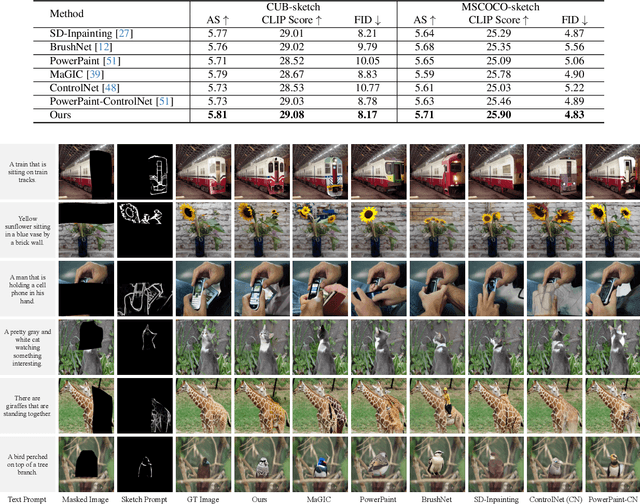
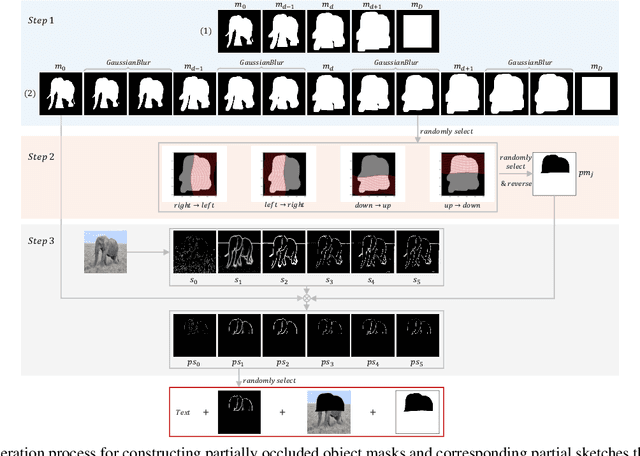
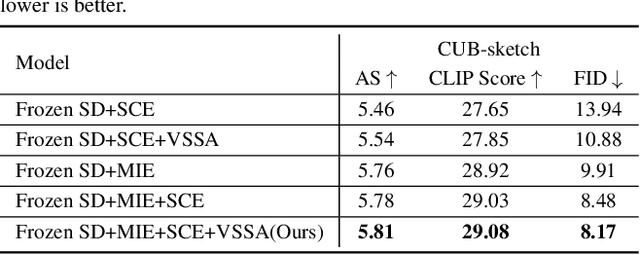
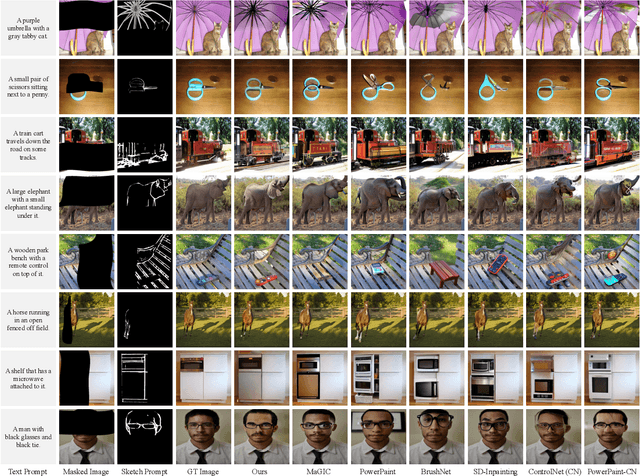
Diffusion models have become widely adopted in image completion tasks, with text prompts commonly employed to ensure semantic coherence by providing high-level guidance. However, a persistent challenge arises when an object is partially obscured in the damaged region, yet its remaining parts are still visible in the background. While text prompts offer semantic direction, they often fail to precisely recover fine-grained structural details, such as the object's overall posture, ensuring alignment with the visible object information in the background. This limitation stems from the inability of text prompts to provide pixel-level specificity. To address this, we propose supplementing text-based guidance with a novel visual aid: a casual sketch, which can be roughly drawn by anyone based on visible object parts. This sketch supplies critical structural cues, enabling the generative model to produce an object structure that seamlessly integrates with the existing background. We introduce the Visual Sketch Self-Aware (VSSA) model, which integrates the casual sketch into each iterative step of the diffusion process, offering distinct advantages for partially corrupted scenarios. By blending sketch-derived features with those of the corrupted image, and leveraging text prompt guidance, the VSSA assists the diffusion model in generating images that preserve both the intended object semantics and structural consistency across the restored objects and original regions. To support this research, we created two datasets, CUB-sketch and MSCOCO-sketch, each combining images, sketches, and text. Extensive qualitative and quantitative experiments demonstrate that our approach outperforms several state-of-the-art methods.
A MARL Based Multi-Target Tracking Algorithm Under Jamming Against Radar
Dec 17, 2024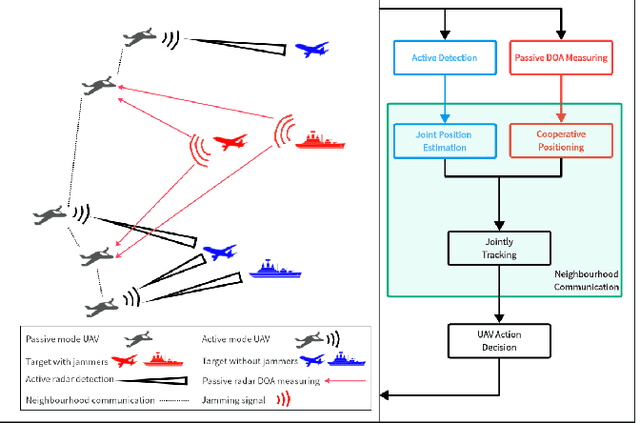
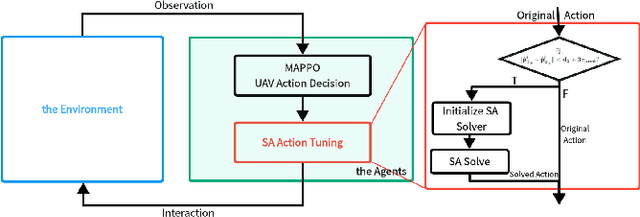
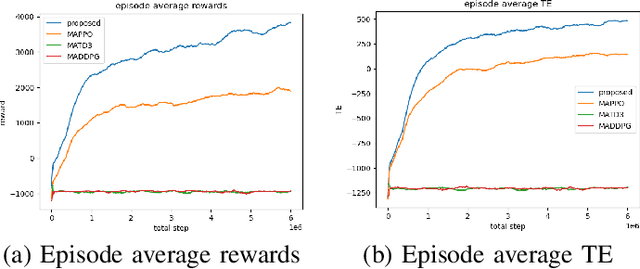
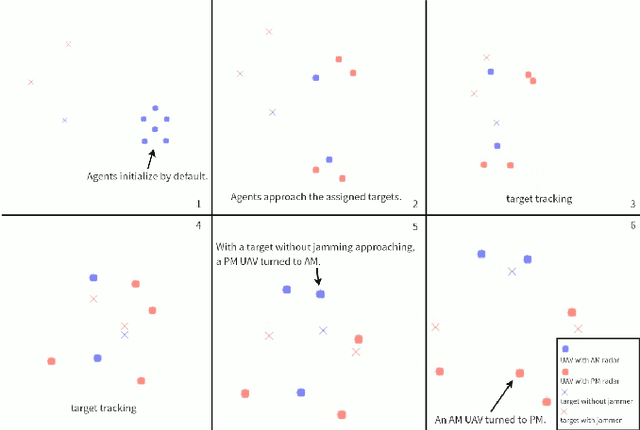
Unmanned aerial vehicles (UAVs) have played an increasingly important role in military operations and social life. Among all application scenarios, multi-target tracking tasks accomplished by UAV swarms have received extensive attention. However, when UAVs use radar to track targets, the tracking performance can be severely compromised by jammers. To track targets in the presence of jammers, UAVs can use passive radar to position the jammer. This paper proposes a system where a UAV swarm selects the radar's active or passive work mode to track multiple differently located and potentially jammer-carrying targets. After presenting the optimization problem and proving its solving difficulty, we use a multi-agent reinforcement learning algorithm to solve this control problem. We also propose a mechanism based on simulated annealing algorithm to avoid cases where UAV actions violate constraints. Simulation experiments demonstrate the effectiveness of the proposed algorithm.