 Add to Chrome
 Add to Firefox
 Add to Edge
Music Captioning
Papers and Code
Rethinking Music Captioning with Music Metadata LLMs
Feb 03, 2026
Music captioning, or the task of generating a natural language description of music, is useful for both music understanding and controllable music generation. Training captioning models, however, typically requires high-quality music caption data which is scarce compared to metadata (e.g., genre, mood, etc.). As a result, it is common to use large language models (LLMs) to synthesize captions from metadata to generate training data for captioning models, though this process imposes a fixed stylization and entangles factual information with natural language style. As a more direct approach, we propose metadata-based captioning. We train a metadata prediction model to infer detailed music metadata from audio and then convert it into expressive captions via pre-trained LLMs at inference time. Compared to a strong end-to-end baseline trained on LLM-generated captions derived from metadata, our method: (1) achieves comparable performance in less training time over end-to-end captioners, (2) offers flexibility to easily change stylization post-training, enabling output captions to be tailored to specific stylistic and quality requirements, and (3) can be prompted with audio and partial metadata to enable powerful metadata imputation or in-filling--a common task for organizing music data.

Bagpiper: Solving Open-Ended Audio Tasks via Rich Captions
Feb 05, 2026Current audio foundation models typically rely on rigid, task-specific supervision, addressing isolated factors of audio rather than the whole. In contrast, human intelligence processes audio holistically, seamlessly bridging physical signals with abstract cognitive concepts to execute complex tasks. Grounded in this philosophy, we introduce Bagpiper, an 8B audio foundation model that interprets physical audio via rich captions, i.e., comprehensive natural language descriptions that encapsulate the critical cognitive concepts inherent in the signal (e.g., transcription, audio events). By pre-training on a massive corpus of 600B tokens, the model establishes a robust bidirectional mapping between raw audio and this high-level conceptual space. During fine-tuning, Bagpiper adopts a caption-then-process workflow, simulating an intermediate cognitive reasoning step to solve diverse tasks without task-specific priors. Experimentally, Bagpiper outperforms Qwen-2.5-Omni on MMAU and AIRBench for audio understanding and surpasses CosyVoice3 and TangoFlux in generation quality, capable of synthesizing arbitrary compositions of speech, music, and sound effects. To the best of our knowledge, Bagpiper is among the first works that achieve unified understanding generation for general audio. Model, data, and code are available at Bagpiper Home Page.
ConceptCaps -- a Distilled Concept Dataset for Interpretability in Music Models
Jan 20, 2026Concept-based interpretability methods like TCAV require clean, well-separated positive and negative examples for each concept. Existing music datasets lack this structure: tags are sparse, noisy, or ill-defined. We introduce ConceptCaps, a dataset of 23k music-caption-audio triplets with explicit labels from a 200-attribute taxonomy. Our pipeline separates semantic modeling from text generation: a VAE learns plausible attribute co-occurrence patterns, a fine-tuned LLM converts attribute lists into professional descriptions, and MusicGen synthesizes corresponding audio. This separation improves coherence and controllability over end-to-end approaches. We validate the dataset through audio-text alignment (CLAP), linguistic quality metrics (BERTScore, MAUVE), and TCAV analysis confirming that concept probes recover musically meaningful patterns. Dataset and code are available online.
Towards Effective Negation Modeling in Joint Audio-Text Models for Music
Jan 20, 2026Joint audio-text models are widely used for music retrieval, yet they struggle with semantic phenomena such as negation. Negation is fundamental for distinguishing the absence (or presence) of musical elements (e.g., "with vocals" vs. "without vocals"), but current systems fail to represent this reliably. In this work, we investigate and mitigate this limitation by training CLAP models from scratch on the Million Song Dataset with LP-MusicCaps-MSD captions. We introduce negation through text augmentation and a dissimilarity-based contrastive loss, designed to explicitly separate original and negated captions in the joint embedding space. To evaluate progress, we propose two protocols that frame negation modeling as retrieval and binary classification tasks. Experiments demonstrate that both methods, individually and combined, improve negation handling while largely preserving retrieval performance.
SLAM-LLM: A Modular, Open-Source Multimodal Large Language Model Framework and Best Practice for Speech, Language, Audio and Music Processing
Jan 14, 2026The recent surge in open-source Multimodal Large Language Models (MLLM) frameworks, such as LLaVA, provides a convenient kickoff for artificial intelligence developers and researchers. However, most of the MLLM frameworks take vision as the main input modality, and provide limited in-depth support for the modality of speech, audio, and music. This situation hinders the development of audio-language models, and forces researchers to spend a lot of effort on code writing and hyperparameter tuning. We present SLAM-LLM, an open-source deep learning framework designed to train customized MLLMs, focused on speech, language, audio, and music processing. SLAM-LLM provides a modular configuration of different encoders, projectors, LLMs, and parameter-efficient fine-tuning plugins. SLAM-LLM also includes detailed training and inference recipes for mainstream tasks, along with high-performance checkpoints like LLM-based Automatic Speech Recognition (ASR), Automated Audio Captioning (AAC), and Music Captioning (MC). Some of these recipes have already reached or are nearing state-of-the-art performance, and some relevant techniques have also been accepted by academic papers. We hope SLAM-LLM will accelerate iteration, development, data engineering, and model training for researchers. We are committed to continually pushing forward audio-based MLLMs through this open-source framework, and call on the community to contribute to the LLM-based speech, audio and music processing.
Training-Efficient Text-to-Music Generation with State-Space Modeling
Jan 21, 2026Recent advances in text-to-music generation (TTM) have yielded high-quality results, but often at the cost of extensive compute and the use of large proprietary internal data. To improve the affordability and openness of TTM training, an open-source generative model backbone that is more training- and data-efficient is needed. In this paper, we constrain the number of trainable parameters in the generative model to match that of the MusicGen-small benchmark (with about 300M parameters), and replace its Transformer backbone with the emerging class of state-space models (SSMs). Specifically, we explore different SSM variants for sequence modeling, and compare a single-stage SSM-based design with a decomposable two-stage SSM/diffusion hybrid design. All proposed models are trained from scratch on a purely public dataset comprising 457 hours of CC-licensed music, ensuring full openness. Our experimental findings are three-fold. First, we show that SSMs exhibit superior training efficiency compared to the Transformer counterpart. Second, despite using only 9% of the FLOPs and 2% of the training data size compared to the MusicGen-small benchmark, our model achieves competitive performance in both objective metrics and subjective listening tests based on MusicCaps captions. Finally, our scaling-down experiment demonstrates that SSMs can maintain competitive performance relative to the Transformer baseline even at the same training budget (measured in iterations), when the model size is reduced to four times smaller. To facilitate the democratization of TTM research, the processed captions, model checkpoints, and source code are available on GitHub via the project page: https://lonian6.github.io/ssmttm/.
Pushing the Frontier of Audiovisual Perception with Large-Scale Multimodal Correspondence Learning
Dec 22, 2025We introduce Perception Encoder Audiovisual, PE-AV, a new family of encoders for audio and video understanding trained with scaled contrastive learning. Built on PE, PE-AV makes several key contributions to extend representations to audio, and natively support joint embeddings across audio-video, audio-text, and video-text modalities. PE-AV's unified cross-modal embeddings enable novel tasks such as speech retrieval, and set a new state of the art across standard audio and video benchmarks. We unlock this by building a strong audiovisual data engine that synthesizes high-quality captions for O(100M) audio-video pairs, enabling large-scale supervision consistent across modalities. Our audio data includes speech, music, and general sound effects-avoiding single-domain limitations common in prior work. We exploit ten pairwise contrastive objectives, showing that scaling cross-modality and caption-type pairs strengthens alignment and improves zero-shot performance. We further develop PE-A-Frame by fine-tuning PE-AV with frame-level contrastive objectives, enabling fine-grained audio-frame-to-text alignment for tasks such as sound event detection.
Music Flamingo: Scaling Music Understanding in Audio Language Models
Nov 13, 2025We introduce Music Flamingo, a novel large audio-language model designed to advance music (including song) understanding in foundational audio models. While audio-language research has progressed rapidly, music remains challenging due to its dynamic, layered, and information-dense nature. Progress has been further limited by the difficulty of scaling open audio understanding models, primarily because of the scarcity of high-quality music data and annotations. As a result, prior models are restricted to producing short, high-level captions, answering only surface-level questions, and showing limited generalization across diverse musical cultures. To address these challenges, we curate MF-Skills, a large-scale dataset labeled through a multi-stage pipeline that yields rich captions and question-answer pairs covering harmony, structure, timbre, lyrics, and cultural context. We fine-tune an enhanced Audio Flamingo 3 backbone on MF-Skills and further strengthen multiple skills relevant to music understanding. To improve the model's reasoning abilities, we introduce a post-training recipe: we first cold-start with MF-Think, a novel chain-of-thought dataset grounded in music theory, followed by GRPO-based reinforcement learning with custom rewards. Music Flamingo achieves state-of-the-art results across 10+ benchmarks for music understanding and reasoning, establishing itself as a generalist and musically intelligent audio-language model. Beyond strong empirical results, Music Flamingo sets a new standard for advanced music understanding by demonstrating how models can move from surface-level recognition toward layered, human-like perception of songs. We believe this work provides both a benchmark and a foundation for the community to build the next generation of models that engage with music as meaningfully as humans do.
FoleyBench: A Benchmark For Video-to-Audio Models
Nov 17, 2025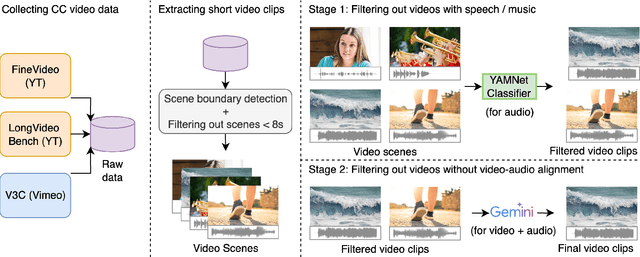
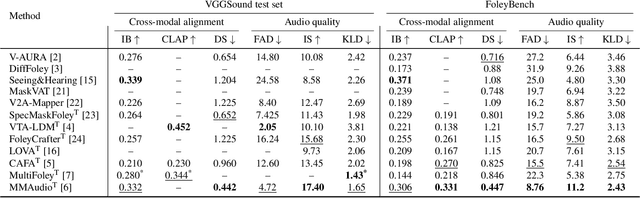
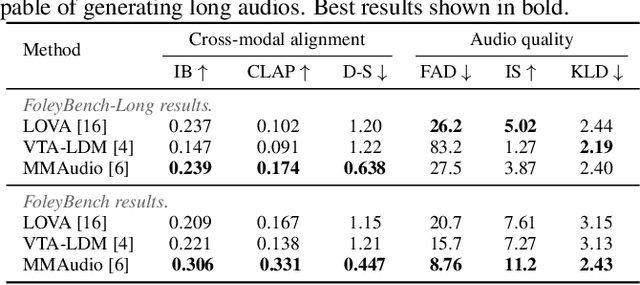
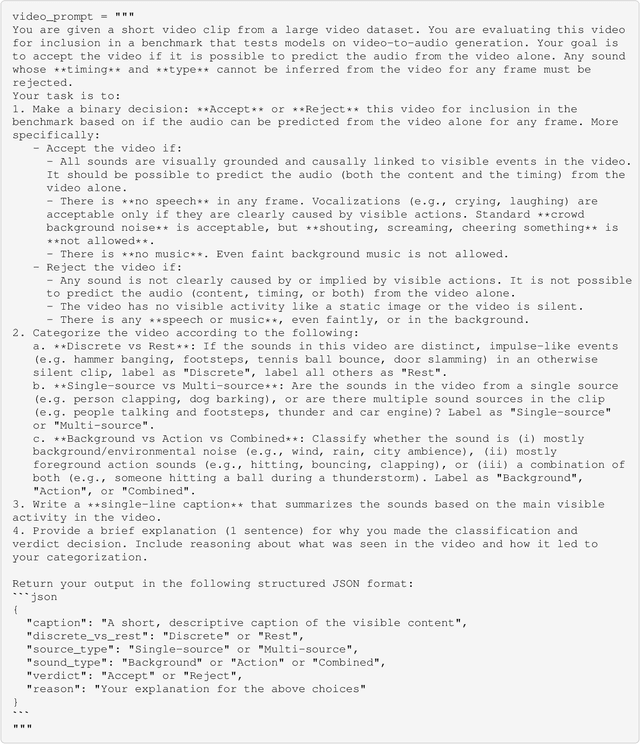
Video-to-audio generation (V2A) is of increasing importance in domains such as film post-production, AR/VR, and sound design, particularly for the creation of Foley sound effects synchronized with on-screen actions. Foley requires generating audio that is both semantically aligned with visible events and temporally aligned with their timing. Yet, there is a mismatch between evaluation and downstream applications due to the absence of a benchmark tailored to Foley-style scenarios. We find that 74% of videos from past evaluation datasets have poor audio-visual correspondence. Moreover, they are dominated by speech and music, domains that lie outside the use case for Foley. To address this gap, we introduce FoleyBench, the first large-scale benchmark explicitly designed for Foley-style V2A evaluation. FoleyBench contains 5,000 (video, ground-truth audio, text caption) triplets, each featuring visible sound sources with audio causally tied to on-screen events. The dataset is built using an automated, scalable pipeline applied to in-the-wild internet videos from YouTube-based and Vimeo-based sources. Compared to past datasets, we show that videos from FoleyBench have stronger coverage of sound categories from a taxonomy specifically designed for Foley sound. Each clip is further labeled with metadata capturing source complexity, UCS/AudioSet category, and video length, enabling fine-grained analysis of model performance and failure modes. We benchmark several state-of-the-art V2A models, evaluating them on audio quality, audio-video alignment, temporal synchronization, and audio-text consistency. Samples are available at: https://gclef-cmu.org/foleybench
Do Joint Language-Audio Embeddings Encode Perceptual Timbre Semantics?
Oct 16, 2025Understanding and modeling the relationship between language and sound is critical for applications such as music information retrieval,text-guided music generation, and audio captioning. Central to these tasks is the use of joint language-audio embedding spaces, which map textual descriptions and auditory content into a shared embedding space. While multimodal embedding models such as MS-CLAP, LAION-CLAP, and MuQ-MuLan have shown strong performance in aligning language and audio, their correspondence to human perception of timbre, a multifaceted attribute encompassing qualities such as brightness, roughness, and warmth, remains underexplored. In this paper, we evaluate the above three joint language-audio embedding models on their ability to capture perceptual dimensions of timbre. Our findings show that LAION-CLAP consistently provides the most reliable alignment with human-perceived timbre semantics across both instrumental sounds and audio effects.