 Add to Chrome
 Add to Firefox
 Add to Edge
Learning Illumination Control in Diffusion Models
Apr 27, 2026
Controlling illumination in images is essential for photography and visual content creation. While closed-source models have demonstrated impressive illumination control, open-source alternatives either require heavy control inputs like depth maps or do not release their data and code. We present a fully open-source and reproducible pipeline for learning illumination control in diffusion models. Our approach builds a data engine that transforms well-lit images into supervised training triplets consisting of a poorly-illuminated input image, a natural language lighting instruction, and a well-illuminated output image. We finetune a diffusion model on this data and demonstrate significant improvements over baseline SD 1.5, SDXL, and FLUX.1-dev models in perceptual similarity, structural similarity, and identity preservation. Our work provides a reproducible solution built entirely with open-source tools and publicly available data. We release all our code, data, and model weights publicly.

Video-Robin: Autoregressive Diffusion Planning for Intent-Grounded Video-to-Music Generation
Apr 19, 2026Video-to-music (V2M) is the fundamental task of creating background music for an input video. Recent V2M models achieve audiovisual alignment by typically relying on visual conditioning alone and provide limited semantic and stylistic controllability to the end user. In this paper, we present Video-Robin, a novel text-conditioned video-to-music generation model that enables fast, high-quality, semantically aligned music generation for video content. To balance musical fidelity and semantic understanding, Video-Robin integrates autoregressive planning with diffusion-based synthesis. Specifically, an autoregressive module models global structure by semantically aligning visual and textual inputs to produce high-level music latents. These latents are subsequently refined into coherent, high-fidelity music using local Diffusion Transformers. By factoring semantically driven planning into diffusion-based synthesis, Video-Robin enables fine-grained creator control without sacrificing audio realism. Our proposed model outperforms baselines that solely accept video input and additional feature conditioned baselines on both in-distribution and out-of-distribution benchmarks with a 2.21x speed in inference compared to SOTA. We will open-source everything upon paper acceptance.
Audio Flamingo Next: Next-Generation Open Audio-Language Models for Speech, Sound, and Music
Apr 13, 2026We present Audio Flamingo Next (AF-Next), the next-generation and most capable large audio-language model in the Audio Flamingo series, designed to advance understanding and reasoning over speech, environmental sounds and music. Compared to Audio Flamingo 3, AF-Next introduces: (i) a stronger foundational audio-language model that significantly improves accuracy across diverse audio understanding tasks; (ii) scalable strategies for constructing large-scale audio understanding and reasoning data beyond existing academic benchmarks; (iii) support for long and complex audio inputs up to 30 minutes; and (iv) Temporal Audio Chain-of-Thought, a new reasoning paradigm that explicitly grounds intermediate reasoning steps to timestamps in long audio, enabling fine-grained temporal alignment and improved interpretability. To enable these capabilities, we first conduct a systematic analysis of Audio Flamingo 3 to identify key gaps in audio understanding and reasoning. We then curate and scale new large-scale datasets totaling over 1 million hours to address these limitations and expand the existing AudioSkills-XL, LongAudio-XL, AF-Think and AF-Chat datasets. AF-Next is trained using a curriculum-based strategy spanning pre-training, mid-training and post-training stages. Extensive experiments across 20 audio understanding and reasoning benchmarks, including challenging long-audio tasks, show that AF-Next outperforms similarly sized open models by large margins and remains highly competitive with and sometimes surpasses, much larger open-weight and closed models. Beyond benchmark performance, AF-Next exhibits strong real-world utility and transfers well to unseen tasks, highlighting its robustness and generalization ability. In addition to all data, code and methods, we open-source 3 variants of AF-Next, including AF-Next-Instruct, AF-Next-Think and AF-Next-Captioner.
On The Application of Linear Attention in Multimodal Transformers
Apr 11, 2026Multimodal Transformers serve as the backbone for state-of-the-art vision-language models, yet their quadratic attention complexity remains a critical barrier to scalability. In this work, we investigate the viability of Linear Attention (LA) as a high-efficiency alternative within multimodal frameworks. By integrating LA, we reduce the computational overhead from quadratic to linear relative to sequence length while preserving competitive performance. We evaluate our approach across ViT-S/16, ViT-B/16, and ViT-L/16 architectures trained on the LAION-400M dataset, with validation focused on ImageNet-21K zero-shot accuracy. Our systematic evaluation demonstrates that Linear Attention not only yields significant computational savings but also adheres to the same scaling laws as standard softmax attention. These findings position Linear Attention as a robust, scalable solution for next-generation multimodal Transformers tasked with processing increasingly large and complex datasets.
MMOU: A Massive Multi-Task Omni Understanding and Reasoning Benchmark for Long and Complex Real-World Videos
Mar 14, 2026Multimodal Large Language Models (MLLMs) have shown strong performance in visual and audio understanding when evaluated in isolation. However, their ability to jointly reason over omni-modal (visual, audio, and textual) signals in long and complex videos remains largely unexplored. We introduce MMOU, a new benchmark designed to systematically evaluate multimodal understanding and reasoning under these challenging, real-world conditions. MMOU consists of 15,000 carefully curated questions paired with 9038 web-collected videos of varying length, spanning diverse domains and exhibiting rich, tightly coupled audio-visual content. The benchmark covers 13 fundamental skill categories, all of which require integrating evidence across modalities and time. All questions are manually annotated across multiple turns by professional annotators, ensuring high quality and reasoning fidelity. We evaluate 20+ state-of-the-art open-source and proprietary multimodal models on MMOU. The results expose substantial performance gaps: the best closed-source model achieves only 64.2% accuracy, while the strongest open-source model reaches just 46.8%. Our results highlight the challenges of long-form omni-modal understanding, revealing that current models frequently fail to apply even fundamental skills in long videos. Through detailed analysis, we further identify systematic failure modes and provide insights into where and why current models break.
SPUR: A Plug-and-Play Framework for Integrating Spatial Audio Understanding and Reasoning into Large Audio-Language Models
Nov 13, 2025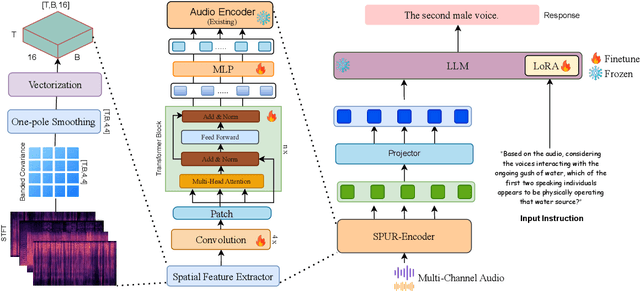
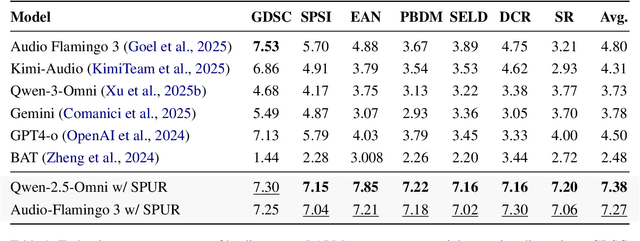
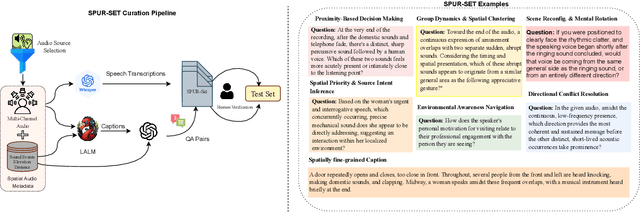
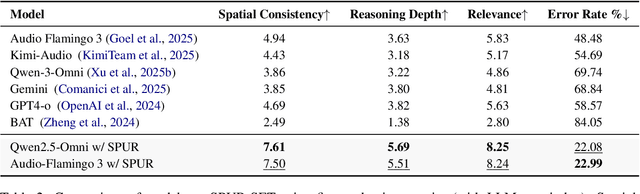
Spatial perception is central to auditory intelligence, enabling accurate understanding of real-world acoustic scenes and advancing human-level perception of the world around us. While recent large audio-language models (LALMs) show strong reasoning over complex audios, most operate on monaural inputs and lack the ability to capture spatial cues such as direction, elevation, and distance. We introduce SPUR, a lightweight, plug-in approach that equips LALMs with spatial perception through minimal architectural changes. SPUR consists of: (i) a First-Order Ambisonics (FOA) encoder that maps (W, X, Y, Z) channels to rotation-aware, listener-centric spatial features, integrated into target LALMs via a multimodal adapter; and (ii) SPUR-Set, a spatial QA dataset combining open-source FOA recordings with controlled simulations, emphasizing relative direction, elevation, distance, and overlap for supervised spatial reasoning. Fine-tuning our model on the SPUR-Set consistently improves spatial QA and multi-speaker attribution while preserving general audio understanding. SPUR provides a simple recipe that transforms monaural LALMs into spatially aware models. Extensive ablations validate the effectiveness of our approach.
Music Flamingo: Scaling Music Understanding in Audio Language Models
Nov 13, 2025We introduce Music Flamingo, a novel large audio-language model designed to advance music (including song) understanding in foundational audio models. While audio-language research has progressed rapidly, music remains challenging due to its dynamic, layered, and information-dense nature. Progress has been further limited by the difficulty of scaling open audio understanding models, primarily because of the scarcity of high-quality music data and annotations. As a result, prior models are restricted to producing short, high-level captions, answering only surface-level questions, and showing limited generalization across diverse musical cultures. To address these challenges, we curate MF-Skills, a large-scale dataset labeled through a multi-stage pipeline that yields rich captions and question-answer pairs covering harmony, structure, timbre, lyrics, and cultural context. We fine-tune an enhanced Audio Flamingo 3 backbone on MF-Skills and further strengthen multiple skills relevant to music understanding. To improve the model's reasoning abilities, we introduce a post-training recipe: we first cold-start with MF-Think, a novel chain-of-thought dataset grounded in music theory, followed by GRPO-based reinforcement learning with custom rewards. Music Flamingo achieves state-of-the-art results across 10+ benchmarks for music understanding and reasoning, establishing itself as a generalist and musically intelligent audio-language model. Beyond strong empirical results, Music Flamingo sets a new standard for advanced music understanding by demonstrating how models can move from surface-level recognition toward layered, human-like perception of songs. We believe this work provides both a benchmark and a foundation for the community to build the next generation of models that engage with music as meaningfully as humans do.
AURA: A Fine-Grained Benchmark and Decomposed Metric for Audio-Visual Reasoning
Aug 10, 2025Current audio-visual (AV) benchmarks focus on final answer accuracy, overlooking the underlying reasoning process. This makes it difficult to distinguish genuine comprehension from correct answers derived through flawed reasoning or hallucinations. To address this, we introduce AURA (Audio-visual Understanding and Reasoning Assessment), a benchmark for evaluating the cross-modal reasoning capabilities of Audio-Visual Large Language Models (AV-LLMs) and Omni-modal Language Models (OLMs). AURA includes questions across six challenging cognitive domains, such as causality, timbre and pitch, tempo and AV synchronization, unanswerability, implicit distractions, and skill profiling, explicitly designed to be unanswerable from a single modality. This forces models to construct a valid logical path grounded in both audio and video, setting AURA apart from AV datasets that allow uni-modal shortcuts. To assess reasoning traces, we propose a novel metric, AuraScore, which addresses the lack of robust tools for evaluating reasoning fidelity. It decomposes reasoning into two aspects: (i) Factual Consistency - whether reasoning is grounded in perceptual evidence, and (ii) Core Inference - the logical validity of each reasoning step. Evaluations of SOTA models on AURA reveal a critical reasoning gap: although models achieve high accuracy (up to 92% on some tasks), their Factual Consistency and Core Inference scores fall below 45%. This discrepancy highlights that models often arrive at correct answers through flawed logic, underscoring the need for our benchmark and paving the way for more robust multimodal evaluation.
Multi-Domain Audio Question Answering Toward Acoustic Content Reasoning in The DCASE 2025 Challenge
May 12, 2025We present Task 5 of the DCASE 2025 Challenge: an Audio Question Answering (AQA) benchmark spanning multiple domains of sound understanding. This task defines three QA subsets (Bioacoustics, Temporal Soundscapes, and Complex QA) to test audio-language models on interactive question-answering over diverse acoustic scenes. We describe the dataset composition (from marine mammal calls to soundscapes and complex real-world clips), the evaluation protocol (top-1 accuracy with answer-shuffling robustness), and baseline systems (Qwen2-Audio-7B, AudioFlamingo 2, Gemini-2-Flash). Preliminary results on the development set are compared, showing strong variation across models and subsets. This challenge aims to advance the audio understanding and reasoning capabilities of audio-language models toward human-level acuity, which are crucial for enabling AI agents to perceive and interact about the world effectively.
ProSE: Diffusion Priors for Speech Enhancement
Mar 09, 2025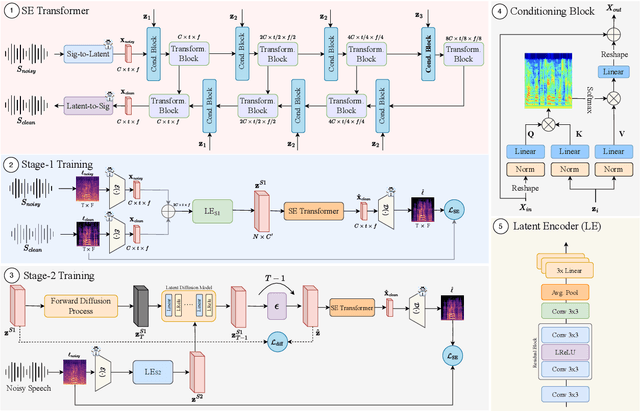
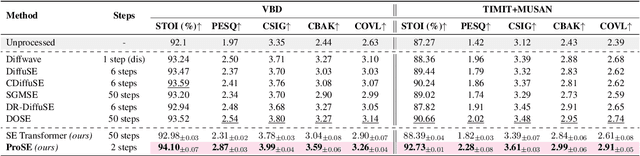
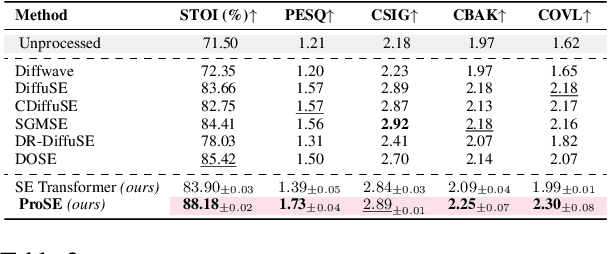
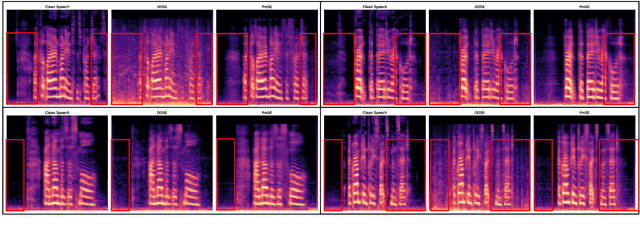
Speech enhancement (SE) is the foundational task of enhancing the clarity and quality of speech in the presence of non-stationary additive noise. While deterministic deep learning models have been commonly employed for SE, recent research indicates that generative models, such as denoising diffusion probabilistic models (DDPMs), have shown promise. However, unlike speech generation, SE has a strong constraint in generating results in accordance with the underlying ground-truth signal. Additionally, for a wide variety of applications, SE systems need to be employed in real-time, and traditional diffusion models (DMs) requiring many iterations of a large model during inference are inefficient. To address these issues, we propose ProSE (diffusion-based Priors for SE), a novel methodology based on an alternative framework for applying diffusion models to SE. Specifically, we first apply DDPMs to generate priors in a latent space due to their powerful distribution mapping capabilities. The priors are then integrated into a transformer-based regression model for SE. The priors guide the regression model in the enhancement process. Since the diffusion process is applied to a compact latent space, the diffusion model takes fewer iterations than the traditional DM to obtain accurate estimations. Additionally, using a regression model for SE avoids the distortion issue caused by misaligned details generated by DMs. Our experiments show that ProSE achieves state-of-the-art performance on benchmark datasets with fewer computational costs.