 Add to Chrome
 Add to Firefox
 Add to Edge
Audio-Visual Flamingo: Open Audio-Visual Intelligence for Long and Complex Videos
Jul 17, 2026
We present Audio-Visual Flamingo (AV-Flamingo), a fully open state-of-the-art audio-visual large language model (AV-LLM) for joint understanding and reasoning over audio, images, and long-form videos. Unlike prior AV-LLMs that primarily focus on short clips, AV-Flamingo is designed for understanding and reasoning over long and complex real-world (audio-visual) videos. To support this, we make three key contributions: (i) Audio-Visual-Skills, a large-scale collection of real-world videos with ~7M caption and question-answer training instances designed to emphasize temporal, compositional, and cross-modal audio-visual reasoning; (ii) a novel three-stage curriculum that progressively trains the model from short-range perception to long-horizon multi-event reasoning; and (iii) Temporal Audio-Visual Interleaved Chain-of-Thought, a reasoning framework that explicitly grounds intermediate reasoning steps to timestamps in long audio-visual streams, improving temporal alignment and interpretability. Extensive experiments across 15+ audio-visual, omni-modal, audio, and vision benchmarks show that AV-Flamingo outperforms similarly sized open models by clear margins and remains highly competitive with, and in some cases surpasses, much larger open-weight and closed models, particularly on long and complex real-world audio-visual understanding and reasoning tasks. Beyond benchmark performance, AV-Flamingo exhibits strong real-world utility and transfers well to unseen tasks, highlighting its robustness and generalization ability.

Unified Audio Intelligence Without Regressing on Text Intelligence
Jul 06, 2026Audio intelligence involves understanding, reasoning about, and generating both audio and speech. In this work, we introduce Nemotron-Labs-Audex-30B-A3B (Audex), a unified audio-text LLM built on Nemotron-Cascade-2-30B-A3B, a strong text-only MoE LLM. Audex adopts a simple unified design with a single Transformer decoder: audio inputs are encoded and projected into the text embedding space, while text tokens and quantized audio output tokens are treated uniformly during generation. This architecture enables strong audio-text fusion, seamless multimodal generation, and compatibility with standard LLM training and inference infrastructure. For training, we meticulously curate audio-text datasets comprising 157.4B audio tokens and 320.5B text tokens. We apply multi-stage supervised training on these datasets, followed by text-only Cascade RL and multi-domain on-policy distillation. Audex delivers state-of-the-art audio understanding, speech recognition and translation, text-to-speech, audio generation, and speech-to-speech generation, while preserving very compelling reasoning, alignment, knowledge, long-context, and agentic capabilities of its text-only LLM backbone with marginal or no regression. We release the model checkpoints to facilitate open research.
Cosmos 3: Omnimodal World Models for Physical AI
Jun 01, 2026We introduce Cosmos 3, a family of omnimodal world models designed to jointly process and generate language, image, video, audio, and action sequences within a unified mixture-of-transformers architecture. By supporting highly flexible input-output configurations, Cosmos 3 seamlessly unifies critical modalities for Physical AI -- effectively subsuming vision-language models, video generators, world simulators, and world-action models into a single framework. Our evaluation demonstrates that Cosmos 3 establishes a new state-of-the-art across a diverse suite of understanding and generation tasks, demonstrating omnimodal world models as scalable, general-purpose backbones for embodied agents. Our post-trained Cosmos 3 models were ranked as the best open-source Text-to-Image and Image-to-Video models by Artificial Analysis, and the best policy model by RoboArena at the time the technical report was written. To accelerate open research and deployment in Physical AI, we make our code, model checkpoints, curated synthetic datasets, and evaluation benchmark available under the Linux Foundation's OpenMDW-1.1 https://openmdw.ai/license/1-1/ License at https://github.com/nvidia/cosmos}{github.com/nvidia/cosmos and https://huggingface.co/collections/nvidia/cosmos3 . The project website is available at https://research.nvidia.com/labs/cosmos-lab/cosmos3 .
Benchmarking Single-Factor Physical Video-to-Audio Generation
May 28, 2026Generative video-to-audio (V2A) models produce highly plausible soundtracks, but it remains unclear whether they capture the underlying physical processes. Existing evaluations emphasize perceptual realism and overlook physical correctness under controlled interventions. In this paper, we introduce FlatSounds, a benchmark that audits the physical reasoning of V2A models through: 1) controlled counterfactual pairs in which a single physical factor is varied, and 2) single-video pattern tests that probe internal consistency and directional trends. These settings test whether the generated audio correctly reflects specific physical properties and timings. Our evaluation of state-of-the-art models reveals a consistent trade-off: models rely more on text captions than the visual stream to infer physics and semantics. Captions generally improve physical and semantic accuracy, but paradoxically degrade temporal alignment. Our results highlight the need to move beyond audio quality toward learning physical processes directly from pixels. Finally, we find that our physics-based metrics correlate strongly with human preference tests on our own data. Project webpage: https://research.nvidia.com/labs/cosmos-lab/flatsounds/
Audio Flamingo Next: Next-Generation Open Audio-Language Models for Speech, Sound, and Music
Apr 13, 2026We present Audio Flamingo Next (AF-Next), the next-generation and most capable large audio-language model in the Audio Flamingo series, designed to advance understanding and reasoning over speech, environmental sounds and music. Compared to Audio Flamingo 3, AF-Next introduces: (i) a stronger foundational audio-language model that significantly improves accuracy across diverse audio understanding tasks; (ii) scalable strategies for constructing large-scale audio understanding and reasoning data beyond existing academic benchmarks; (iii) support for long and complex audio inputs up to 30 minutes; and (iv) Temporal Audio Chain-of-Thought, a new reasoning paradigm that explicitly grounds intermediate reasoning steps to timestamps in long audio, enabling fine-grained temporal alignment and improved interpretability. To enable these capabilities, we first conduct a systematic analysis of Audio Flamingo 3 to identify key gaps in audio understanding and reasoning. We then curate and scale new large-scale datasets totaling over 1 million hours to address these limitations and expand the existing AudioSkills-XL, LongAudio-XL, AF-Think and AF-Chat datasets. AF-Next is trained using a curriculum-based strategy spanning pre-training, mid-training and post-training stages. Extensive experiments across 20 audio understanding and reasoning benchmarks, including challenging long-audio tasks, show that AF-Next outperforms similarly sized open models by large margins and remains highly competitive with and sometimes surpasses, much larger open-weight and closed models. Beyond benchmark performance, AF-Next exhibits strong real-world utility and transfers well to unseen tasks, highlighting its robustness and generalization ability. In addition to all data, code and methods, we open-source 3 variants of AF-Next, including AF-Next-Instruct, AF-Next-Think and AF-Next-Captioner.
Music Flamingo: Scaling Music Understanding in Audio Language Models
Nov 13, 2025We introduce Music Flamingo, a novel large audio-language model designed to advance music (including song) understanding in foundational audio models. While audio-language research has progressed rapidly, music remains challenging due to its dynamic, layered, and information-dense nature. Progress has been further limited by the difficulty of scaling open audio understanding models, primarily because of the scarcity of high-quality music data and annotations. As a result, prior models are restricted to producing short, high-level captions, answering only surface-level questions, and showing limited generalization across diverse musical cultures. To address these challenges, we curate MF-Skills, a large-scale dataset labeled through a multi-stage pipeline that yields rich captions and question-answer pairs covering harmony, structure, timbre, lyrics, and cultural context. We fine-tune an enhanced Audio Flamingo 3 backbone on MF-Skills and further strengthen multiple skills relevant to music understanding. To improve the model's reasoning abilities, we introduce a post-training recipe: we first cold-start with MF-Think, a novel chain-of-thought dataset grounded in music theory, followed by GRPO-based reinforcement learning with custom rewards. Music Flamingo achieves state-of-the-art results across 10+ benchmarks for music understanding and reasoning, establishing itself as a generalist and musically intelligent audio-language model. Beyond strong empirical results, Music Flamingo sets a new standard for advanced music understanding by demonstrating how models can move from surface-level recognition toward layered, human-like perception of songs. We believe this work provides both a benchmark and a foundation for the community to build the next generation of models that engage with music as meaningfully as humans do.
Multi-Domain Audio Question Answering Toward Acoustic Content Reasoning in The DCASE 2025 Challenge
May 12, 2025We present Task 5 of the DCASE 2025 Challenge: an Audio Question Answering (AQA) benchmark spanning multiple domains of sound understanding. This task defines three QA subsets (Bioacoustics, Temporal Soundscapes, and Complex QA) to test audio-language models on interactive question-answering over diverse acoustic scenes. We describe the dataset composition (from marine mammal calls to soundscapes and complex real-world clips), the evaluation protocol (top-1 accuracy with answer-shuffling robustness), and baseline systems (Qwen2-Audio-7B, AudioFlamingo 2, Gemini-2-Flash). Preliminary results on the development set are compared, showing strong variation across models and subsets. This challenge aims to advance the audio understanding and reasoning capabilities of audio-language models toward human-level acuity, which are crucial for enabling AI agents to perceive and interact about the world effectively.
Audio Flamingo 2: An Audio-Language Model with Long-Audio Understanding and Expert Reasoning Abilities
Mar 06, 2025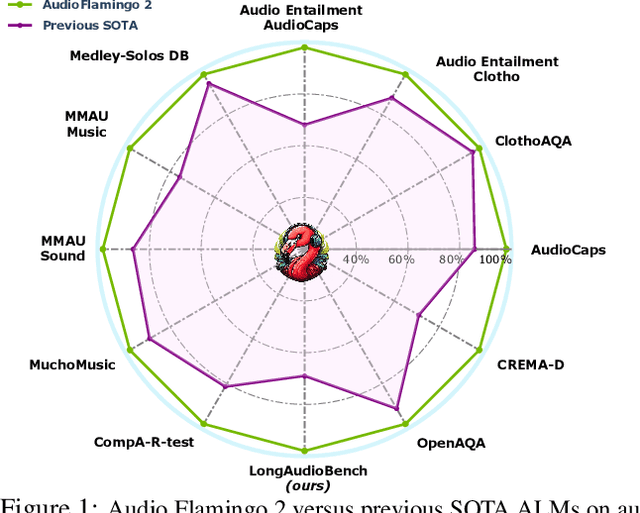
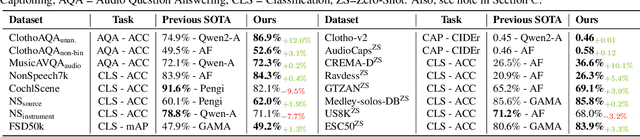
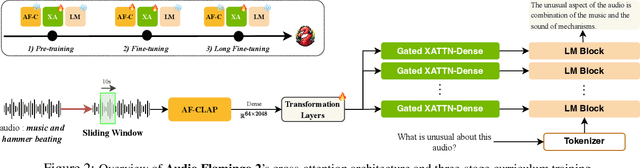
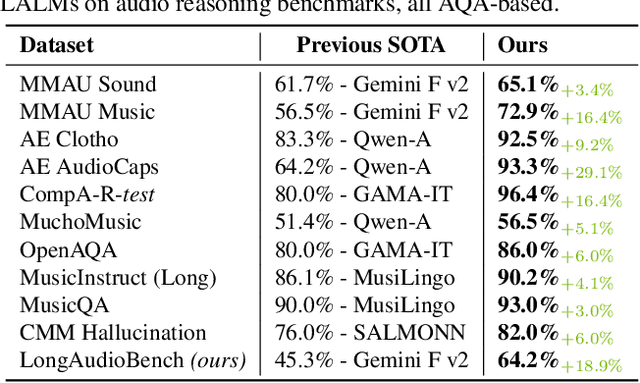
Understanding and reasoning over non-speech sounds and music are crucial for both humans and AI agents to interact effectively with their environments. In this paper, we introduce Audio Flamingo 2 (AF2), an Audio-Language Model (ALM) with advanced audio understanding and reasoning capabilities. AF2 leverages (i) a custom CLAP model, (ii) synthetic Audio QA data for fine-grained audio reasoning, and (iii) a multi-stage curriculum learning strategy. AF2 achieves state-of-the-art performance with only a 3B parameter small language model, surpassing large open-source and proprietary models across over 20 benchmarks. Next, for the first time, we extend audio understanding to long audio segments (30 secs to 5 mins) and propose LongAudio, a large and novel dataset for training ALMs on long audio captioning and question-answering tasks. Fine-tuning AF2 on LongAudio leads to exceptional performance on our proposed LongAudioBench, an expert annotated benchmark for evaluating ALMs on long audio understanding capabilities. We conduct extensive ablation studies to confirm the efficacy of our approach. Project Website: https://research.nvidia.com/labs/adlr/AF2/.
A2SB: Audio-to-Audio Schrodinger Bridges
Jan 20, 2025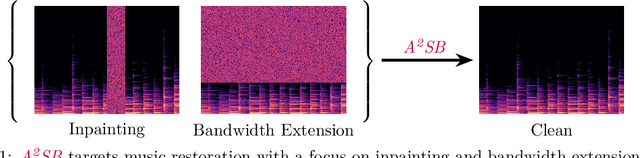
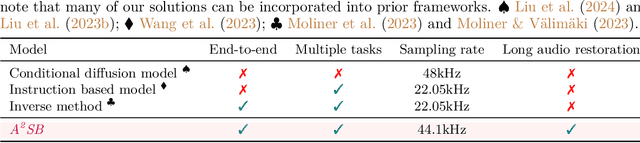

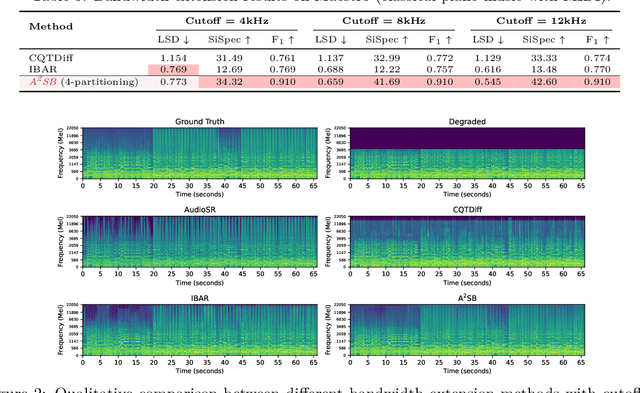
Audio in the real world may be perturbed due to numerous factors, causing the audio quality to be degraded. The following work presents an audio restoration model tailored for high-res music at 44.1kHz. Our model, Audio-to-Audio Schrodinger Bridges (A2SB), is capable of both bandwidth extension (predicting high-frequency components) and inpainting (re-generating missing segments). Critically, A2SB is end-to-end without need of a vocoder to predict waveform outputs, able to restore hour-long audio inputs, and trained on permissively licensed music data. A2SB is capable of achieving state-of-the-art bandwidth extension and inpainting quality on several out-of-distribution music test sets. Our demo website is https: //research.nvidia.com/labs/adlr/A2SB/.
TangoFlux: Super Fast and Faithful Text to Audio Generation with Flow Matching and Clap-Ranked Preference Optimization
Dec 30, 2024We introduce TangoFlux, an efficient Text-to-Audio (TTA) generative model with 515M parameters, capable of generating up to 30 seconds of 44.1kHz audio in just 3.7 seconds on a single A40 GPU. A key challenge in aligning TTA models lies in the difficulty of creating preference pairs, as TTA lacks structured mechanisms like verifiable rewards or gold-standard answers available for Large Language Models (LLMs). To address this, we propose CLAP-Ranked Preference Optimization (CRPO), a novel framework that iteratively generates and optimizes preference data to enhance TTA alignment. We demonstrate that the audio preference dataset generated using CRPO outperforms existing alternatives. With this framework, TangoFlux achieves state-of-the-art performance across both objective and subjective benchmarks. We open source all code and models to support further research in TTA generation.