 Add to Chrome
 Add to Firefox
 Add to Edge
Music Flamingo: Scaling Music Understanding in Audio Language Models
Nov 13, 2025
We introduce Music Flamingo, a novel large audio-language model designed to advance music (including song) understanding in foundational audio models. While audio-language research has progressed rapidly, music remains challenging due to its dynamic, layered, and information-dense nature. Progress has been further limited by the difficulty of scaling open audio understanding models, primarily because of the scarcity of high-quality music data and annotations. As a result, prior models are restricted to producing short, high-level captions, answering only surface-level questions, and showing limited generalization across diverse musical cultures. To address these challenges, we curate MF-Skills, a large-scale dataset labeled through a multi-stage pipeline that yields rich captions and question-answer pairs covering harmony, structure, timbre, lyrics, and cultural context. We fine-tune an enhanced Audio Flamingo 3 backbone on MF-Skills and further strengthen multiple skills relevant to music understanding. To improve the model's reasoning abilities, we introduce a post-training recipe: we first cold-start with MF-Think, a novel chain-of-thought dataset grounded in music theory, followed by GRPO-based reinforcement learning with custom rewards. Music Flamingo achieves state-of-the-art results across 10+ benchmarks for music understanding and reasoning, establishing itself as a generalist and musically intelligent audio-language model. Beyond strong empirical results, Music Flamingo sets a new standard for advanced music understanding by demonstrating how models can move from surface-level recognition toward layered, human-like perception of songs. We believe this work provides both a benchmark and a foundation for the community to build the next generation of models that engage with music as meaningfully as humans do.

A2SB: Audio-to-Audio Schrodinger Bridges
Jan 20, 2025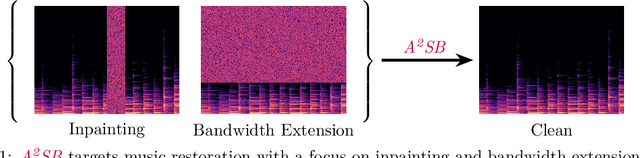
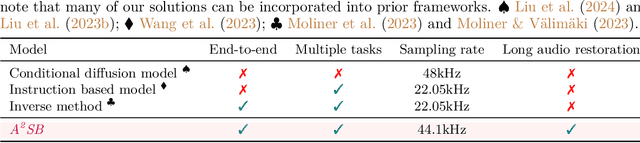

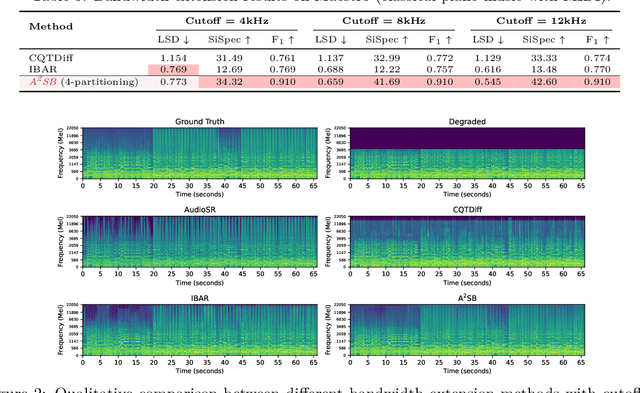
Audio in the real world may be perturbed due to numerous factors, causing the audio quality to be degraded. The following work presents an audio restoration model tailored for high-res music at 44.1kHz. Our model, Audio-to-Audio Schrodinger Bridges (A2SB), is capable of both bandwidth extension (predicting high-frequency components) and inpainting (re-generating missing segments). Critically, A2SB is end-to-end without need of a vocoder to predict waveform outputs, able to restore hour-long audio inputs, and trained on permissively licensed music data. A2SB is capable of achieving state-of-the-art bandwidth extension and inpainting quality on several out-of-distribution music test sets. Our demo website is https: //research.nvidia.com/labs/adlr/A2SB/.