 Add to Chrome
 Add to Firefox
 Add to Edge
Anomalous Sound Detection Meets Noise-Aware Self-Supervised Learning
Aug 01, 2026
In this paper, we introduce noise-aware self-supervised learning (NA-SSL) models for noise-aware anomalous sound detection (NA-ASD). NA-ASD is an ASD task with two-channel audio recordings, where one microphone is located close to the target machine and the other is located farther away to capture noise. For this task, we simulate two-channel recordings using diverse audio datasets and train NA-SSL models to extract clean SSL representations of the close-microphone signal by using the far-microphone recording dominated by background noise as auxiliary information. The NA-SSL models are then used as frontends in the standard ASD framework. Our experimental evaluation on the DCASE 2026 Challenge Task 2 development dataset demonstrates the effectiveness of the NA-SSL framework across three base SSL models (BEATs, EAT, and Dasheng), both with and without discriminative fine-tuning. Furthermore, the challenge results proved the effectiveness of the proposed approach, where the NA-BEATs system won the challenge by a large margin, achieving an official score of 70.24%, while the second-place system achieved 65.46%.

NABEATs: Noise-Aware Audio Representation Learning
Jul 18, 2026We propose the concept of noise-aware audio self-supervised learning (SSL), whose goal is to encode audio mixtures while suppressing undesired noise, and present Noise-Aware BEATs (NABEATs) as a BEATs-based realization of this framework. Audio SSL models are designed to handle a wide range of audio signals. Consequently, under noisy conditions, they cannot effectively focus on the target sounds relevant to a downstream task, resulting in degraded performance. To address this issue, NABEATs is trained to estimate clean BEATs representations from a noisy audio signal with an auxiliary reference noise input. This reference noise enables the model to account for specific noise characteristics at inference time, thereby achieving better generalization across operating environments. Our experimental evaluations demonstrate that NABEATs significantly improves performance of various downstream tasks under noisy conditions and also generalizes well to unseen noise types.
Technical Report for MERL's Real-TSE Challenge Submission
Jul 10, 2026Target speech extraction (TSE) has largely been dominated by neural network-based approaches trained and evaluated on synthetic fully overlapped data. The Real-TSE Challenge aims to advance performance on real-world far-field noisy and reverberant recordings. This technical report describes MERL's submission to the Real-TSE Challenge. Rather than proposing a novel model architecture, we built upon the baseline model and focused primarily on data preparation and cleaning. Our system was trained in four stages, beginning with pre-training on fully overlapped mixtures and simulated multi-talker conversations with noise and reverberation applied to both the mixture and the enrollment utterances. We then adapted the model to real-world conditions using noisy far-field recordings with pseudo-targets derived from processed close-talk microphone signals. Our submission achieved first place in the second track, demonstrating the critical importance of high-quality data preparation. Furthermore, we observed that DNSMOS and speaker similarity are susceptible to over-optimization, motivating an investigation of their robustness using adversarial attacks. The results show that both metrics can be driven to extreme values without degrading the token error rate or the VAD-based F1 score.
Predictive-Generative Drift Decomposition for Speech Enhancement and Separation
May 07, 2026We propose a plug-and-play framework for speech enhancement and separation that augments predictive methods with a generative speech prior. Our approach, termed Stochastic Interpolant Prior for Speech (SIPS), builds on stochastic interpolants and leverages their flexibility to bridge predictive and generative modeling. Specifically, we decompose the interpolation dynamics into a task-specific drift and a stochastic denoising component, allowing a predictive estimate to be integrated directly into the generative sampling process. This results in a mathematically grounded framework for combining strong pretrained predictors with the expressive power of generative models. To this end, we train a score model using only clean speech, yielding a degradation-agnostic prior that can be reused across tasks. During inference, the predictor provides a deterministic drift that steers the sampling process toward a task-consistent estimate, while the score model preserves perceptual naturalness. Unlike prior hybrid approaches, which typically rely on architecture-specific conditioning and are tied to particular predictors or degradation settings, SIPS provides a unified framework that generalizes across predictors and additive degradation tasks. We demonstrate its effectiveness for both speech enhancement and speech separation using recent predictors such as SEMamba and FlexIO. The proposed method consistently improves perceptual quality, achieving gains up +1.0 NISQA for speech separation.
Pushing the Frontier of Audiovisual Perception with Large-Scale Multimodal Correspondence Learning
Dec 22, 2025We introduce Perception Encoder Audiovisual, PE-AV, a new family of encoders for audio and video understanding trained with scaled contrastive learning. Built on PE, PE-AV makes several key contributions to extend representations to audio, and natively support joint embeddings across audio-video, audio-text, and video-text modalities. PE-AV's unified cross-modal embeddings enable novel tasks such as speech retrieval, and set a new state of the art across standard audio and video benchmarks. We unlock this by building a strong audiovisual data engine that synthesizes high-quality captions for O(100M) audio-video pairs, enabling large-scale supervision consistent across modalities. Our audio data includes speech, music, and general sound effects-avoiding single-domain limitations common in prior work. We exploit ten pairwise contrastive objectives, showing that scaling cross-modality and caption-type pairs strengthens alignment and improves zero-shot performance. We further develop PE-A-Frame by fine-tuning PE-AV with frame-level contrastive objectives, enabling fine-grained audio-frame-to-text alignment for tasks such as sound event detection.
SAM Audio: Segment Anything in Audio
Dec 19, 2025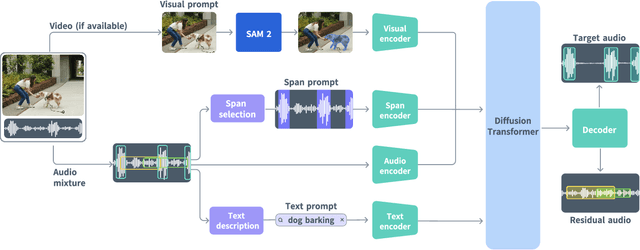

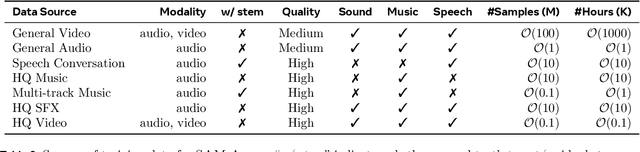
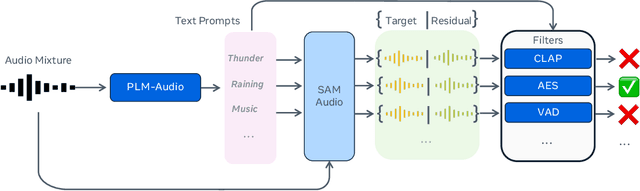
General audio source separation is a key capability for multimodal AI systems that can perceive and reason about sound. Despite substantial progress in recent years, existing separation models are either domain-specific, designed for fixed categories such as speech or music, or limited in controllability, supporting only a single prompting modality such as text. In this work, we present SAM Audio, a foundation model for general audio separation that unifies text, visual, and temporal span prompting within a single framework. Built on a diffusion transformer architecture, SAM Audio is trained with flow matching on large-scale audio data spanning speech, music, and general sounds, and can flexibly separate target sources described by language, visual masks, or temporal spans. The model achieves state-of-the-art performance across a diverse suite of benchmarks, including general sound, speech, music, and musical instrument separation in both in-the-wild and professionally produced audios, substantially outperforming prior general-purpose and specialized systems. Furthermore, we introduce a new real-world separation benchmark with human-labeled multimodal prompts and a reference-free evaluation model that correlates strongly with human judgment.
ReverbFX: A Dataset of Room Impulse Responses Derived from Reverb Effect Plugins for Singing Voice Dereverberation
May 26, 2025We present ReverbFX, a new room impulse response (RIR) dataset designed for singing voice dereverberation research. Unlike existing datasets based on real recorded RIRs, ReverbFX features a diverse collection of RIRs captured from various reverb audio effect plugins commonly used in music production. We conduct comprehensive experiments using the proposed dataset to benchmark the challenge of dereverberation of singing voice recordings affected by artificial reverbs. We train two state-of-the-art generative models using ReverbFX and demonstrate that models trained with plugin-derived RIRs outperform those trained on realistic RIRs in artificial reverb scenarios.
LipDiffuser: Lip-to-Speech Generation with Conditional Diffusion Models
May 16, 2025We present LipDiffuser, a conditional diffusion model for lip-to-speech generation synthesizing natural and intelligible speech directly from silent video recordings. Our approach leverages the magnitude-preserving ablated diffusion model (MP-ADM) architecture as a denoiser model. To effectively condition the model, we incorporate visual features using magnitude-preserving feature-wise linear modulation (MP-FiLM) alongside speaker embeddings. A neural vocoder then reconstructs the speech waveform from the generated mel-spectrograms. Evaluations on LRS3 and TCD-TIMIT demonstrate that LipDiffuser outperforms existing lip-to-speech baselines in perceptual speech quality and speaker similarity, while remaining competitive in downstream automatic speech recognition (ASR). These findings are also supported by a formal listening experiment. Extensive ablation studies and cross-dataset evaluation confirm the effectiveness and generalization capabilities of our approach.
Normalize Everything: A Preconditioned Magnitude-Preserving Architecture for Diffusion-Based Speech Enhancement
May 08, 2025This paper presents a new framework for diffusion-based speech enhancement. Our method employs a Schroedinger bridge to transform the noisy speech distribution into the clean speech distribution. To stabilize and improve training, we employ time-dependent scalings of the inputs and outputs of the network, known as preconditioning. We consider two skip connection configurations, which either include or omit the current process state in the denoiser's output, enabling the network to predict either environmental noise or clean speech. Each approach leads to improved performance on different speech enhancement metrics. To maintain stable magnitude levels and balance during training, we use a magnitude-preserving network architecture that normalizes all activations and network weights to unit length. Additionally, we propose learning the contribution of the noisy input within each network block for effective input conditioning. After training, we apply a method to approximate different exponential moving average (EMA) profiles and investigate their effects on the speech enhancement performance. In contrast to image generation tasks, where longer EMA lengths often enhance mode coverage, we observe that shorter EMA lengths consistently lead to better performance on standard speech enhancement metrics. Code, audio examples, and checkpoints are available online.
Non-intrusive Speech Quality Assessment with Diffusion Models Trained on Clean Speech
Oct 23, 2024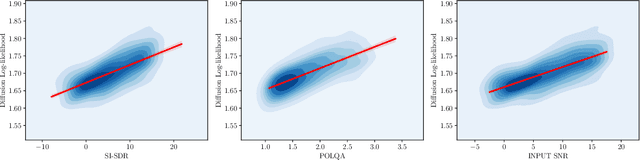
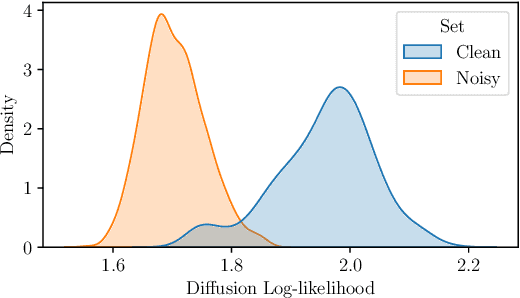
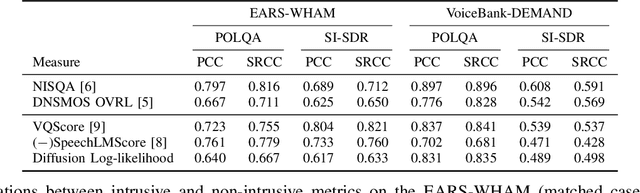
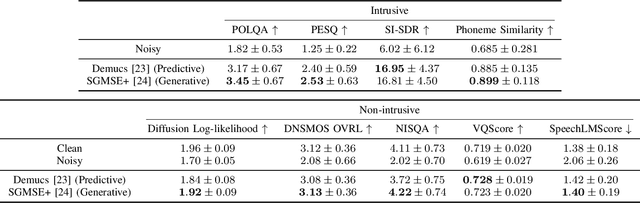
Diffusion models have found great success in generating high quality, natural samples of speech, but their potential for density estimation for speech has so far remained largely unexplored. In this work, we leverage an unconditional diffusion model trained only on clean speech for the assessment of speech quality. We show that the quality of a speech utterance can be assessed by estimating the likelihood of a corresponding sample in the terminating Gaussian distribution, obtained via a deterministic noising process. The resulting method is purely unsupervised, trained only on clean speech, and therefore does not rely on annotations. Our diffusion-based approach leverages clean speech priors to assess quality based on how the input relates to the learned distribution of clean data. Our proposed log-likelihoods show promising results, correlating well with intrusive speech quality metrics such as POLQA and SI-SDR.