 Add to Chrome
 Add to Firefox
 Add to Edge
MIDI-Informed Singing Accompaniment Generation in a Compositional Song Pipeline
Feb 24, 2026
Song generation aims to produce full songs with vocals and accompaniment from lyrics and text descriptions, yet end-to-end models remain data- and compute-intensive and provide limited editability. We advocate a compositional alternative that decomposes the task into melody composition, singing voice synthesis, and singing accompaniment generation. Central to our approach is MIDI-informed singing accompaniment generation (MIDI-SAG), which conditions accompaniment on the symbolic vocal-melody MIDI to improve rhythmic and harmonic alignment between singing and instrumentation. Moreover, beyond conventional SAG settings that assume continuously sung vocals, compositional song generation features intermittent vocals; we address this by combining explicit rhythmic/harmonic controls with audio continuation to keep the backing track consistent across vocal and non-vocal regions. With lightweight newly trained components requiring only 2.5k hours of audio on a single RTX 3090, our pipeline approaches the perceptual quality of recent open-source end-to-end baselines in several metrics. We provide audio demos and will open-source our model at https://composerflow.github.io/web/.

Training-Efficient Text-to-Music Generation with State-Space Modeling
Jan 21, 2026Recent advances in text-to-music generation (TTM) have yielded high-quality results, but often at the cost of extensive compute and the use of large proprietary internal data. To improve the affordability and openness of TTM training, an open-source generative model backbone that is more training- and data-efficient is needed. In this paper, we constrain the number of trainable parameters in the generative model to match that of the MusicGen-small benchmark (with about 300M parameters), and replace its Transformer backbone with the emerging class of state-space models (SSMs). Specifically, we explore different SSM variants for sequence modeling, and compare a single-stage SSM-based design with a decomposable two-stage SSM/diffusion hybrid design. All proposed models are trained from scratch on a purely public dataset comprising 457 hours of CC-licensed music, ensuring full openness. Our experimental findings are three-fold. First, we show that SSMs exhibit superior training efficiency compared to the Transformer counterpart. Second, despite using only 9% of the FLOPs and 2% of the training data size compared to the MusicGen-small benchmark, our model achieves competitive performance in both objective metrics and subjective listening tests based on MusicCaps captions. Finally, our scaling-down experiment demonstrates that SSMs can maintain competitive performance relative to the Transformer baseline even at the same training budget (measured in iterations), when the model size is reduced to four times smaller. To facilitate the democratization of TTM research, the processed captions, model checkpoints, and source code are available on GitHub via the project page: https://lonian6.github.io/ssmttm/.
Exploring State-Space-Model based Language Model in Music Generation
Jul 09, 2025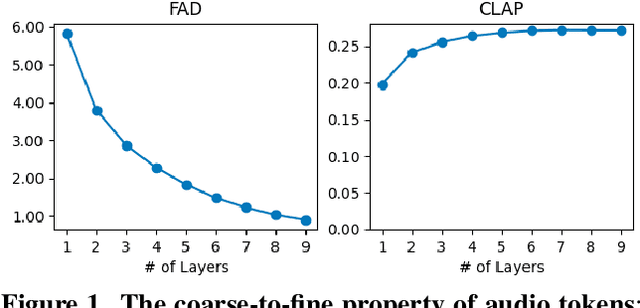
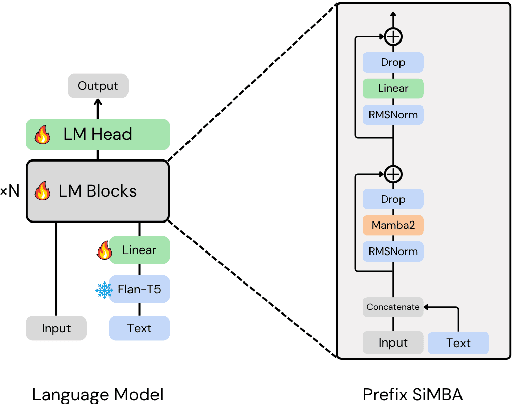
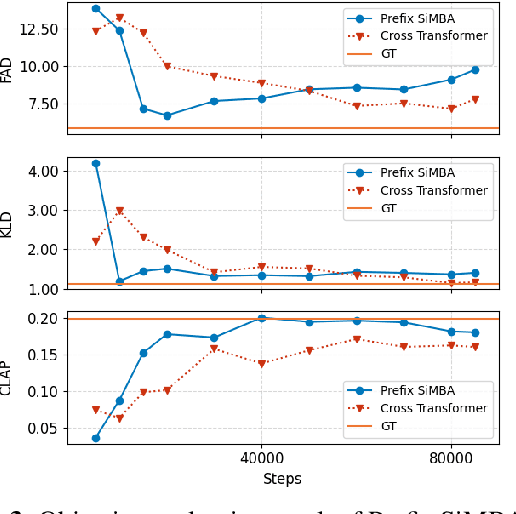
The recent surge in State Space Models (SSMs), particularly the emergence of Mamba, has established them as strong alternatives or complementary modules to Transformers across diverse domains. In this work, we aim to explore the potential of Mamba-based architectures for text-to-music generation. We adopt discrete tokens of Residual Vector Quantization (RVQ) as the modeling representation and empirically find that a single-layer codebook can capture semantic information in music. Motivated by this observation, we focus on modeling a single-codebook representation and adapt SiMBA, originally designed as a Mamba-based encoder, to function as a decoder for sequence modeling. We compare its performance against a standard Transformer-based decoder. Our results suggest that, under limited-resource settings, SiMBA achieves much faster convergence and generates outputs closer to the ground truth. This demonstrates the promise of SSMs for efficient and expressive text-to-music generation. We put audio examples on Github.