 Add to Chrome
 Add to Firefox
 Add to Edge
Cosmos 3: Omnimodal World Models for Physical AI
Jun 01, 2026
We introduce Cosmos 3, a family of omnimodal world models designed to jointly process and generate language, image, video, audio, and action sequences within a unified mixture-of-transformers architecture. By supporting highly flexible input-output configurations, Cosmos 3 seamlessly unifies critical modalities for Physical AI -- effectively subsuming vision-language models, video generators, world simulators, and world-action models into a single framework. Our evaluation demonstrates that Cosmos 3 establishes a new state-of-the-art across a diverse suite of understanding and generation tasks, demonstrating omnimodal world models as scalable, general-purpose backbones for embodied agents. Our post-trained Cosmos 3 models were ranked as the best open-source Text-to-Image and Image-to-Video models by Artificial Analysis, and the best policy model by RoboArena at the time the technical report was written. To accelerate open research and deployment in Physical AI, we make our code, model checkpoints, curated synthetic datasets, and evaluation benchmark available under the Linux Foundation's OpenMDW-1.1 https://openmdw.ai/license/1-1/ License at https://github.com/nvidia/cosmos}{github.com/nvidia/cosmos and https://huggingface.co/collections/nvidia/cosmos3 . The project website is available at https://research.nvidia.com/labs/cosmos-lab/cosmos3 .

Benchmarking Single-Factor Physical Video-to-Audio Generation
May 28, 2026Generative video-to-audio (V2A) models produce highly plausible soundtracks, but it remains unclear whether they capture the underlying physical processes. Existing evaluations emphasize perceptual realism and overlook physical correctness under controlled interventions. In this paper, we introduce FlatSounds, a benchmark that audits the physical reasoning of V2A models through: 1) controlled counterfactual pairs in which a single physical factor is varied, and 2) single-video pattern tests that probe internal consistency and directional trends. These settings test whether the generated audio correctly reflects specific physical properties and timings. Our evaluation of state-of-the-art models reveals a consistent trade-off: models rely more on text captions than the visual stream to infer physics and semantics. Captions generally improve physical and semantic accuracy, but paradoxically degrade temporal alignment. Our results highlight the need to move beyond audio quality toward learning physical processes directly from pixels. Finally, we find that our physics-based metrics correlate strongly with human preference tests on our own data. Project webpage: https://research.nvidia.com/labs/cosmos-lab/flatsounds/
Nemotron 3 Nano Omni: Efficient and Open Multimodal Intelligence
Apr 27, 2026We introduce Nemotron 3 Nano Omni, the latest model in the Nemotron multimodal series and the first to natively support audio inputs alongside text, images, and video. Nemotron 3 Nano Omni delivers consistent accuracy improvements over its predecessor, Nemotron Nano V2 VL, across all modalities, enabled by advances in architecture, training data and recipes. In particular, Nemotron 3 delivers leading results in real-world document understanding, long audio-video comprehension, and agentic computer use. Built on the highly efficient Nemotron 3 Nano 30B-A3B backbone, Nemotron 3 Nano Omni further incorporates innovative multimodal token-reduction techniques to deliver substantially lower inference latency and higher throughput than other models of similar size. We are releasing model checkpoints in BF16, FP8, and FP4 formats, along with portions of the training data and codebase to facilitate further research and development.
Audio Flamingo Next: Next-Generation Open Audio-Language Models for Speech, Sound, and Music
Apr 13, 2026We present Audio Flamingo Next (AF-Next), the next-generation and most capable large audio-language model in the Audio Flamingo series, designed to advance understanding and reasoning over speech, environmental sounds and music. Compared to Audio Flamingo 3, AF-Next introduces: (i) a stronger foundational audio-language model that significantly improves accuracy across diverse audio understanding tasks; (ii) scalable strategies for constructing large-scale audio understanding and reasoning data beyond existing academic benchmarks; (iii) support for long and complex audio inputs up to 30 minutes; and (iv) Temporal Audio Chain-of-Thought, a new reasoning paradigm that explicitly grounds intermediate reasoning steps to timestamps in long audio, enabling fine-grained temporal alignment and improved interpretability. To enable these capabilities, we first conduct a systematic analysis of Audio Flamingo 3 to identify key gaps in audio understanding and reasoning. We then curate and scale new large-scale datasets totaling over 1 million hours to address these limitations and expand the existing AudioSkills-XL, LongAudio-XL, AF-Think and AF-Chat datasets. AF-Next is trained using a curriculum-based strategy spanning pre-training, mid-training and post-training stages. Extensive experiments across 20 audio understanding and reasoning benchmarks, including challenging long-audio tasks, show that AF-Next outperforms similarly sized open models by large margins and remains highly competitive with and sometimes surpasses, much larger open-weight and closed models. Beyond benchmark performance, AF-Next exhibits strong real-world utility and transfers well to unseen tasks, highlighting its robustness and generalization ability. In addition to all data, code and methods, we open-source 3 variants of AF-Next, including AF-Next-Instruct, AF-Next-Think and AF-Next-Captioner.
MMOU: A Massive Multi-Task Omni Understanding and Reasoning Benchmark for Long and Complex Real-World Videos
Mar 14, 2026Multimodal Large Language Models (MLLMs) have shown strong performance in visual and audio understanding when evaluated in isolation. However, their ability to jointly reason over omni-modal (visual, audio, and textual) signals in long and complex videos remains largely unexplored. We introduce MMOU, a new benchmark designed to systematically evaluate multimodal understanding and reasoning under these challenging, real-world conditions. MMOU consists of 15,000 carefully curated questions paired with 9038 web-collected videos of varying length, spanning diverse domains and exhibiting rich, tightly coupled audio-visual content. The benchmark covers 13 fundamental skill categories, all of which require integrating evidence across modalities and time. All questions are manually annotated across multiple turns by professional annotators, ensuring high quality and reasoning fidelity. We evaluate 20+ state-of-the-art open-source and proprietary multimodal models on MMOU. The results expose substantial performance gaps: the best closed-source model achieves only 64.2% accuracy, while the strongest open-source model reaches just 46.8%. Our results highlight the challenges of long-form omni-modal understanding, revealing that current models frequently fail to apply even fundamental skills in long videos. Through detailed analysis, we further identify systematic failure modes and provide insights into where and why current models break.
Speech-Hands: A Self-Reflection Voice Agentic Approach to Speech Recognition and Audio Reasoning with Omni Perception
Jan 14, 2026We introduce a voice-agentic framework that learns one critical omni-understanding skill: knowing when to trust itself versus when to consult external audio perception. Our work is motivated by a crucial yet counterintuitive finding: naively fine-tuning an omni-model on both speech recognition and external sound understanding tasks often degrades performance, as the model can be easily misled by noisy hypotheses. To address this, our framework, Speech-Hands, recasts the problem as an explicit self-reflection decision. This learnable reflection primitive proves effective in preventing the model from being derailed by flawed external candidates. We show that this agentic action mechanism generalizes naturally from speech recognition to complex, multiple-choice audio reasoning. Across the OpenASR leaderboard, Speech-Hands consistently outperforms strong baselines by 12.1% WER on seven benchmarks. The model also achieves 77.37% accuracy and high F1 on audio QA decisions, showing robust generalization and reliability across diverse audio question answering datasets. By unifying perception and decision-making, our work offers a practical path toward more reliable and resilient audio intelligence.
Music Flamingo: Scaling Music Understanding in Audio Language Models
Nov 13, 2025We introduce Music Flamingo, a novel large audio-language model designed to advance music (including song) understanding in foundational audio models. While audio-language research has progressed rapidly, music remains challenging due to its dynamic, layered, and information-dense nature. Progress has been further limited by the difficulty of scaling open audio understanding models, primarily because of the scarcity of high-quality music data and annotations. As a result, prior models are restricted to producing short, high-level captions, answering only surface-level questions, and showing limited generalization across diverse musical cultures. To address these challenges, we curate MF-Skills, a large-scale dataset labeled through a multi-stage pipeline that yields rich captions and question-answer pairs covering harmony, structure, timbre, lyrics, and cultural context. We fine-tune an enhanced Audio Flamingo 3 backbone on MF-Skills and further strengthen multiple skills relevant to music understanding. To improve the model's reasoning abilities, we introduce a post-training recipe: we first cold-start with MF-Think, a novel chain-of-thought dataset grounded in music theory, followed by GRPO-based reinforcement learning with custom rewards. Music Flamingo achieves state-of-the-art results across 10+ benchmarks for music understanding and reasoning, establishing itself as a generalist and musically intelligent audio-language model. Beyond strong empirical results, Music Flamingo sets a new standard for advanced music understanding by demonstrating how models can move from surface-level recognition toward layered, human-like perception of songs. We believe this work provides both a benchmark and a foundation for the community to build the next generation of models that engage with music as meaningfully as humans do.
NVIDIA Nemotron Nano V2 VL
Nov 07, 2025We introduce Nemotron Nano V2 VL, the latest model of the Nemotron vision-language series designed for strong real-world document understanding, long video comprehension, and reasoning tasks. Nemotron Nano V2 VL delivers significant improvements over our previous model, Llama-3.1-Nemotron-Nano-VL-8B, across all vision and text domains through major enhancements in model architecture, datasets, and training recipes. Nemotron Nano V2 VL builds on Nemotron Nano V2, a hybrid Mamba-Transformer LLM, and innovative token reduction techniques to achieve higher inference throughput in long document and video scenarios. We are releasing model checkpoints in BF16, FP8, and FP4 formats and sharing large parts of our datasets, recipes and training code.
Visually Interpretable Subtask Reasoning for Visual Question Answering
May 12, 2025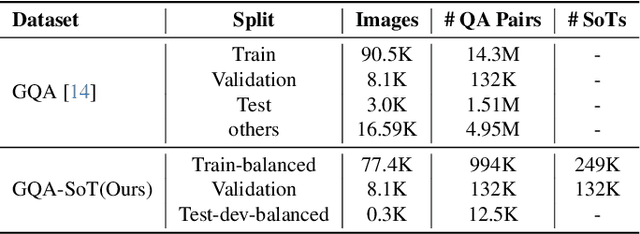

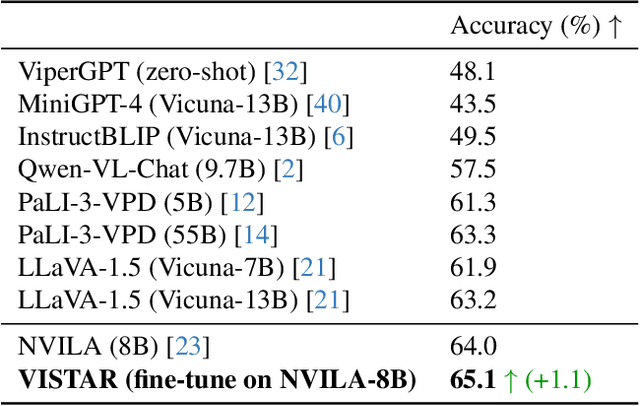
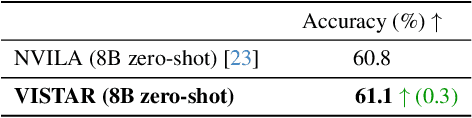
Answering complex visual questions like `Which red furniture can be used for sitting?' requires multi-step reasoning, including object recognition, attribute filtering, and relational understanding. Recent work improves interpretability in multimodal large language models (MLLMs) by decomposing tasks into sub-task programs, but these methods are computationally expensive and less accurate due to poor adaptation to target data. To address this, we introduce VISTAR (Visually Interpretable Subtask-Aware Reasoning Model), a subtask-driven training framework that enhances both interpretability and reasoning by generating textual and visual explanations within MLLMs. Instead of relying on external models, VISTAR fine-tunes MLLMs to produce structured Subtask-of-Thought rationales (step-by-step reasoning sequences). Experiments on two benchmarks show that VISTAR consistently improves reasoning accuracy while maintaining interpretability. Our code and dataset will be available at https://github.com/ChengJade/VISTAR.
ETTA: Elucidating the Design Space of Text-to-Audio Models
Dec 26, 2024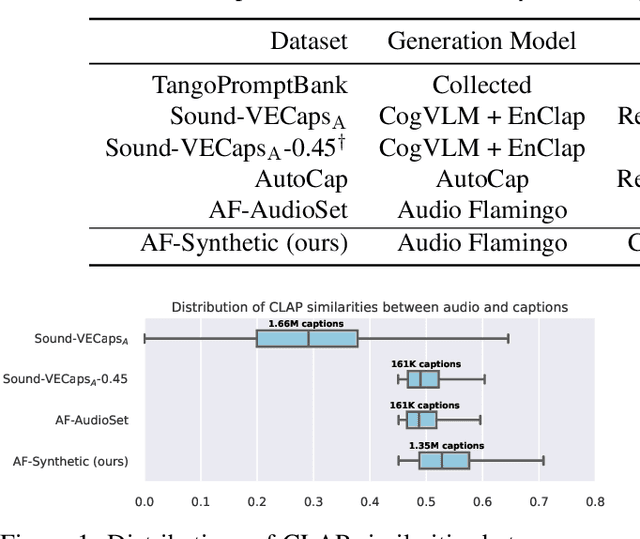
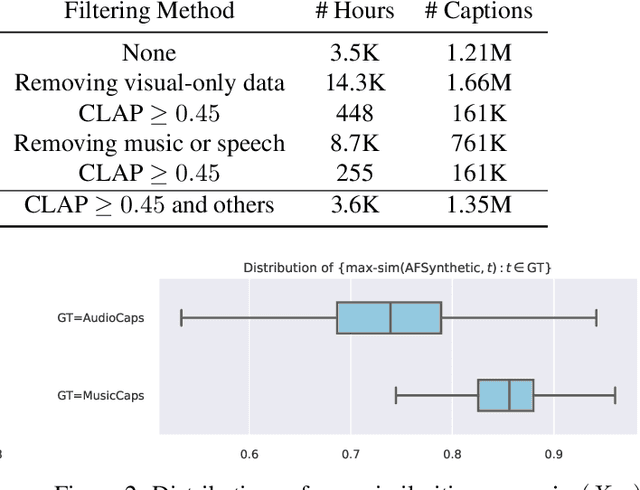
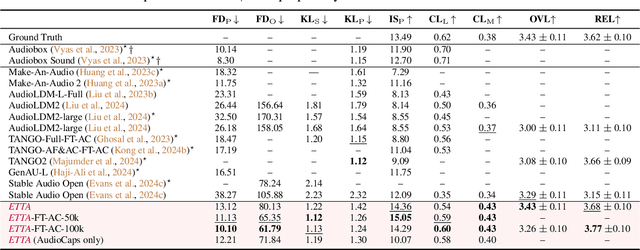
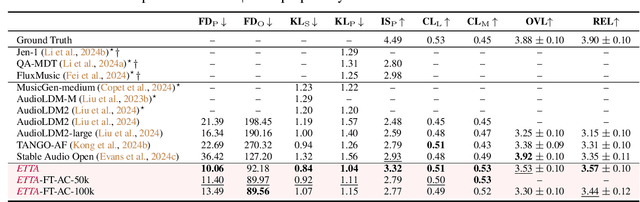
Recent years have seen significant progress in Text-To-Audio (TTA) synthesis, enabling users to enrich their creative workflows with synthetic audio generated from natural language prompts. Despite this progress, the effects of data, model architecture, training objective functions, and sampling strategies on target benchmarks are not well understood. With the purpose of providing a holistic understanding of the design space of TTA models, we set up a large-scale empirical experiment focused on diffusion and flow matching models. Our contributions include: 1) AF-Synthetic, a large dataset of high quality synthetic captions obtained from an audio understanding model; 2) a systematic comparison of different architectural, training, and inference design choices for TTA models; 3) an analysis of sampling methods and their Pareto curves with respect to generation quality and inference speed. We leverage the knowledge obtained from this extensive analysis to propose our best model dubbed Elucidated Text-To-Audio (ETTA). When evaluated on AudioCaps and MusicCaps, ETTA provides improvements over the baselines trained on publicly available data, while being competitive with models trained on proprietary data. Finally, we show ETTA's improved ability to generate creative audio following complex and imaginative captions -- a task that is more challenging than current benchmarks.