 Add to Chrome
 Add to Firefox
 Add to Edge
Multi Modal Entity Alignment
Papers and Code
Beyond Unimodal Shortcuts: MLLMs as Cross-Modal Reasoners for Grounded Named Entity Recognition
Feb 04, 2026
Grounded Multimodal Named Entity Recognition (GMNER) aims to extract text-based entities, assign them semantic categories, and ground them to corresponding visual regions. In this work, we explore the potential of Multimodal Large Language Models (MLLMs) to perform GMNER in an end-to-end manner, moving beyond their typical role as auxiliary tools within cascaded pipelines. Crucially, our investigation reveals a fundamental challenge: MLLMs exhibit $\textbf{modality bias}$, including visual bias and textual bias, which stems from their tendency to take unimodal shortcuts rather than rigorous cross-modal verification. To address this, we propose Modality-aware Consistency Reasoning ($\textbf{MCR}$), which enforces structured cross-modal reasoning through Multi-style Reasoning Schema Injection (MRSI) and Constraint-guided Verifiable Optimization (CVO). MRSI transforms abstract constraints into executable reasoning chains, while CVO empowers the model to dynamically align its reasoning trajectories with Group Relative Policy Optimization (GRPO). Experiments on GMNER and visual grounding tasks demonstrate that MCR effectively mitigates modality bias and achieves superior performance compared to existing baselines.

MyGram: Modality-aware Graph Transformer with Global Distribution for Multi-modal Entity Alignment
Jan 17, 2026Multi-modal entity alignment aims to identify equivalent entities between two multi-modal Knowledge graphs by integrating multi-modal data, such as images and text, to enrich the semantic representations of entities. However, existing methods may overlook the structural contextual information within each modality, making them vulnerable to interference from shallow features. To address these challenges, we propose MyGram, a modality-aware graph transformer with global distribution for multi-modal entity alignment. Specifically, we develop a modality diffusion learning module to capture deep structural contextual information within modalities and enable fine-grained multi-modal fusion. In addition, we introduce a Gram Loss that acts as a regularization constraint by minimizing the volume of a 4-dimensional parallelotope formed by multi-modal features, thereby achieving global distribution consistency across modalities. We conduct experiments on five public datasets. Results show that MyGram outperforms baseline models, achieving a maximum improvement of 4.8% in Hits@1 on FBDB15K, 9.9% on FBYG15K, and 4.3% on DBP15K.
M$^3$KG-RAG: Multi-hop Multimodal Knowledge Graph-enhanced Retrieval-Augmented Generation
Dec 24, 2025Retrieval-Augmented Generation (RAG) has recently been extended to multimodal settings, connecting multimodal large language models (MLLMs) with vast corpora of external knowledge such as multimodal knowledge graphs (MMKGs). Despite their recent success, multimodal RAG in the audio-visual domain remains challenging due to 1) limited modality coverage and multi-hop connectivity of existing MMKGs, and 2) retrieval based solely on similarity in a shared multimodal embedding space, which fails to filter out off-topic or redundant knowledge. To address these limitations, we propose M$^3$KG-RAG, a Multi-hop Multimodal Knowledge Graph-enhanced RAG that retrieves query-aligned audio-visual knowledge from MMKGs, improving reasoning depth and answer faithfulness in MLLMs. Specifically, we devise a lightweight multi-agent pipeline to construct multi-hop MMKG (M$^3$KG), which contains context-enriched triplets of multimodal entities, enabling modality-wise retrieval based on input queries. Furthermore, we introduce GRASP (Grounded Retrieval And Selective Pruning), which ensures precise entity grounding to the query, evaluates answer-supporting relevance, and prunes redundant context to retain only knowledge essential for response generation. Extensive experiments across diverse multimodal benchmarks demonstrate that M$^3$KG-RAG significantly enhances MLLMs' multimodal reasoning and grounding over existing approaches.
CoFi-Dec: Hallucination-Resistant Decoding via Coarse-to-Fine Generative Feedback in Large Vision-Language Models
Dec 29, 2025Large Vision-Language Models (LVLMs) have achieved impressive progress in multi-modal understanding and generation. However, they still tend to produce hallucinated content that is inconsistent with the visual input, which limits their reliability in real-world applications. We propose \textbf{CoFi-Dec}, a training-free decoding framework that mitigates hallucinations by integrating generative self-feedback with coarse-to-fine visual conditioning. Inspired by the human visual process from global scene perception to detailed inspection, CoFi-Dec first generates two intermediate textual responses conditioned on coarse- and fine-grained views of the original image. These responses are then transformed into synthetic images using a text-to-image model, forming multi-level visual hypotheses that enrich grounding cues. To unify the predictions from these multiple visual conditions, we introduce a Wasserstein-based fusion mechanism that aligns their predictive distributions into a geometrically consistent decoding trajectory. This principled fusion reconciles high-level semantic consistency with fine-grained visual grounding, leading to more robust and faithful outputs. Extensive experiments on six hallucination-focused benchmarks show that CoFi-Dec substantially reduces both entity-level and semantic-level hallucinations, outperforming existing decoding strategies. The framework is model-agnostic, requires no additional training, and can be seamlessly applied to a wide range of LVLMs. The implementation is available at https://github.com/AI-Researcher-Team/CoFi-Dec.
Beyond Vision: Contextually Enriched Image Captioning with Multi-Modal Retrieva
Dec 23, 2025Real-world image captions often lack contextual depth, omitting crucial details such as event background, temporal cues, outcomes, and named entities that are not visually discernible. This gap limits the effectiveness of image understanding in domains like journalism, education, and digital archives, where richer, more informative descriptions are essential. To address this, we propose a multimodal pipeline that augments visual input with external textual knowledge. Our system retrieves semantically similar images using BEIT-3 (Flickr30k-384 and COCO-384) and SigLIP So-384, reranks them using ORB and SIFT for geometric alignment, and extracts contextual information from related articles via semantic search. A fine-tuned Qwen3 model with QLoRA then integrates this context with base captions generated by Instruct BLIP (Vicuna-7B) to produce event-enriched, context-aware descriptions. Evaluated on the OpenEvents v1 dataset, our approach generates significantly more informative captions compared to traditional methods, showing strong potential for real-world applications requiring deeper visual-textual understanding
MetaHGNIE: Meta-Path Induced Hypergraph Contrastive Learning in Heterogeneous Knowledge Graphs
Dec 13, 2025Node importance estimation (NIE) in heterogeneous knowledge graphs is a critical yet challenging task, essential for applications such as recommendation, knowledge reasoning, and question answering. Existing methods often rely on pairwise connections, neglecting high-order dependencies among multiple entities and relations, and they treat structural and semantic signals independently, hindering effective cross-modal integration. To address these challenges, we propose MetaHGNIE, a meta-path induced hypergraph contrastive learning framework for disentangling and aligning structural and semantic information. MetaHGNIE constructs a higher-order knowledge graph via meta-path sequences, where typed hyperedges capture multi-entity relational contexts. Structural dependencies are aggregated with local attention, while semantic representations are encoded through a hypergraph transformer equipped with sparse chunking to reduce redundancy. Finally, a multimodal fusion module integrates structural and semantic embeddings under contrastive learning with auxiliary supervision, ensuring robust cross-modal alignment. Extensive experiments on benchmark NIE datasets demonstrate that MetaHGNIE consistently outperforms state-of-the-art baselines. These results highlight the effectiveness of explicitly modeling higher-order interactions and cross-modal alignment in heterogeneous knowledge graphs. Our code is available at https://github.com/SEU-WENJIA/DualHNIE
LongT2IBench: A Benchmark for Evaluating Long Text-to-Image Generation with Graph-structured Annotations
Dec 10, 2025The increasing popularity of long Text-to-Image (T2I) generation has created an urgent need for automatic and interpretable models that can evaluate the image-text alignment in long prompt scenarios. However, the existing T2I alignment benchmarks predominantly focus on short prompt scenarios and only provide MOS or Likert scale annotations. This inherent limitation hinders the development of long T2I evaluators, particularly in terms of the interpretability of alignment. In this study, we contribute LongT2IBench, which comprises 14K long text-image pairs accompanied by graph-structured human annotations. Given the detail-intensive nature of long prompts, we first design a Generate-Refine-Qualify annotation protocol to convert them into textual graph structures that encompass entities, attributes, and relations. Through this transformation, fine-grained alignment annotations are achieved based on these granular elements. Finally, the graph-structed annotations are converted into alignment scores and interpretations to facilitate the design of T2I evaluation models. Based on LongT2IBench, we further propose LongT2IExpert, a LongT2I evaluator that enables multi-modal large language models (MLLMs) to provide both quantitative scores and structured interpretations through an instruction-tuning process with Hierarchical Alignment Chain-of-Thought (CoT). Extensive experiments and comparisons demonstrate the superiority of the proposed LongT2IExpert in alignment evaluation and interpretation. Data and code have been released in https://welldky.github.io/LongT2IBench-Homepage/.
Libra-MIL: Multimodal Prototypes Stereoscopic Infused with Task-specific Language Priors for Few-shot Whole Slide Image Classification
Nov 11, 2025While Large Language Models (LLMs) are emerging as a promising direction in computational pathology, the substantial computational cost of giga-pixel Whole Slide Images (WSIs) necessitates the use of Multi-Instance Learning (MIL) to enable effective modeling. A key challenge is that pathological tasks typically provide only bag-level labels, while instance-level descriptions generated by LLMs often suffer from bias due to a lack of fine-grained medical knowledge. To address this, we propose that constructing task-specific pathological entity prototypes is crucial for learning generalizable features and enhancing model interpretability. Furthermore, existing vision-language MIL methods often employ unidirectional guidance, limiting cross-modal synergy. In this paper, we introduce a novel approach, Multimodal Prototype-based Multi-Instance Learning, that promotes bidirectional interaction through a balanced information compression scheme. Specifically, we leverage a frozen LLM to generate task-specific pathological entity descriptions, which are learned as text prototypes. Concurrently, the vision branch learns instance-level prototypes to mitigate the model's reliance on redundant data. For the fusion stage, we employ the Stereoscopic Optimal Transport (SOT) algorithm, which is based on a similarity metric, thereby facilitating broader semantic alignment in a higher-dimensional space. We conduct few-shot classification and explainability experiments on three distinct cancer datasets, and the results demonstrate the superior generalization capabilities of our proposed method.
Looking Beyond the Obvious: A Survey on Abstract Concept Recognition for Video Understanding
Aug 28, 2025The automatic understanding of video content is advancing rapidly. Empowered by deeper neural networks and large datasets, machines are increasingly capable of understanding what is concretely visible in video frames, whether it be objects, actions, events, or scenes. In comparison, humans retain a unique ability to also look beyond concrete entities and recognize abstract concepts like justice, freedom, and togetherness. Abstract concept recognition forms a crucial open challenge in video understanding, where reasoning on multiple semantic levels based on contextual information is key. In this paper, we argue that the recent advances in foundation models make for an ideal setting to address abstract concept understanding in videos. Automated understanding of high-level abstract concepts is imperative as it enables models to be more aligned with human reasoning and values. In this survey, we study different tasks and datasets used to understand abstract concepts in video content. We observe that, periodically and over a long period, researchers have attempted to solve these tasks, making the best use of the tools available at their disposal. We advocate that drawing on decades of community experience will help us shed light on this important open grand challenge and avoid ``re-inventing the wheel'' as we start revisiting it in the era of multi-modal foundation models.
Mitigating Modality Bias in Multi-modal Entity Alignment from a Causal Perspective
Apr 29, 2025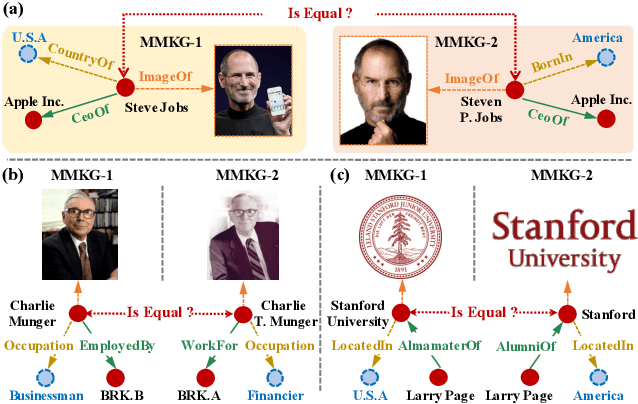
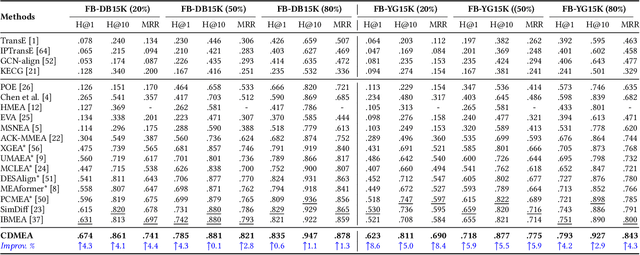
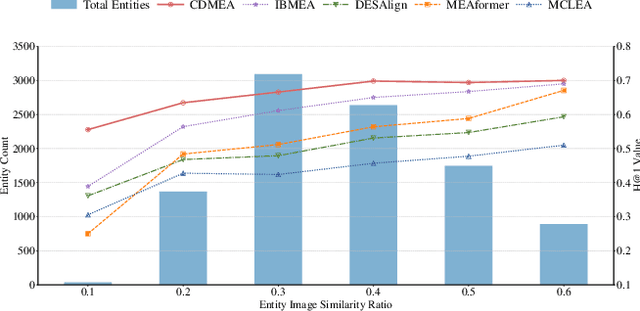
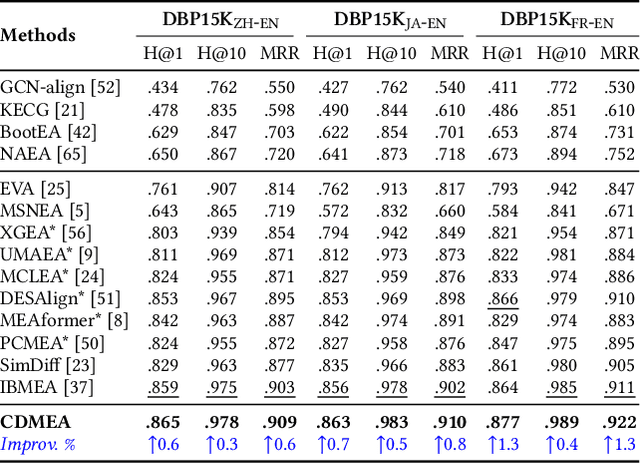
Multi-Modal Entity Alignment (MMEA) aims to retrieve equivalent entities from different Multi-Modal Knowledge Graphs (MMKGs), a critical information retrieval task. Existing studies have explored various fusion paradigms and consistency constraints to improve the alignment of equivalent entities, while overlooking that the visual modality may not always contribute positively. Empirically, entities with low-similarity images usually generate unsatisfactory performance, highlighting the limitation of overly relying on visual features. We believe the model can be biased toward the visual modality, leading to a shortcut image-matching task. To address this, we propose a counterfactual debiasing framework for MMEA, termed CDMEA, which investigates visual modality bias from a causal perspective. Our approach aims to leverage both visual and graph modalities to enhance MMEA while suppressing the direct causal effect of the visual modality on model predictions. By estimating the Total Effect (TE) of both modalities and excluding the Natural Direct Effect (NDE) of the visual modality, we ensure that the model predicts based on the Total Indirect Effect (TIE), effectively utilizing both modalities and reducing visual modality bias. Extensive experiments on 9 benchmark datasets show that CDMEA outperforms 14 state-of-the-art methods, especially in low-similarity, high-noise, and low-resource data scenarios.