 Add to Chrome
 Add to Firefox
 Add to Edge
Beyond Patches: Superpixel Token-based Transformers for Attribute-Specific Fashion Retrieval
Jun 09, 2026
Attribute-Specific Fashion Retrieval (ASFR) aims to improve fine-grained image retrieval by focusing on specific attributes. However, existing patch-based attention and Transformer methods often misalign with irregular attribute regions and are prone to background noise, limiting their ability to capture subtle, pixel-level microstructures. To tackle these challenges, we propose SuperFashion, the first ASFR framework that adopts superpixel tokens within a Transformer architecture. SuperFashion initially employs an attribute-guided attention mechanism to extract attribute-related features, which in turn guide the cropping of semantically meaningful image regions. Superpixel segmentation is then leveraged on these regions to generate compact, semantically coherent superpixel tokens. By incorporating modality-specific embeddings for both attribute and superpixel tokens, the superpixel token-based Transformer facilitates adaptive interaction and fusion, thereby enhancing attribute localization and discrimination. Extensive experiments on FashionAI, DARN, and DeepFashion demonstrate relative overall MAP improvements of 1.84%, 9.27%, and 9.35% over prior SOTA. SuperFashion offers a new solution for web-based image retrieval.
* 9 pages, 5 figures. Published in the Proceedings of the ACM Web Conference 2026 (WWW '26). Author version with minor corrections; results and conclusions unchanged

MemAudit: Post-hoc Auditing of Poisoned Agent Memory via Causal Attribution and Structural Anomaly Detection
May 22, 2026Large language model agents increasingly rely on persistent memory to store past interactions, retrieve relevant demonstrations, and improve long-horizon task execution. However, this memory mechanism also creates a practical security vulnerability: an adversarial user may inject malicious records into the agent's memory through ordinary interaction, and these records can later be retrieved to steer the agent's reasoning and actions. Existing defenses primarily focus on online intervention, such as prompt filtering or output blocking, but they do not address the post-hoc question of which stored memories are responsible after harmful behavior has already been observed. We propose \textbf{MemAudit}, a post-hoc causal memory auditing framework for memory-augmented LLM agents. The framework combines two complementary signals: (1) a counterfactual memory influence score that measures each memory's causal contribution to harmful outputs, and (2) a memory consistency graph that identifies structurally anomalous memories within the broader memory store. We evaluate MemAudit against MINJA, a query-only memory injection attack in which malicious records are generated and stored through normal agent interactions rather than direct memory-bank modification. Across both QA and reasoning-agent settings, MemAudit substantially reduces attack success rates under realistic post-hoc auditing scenarios. The results show that QA attack success is reduced from $70\%$ to $0\%$, while RAP attack success drops from $83.3\%$ to $0\%$.
TriPlay-RL: Tri-Role Self-Play Reinforcement Learning for LLM Safety Alignment
Jan 26, 2026In recent years, safety risks associated with large language models have become increasingly prominent, highlighting the urgent need to mitigate the generation of toxic and harmful content. The mainstream paradigm for LLM safety alignment typically adopts a collaborative framework involving three roles: an attacker for adversarial prompt generation, a defender for safety defense, and an evaluator for response assessment. In this paper, we propose a closed-loop reinforcement learning framework called TriPlay-RL that enables iterative and co-improving collaboration among three roles with near-zero manual annotation. Experimental results show that the attacker preserves high output diversity while achieving a 20%-50% improvement in adversarial effectiveness; the defender attains 10%-30% gains in safety performance without degrading general reasoning capability; and the evaluator continuously refines its fine-grained judgment ability through iterations, accurately distinguishing unsafe responses, simple refusals, and useful guidance. Overall, our framework establishes an efficient and scalable paradigm for LLM safety alignment, enabling continuous co-evolution within a unified learning loop.
Mitigating Modality Bias in Multi-modal Entity Alignment from a Causal Perspective
Apr 29, 2025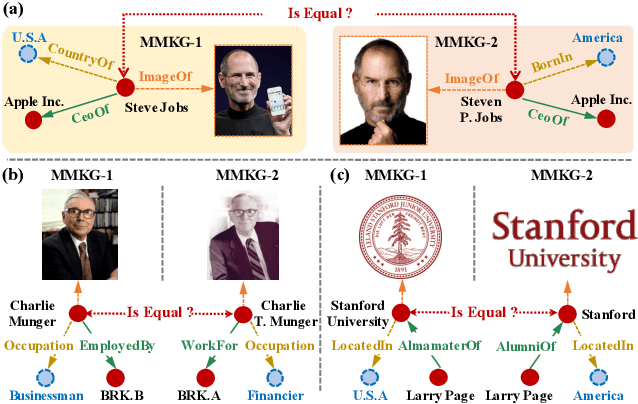
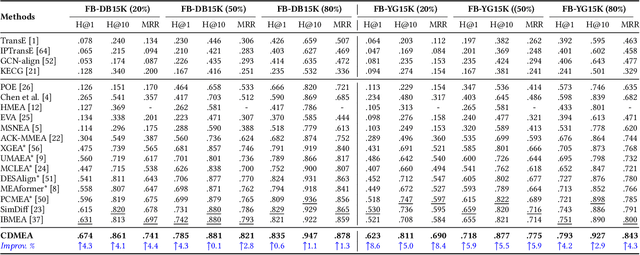
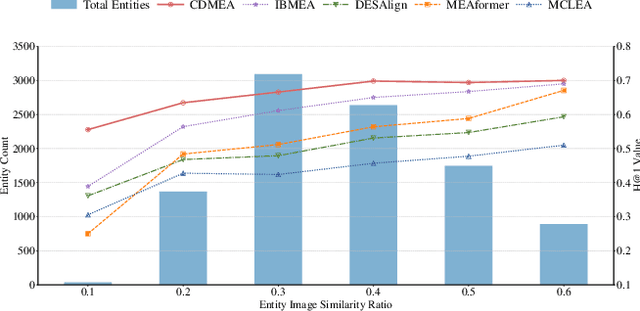
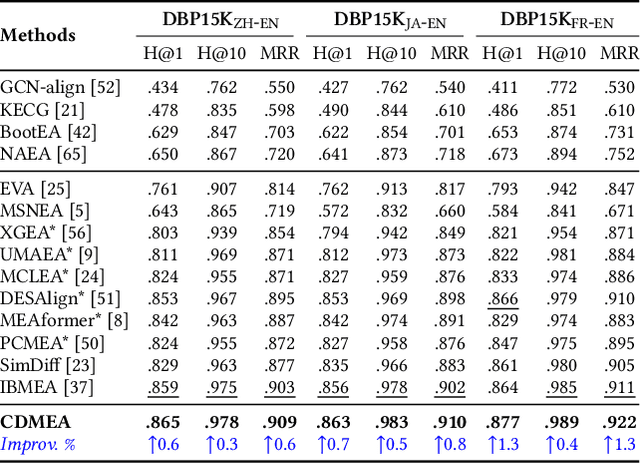
Multi-Modal Entity Alignment (MMEA) aims to retrieve equivalent entities from different Multi-Modal Knowledge Graphs (MMKGs), a critical information retrieval task. Existing studies have explored various fusion paradigms and consistency constraints to improve the alignment of equivalent entities, while overlooking that the visual modality may not always contribute positively. Empirically, entities with low-similarity images usually generate unsatisfactory performance, highlighting the limitation of overly relying on visual features. We believe the model can be biased toward the visual modality, leading to a shortcut image-matching task. To address this, we propose a counterfactual debiasing framework for MMEA, termed CDMEA, which investigates visual modality bias from a causal perspective. Our approach aims to leverage both visual and graph modalities to enhance MMEA while suppressing the direct causal effect of the visual modality on model predictions. By estimating the Total Effect (TE) of both modalities and excluding the Natural Direct Effect (NDE) of the visual modality, we ensure that the model predicts based on the Total Indirect Effect (TIE), effectively utilizing both modalities and reducing visual modality bias. Extensive experiments on 9 benchmark datasets show that CDMEA outperforms 14 state-of-the-art methods, especially in low-similarity, high-noise, and low-resource data scenarios.