 Add to Chrome
 Add to Firefox
 Add to Edge
FDP: A Frequency-Decomposition Preprocessing Pipeline for Unsupervised Anomaly Detection in Brain MRI
Nov 17, 2025
Due to the diversity of brain anatomy and the scarcity of annotated data, supervised anomaly detection for brain MRI remains challenging, driving the development of unsupervised anomaly detection (UAD) approaches. Current UAD methods typically utilize artificially generated noise perturbations on healthy MRIs to train generative models for normal anatomy reconstruction, enabling anomaly detection via residual mapping. However, such simulated anomalies lack the biophysical fidelity and morphological complexity characteristic of true clinical lesions. To advance UAD in brain MRI, we conduct the first systematic frequency-domain analysis of pathological signatures, revealing two key properties: (1) anomalies exhibit unique frequency patterns distinguishable from normal anatomy, and (2) low-frequency signals maintain consistent representations across healthy scans. These insights motivate our Frequency-Decomposition Preprocessing (FDP) framework, the first UAD method to leverage frequency-domain reconstruction for simultaneous pathology suppression and anatomical preservation. FDP can integrate seamlessly with existing anomaly simulation techniques, consistently enhancing detection performance across diverse architectures while maintaining diagnostic fidelity. Experimental results demonstrate that FDP consistently improves anomaly detection performance when integrated with existing methods. Notably, FDP achieves a 17.63% increase in DICE score with LDM while maintaining robust improvements across multiple baselines. The code is available at https://github.com/ls1rius/MRI_FDP.

Libra-MIL: Multimodal Prototypes Stereoscopic Infused with Task-specific Language Priors for Few-shot Whole Slide Image Classification
Nov 11, 2025While Large Language Models (LLMs) are emerging as a promising direction in computational pathology, the substantial computational cost of giga-pixel Whole Slide Images (WSIs) necessitates the use of Multi-Instance Learning (MIL) to enable effective modeling. A key challenge is that pathological tasks typically provide only bag-level labels, while instance-level descriptions generated by LLMs often suffer from bias due to a lack of fine-grained medical knowledge. To address this, we propose that constructing task-specific pathological entity prototypes is crucial for learning generalizable features and enhancing model interpretability. Furthermore, existing vision-language MIL methods often employ unidirectional guidance, limiting cross-modal synergy. In this paper, we introduce a novel approach, Multimodal Prototype-based Multi-Instance Learning, that promotes bidirectional interaction through a balanced information compression scheme. Specifically, we leverage a frozen LLM to generate task-specific pathological entity descriptions, which are learned as text prototypes. Concurrently, the vision branch learns instance-level prototypes to mitigate the model's reliance on redundant data. For the fusion stage, we employ the Stereoscopic Optimal Transport (SOT) algorithm, which is based on a similarity metric, thereby facilitating broader semantic alignment in a higher-dimensional space. We conduct few-shot classification and explainability experiments on three distinct cancer datasets, and the results demonstrate the superior generalization capabilities of our proposed method.
Dynamic Entity-Masked Graph Diffusion Model for histopathological image Representation Learning
Dec 13, 2024
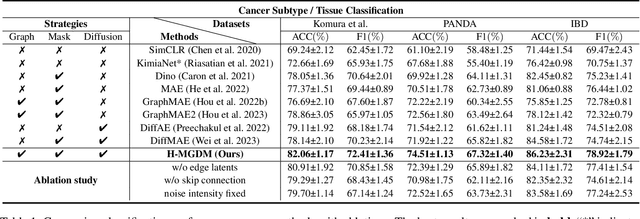


Significant disparities between the features of natural images and those inherent to histopathological images make it challenging to directly apply and transfer pre-trained models from natural images to histopathology tasks. Moreover, the frequent lack of annotations in histopathology patch images has driven researchers to explore self-supervised learning methods like mask reconstruction for learning representations from large amounts of unlabeled data. Crucially, previous mask-based efforts in self-supervised learning have often overlooked the spatial interactions among entities, which are essential for constructing accurate representations of pathological entities. To address these challenges, constructing graphs of entities is a promising approach. In addition, the diffusion reconstruction strategy has recently shown superior performance through its random intensity noise addition technique to enhance the robust learned representation. Therefore, we introduce H-MGDM, a novel self-supervised Histopathology image representation learning method through the Dynamic Entity-Masked Graph Diffusion Model. Specifically, we propose to use complementary subgraphs as latent diffusion conditions and self-supervised targets respectively during pre-training. We note that the graph can embed entities' topological relationships and enhance representation. Dynamic conditions and targets can improve pathological fine reconstruction. Our model has conducted pretraining experiments on three large histopathological datasets. The advanced predictive performance and interpretability of H-MGDM are clearly evaluated on comprehensive downstream tasks such as classification and survival analysis on six datasets. Our code will be publicly available at https://github.com/centurion-crawler/H-MGDM.