 Add to Chrome
 Add to Firefox
 Add to Edge
MMArt A Multi-Perspective Multimodal Dataset for Visual Art Understanding
Aug 11, 2026
Recent vision-language models demonstrate impressive general visual understanding, yet their art interpretation remains shallow: they describe surface content but struggle with formal analysis, grounded historical interpretation, or affective characterization. We argue this is not only a model but also a dataset limitation. Existing art datasets are single perspective resources, where no dataset provides narrative, formal, emotional, and historical perspectives simultaneously for the same artworks. We introduce MMArt, a large-scale dataset of 74,234 WikiArt paintings, each annotated with four independently annotated perspectives plus a harmonized unified caption, produced by specialized vision-language models or human annotation and validated through complementary quality evaluations. Two complementarity analyses establish that perspectives encode genuinely distinct information. A generative analysis shows that formal analysis descriptions best preserve compositional style, and historical descriptions carry strong affective signal in reconstructed images. A discriminative retrieval analysis reveals task-asymmetry: narrative descriptions drive retrieval (R@1 = 44.0%), while formal descriptions, strongest for reconstruction, are nearly nondiscriminative at retrieval scale (R@1 = 7.8%). Leave-one-out analysis further confirms that historical descriptions are the least replaceable perspective across both tasks. Together, the two analyses establish that no single perspective suffices for all tasks, directly motivating MMArt multi-perspective design. The dataset, code, and additional information are available at https://shuaiwang97.github.io/MMArt/.

A-MAR: Agent-based Multimodal Art Retrieval for Fine-Grained Artwork Understanding
Apr 21, 2026Understanding artworks requires multi-step reasoning over visual content and cultural, historical, and stylistic context. While recent multimodal large language models show promise in artwork explanation, they rely on implicit reasoning and internalized knowl- edge, limiting interpretability and explicit evidence grounding. We propose A-MAR, an Agent-based Multimodal Art Retrieval framework that explicitly conditions retrieval on structured reasoning plans. Given an artwork and a user query, A-MAR first decomposes the task into a structured reasoning plan that specifies the goals and evidence requirements for each step. Retrieval is then conditionedon this plan, enabling targeted evidence selection and supporting step-wise, grounded explanations. To evaluate agent-based multi- modal reasoning within the art domain, we introduce ArtCoT-QA. This diagnostic benchmark features multi-step reasoning chains for diverse art-related queries, enabling a granular analysis that extends beyond simple final answer accuracy. Experiments on SemArt and Artpedia show that A-MAR consistently outperforms static, non planned retrieval and strong MLLM baselines in final explanation quality, while evaluations on ArtCoT-QA further demonstrate its advantages in evidence grounding and multi-step reasoning ability. These results highlight the importance of reasoning-conditioned retrieval for knowledge-intensive multimodal understanding and position A-MAR as a step toward interpretable, goal-driven AI systems, with particular relevance to cultural industries. The code and data are available at: https://github.com/ShuaiWang97/A-MAR.
A Novel Automatic Framework for Speaker Drift Detection in Synthesized Speech
Apr 07, 2026Recent diffusion-based text-to-speech (TTS) models achieve high naturalness and expressiveness, yet often suffer from speaker drift, a subtle, gradual shift in perceived speaker identity within a single utterance. This underexplored phenomenon undermines the coherence of synthetic speech, especially in long-form or interactive settings. We introduce the first automatic framework for detecting speaker drift by formulating it as a binary classification task over utterance-level speaker consistency. Our method computes cosine similarity across overlapping segments of synthesized speech and prompts large language models (LLMs) with structured representations to assess drift. We provide theoretical guarantees for cosine-based drift detection and demonstrate that speaker embeddings exhibit meaningful geometric clustering on the unit sphere. To support evaluation, we construct a high-quality synthetic benchmark with human-validated speaker drift annotations. Experiments with multiple state-of-the-art LLMs confirm the viability of this embedding-to-reasoning pipeline. Our work establishes speaker drift as a standalone research problem and bridges geometric signal analysis with LLM-based perceptual reasoning in modern TTS.
VL-KGE: Vision-Language Models Meet Knowledge Graph Embeddings
Mar 02, 2026Real-world multimodal knowledge graphs (MKGs) are inherently heterogeneous, modeling entities that are associated with diverse modalities. Traditional knowledge graph embedding (KGE) methods excel at learning continuous representations of entities and relations, yet they are typically designed for unimodal settings. Recent approaches extend KGE to multimodal settings but remain constrained, often processing modalities in isolation, resulting in weak cross-modal alignment, and relying on simplistic assumptions such as uniform modality availability across entities. Vision-Language Models (VLMs) offer a powerful way to align diverse modalities within a shared embedding space. We propose Vision-Language Knowledge Graph Embeddings (VL-KGE), a framework that integrates cross-modal alignment from VLMs with structured relational modeling to learn unified multimodal representations of knowledge graphs. Experiments on WN9-IMG and two novel fine art MKGs, WikiArt-MKG-v1 and WikiArt-MKG-v2, demonstrate that VL-KGE consistently improves over traditional unimodal and multimodal KGE methods in link prediction tasks. Our results highlight the value of VLMs for multimodal KGE, enabling more robust and structured reasoning over large-scale heterogeneous knowledge graphs.
* Published in Proceedings of the ACM Web Conference 2026 (WWW '26). This arXiv version includes extended supplementary material
SAM3-LiteText: An Anatomical Study of the SAM3 Text Encoder for Efficient Vision-Language Segmentation
Feb 12, 2026Vision-language segmentation models such as SAM3 enable flexible, prompt-driven visual grounding, but inherit large, general-purpose text encoders originally designed for open-ended language understanding. In practice, segmentation prompts are short, structured, and semantically constrained, leading to substantial over-provisioning in text encoder capacity and persistent computational and memory overhead. In this paper, we perform a large-scale anatomical analysis of text prompting in vision-language segmentation, covering 404,796 real prompts across multiple benchmarks. Our analysis reveals severe redundancy: most context windows are underutilized, vocabulary usage is highly sparse, and text embeddings lie on low-dimensional manifold despite high-dimensional representations. Motivated by these findings, we propose SAM3-LiteText, a lightweight text encoding framework that replaces the original SAM3 text encoder with a compact MobileCLIP student that is optimized by knowledge distillation. Extensive experiments on image and video segmentation benchmarks show that SAM3-LiteText reduces text encoder parameters by up to 88%, substantially reducing static memory footprint, while maintaining segmentation performance comparable to the original model. Code: https://github.com/SimonZeng7108/efficientsam3/tree/sam3_litetext.
Looking Beyond the Obvious: A Survey on Abstract Concept Recognition for Video Understanding
Aug 28, 2025The automatic understanding of video content is advancing rapidly. Empowered by deeper neural networks and large datasets, machines are increasingly capable of understanding what is concretely visible in video frames, whether it be objects, actions, events, or scenes. In comparison, humans retain a unique ability to also look beyond concrete entities and recognize abstract concepts like justice, freedom, and togetherness. Abstract concept recognition forms a crucial open challenge in video understanding, where reasoning on multiple semantic levels based on contextual information is key. In this paper, we argue that the recent advances in foundation models make for an ideal setting to address abstract concept understanding in videos. Automated understanding of high-level abstract concepts is imperative as it enables models to be more aligned with human reasoning and values. In this survey, we study different tasks and datasets used to understand abstract concepts in video content. We observe that, periodically and over a long period, researchers have attempted to solve these tasks, making the best use of the tools available at their disposal. We advocate that drawing on decades of community experience will help us shed light on this important open grand challenge and avoid ``re-inventing the wheel'' as we start revisiting it in the era of multi-modal foundation models.
ArtRAG: Retrieval-Augmented Generation with Structured Context for Visual Art Understanding
May 09, 2025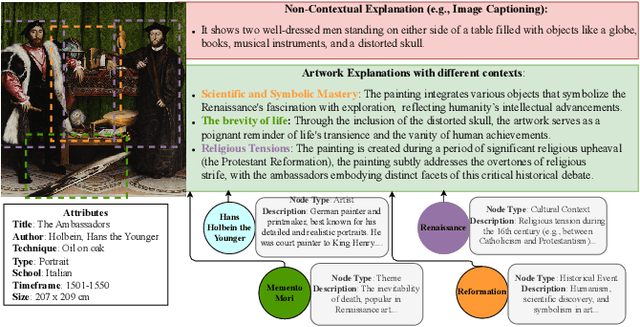
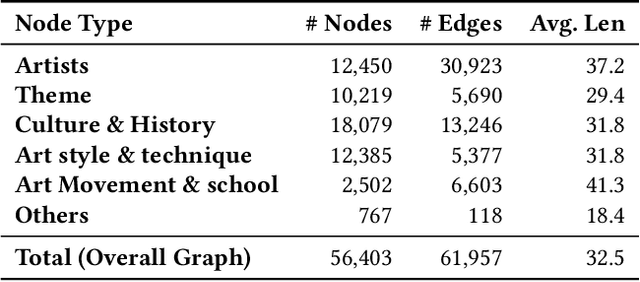

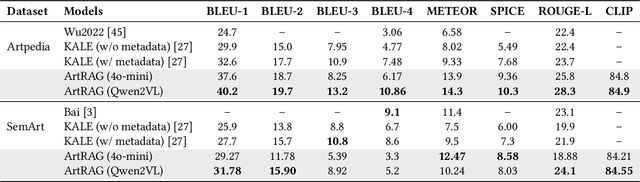
Understanding visual art requires reasoning across multiple perspectives -- cultural, historical, and stylistic -- beyond mere object recognition. While recent multimodal large language models (MLLMs) perform well on general image captioning, they often fail to capture the nuanced interpretations that fine art demands. We propose ArtRAG, a novel, training-free framework that combines structured knowledge with retrieval-augmented generation (RAG) for multi-perspective artwork explanation. ArtRAG automatically constructs an Art Context Knowledge Graph (ACKG) from domain-specific textual sources, organizing entities such as artists, movements, themes, and historical events into a rich, interpretable graph. At inference time, a multi-granular structured retriever selects semantically and topologically relevant subgraphs to guide generation. This enables MLLMs to produce contextually grounded, culturally informed art descriptions. Experiments on the SemArt and Artpedia datasets show that ArtRAG outperforms several heavily trained baselines. Human evaluations further confirm that ArtRAG generates coherent, insightful, and culturally enriched interpretations.
The CASTLE 2024 Dataset: Advancing the Art of Multimodal Understanding
Mar 21, 2025Egocentric video has seen increased interest in recent years, as it is used in a range of areas. However, most existing datasets are limited to a single perspective. In this paper, we present the CASTLE 2024 dataset, a multimodal collection containing ego- and exo-centric (i.e., first- and third-person perspective) video and audio from 15 time-aligned sources, as well as other sensor streams and auxiliary data. The dataset was recorded by volunteer participants over four days in a fixed location and includes the point of view of 10 participants, with an additional 5 fixed cameras providing an exocentric perspective. The entire dataset contains over 600 hours of UHD video recorded at 50 frames per second. In contrast to other datasets, CASTLE 2024 does not contain any partial censoring, such as blurred faces or distorted audio. The dataset is available via https://castle-dataset.github.io/.
Gradient Weight-normalized Low-rank Projection for Efficient LLM Training
Dec 27, 2024Large Language Models (LLMs) have shown remarkable performance across various tasks, but the escalating demands on computational resources pose significant challenges, particularly in the extensive utilization of full fine-tuning for downstream tasks. To address this, parameter-efficient fine-tuning (PEFT) methods have been developed, but they often underperform compared to full fine-tuning and struggle with memory efficiency. In this work, we introduce Gradient Weight-Normalized Low-Rank Projection (GradNormLoRP), a novel approach that enhances both parameter and memory efficiency while maintaining comparable performance to full fine-tuning. GradNormLoRP normalizes the weight matrix to improve gradient conditioning, facilitating better convergence during optimization. Additionally, it applies low-rank approximations to the weight and gradient matrices, significantly reducing memory usage during training. Extensive experiments demonstrate that our 8-bit GradNormLoRP reduces optimizer memory usage by up to 89.5% and enables the pre-training of large LLMs, such as LLaMA 7B, on consumer-level GPUs like the NVIDIA RTX 4090, without additional inference costs. Moreover, GradNormLoRP outperforms existing low-rank methods in fine-tuning tasks. For instance, when fine-tuning the RoBERTa model on all GLUE tasks with a rank of 8, GradNormLoRP achieves an average score of 80.65, surpassing LoRA's score of 79.23. These results underscore GradNormLoRP as a promising alternative for efficient LLM pre-training and fine-tuning. Source code and Appendix: https://github.com/Jhhuangkay/Gradient-Weight-normalized-Low-rank-Projection-for-Efficient-LLM-Training
Non-Progressive Influence Maximization in Dynamic Social Networks
Dec 10, 2024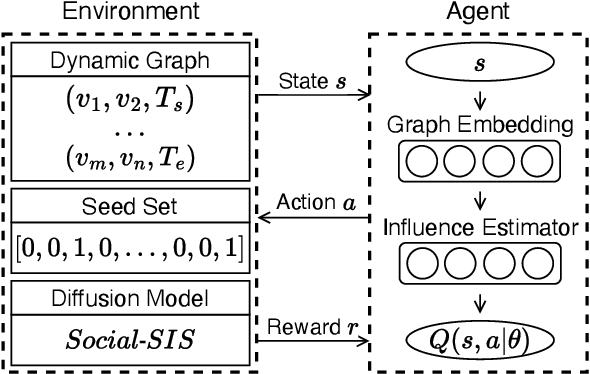
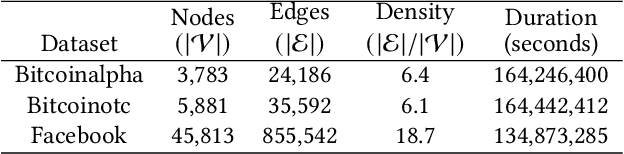
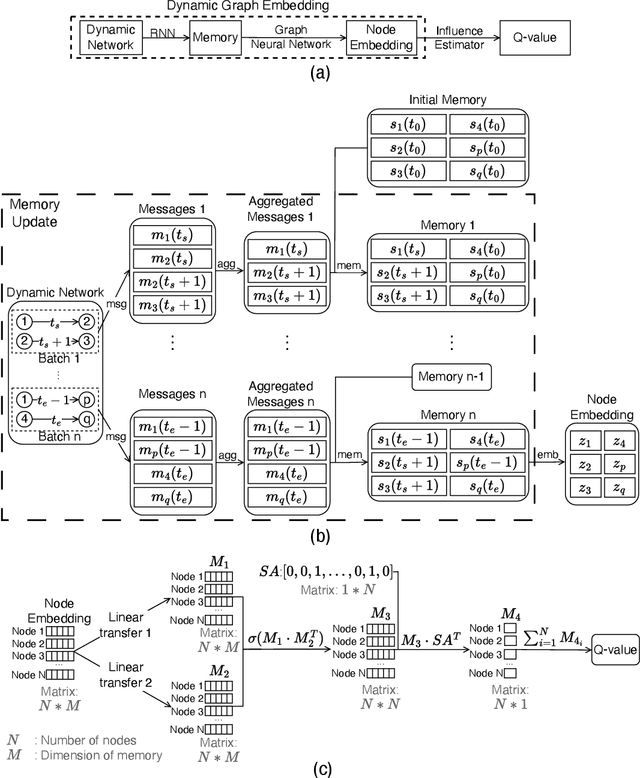
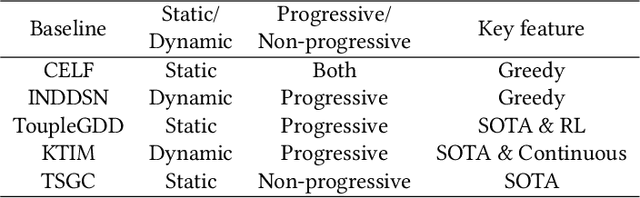
The influence maximization (IM) problem involves identifying a set of key individuals in a social network who can maximize the spread of influence through their network connections. With the advent of geometric deep learning on graphs, great progress has been made towards better solutions for the IM problem. In this paper, we focus on the dynamic non-progressive IM problem, which considers the dynamic nature of real-world social networks and the special case where the influence diffusion is non-progressive, i.e., nodes can be activated multiple times. We first extend an existing diffusion model to capture the non-progressive influence propagation in dynamic social networks. We then propose the method, DNIMRL, which employs deep reinforcement learning and dynamic graph embedding to solve the dynamic non-progressive IM problem. In particular, we propose a novel algorithm that effectively leverages graph embedding to capture the temporal changes of dynamic networks and seamlessly integrates with deep reinforcement learning. The experiments, on different types of real-world social network datasets, demonstrate that our method outperforms state-of-the-art baselines.