 Add to Chrome
 Add to Firefox
 Add to Edge
Self-supervised Adversarial Purification for Graph Neural Networks
May 28, 2026
Defending Graph Neural Networks (GNNs) against adversarial attacks requires balancing accuracy and robustness, a trade-off often mishandled by traditional methods like adversarial training that intertwine these conflicting objectives within a single classifier. To overcome this limitation, we propose a self-supervised adversarial purification framework. We separate robustness from the classifier by introducing a dedicated purifier, which cleanses the input data before classification. In contrast to prior adversarial purification methods, we propose GPR-GAE, a novel graph auto-encoder (GAE), as a specialized purifier trained with a self-supervised strategy, adapting to diverse graph structures in a data-driven manner. Utilizing multiple Generalized PageRank (GPR) filters, GPR-GAE captures diverse structural representations for robust and effective purification. Our multi-step purification process further facilitates GPR-GAE to achieve precise graph recovery and robust defense against structural perturbations. Experiments across diverse datasets and attack scenarios demonstrate the state-of-the-art robustness of GPR-GAE, showcasing it as an independent plug-and-play purifier for GNN classifiers.
* Accepted at ICML 2025. 21 pages. Code is available at: https://github.com/woodavid31/GPR-GAE

VGenST-Bench: A Benchmark for Spatio-Temporal Reasoning via Active Video Synthesis
May 21, 2026Spatio-temporal reasoning is a core capability for Multimodal Large Language Models (MLLMs) operating in the real world. As such, evaluating it precisely has become an essential challenge. However, existing spatio-temporal reasoning benchmark datasets primarily rely on static image sets or passively curated video data, which limits the evaluation of fine-grained reasoning capabilities. In this paper, we introduce VGenST-Bench, a video benchmark that employs generative models to actively synthesize highly controlled and diverse evaluation scenarios. To construct VGenST-Bench, we propose a multi-agent pipeline incorporating a human quality control stage, ensuring the quality of all generated videos and QA pairs. We establish a comprehensive 3x2x2 video taxonomy, encompassing Spatial Scale, Perspective, and Scene Dynamics to span diverse scenarios. Furthermore, we design a hierarchical task suite that decouples low-level visual perception from high-level spatio-temporal reasoning. By shifting the paradigm from passive curation to active synthesis, VGenST-Bench enables fine-grained diagnosis of spatio-temporal understanding in MLLMs.
JUDO: A Juxtaposed Domain-Oriented Multimodal Reasoner for Industrial Anomaly QA
May 19, 2026Industrial anomaly detection has been significantly advanced by Large Multimodal Models (LMMs), enabling diverse human instructions beyond detection, particularly through visually grounded reasoning for better image understanding. However, LMMs lack domain-specific knowledge, which limits their ability to generate accurate responses in complex industrial scenarios. In this work, we present JUDO, Juxtaposed Domain-Oriented Multimodal Reasoner, a framework that efficiently incorporates domain knowledge and context in visual and textual reasoning. Through visual reasoning, our model segments the defect region by juxtaposing query images with normal images as visual domain context, enabling a fine-grained visual comparative inspection. Furthermore, we inject domain knowledge through supervised fine-tuning (SFT) to enhance context understanding and subsequently guide domain reasoning through reinforcement learning (GRPO) with tailored rewards, opting for a domain-oriented reasoning process. Experimental results demonstrate that JUDO achieves superior performance on the MMAD benchmark, surpassing models such as Qwen2.5-VL-7B and GPT-4o. These results highlight the importance of enhancing domain knowledge and context for effective reasoning in anomaly understanding.
Group3D: MLLM-Driven Semantic Grouping for Open-Vocabulary 3D Object Detection
Mar 23, 2026Open-vocabulary 3D object detection aims to localize and recognize objects beyond a fixed training taxonomy. In multi-view RGB settings, recent approaches often decouple geometry-based instance construction from semantic labeling, generating class-agnostic fragments and assigning open-vocabulary categories post hoc. While flexible, such decoupling leaves instance construction governed primarily by geometric consistency, without semantic constraints during merging. When geometric evidence is view-dependent and incomplete, this geometry-only merging can lead to irreversible association errors, including over-merging of distinct objects or fragmentation of a single instance. We propose Group3D, a multi-view open-vocabulary 3D detection framework that integrates semantic constraints directly into the instance construction process. Group3D maintains a scene-adaptive vocabulary derived from a multimodal large language model (MLLM) and organizes it into semantic compatibility groups that encode plausible cross-view category equivalence. These groups act as merge-time constraints: 3D fragments are associated only when they satisfy both semantic compatibility and geometric consistency. This semantically gated merging mitigates geometry-driven over-merging while absorbing multi-view category variability. Group3D supports both pose-known and pose-free settings, relying only on RGB observations. Experiments on ScanNet and ARKitScenes demonstrate that Group3D achieves state-of-the-art performance in multi-view open-vocabulary 3D detection, while exhibiting strong generalization in zero-shot scenarios. The project page is available at https://ubin108.github.io/Group3D/.
Low-pass Personalized Subgraph Federated Recommendation
Mar 20, 2026Federated Recommender Systems (FRS) preserve privacy by training decentralized models on client-specific user-item subgraphs without sharing raw data. However, FRS faces a unique challenge: subgraph structural imbalance, where drastic variations in subgraph scale (user/item counts) and connectivity (item degree) misalign client representations, making it challenging to train a robust model that respects each client's unique structural characteristics. To address this, we propose a Low-pass Personalized Subgraph Federated recommender system (LPSFed). LPSFed leverages graph Fourier transforms and low-pass spectral filtering to extract low-frequency structural signals that remain stable across subgraphs of varying size and degree, allowing robust personalized parameter updates guided by similarity to a neutral structural anchor. Additionally, we leverage a localized popularity bias-aware margin that captures item-degree imbalance within each subgraph and incorporates it into a personalized bias correction term to mitigate recommendation bias. Supported by theoretical analysis and validated on five real-world datasets, LPSFed achieves superior recommendation accuracy and enhances model robustness.
M$^3$KG-RAG: Multi-hop Multimodal Knowledge Graph-enhanced Retrieval-Augmented Generation
Dec 24, 2025Retrieval-Augmented Generation (RAG) has recently been extended to multimodal settings, connecting multimodal large language models (MLLMs) with vast corpora of external knowledge such as multimodal knowledge graphs (MMKGs). Despite their recent success, multimodal RAG in the audio-visual domain remains challenging due to 1) limited modality coverage and multi-hop connectivity of existing MMKGs, and 2) retrieval based solely on similarity in a shared multimodal embedding space, which fails to filter out off-topic or redundant knowledge. To address these limitations, we propose M$^3$KG-RAG, a Multi-hop Multimodal Knowledge Graph-enhanced RAG that retrieves query-aligned audio-visual knowledge from MMKGs, improving reasoning depth and answer faithfulness in MLLMs. Specifically, we devise a lightweight multi-agent pipeline to construct multi-hop MMKG (M$^3$KG), which contains context-enriched triplets of multimodal entities, enabling modality-wise retrieval based on input queries. Furthermore, we introduce GRASP (Grounded Retrieval And Selective Pruning), which ensures precise entity grounding to the query, evaluates answer-supporting relevance, and prunes redundant context to retain only knowledge essential for response generation. Extensive experiments across diverse multimodal benchmarks demonstrate that M$^3$KG-RAG significantly enhances MLLMs' multimodal reasoning and grounding over existing approaches.
Balancing Graph Embedding Smoothness in Self-Supervised Learning via Information-Theoretic Decomposition
Apr 16, 2025Self-supervised learning (SSL) in graphs has garnered significant attention, particularly in employing Graph Neural Networks (GNNs) with pretext tasks initially designed for other domains, such as contrastive learning and feature reconstruction. However, it remains uncertain whether these methods effectively reflect essential graph properties, precisely representation similarity with its neighbors. We observe that existing methods position opposite ends of a spectrum driven by the graph embedding smoothness, with each end corresponding to outperformance on specific downstream tasks. Decomposing the SSL objective into three terms via an information-theoretic framework with a neighbor representation variable reveals that this polarization stems from an imbalance among the terms, which existing methods may not effectively maintain. Further insights suggest that balancing between the extremes can lead to improved performance across a wider range of downstream tasks. A framework, BSG (Balancing Smoothness in Graph SSL), introduces novel loss functions designed to supplement the representation quality in graph-based SSL by balancing the derived three terms: neighbor loss, minimal loss, and divergence loss. We present a theoretical analysis of the effects of these loss functions, highlighting their significance from both the SSL and graph smoothness perspectives. Extensive experiments on multiple real-world datasets across node classification and link prediction consistently demonstrate that BSG achieves state-of-the-art performance, outperforming existing methods. Our implementation code is available at https://github.com/steve30572/BSG.
Large Language Models Are Better Logical Fallacy Reasoners with Counterargument, Explanation, and Goal-Aware Prompt Formulation
Mar 30, 2025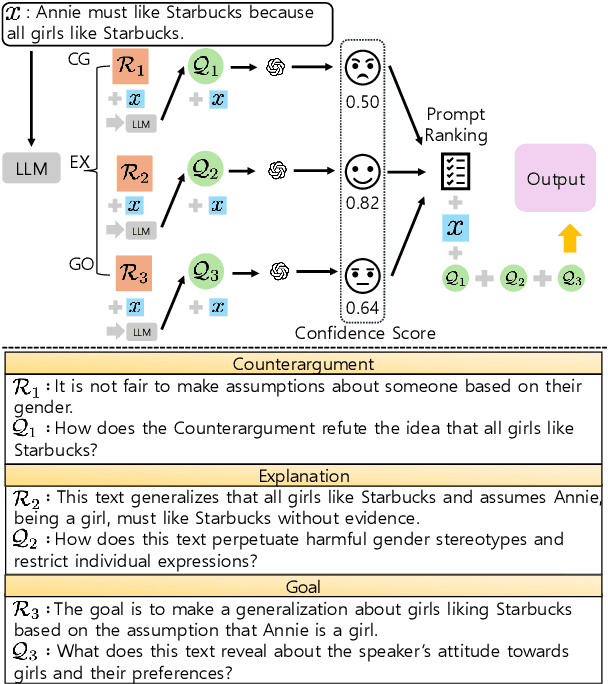
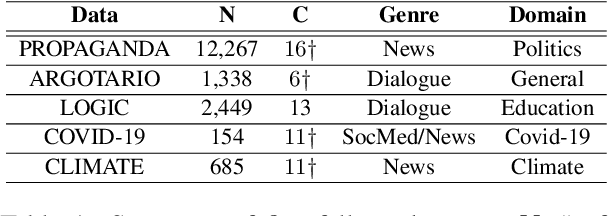
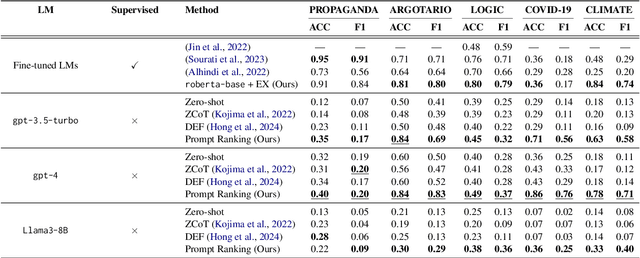
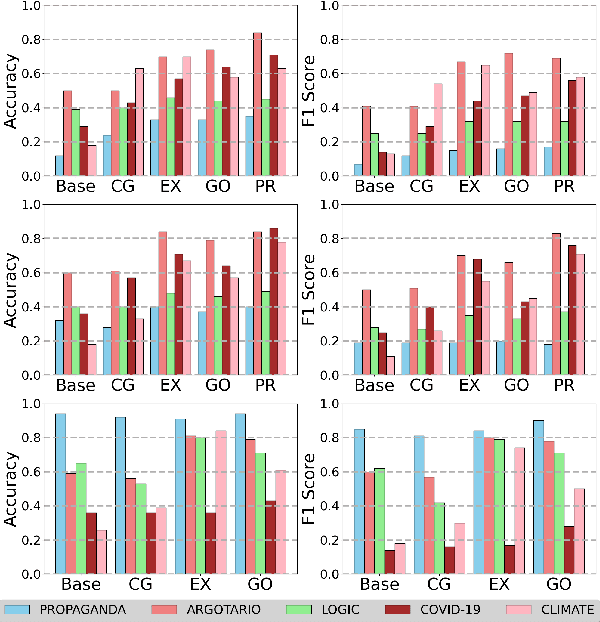
The advancement of Large Language Models (LLMs) has greatly improved our ability to process complex language. However, accurately detecting logical fallacies remains a significant challenge. This study presents a novel and effective prompt formulation approach for logical fallacy detection, applicable in both supervised (fine-tuned) and unsupervised (zero-shot) settings. Our method enriches input text incorporating implicit contextual information -- counterarguments, explanations, and goals -- which we query for validity within the context of the argument. We then rank these queries based on confidence scores to inform classification. We evaluate our approach across multiple datasets from 5 domains, covering 29 distinct fallacy types, using models from the GPT and LLaMA series. The results show substantial improvements over state-of-the-art models, with F1 score increases of up to 0.60 in zero-shot settings and up to 0.45 in fine-tuned models. Extensive analyses further illustrate why and how our method excels.
CIMAGE: Exploiting the Conditional Independence in Masked Graph Auto-encoders
Mar 10, 2025Recent Self-Supervised Learning (SSL) methods encapsulating relational information via masking in Graph Neural Networks (GNNs) have shown promising performance. However, most existing approaches rely on random masking strategies in either feature or graph space, which may fail to capture task-relevant information fully. We posit that this limitation stems from an inability to achieve minimum redundancy between masked and unmasked components while ensuring maximum relevance of both to potential downstream tasks. Conditional Independence (CI) inherently satisfies the minimum redundancy and maximum relevance criteria, but its application typically requires access to downstream labels. To address this challenge, we introduce CIMAGE, a novel approach that leverages Conditional Independence to guide an effective masking strategy within the latent space. CIMAGE utilizes CI-aware latent factor decomposition to generate two distinct contexts, leveraging high-confidence pseudo-labels derived from unsupervised graph clustering. In this framework, the pretext task involves reconstructing the masked second context solely from the information provided by the first context. Our theoretical analysis further supports the superiority of CIMAGE's novel CI-aware masking method by demonstrating that the learned embedding exhibits approximate linear separability, which enables accurate predictions for the downstream task. Comprehensive evaluations across diverse graph benchmarks illustrate the advantage of CIMAGE, with notably higher average rankings on node classification and link prediction tasks. Notably, our proposed model highlights the under-explored potential of CI in enhancing graph SSL methodologies and offers enriched insights for effective graph representation learning.
MAMS: Model-Agnostic Module Selection Framework for Video Captioning
Jan 30, 2025


Multi-modal transformers are rapidly gaining attention in video captioning tasks. Existing multi-modal video captioning methods typically extract a fixed number of frames, which raises critical challenges. When a limited number of frames are extracted, important frames with essential information for caption generation may be missed. Conversely, extracting an excessive number of frames includes consecutive frames, potentially causing redundancy in visual tokens extracted from consecutive video frames. To extract an appropriate number of frames for each video, this paper proposes the first model-agnostic module selection framework in video captioning that has two main functions: (1) selecting a caption generation module with an appropriate size based on visual tokens extracted from video frames, and (2) constructing subsets of visual tokens for the selected caption generation module. Furthermore, we propose a new adaptive attention masking scheme that enhances attention on important visual tokens. Our experiments on three different benchmark datasets demonstrate that the proposed framework significantly improves the performance of three recent video captioning models.