 Add to Chrome
 Add to Firefox
 Add to Edge
Egobody
Papers and Code
Masked Modeling for Human Motion Recovery Under Occlusions
Jan 23, 2026
Human motion reconstruction from monocular videos is a fundamental challenge in computer vision, with broad applications in AR/VR, robotics, and digital content creation, but remains challenging under frequent occlusions in real-world settings. Existing regression-based methods are efficient but fragile to missing observations, while optimization- and diffusion-based approaches improve robustness at the cost of slow inference speed and heavy preprocessing steps. To address these limitations, we leverage recent advances in generative masked modeling and present MoRo: Masked Modeling for human motion Recovery under Occlusions. MoRo is an occlusion-robust, end-to-end generative framework that formulates motion reconstruction as a video-conditioned task, and efficiently recover human motion in a consistent global coordinate system from RGB videos. By masked modeling, MoRo naturally handles occlusions while enabling efficient, end-to-end inference. To overcome the scarcity of paired video-motion data, we design a cross-modality learning scheme that learns multi-modal priors from a set of heterogeneous datasets: (i) a trajectory-aware motion prior trained on MoCap datasets, (ii) an image-conditioned pose prior trained on image-pose datasets, capturing diverse per-frame poses, and (iii) a video-conditioned masked transformer that fuses motion and pose priors, finetuned on video-motion datasets to integrate visual cues with motion dynamics for robust inference. Extensive experiments on EgoBody and RICH demonstrate that MoRo substantially outperforms state-of-the-art methods in accuracy and motion realism under occlusions, while performing on-par in non-occluded scenarios. MoRo achieves real-time inference at 70 FPS on a single H200 GPU.

Event-based Egocentric Human Pose Estimation in Dynamic Environment
May 28, 2025Estimating human pose using a front-facing egocentric camera is essential for applications such as sports motion analysis, VR/AR, and AI for wearable devices. However, many existing methods rely on RGB cameras and do not account for low-light environments or motion blur. Event-based cameras have the potential to address these challenges. In this work, we introduce a novel task of human pose estimation using a front-facing event-based camera mounted on the head and propose D-EventEgo, the first framework for this task. The proposed method first estimates the head poses, and then these are used as conditions to generate body poses. However, when estimating head poses, the presence of dynamic objects mixed with background events may reduce head pose estimation accuracy. Therefore, we introduce the Motion Segmentation Module to remove dynamic objects and extract background information. Extensive experiments on our synthetic event-based dataset derived from EgoBody, demonstrate that our approach outperforms our baseline in four out of five evaluation metrics in dynamic environments.
The Invisible EgoHand: 3D Hand Forecasting through EgoBody Pose Estimation
Apr 11, 2025Forecasting hand motion and pose from an egocentric perspective is essential for understanding human intention. However, existing methods focus solely on predicting positions without considering articulation, and only when the hands are visible in the field of view. This limitation overlooks the fact that approximate hand positions can still be inferred even when they are outside the camera's view. In this paper, we propose a method to forecast the 3D trajectories and poses of both hands from an egocentric video, both in and out of the field of view. We propose a diffusion-based transformer architecture for Egocentric Hand Forecasting, EgoH4, which takes as input the observation sequence and camera poses, then predicts future 3D motion and poses for both hands of the camera wearer. We leverage full-body pose information, allowing other joints to provide constraints on hand motion. We denoise the hand and body joints along with a visibility predictor for hand joints and a 3D-to-2D reprojection loss that minimizes the error when hands are in-view. We evaluate EgoH4 on the Ego-Exo4D dataset, combining subsets with body and hand annotations. We train on 156K sequences and evaluate on 34K sequences, respectively. EgoH4 improves the performance by 3.4cm and 5.1cm over the baseline in terms of ADE for hand trajectory forecasting and MPJPE for hand pose forecasting. Project page: https://masashi-hatano.github.io/EgoH4/
Robust Human Registration with Body Part Segmentation on Noisy Point Clouds
Apr 04, 2025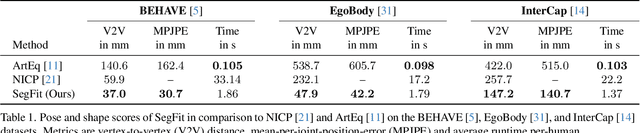
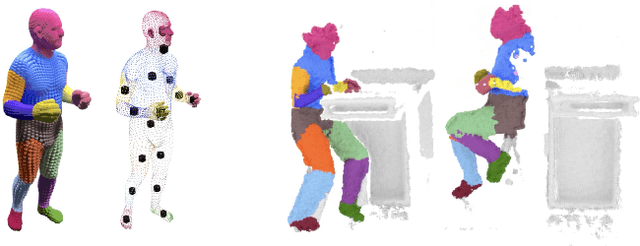
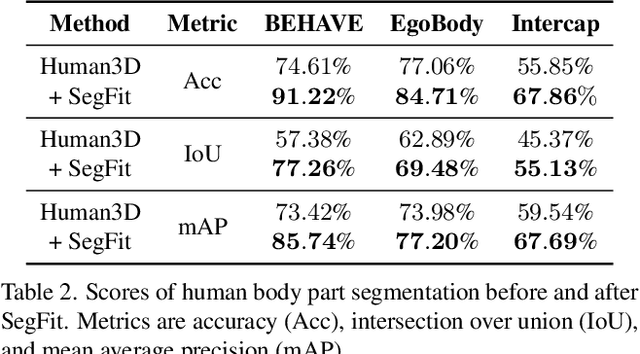
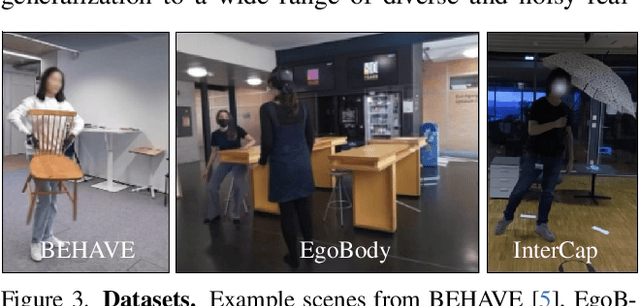
Registering human meshes to 3D point clouds is essential for applications such as augmented reality and human-robot interaction but often yields imprecise results due to noise and background clutter in real-world data. We introduce a hybrid approach that incorporates body-part segmentation into the mesh fitting process, enhancing both human pose estimation and segmentation accuracy. Our method first assigns body part labels to individual points, which then guide a two-step SMPL-X fitting: initial pose and orientation estimation using body part centroids, followed by global refinement of the point cloud alignment. Additionally, we demonstrate that the fitted human mesh can refine body part labels, leading to improved segmentation. Evaluations on the cluttered and noisy real-world datasets InterCap, EgoBody, and BEHAVE show that our approach significantly outperforms prior methods in both pose estimation and segmentation accuracy. Code and results are available on our project website: https://segfit.github.io
AiOS: All-in-One-Stage Expressive Human Pose and Shape Estimation
Mar 26, 2024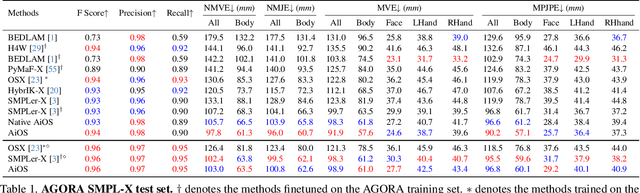
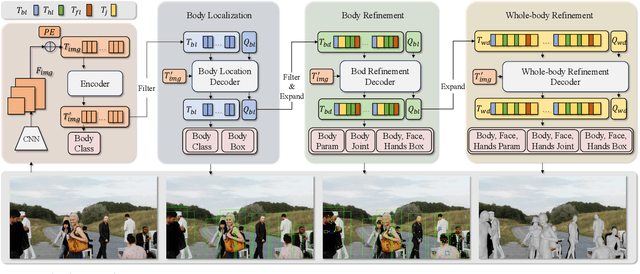
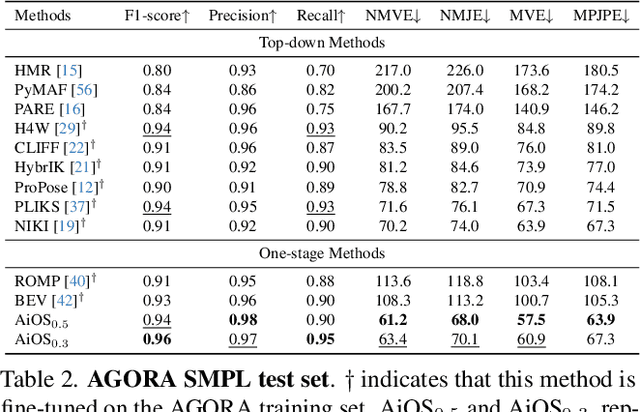
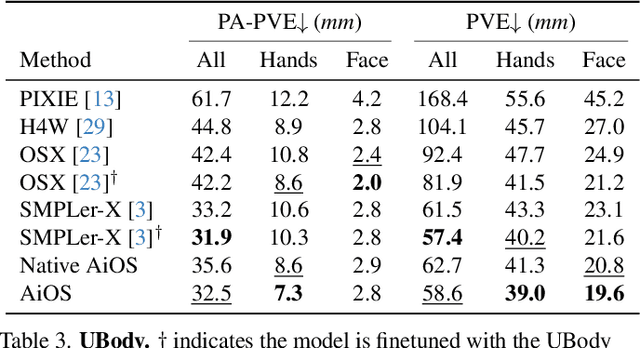
Expressive human pose and shape estimation (a.k.a. 3D whole-body mesh recovery) involves the human body, hand, and expression estimation. Most existing methods have tackled this task in a two-stage manner, first detecting the human body part with an off-the-shelf detection model and inferring the different human body parts individually. Despite the impressive results achieved, these methods suffer from 1) loss of valuable contextual information via cropping, 2) introducing distractions, and 3) lacking inter-association among different persons and body parts, inevitably causing performance degradation, especially for crowded scenes. To address these issues, we introduce a novel all-in-one-stage framework, AiOS, for multiple expressive human pose and shape recovery without an additional human detection step. Specifically, our method is built upon DETR, which treats multi-person whole-body mesh recovery task as a progressive set prediction problem with various sequential detection. We devise the decoder tokens and extend them to our task. Specifically, we first employ a human token to probe a human location in the image and encode global features for each instance, which provides a coarse location for the later transformer block. Then, we introduce a joint-related token to probe the human joint in the image and encoder a fine-grained local feature, which collaborates with the global feature to regress the whole-body mesh. This straightforward but effective model outperforms previous state-of-the-art methods by a 9% reduction in NMVE on AGORA, a 30% reduction in PVE on EHF, a 10% reduction in PVE on ARCTIC, and a 3% reduction in PVE on EgoBody.
SMPLest-X: Ultimate Scaling for Expressive Human Pose and Shape Estimation
Jan 16, 2025Expressive human pose and shape estimation (EHPS) unifies body, hands, and face motion capture with numerous applications. Despite encouraging progress, current state-of-the-art methods focus on training innovative architectural designs on confined datasets. In this work, we investigate the impact of scaling up EHPS towards a family of generalist foundation models. 1) For data scaling, we perform a systematic investigation on 40 EHPS datasets, encompassing a wide range of scenarios that a model trained on any single dataset cannot handle. More importantly, capitalizing on insights obtained from the extensive benchmarking process, we optimize our training scheme and select datasets that lead to a significant leap in EHPS capabilities. Ultimately, we achieve diminishing returns at 10M training instances from diverse data sources. 2) For model scaling, we take advantage of vision transformers (up to ViT-Huge as the backbone) to study the scaling law of model sizes in EHPS. To exclude the influence of algorithmic design, we base our experiments on two minimalist architectures: SMPLer-X, which consists of an intermediate step for hand and face localization, and SMPLest-X, an even simpler version that reduces the network to its bare essentials and highlights significant advances in the capture of articulated hands. With big data and the large model, the foundation models exhibit strong performance across diverse test benchmarks and excellent transferability to even unseen environments. Moreover, our finetuning strategy turns the generalist into specialist models, allowing them to achieve further performance boosts. Notably, our foundation models consistently deliver state-of-the-art results on seven benchmarks such as AGORA, UBody, EgoBody, and our proposed SynHand dataset for comprehensive hand evaluation. (Code is available at: https://github.com/wqyin/SMPLest-X).
Motion Diffusion-Guided 3D Global HMR from a Dynamic Camera
Nov 15, 2024
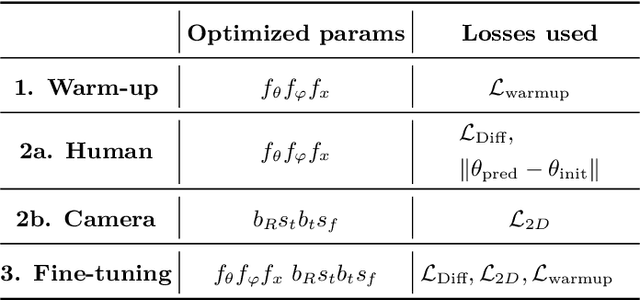


Motion capture technologies have transformed numerous fields, from the film and gaming industries to sports science and healthcare, by providing a tool to capture and analyze human movement in great detail. The holy grail in the topic of monocular global human mesh and motion reconstruction (GHMR) is to achieve accuracy on par with traditional multi-view capture on any monocular videos captured with a dynamic camera, in-the-wild. This is a challenging task as the monocular input has inherent depth ambiguity, and the moving camera adds additional complexity as the rendered human motion is now a product of both human and camera movement. Not accounting for this confusion, existing GHMR methods often output motions that are unrealistic, e.g. unaccounted root translation of the human causes foot sliding. We present DiffOpt, a novel 3D global HMR method using Diffusion Optimization. Our key insight is that recent advances in human motion generation, such as the motion diffusion model (MDM), contain a strong prior of coherent human motion. The core of our method is to optimize the initial motion reconstruction using the MDM prior. This step can lead to more globally coherent human motion. Our optimization jointly optimizes the motion prior loss and reprojection loss to correctly disentangle the human and camera motions. We validate DiffOpt with video sequences from the Electromagnetic Database of Global 3D Human Pose and Shape in the Wild (EMDB) and Egobody, and demonstrate superior global human motion recovery capability over other state-of-the-art global HMR methods most prominently in long video settings.
3D Human Reconstruction in the Wild with Synthetic Data Using Generative Models
Mar 17, 2024In this work, we show that synthetic data created by generative models is complementary to computer graphics (CG) rendered data for achieving remarkable generalization performance on diverse real-world scenes for 3D human pose and shape estimation (HPS). Specifically, we propose an effective approach based on recent diffusion models, termed HumanWild, which can effortlessly generate human images and corresponding 3D mesh annotations. We first collect a large-scale human-centric dataset with comprehensive annotations, e.g., text captions and surface normal images. Then, we train a customized ControlNet model upon this dataset to generate diverse human images and initial ground-truth labels. At the core of this step is that we can easily obtain numerous surface normal images from a 3D human parametric model, e.g., SMPL-X, by rendering the 3D mesh onto the image plane. As there exists inevitable noise in the initial labels, we then apply an off-the-shelf foundation segmentation model, i.e., SAM, to filter negative data samples. Our data generation pipeline is flexible and customizable to facilitate different real-world tasks, e.g., ego-centric scenes and perspective-distortion scenes. The generated dataset comprises 0.79M images with corresponding 3D annotations, covering versatile viewpoints, scenes, and human identities. We train various HPS regressors on top of the generated data and evaluate them on a wide range of benchmarks (3DPW, RICH, EgoBody, AGORA, SSP-3D) to verify the effectiveness of the generated data. By exclusively employing generative models, we generate large-scale in-the-wild human images and high-quality annotations, eliminating the need for real-world data collection.
SMPLer-X: Scaling Up Expressive Human Pose and Shape Estimation
Sep 29, 2023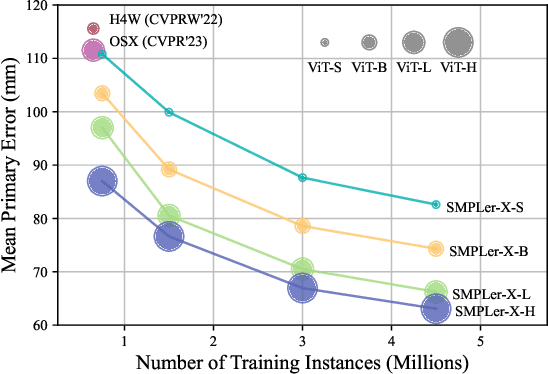
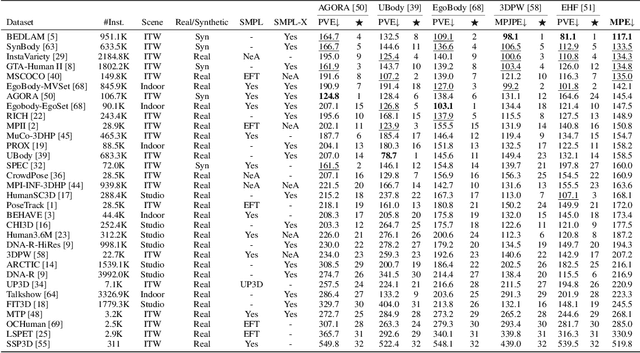
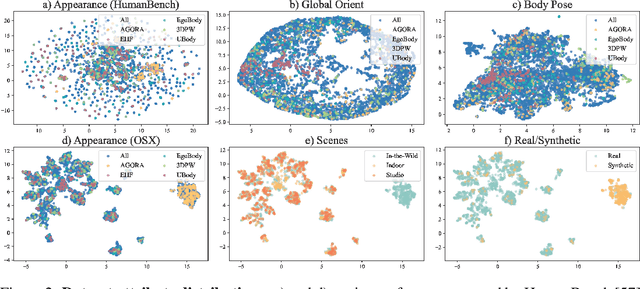
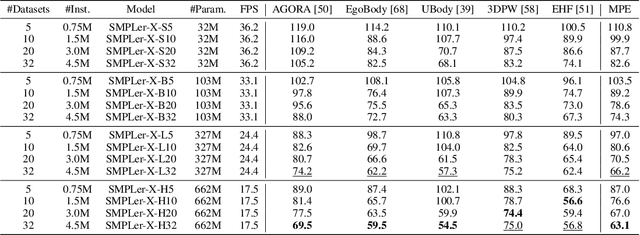
Expressive human pose and shape estimation (EHPS) unifies body, hands, and face motion capture with numerous applications. Despite encouraging progress, current state-of-the-art methods still depend largely on confined training datasets. In this work, we investigate scaling up EHPS towards the first generalist foundation model (dubbed SMPLer-X), with up to ViT-Huge as the backbone and training with up to 4.5M instances from diverse data sources. With big data and the large model, SMPLer-X exhibits strong performance across diverse test benchmarks and excellent transferability to even unseen environments. 1) For the data scaling, we perform a systematic investigation on 32 EHPS datasets, encompassing a wide range of scenarios that a model trained on any single dataset cannot handle. More importantly, capitalizing on insights obtained from the extensive benchmarking process, we optimize our training scheme and select datasets that lead to a significant leap in EHPS capabilities. 2) For the model scaling, we take advantage of vision transformers to study the scaling law of model sizes in EHPS. Moreover, our finetuning strategy turn SMPLer-X into specialist models, allowing them to achieve further performance boosts. Notably, our foundation model SMPLer-X consistently delivers state-of-the-art results on seven benchmarks such as AGORA (107.2 mm NMVE), UBody (57.4 mm PVE), EgoBody (63.6 mm PVE), and EHF (62.3 mm PVE without finetuning).
Decoupling Human and Camera Motion from Videos in the Wild
Mar 20, 2023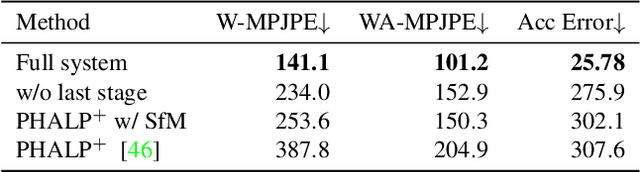
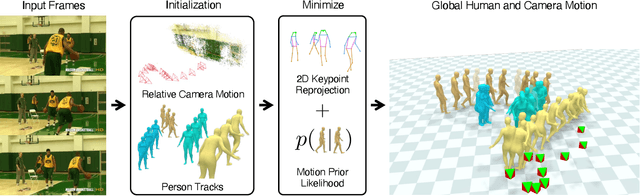
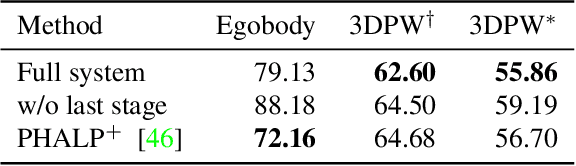
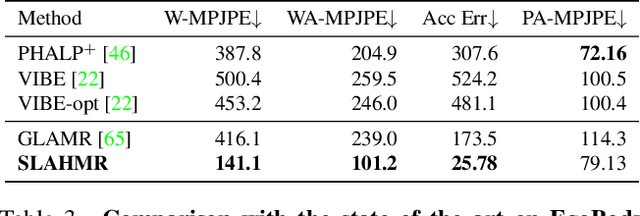
We propose a method to reconstruct global human trajectories from videos in the wild. Our optimization method decouples the camera and human motion, which allows us to place people in the same world coordinate frame. Most existing methods do not model the camera motion; methods that rely on the background pixels to infer 3D human motion usually require a full scene reconstruction, which is often not possible for in-the-wild videos. However, even when existing SLAM systems cannot recover accurate scene reconstructions, the background pixel motion still provides enough signal to constrain the camera motion. We show that relative camera estimates along with data-driven human motion priors can resolve the scene scale ambiguity and recover global human trajectories. Our method robustly recovers the global 3D trajectories of people in challenging in-the-wild videos, such as PoseTrack. We quantify our improvement over existing methods on 3D human dataset Egobody. We further demonstrate that our recovered camera scale allows us to reason about motion of multiple people in a shared coordinate frame, which improves performance of downstream tracking in PoseTrack. Code and video results can be found at https://vye16.github.io/slahmr.