 Add to Chrome
 Add to Firefox
 Add to Edge
WorldRover: A Scalable Synthetic Video Data Engine for World Exploration with Rich Annotations
Aug 16, 2026
Learning to generate or reconstruct explorable worlds requires video paired with more than RGB: camera motion, scene geometry, temporal correspondence and, for interactive models, control signals. Real capture can provide some of these signals, but dense geometry and long-range correspondence usually rely on estimation or specialised instrumentation. Rendering provides these quantities directly, yet existing synthetic resources rarely combine them on the same frames while also supporting controlled changes of viewpoint and appearance. We introduce WorldRover, a data engine for generating richly annotated, long-range explorations of artist-built environments. At its core, WorldRover-Engine is an Unreal Engine pipeline that executes and offline-renders minute-scale routes while preserving their full trajectories and scene geometry. The same exploration can be replayed from first-person, third-person, and 360 panoramic cameras under different environmental states. Using WorldRover-Engine, we construct WorldRover-10M, whose sequences pair RGB with metric depth, camera trajectories, and trajectory-derived action signals throughout each exploration. Third-person subsets additionally provide dense optical flow, long-range 2D/3D point tracks with visibility, and a character trajectory distinct from the camera trajectory. The engine can render a traversal from first-person, third-person and 360 panoramic viewpoints, under different environmental states or with a neutral white material, while preserving the route and scene geometry. WorldRover therefore turns long-horizon world exploration into a scalable data-generation problem, providing supervision for models that must build, maintain, and revisit coherent representations of an explorable world.

Can We Defend Against AI-Generated Video Attacks on Real-World Crisis Events? A Systematic Evaluation of Detectors, Generators and Social Dissemination
Aug 14, 2026Recent video generators can fabricate realistic depictions of wars, disasters, public emergencies, and other real-world crises, creating substantial risks of misinformation. Existing benchmarks, however, provide limited evidence on detector and generator behavior in such settings, including how detectability varies with generation conditions, how people perceive generated videos, and whether detectors remain reliable during social dissemination. To address this gap, we introduce RA-Bench, a benchmark for AI-generated video detection that uses Real videos as Anchors. RA-Bench contains 17,886 videos, comprising 1,830 real-video anchors across 10 social-risk categories and 16,056 generated clips from four open-source and five closed-source generators. Based on RA-Bench, we organize our evaluation along three dimensions. We first assess detector generalization across seven traditional detectors, ten zero-shot multimodal models under three review settings, and two MLLMs specifically fine-tuned on AI-generated video detection. Across these methods, none of the three detector families generalizes consistently across RA-Bench instances. We then examine how detectability varies with generation quality, conditioning information, and sampling seeds. These analyses show that generation properties affect detector families differently, while source-level detection patterns remain stable across seeds. Finally, we study human authenticity judgments and detector reliability during social dissemination. We find that videos that mislead people are also difficult for current detectors, and that social dissemination makes detection harder. Together, these findings show that current methods struggle to detect realistic AI-generated videos, highlighting the need for detectors robust to evolving video generators.
Sekai2: From World Exploration to Interactive World Modeling
Aug 11, 2026Video world models must capture how scenes evolve over time and across viewpoints. Training them for long-horizon generation and camera control therefore benefits from long videos paired with camera trajectories and temporally grounded semantics. Existing corpora rarely offer the three together: large-scale web video provides broad visual diversity but no trajectories or time-aligned text, while pose-annotated datasets are typically short-range or reconstruction-oriented. We introduce Sekai2, a multi-source real-world video dataset that carries the world-exploration footage of Sekai toward interactive world modeling. The release contains 128,892 clips totaling 2,826 hours from 10,428 source videos across 113 countries or regions, and is deliberately weighted toward sustained observation: under a common 120-second decomposition, 43,594 segments reach the full two minutes and account for 51.4% of all footage. Every clip includes a released camera trajectory and hierarchical annotations disentangling subject motion, environment dynamics, static scene content, and camera behavior, resulting in 649,597 temporally grounded segments. Crucially, we further introduce 982 panoramic sequences captured along non-linear trajectories with loops and revisits. These revisits provide repeated observations of the same locations across time and viewpoints, offering essential supervision for learning persistent scene representations, long-term spatial memory, and geometrically consistent world models. Corpus-scale analyses demonstrate complete pose-and-caption coverage, broad geographic and semantic diversity, varied camera trajectories, and highly non-redundant temporal descriptions. Together, these properties make Sekai2 a scalable resource for long-horizon video generation, camera-controllable synthesis, and interactive world-model pre-training.
AlayaWorld: Interactive Long-Horizon World Modeling -- Full Technical Report
Jul 20, 2026Unlike conventional video game development, which relies on labor-intensive pipelines for asset production, animation, physics, and programming, video world models generate interactive environments from user inputs instantly. It enable us to create customized, explorable, and continuously evolving virtual world from text, an image, or video. Realizing this vision requires four tightly coupled capabilities: interaction, persistent spatiotemporal consistency, stable long-horizon generation, and efficient response. We present AlayaWorld, an interactive long-horizon video world model that generates 24-fps video at 540p and 720p. Built on a 15B video diffusion transformer, AlayaWorld generates short latent chunks autoregressively under camera trajectories and switchable text prompts. Its bounded visual context combines a persistent sink frame, compressed temporal history, geometry-aligned spatial memory, and recent-frame conditioning. To reduce long-term drift, the model is trained with corrupted histories and prediction residuals collected from its own roll-outs. We further introduce a discrete autoregressive distillation formulation that combines distribution-matching distillation, self-forcing++, and consistency distillation, reducing inference from approximately 30 sampling steps to four steps per chunk. On iWorld-Bench, AlayaWorld achieves the best performance over long-horizon generation. Conceived as a full-stack, open-source, and long-term project, AlayaWorld is intended to provide an extensible foundation for future research on interactive video world models.
AlayaWorld: Long-Horizon and Playable Video World Generation
Jul 07, 2026Game worlds have traditionally been built through labor-intensive production pipelines, making them costly to develop, difficult to customization, and expensive to modify after deployment. Recent advances in video world models offer a fundamentally different paradigm. Rather than explicitly authoring every component of a virtual environment, these models autoregressively synthesize future observations conditioned on the current world state and user interactions, enabling playable worlds to be generated online. Trained on both gameplay recordings and real-world videos, they can capture diverse visual appearances and physical dynamics, opening new opportunities for interactive applications beyond gaming, including embodied intelligence. In this paper, we present \textbf{AlayaWorld}, a full-stack open-source framework for building interactive generative worlds. AlayaWorld enables open-ended real-time interaction, allowing users to freely navigate and perform diverse actions such as combat, spell casting, and monster summoning. The framework unifies the complete development-from data preparation model architecture, model training, inference acceleration, and deployment-within a modular and extensible architecture. Alongside the framework, we release reproducible pipelines, reference implementations, evaluation tools, and comprehensive documentation, establishing a practical foundation for future research and real-time applications of generative world models.
WorldMark: A Unified Benchmark Suite for Interactive Video World Models
Apr 23, 2026Interactive video generation models such as Genie, YUME, HY-World, and Matrix-Game are advancing rapidly, yet every model is evaluated on its own benchmark with private scenes and trajectories, making fair cross-model comparison impossible. Existing public benchmarks offer useful metrics such as trajectory error, aesthetic scores, and VLM-based judgments, but none supplies the standardized test conditions -- identical scenes, identical action sequences, and a unified control interface -- needed to make those metrics comparable across models with heterogeneous inputs. We introduce WorldMark, the first benchmark that provides such a common playing field for interactive Image-to-Video world models. WorldMark contributes: (1) a unified action-mapping layer that translates a shared WASD-style action vocabulary into each model's native control format, enabling apples-to-apples comparison across six major models on identical scenes and trajectories; (2) a hierarchical test suite of 500 evaluation cases covering first- and third-person viewpoints, photorealistic and stylized scenes, and three difficulty tiers from Easy to Hard spanning 20-60s; and (3) a modular evaluation toolkit for Visual Quality, Control Alignment, and World Consistency, designed so that researchers can reuse our standardized inputs while plugging in their own metrics as the field evolves. We will release all data, evaluation code, and model outputs to facilitate future research. Beyond offline metrics, we launch World Model Arena (warena.ai), an online platform where anyone can pit leading world models against each other in side-by-side battles and watch the live leaderboard.
Generative Video Matting
Aug 11, 2025Video matting has traditionally been limited by the lack of high-quality ground-truth data. Most existing video matting datasets provide only human-annotated imperfect alpha and foreground annotations, which must be composited to background images or videos during the training stage. Thus, the generalization capability of previous methods in real-world scenarios is typically poor. In this work, we propose to solve the problem from two perspectives. First, we emphasize the importance of large-scale pre-training by pursuing diverse synthetic and pseudo-labeled segmentation datasets. We also develop a scalable synthetic data generation pipeline that can render diverse human bodies and fine-grained hairs, yielding around 200 video clips with a 3-second duration for fine-tuning. Second, we introduce a novel video matting approach that can effectively leverage the rich priors from pre-trained video diffusion models. This architecture offers two key advantages. First, strong priors play a critical role in bridging the domain gap between synthetic and real-world scenes. Second, unlike most existing methods that process video matting frame-by-frame and use an independent decoder to aggregate temporal information, our model is inherently designed for video, ensuring strong temporal consistency. We provide a comprehensive quantitative evaluation across three benchmark datasets, demonstrating our approach's superior performance, and present comprehensive qualitative results in diverse real-world scenes, illustrating the strong generalization capability of our method. The code is available at https://github.com/aim-uofa/GVM.
POMATO: Marrying Pointmap Matching with Temporal Motion for Dynamic 3D Reconstruction
Apr 08, 20253D reconstruction in dynamic scenes primarily relies on the combination of geometry estimation and matching modules where the latter task is pivotal for distinguishing dynamic regions which can help to mitigate the interference introduced by camera and object motion. Furthermore, the matching module explicitly models object motion, enabling the tracking of specific targets and advancing motion understanding in complex scenarios. Recently, the proposed representation of pointmap in DUSt3R suggests a potential solution to unify both geometry estimation and matching in 3D space, but it still struggles with ambiguous matching in dynamic regions, which may hamper further improvement. In this work, we present POMATO, a unified framework for dynamic 3D reconstruction by marrying pointmap matching with temporal motion. Specifically, our method first learns an explicit matching relationship by mapping RGB pixels from both dynamic and static regions across different views to 3D pointmaps within a unified coordinate system. Furthermore, we introduce a temporal motion module for dynamic motions that ensures scale consistency across different frames and enhances performance in tasks requiring both precise geometry and reliable matching, most notably 3D point tracking. We show the effectiveness of the proposed pointmap matching and temporal fusion paradigm by demonstrating the remarkable performance across multiple downstream tasks, including video depth estimation, 3D point tracking, and pose estimation. Code and models are publicly available at https://github.com/wyddmw/POMATO.
GeoBench: Benchmarking and Analyzing Monocular Geometry Estimation Models
Jun 18, 2024
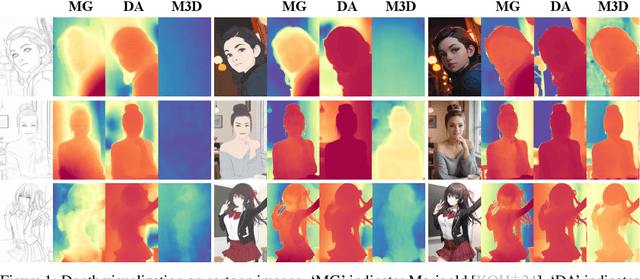


Recent advances in discriminative and generative pretraining have yielded geometry estimation models with strong generalization capabilities. While discriminative monocular geometry estimation methods rely on large-scale fine-tuning data to achieve zero-shot generalization, several generative-based paradigms show the potential of achieving impressive generalization performance on unseen scenes by leveraging pre-trained diffusion models and fine-tuning on even a small scale of synthetic training data. Frustratingly, these models are trained with different recipes on different datasets, making it hard to find out the critical factors that determine the evaluation performance. Besides, current geometry evaluation benchmarks have two main drawbacks that may prevent the development of the field, i.e., limited scene diversity and unfavorable label quality. To resolve the above issues, (1) we build fair and strong baselines in a unified codebase for evaluating and analyzing the geometry estimation models; (2) we evaluate monocular geometry estimators on more challenging benchmarks for geometry estimation task with diverse scenes and high-quality annotations. Our results reveal that pre-trained using large data, discriminative models such as DINOv2, can outperform generative counterparts with a small amount of high-quality synthetic data under the same training configuration, which suggests that fine-tuning data quality is a more important factor than the data scale and model architecture. Our observation also raises a question: if simply fine-tuning a general vision model such as DINOv2 using a small amount of synthetic depth data produces SOTA results, do we really need complex generative models for depth estimation? We believe this work can propel advancements in geometry estimation tasks as well as a wide range of downstream applications.
3D Human Reconstruction in the Wild with Synthetic Data Using Generative Models
Mar 17, 2024In this work, we show that synthetic data created by generative models is complementary to computer graphics (CG) rendered data for achieving remarkable generalization performance on diverse real-world scenes for 3D human pose and shape estimation (HPS). Specifically, we propose an effective approach based on recent diffusion models, termed HumanWild, which can effortlessly generate human images and corresponding 3D mesh annotations. We first collect a large-scale human-centric dataset with comprehensive annotations, e.g., text captions and surface normal images. Then, we train a customized ControlNet model upon this dataset to generate diverse human images and initial ground-truth labels. At the core of this step is that we can easily obtain numerous surface normal images from a 3D human parametric model, e.g., SMPL-X, by rendering the 3D mesh onto the image plane. As there exists inevitable noise in the initial labels, we then apply an off-the-shelf foundation segmentation model, i.e., SAM, to filter negative data samples. Our data generation pipeline is flexible and customizable to facilitate different real-world tasks, e.g., ego-centric scenes and perspective-distortion scenes. The generated dataset comprises 0.79M images with corresponding 3D annotations, covering versatile viewpoints, scenes, and human identities. We train various HPS regressors on top of the generated data and evaluate them on a wide range of benchmarks (3DPW, RICH, EgoBody, AGORA, SSP-3D) to verify the effectiveness of the generated data. By exclusively employing generative models, we generate large-scale in-the-wild human images and high-quality annotations, eliminating the need for real-world data collection.