 Add to Chrome
 Add to Firefox
 Add to Edge
Agent Lightning v1.0: Towards Harnessed Agentic RL
Aug 18, 2026
Modern agents operate inside agent harnesses that manage tools, context, and control flow, making the harness a critical part of the agent system. Our original Agent Lightning introduced a disaggregated architecture that connects arbitrary agents to RL training through an LLM endpoint proxy, an approach later adopted by frameworks such as verl Uni-Agent, AReaL 2.0, slime, and Polar. We refer to this paradigm as harnessed agentic RL, where the deploy-time harness directly participates in model post-training. Harnessed agentic RL differs fundamentally from traditional agentic RL: the harness, rather than the training engine, owns the environment interaction loop, while the trainer observes only sequences of LLM request-response pairs. This introduces challenges in retokenization, sample merging, advantage calculation, loss normalization, and backend scheduling, which can substantially affect training stability and effectiveness. We present Agent Lightning v1.0, a lightweight framework for harnessed agentic RL implemented in approximately 3,500 lines of code. It supports arbitrary agent harnesses and serves as a practical testbed for studying these challenges. We evaluate it on instruction-following, search, and coding agents, and provide a complete reproducible pipeline for coding-agent RL. Using only 6K training examples and modest compute, RL improves Qwen3.5-9B on SWE-bench Verified from 41.8% to 56.4%, a 14.6-point absolute gain. We release the complete workflow and training scripts to facilitate reproducible research on harnessed agentic RL.

VCBench: A Streaming Counting Benchmark for Spatial-Temporal State Maintenance in Long Videos
Mar 13, 2026Video understanding requires models to continuously track and update world state during playback. While existing benchmarks have advanced video understanding evaluation across multiple dimensions, the observation of how models maintain world state remains insufficient. We propose VCBench, a streaming counting benchmark that repositions counting as a minimal probe for diagnosing world state maintenance capability. We decompose this capability into object counting (tracking currently visible objects vs.\ tracking cumulative unique identities) and event counting (detecting instantaneous actions vs.\ tracking complete activity cycles), forming 8 fine-grained subcategories. VCBench contains 406 videos with frame-by-frame annotations of 10,071 event occurrence moments and object state change moments, generating 1,000 streaming QA pairs with 4,576 query points along timelines. By observing state maintenance trajectories through streaming multi-point queries, we design three complementary metrics to diagnose numerical precision, trajectory consistency, and temporal awareness. Evaluation on mainstream video-language models shows that current models still exhibit significant deficiencies in spatial-temporal state maintenance, particularly struggling with tasks like periodic event counting. VCBench provides a diagnostic framework for measuring and improving state maintenance in video understanding systems.
RAPO: Expanding Exploration for LLM Agents via Retrieval-Augmented Policy Optimization
Mar 03, 2026Agentic Reinforcement Learning (Agentic RL) has shown remarkable potential in large language model-based (LLM) agents. These works can empower LLM agents to tackle complex tasks via multi-step, tool-integrated reasoning. However, an inherent limitation of existing Agentic RL methods is their reliance on a pure on-policy paradigm for exploration, restricting exploration to the agent's self-generated outputs and preventing the discovery of new reasoning perspectives for further improvement. While recent efforts incorporate auxiliary off-policy signals to enhance exploration, they typically utilize full off-policy trajectories for trajectory-level policy estimation, overlooking the necessity for the fine-grained, step-level exploratory dynamics within agentic rollout. In this paper, we revisit exploration in Agentic RL and propose Retrieval-Augmented Policy Optimization (RAPO), a novel RL framework that introduces retrieval to explicitly expand exploration during training. To achieve this, we decompose the Agentic RL training process into two phases: (i) Hybrid-policy Agentic Rollout, and (ii) Retrieval-aware Policy Optimization. Specifically, we propose a Hybrid-policy Agentic Rollout strategy, which allows the agents to continuously reason over the retrieved off-policy step-level traces. It dynamically extends the reasoning receptive field of agents, enabling broader exploration conditioned on external behaviors. Subsequently, we introduce the Retrieval-aware Policy Optimization mechanism, which calibrates the policy gradient estimation with retrieval reward and importance shaping, stabilizing training and prioritizing retrieval-illuminating exploration. Extensive experiments show that RAPO achieves an +5.0% average gain on fourteen datasets across three agentic reasoning tasks, while delivering 1.2x faster training efficiency.
Masked Modeling for Human Motion Recovery Under Occlusions
Jan 23, 2026Human motion reconstruction from monocular videos is a fundamental challenge in computer vision, with broad applications in AR/VR, robotics, and digital content creation, but remains challenging under frequent occlusions in real-world settings. Existing regression-based methods are efficient but fragile to missing observations, while optimization- and diffusion-based approaches improve robustness at the cost of slow inference speed and heavy preprocessing steps. To address these limitations, we leverage recent advances in generative masked modeling and present MoRo: Masked Modeling for human motion Recovery under Occlusions. MoRo is an occlusion-robust, end-to-end generative framework that formulates motion reconstruction as a video-conditioned task, and efficiently recover human motion in a consistent global coordinate system from RGB videos. By masked modeling, MoRo naturally handles occlusions while enabling efficient, end-to-end inference. To overcome the scarcity of paired video-motion data, we design a cross-modality learning scheme that learns multi-modal priors from a set of heterogeneous datasets: (i) a trajectory-aware motion prior trained on MoCap datasets, (ii) an image-conditioned pose prior trained on image-pose datasets, capturing diverse per-frame poses, and (iii) a video-conditioned masked transformer that fuses motion and pose priors, finetuned on video-motion datasets to integrate visual cues with motion dynamics for robust inference. Extensive experiments on EgoBody and RICH demonstrate that MoRo substantially outperforms state-of-the-art methods in accuracy and motion realism under occlusions, while performing on-par in non-occluded scenarios. MoRo achieves real-time inference at 70 FPS on a single H200 GPU.
Rethinking Time Encoding via Learnable Transformation Functions
May 01, 2025Effectively modeling time information and incorporating it into applications or models involving chronologically occurring events is crucial. Real-world scenarios often involve diverse and complex time patterns, which pose significant challenges for time encoding methods. While previous methods focus on capturing time patterns, many rely on specific inductive biases, such as using trigonometric functions to model periodicity. This narrow focus on single-pattern modeling makes them less effective in handling the diversity and complexities of real-world time patterns. In this paper, we investigate to improve the existing commonly used time encoding methods and introduce Learnable Transformation-based Generalized Time Encoding (LeTE). We propose using deep function learning techniques to parameterize non-linear transformations in time encoding, making them learnable and capable of modeling generalized time patterns, including diverse and complex temporal dynamics. By enabling learnable transformations, LeTE encompasses previous methods as specific cases and allows seamless integration into a wide range of tasks. Through extensive experiments across diverse domains, we demonstrate the versatility and effectiveness of LeTE.
Unifying Text Semantics and Graph Structures for Temporal Text-attributed Graphs with Large Language Models
Mar 18, 2025Temporal graph neural networks (TGNNs) have shown remarkable performance in temporal graph modeling. However, real-world temporal graphs often possess rich textual information, giving rise to temporal text-attributed graphs (TTAGs). Such combination of dynamic text semantics and evolving graph structures introduces heightened complexity. Existing TGNNs embed texts statically and rely heavily on encoding mechanisms that biasedly prioritize structural information, overlooking the temporal evolution of text semantics and the essential interplay between semantics and structures for synergistic reinforcement. To tackle these issues, we present \textbf{{Cross}}, a novel framework that seamlessly extends existing TGNNs for TTAG modeling. The key idea is to employ the advanced large language models (LLMs) to extract the dynamic semantics in text space and then generate expressive representations unifying both semantics and structures. Specifically, we propose a Temporal Semantics Extractor in the {Cross} framework, which empowers the LLM to offer the temporal semantic understanding of node's evolving contexts of textual neighborhoods, facilitating semantic dynamics. Subsequently, we introduce the Semantic-structural Co-encoder, which collaborates with the above Extractor for synthesizing illuminating representations by jointly considering both semantic and structural information while encouraging their mutual reinforcement. Extensive experimental results on four public datasets and one practical industrial dataset demonstrate {Cross}'s significant effectiveness and robustness.
LLM-GAN: Construct Generative Adversarial Network Through Large Language Models For Explainable Fake News Detection
Sep 03, 2024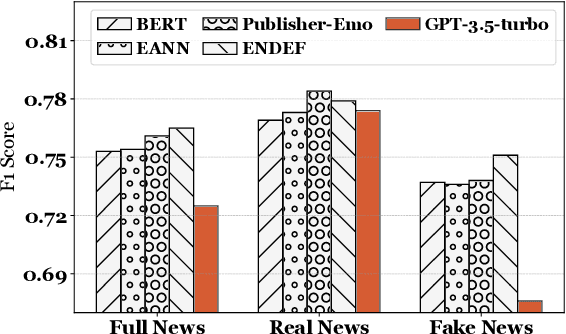


Explainable fake news detection predicts the authenticity of news items with annotated explanations. Today, Large Language Models (LLMs) are known for their powerful natural language understanding and explanation generation abilities. However, presenting LLMs for explainable fake news detection remains two main challenges. Firstly, fake news appears reasonable and could easily mislead LLMs, leaving them unable to understand the complex news-faking process. Secondly, utilizing LLMs for this task would generate both correct and incorrect explanations, which necessitates abundant labor in the loop. In this paper, we propose LLM-GAN, a novel framework that utilizes prompting mechanisms to enable an LLM to become Generator and Detector and for realistic fake news generation and detection. Our results demonstrate LLM-GAN's effectiveness in both prediction performance and explanation quality. We further showcase the integration of LLM-GAN to a cloud-native AI platform to provide better fake news detection service in the cloud.
DTFormer: A Transformer-Based Method for Discrete-Time Dynamic Graph Representation Learning
Jul 26, 2024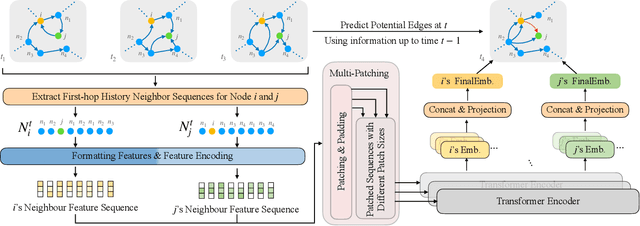

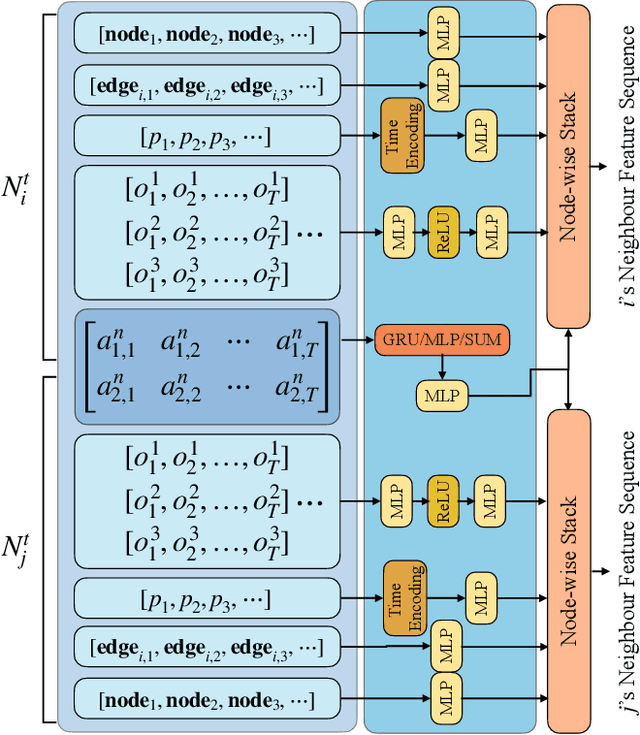

Discrete-Time Dynamic Graphs (DTDGs), which are prevalent in real-world implementations and notable for their ease of data acquisition, have garnered considerable attention from both academic researchers and industry practitioners. The representation learning of DTDGs has been extensively applied to model the dynamics of temporally changing entities and their evolving connections. Currently, DTDG representation learning predominantly relies on GNN+RNN architectures, which manifest the inherent limitations of both Graph Neural Networks (GNNs) and Recurrent Neural Networks (RNNs). GNNs suffer from the over-smoothing issue as the models architecture goes deeper, while RNNs struggle to capture long-term dependencies effectively. GNN+RNN architectures also grapple with scaling to large graph sizes and long sequences. Additionally, these methods often compute node representations separately and focus solely on individual node characteristics, thereby overlooking the behavior intersections between the two nodes whose link is being predicted, such as instances where the two nodes appear together in the same context or share common neighbors. This paper introduces a novel representation learning method DTFormer for DTDGs, pivoting from the traditional GNN+RNN framework to a Transformer-based architecture. Our approach exploits the attention mechanism to concurrently process topological information within the graph at each timestamp and temporal dynamics of graphs along the timestamps, circumventing the aforementioned fundamental weakness of both GNNs and RNNs. Moreover, we enhance the model's expressive capability by incorporating the intersection relationships among nodes and integrating a multi-patching module. Extensive experiments conducted on six public dynamic graph benchmark datasets confirm our model's efficacy, achieving the SOTA performance.
Towards Adaptive Neighborhood for Advancing Temporal Interaction Graph Modeling
Jun 14, 2024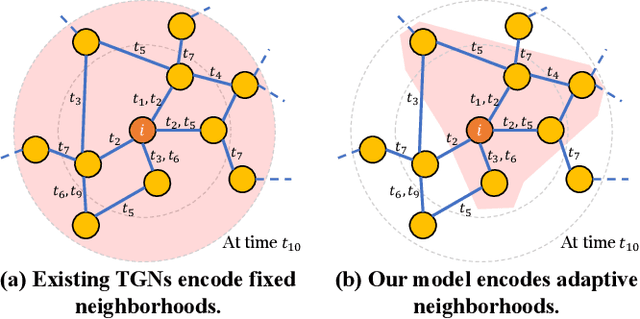
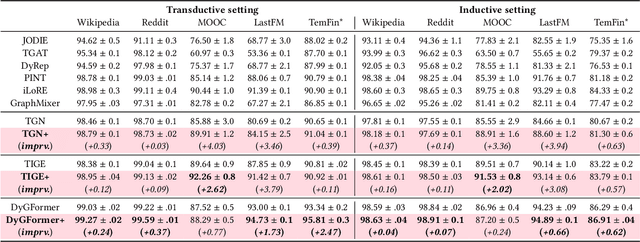
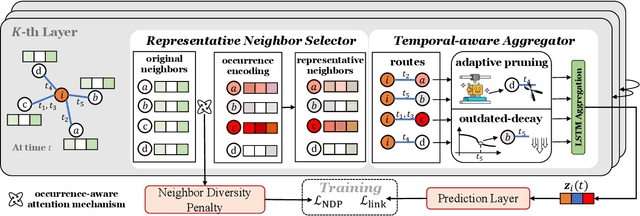

Temporal Graph Networks (TGNs) have demonstrated their remarkable performance in modeling temporal interaction graphs. These works can generate temporal node representations by encoding the surrounding neighborhoods for the target node. However, an inherent limitation of existing TGNs is their reliance on fixed, hand-crafted rules for neighborhood encoding, overlooking the necessity for an adaptive and learnable neighborhood that can accommodate both personalization and temporal evolution across different timestamps. In this paper, we aim to enhance existing TGNs by introducing an adaptive neighborhood encoding mechanism. We present SEAN, a flexible plug-and-play model that can be seamlessly integrated with existing TGNs, effectively boosting their performance. To achieve this, we decompose the adaptive neighborhood encoding process into two phases: (i) representative neighbor selection, and (ii) temporal-aware neighborhood information aggregation. Specifically, we propose the Representative Neighbor Selector component, which automatically pinpoints the most important neighbors for the target node. It offers a tailored understanding of each node's unique surrounding context, facilitating personalization. Subsequently, we propose a Temporal-aware Aggregator, which synthesizes neighborhood aggregation by selectively determining the utilization of aggregation routes and decaying the outdated information, allowing our model to adaptively leverage both the contextually significant and current information during aggregation. We conduct extensive experiments by integrating SEAN into three representative TGNs, evaluating their performance on four public datasets and one financial benchmark dataset introduced in this paper. The results demonstrate that SEAN consistently leads to performance improvements across all models, achieving SOTA performance and exceptional robustness.
Prompt Learning on Temporal Interaction Graphs
Feb 09, 2024Temporal Interaction Graphs (TIGs) are widely utilized to represent real-world systems. To facilitate representation learning on TIGs, researchers have proposed a series of TIG models. However, these models are still facing two tough gaps between the pre-training and downstream predictions in their ``pre-train, predict'' training paradigm. First, the temporal discrepancy between the pre-training and inference data severely undermines the models' applicability in distant future predictions on the dynamically evolving data. Second, the semantic divergence between pretext and downstream tasks hinders their practical applications, as they struggle to align with their learning and prediction capabilities across application scenarios. Recently, the ``pre-train, prompt'' paradigm has emerged as a lightweight mechanism for model generalization. Applying this paradigm is a potential solution to solve the aforementioned challenges. However, the adaptation of this paradigm to TIGs is not straightforward. The application of prompting in static graph contexts falls short in temporal settings due to a lack of consideration for time-sensitive dynamics and a deficiency in expressive power. To address this issue, we introduce Temporal Interaction Graph Prompting (TIGPrompt), a versatile framework that seamlessly integrates with TIG models, bridging both the temporal and semantic gaps. In detail, we propose a temporal prompt generator to offer temporally-aware prompts for different tasks. These prompts stand out for their minimalistic design, relying solely on the tuning of the prompt generator with very little supervision data. To cater to varying computational resource demands, we propose an extended ``pre-train, prompt-based fine-tune'' paradigm, offering greater flexibility. Through extensive experiments, the TIGPrompt demonstrates the SOTA performance and remarkable efficiency advantages.