 Add to Chrome
 Add to Firefox
 Add to Edge
ARAPDiffusion: ARAP Regularization for Diffusion-Based Deformable Shape Space Learning
Jun 05, 2026
This paper introduces ARAPDiffusion, a latent diffusion model to learn the underlying continuous shape space of a deformation shape collection. The key innovation is in injecting the as-rigid-as-possible (ARAP) deformation model as regularization losses into latent diffusion (LD), releasing the requirement of having abundant 3D training data for learning generative models. In contrast to the standard LD, we show how the ARAP model can be used to improve both the encoder/decoder and the LD model. The training procedure alternates between using the synthetic distribution defined by the LD model to develop a regularization loss that enhances the shape encoder/decoder and using the shape decoder to develop a regularization loss to improve the LD model. We also show the benefit of the LD paradigm in combining a representation-free LD process and an implicit shape decoder that is applicable to unorganized point clouds. The experimental results of unconditional and conditional shape generation demonstrate the advantages of ARAPDiffusion over baseline approaches.

Recovering Physically Plausible Human-Object Interactions from Monocular Videos
Jun 03, 2026In this paper, we propose RePHO, a method to reconstruct physically plausible human-object interactions (HOI) from monocular videos. While existing kinematic-based approaches produce visually plausible motion, they often result in physically implausible artifacts such as interpenetration and object floating. To overcome these issues, we introduce a physics-guided reconstruction framework. We begin with a kinematic estimate and then refine it by training a policy with reinforcement learning (RL). This policy is optimized to reproduce the interaction in a physics simulator. Because kinematic estimates are typically noisy, naive RL training can fail. Therefore, we propose an adaptive sampling strategy with a dual self-updating mechanism that can identify the frames with the most informative and reliable kinematic reconstruction. Our process progressively improves reconstruction quality and yields physically consistent HOI sequences. We demonstrate our approach on two standard HOI benchmarks and achieve clear improvements in physical plausibility metrics over state-of-the-art methods. Project Page: https://dingbang777.github.io/RePHO/
HumanNOVA: Photorealistic, Universal and Rapid 3D Human Avatar Modeling from a Single Image
Jun 01, 2026In this paper, we present HumanNOVA, a photorealistic, universal, and rapid model for generating 3D human avatars from a single RGB image. Achieving both photorealism and generalization is challenging due to the scarcity of diverse, high-quality 3D human data. To address this, we build a scalable data generation pipeline that follows two strategies. The first one is to leverage existing rigged assets and animate them with extensive poses from daily life. The second strategy is to utilize existing multi-camera captures of humans and employ fitting to generate more diverse views for training. These two strategies enable us to scale up to 100k assets, significantly enhancing both the quantity and the diversity of data for robust model training. In terms of the architecture, HumanNOVA adopts a feed-forward, token-conditioned avatar modeling framework that allows fast inference in less than one second and requires no test-time optimization. Given an input image and an estimated simplified human mesh (SMPL) without detailed geometry or appearance, the model first encodes both inputs into compact token representations. These tokens then act as conditioning signals and are fused through cross-attention to construct a triplane-based 3D avatar representation. Extensive experiments on multiple benchmarks demonstrate the superiority of our approach, both quantitatively and qualitatively, as well as its robustness under diverse input image conditions. Project page at https://HumanNOVA.github.io .
Natural Human Motion Recovery by Aligning High-Order Temporal Dynamics from Monocular Videos
May 26, 2026Human motion recovered from monocular videos often appears overly smooth or dynamically inconsistent, even when joint positions are numerically accurate. We observe that this limitation stems from the absence of reliable high-order temporal cues -- velocity and acceleration -- which are essential for reconstructing motion that exhibits realistic momentum, timing, and high-frequency detail. We introduce HTD-Refine, a post-processing framework that augments existing Human Motion Recovery (HMR) pipelines using explicitly estimated high-order temporal dynamics. At the core of our system is PVA-Net, a temporal transformer that infers per-joint 2D positions, 3D velocities, and 3D accelerations directly from a monocular video. These predicted dynamics serve as soft yet informative constraints in a global optimization procedure that refines world-space trajectories, significantly reducing jitter, suppressing over-smoothing, and restoring physically plausible motion. Extensive experiments on challenging in-the-wild benchmarks show that HTD-Refine consistently improves state-of-the-art HMR methods, yielding more accurate global trajectories and substantially more natural motion dynamics. Our results highlight the critical role of high-order temporal modeling in advancing monocular human motion recovery.
RayZer: A Self-supervised Large View Synthesis Model
May 01, 2025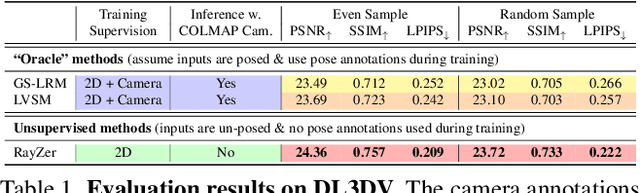
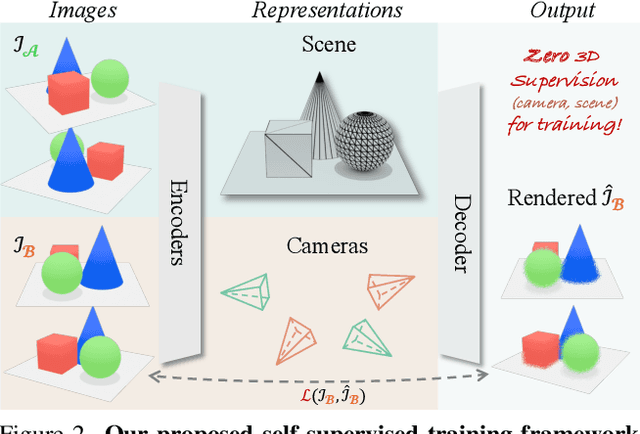
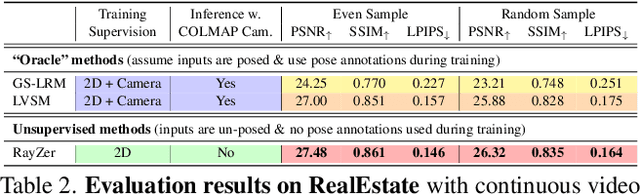
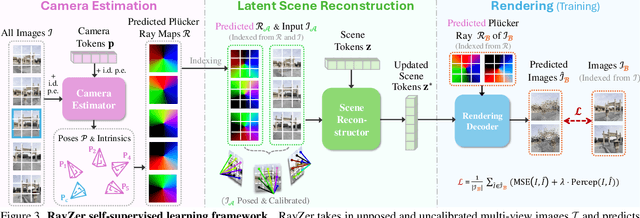
We present RayZer, a self-supervised multi-view 3D Vision model trained without any 3D supervision, i.e., camera poses and scene geometry, while exhibiting emerging 3D awareness. Concretely, RayZer takes unposed and uncalibrated images as input, recovers camera parameters, reconstructs a scene representation, and synthesizes novel views. During training, RayZer relies solely on its self-predicted camera poses to render target views, eliminating the need for any ground-truth camera annotations and allowing RayZer to be trained with 2D image supervision. The emerging 3D awareness of RayZer is attributed to two key factors. First, we design a self-supervised framework, which achieves 3D-aware auto-encoding of input images by disentangling camera and scene representations. Second, we design a transformer-based model in which the only 3D prior is the ray structure, connecting camera, pixel, and scene simultaneously. RayZer demonstrates comparable or even superior novel view synthesis performance than ``oracle'' methods that rely on pose annotations in both training and testing. Project: https://hwjiang1510.github.io/RayZer/
Reconstructing Humans with a Biomechanically Accurate Skeleton
Mar 27, 2025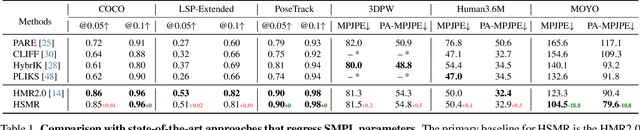
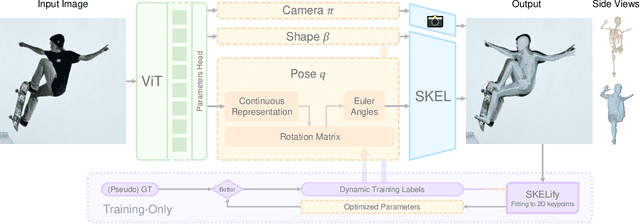
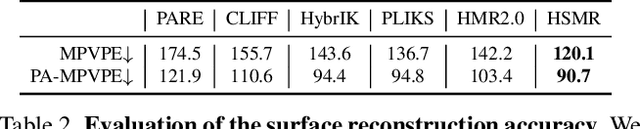
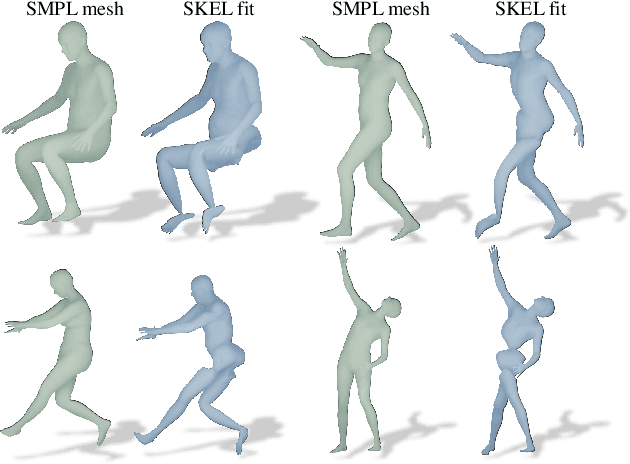
In this paper, we introduce a method for reconstructing 3D humans from a single image using a biomechanically accurate skeleton model. To achieve this, we train a transformer that takes an image as input and estimates the parameters of the model. Due to the lack of training data for this task, we build a pipeline to produce pseudo ground truth model parameters for single images and implement a training procedure that iteratively refines these pseudo labels. Compared to state-of-the-art methods for 3D human mesh recovery, our model achieves competitive performance on standard benchmarks, while it significantly outperforms them in settings with extreme 3D poses and viewpoints. Additionally, we show that previous reconstruction methods frequently violate joint angle limits, leading to unnatural rotations. In contrast, our approach leverages the biomechanically plausible degrees of freedom making more realistic joint rotation estimates. We validate our approach across multiple human pose estimation benchmarks. We make the code, models and data available at: https://isshikihugh.github.io/HSMR/
MegaSynth: Scaling Up 3D Scene Reconstruction with Synthesized Data
Dec 18, 2024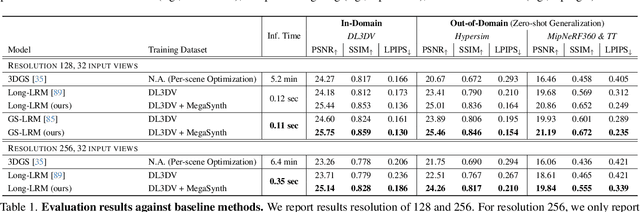
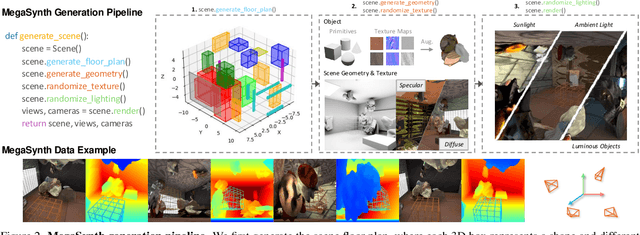
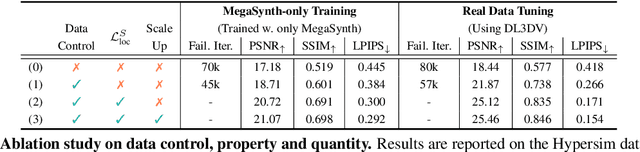
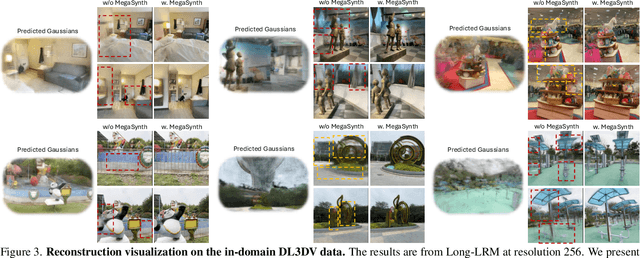
We propose scaling up 3D scene reconstruction by training with synthesized data. At the core of our work is MegaSynth, a procedurally generated 3D dataset comprising 700K scenes - over 50 times larger than the prior real dataset DL3DV - dramatically scaling the training data. To enable scalable data generation, our key idea is eliminating semantic information, removing the need to model complex semantic priors such as object affordances and scene composition. Instead, we model scenes with basic spatial structures and geometry primitives, offering scalability. Besides, we control data complexity to facilitate training while loosely aligning it with real-world data distribution to benefit real-world generalization. We explore training LRMs with both MegaSynth and available real data. Experiment results show that joint training or pre-training with MegaSynth improves reconstruction quality by 1.2 to 1.8 dB PSNR across diverse image domains. Moreover, models trained solely on MegaSynth perform comparably to those trained on real data, underscoring the low-level nature of 3D reconstruction. Additionally, we provide an in-depth analysis of MegaSynth's properties for enhancing model capability, training stability, and generalization.
FIction: 4D Future Interaction Prediction from Video
Dec 01, 2024


Anticipating how a person will interact with objects in an environment is essential for activity understanding, but existing methods are limited to the 2D space of video frames-capturing physically ungrounded predictions of 'what' and ignoring the 'where' and 'how'. We introduce 4D future interaction prediction from videos. Given an input video of a human activity, the goal is to predict what objects at what 3D locations the person will interact with in the next time period (e.g., cabinet, fridge), and how they will execute that interaction (e.g., poses for bending, reaching, pulling). We propose a novel model FIction that fuses the past video observation of the person's actions and their environment to predict both the 'where' and 'how' of future interactions. Through comprehensive experiments on a variety of activities and real-world environments in Ego-Exo4D, we show that our proposed approach outperforms prior autoregressive and (lifted) 2D video models substantially, with more than 30% relative gains.
OKAMI: Teaching Humanoid Robots Manipulation Skills through Single Video Imitation
Oct 15, 2024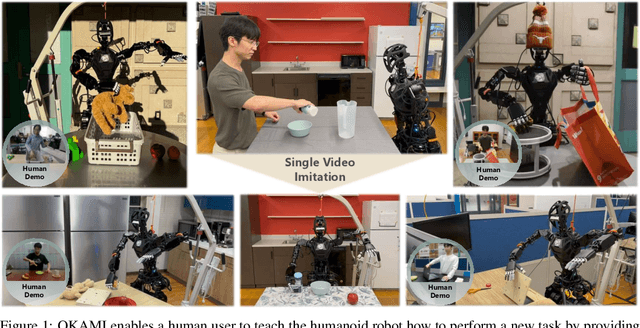


We study the problem of teaching humanoid robots manipulation skills by imitating from single video demonstrations. We introduce OKAMI, a method that generates a manipulation plan from a single RGB-D video and derives a policy for execution. At the heart of our approach is object-aware retargeting, which enables the humanoid robot to mimic the human motions in an RGB-D video while adjusting to different object locations during deployment. OKAMI uses open-world vision models to identify task-relevant objects and retarget the body motions and hand poses separately. Our experiments show that OKAMI achieves strong generalizations across varying visual and spatial conditions, outperforming the state-of-the-art baseline on open-world imitation from observation. Furthermore, OKAMI rollout trajectories are leveraged to train closed-loop visuomotor policies, which achieve an average success rate of 79.2% without the need for labor-intensive teleoperation. More videos can be found on our website https://ut-austin-rpl.github.io/OKAMI/.
Estimating Body and Hand Motion in an Ego-sensed World
Oct 04, 2024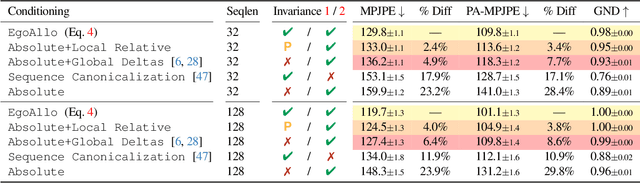
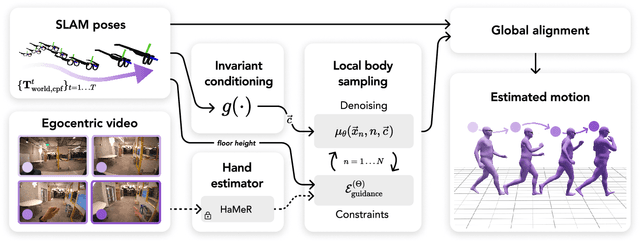
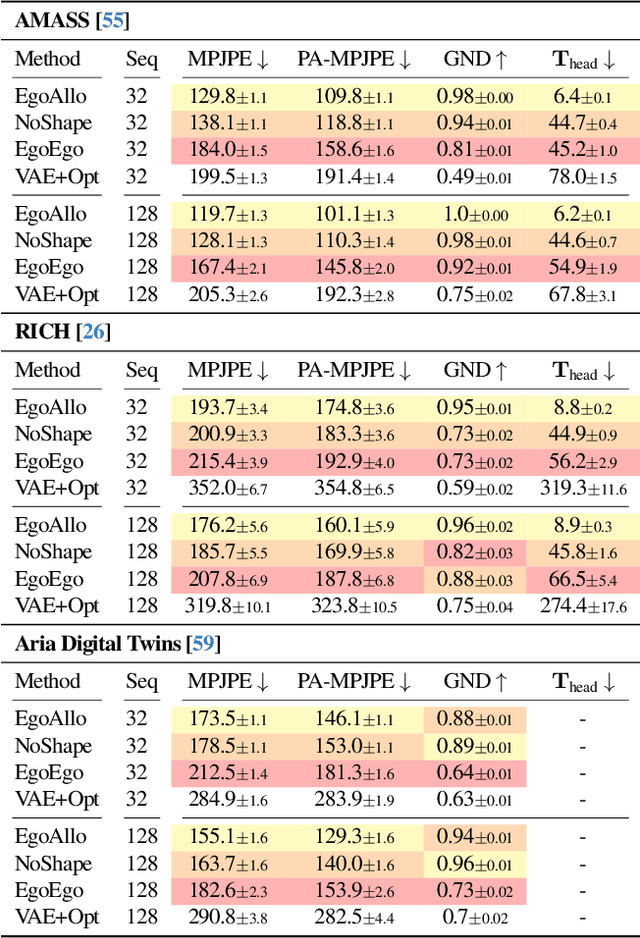

We present EgoAllo, a system for human motion estimation from a head-mounted device. Using only egocentric SLAM poses and images, EgoAllo guides sampling from a conditional diffusion model to estimate 3D body pose, height, and hand parameters that capture the wearer's actions in the allocentric coordinate frame of the scene. To achieve this, our key insight is in representation: we propose spatial and temporal invariance criteria for improving model performance, from which we derive a head motion conditioning parameterization that improves estimation by up to 18%. We also show how the bodies estimated by our system can improve the hands: the resulting kinematic and temporal constraints result in over 40% lower hand estimation errors compared to noisy monocular estimates. Project page: https://egoallo.github.io/