 Add to Chrome
 Add to Firefox
 Add to Edge
EgoExoMoCap: Distributed Ego-Exo Human Motion Capture
Jul 17, 2026
Human motion capture from head-mounted devices (HMDs) offers a scalable way to acquire real-world human motion and interaction data, which is crucial for applications in embodied AI and VR/AR. Existing approaches focus on either egocentric body tracking, estimating the motion of the subject wearing the device, or exocentric tracking, capturing the movements of people in the wearer's surroundings. So far, these two paradigms have largely been explored in isolation. In this paper, we propose a novel distributed framework that jointly leverages ego- and exocentric multi-modal signals for human motion estimation from HMDs. Unlike traditional motion capture systems requiring bulky multi-camera setups or obtrusive mocap suits, our approach, EgoExoMoCap, is as simple as two (or more) people, each wearing a pair of smart glasses. The method leverages head (plus potentially wrist) tracking signals for accurate estimation of global motion in the 3D world and combines context-aware image features based on DINOv3 to achieve robustness in the presence of noise and occlusions. Extensive experiments on two in-the-wild datasets show that our approach can robustly reconstruct motion even in challenging scenarios.

GIRAF: Towards Generalizable Human Interactions with Articulated Objects
Jul 08, 2026Synthesizing realistic full-body human interactions with articulated objects is a fundamental challenge for embodied AI and graphics, with applications in robotics training and virtual agents. Existing models remain limited: some focus on simple activities with static objects, while others restrict attention to hand-only manipulation. This leaves open the problem of generating coordinated full-body motion that approaches, manipulates, and moves articulated objects in a realistic and generalizable way. The key difficulty lies in reasoning jointly about locomotion, fine-grained contact, and object articulation. Models must capture subtle hand-object correspondences that transfer across object geometries, while also producing seamless transitions from navigation to manipulation. At the same time, the scarcity of large-scale paired motion-scene data makes it difficult to generalize across diverse object positions and shapes. We introduce a text-conditioned diffusion model that addresses these challenges through three core ideas: an object-centric representation that unifies hand-object contact with object surfaces, a mixed-domain training strategy that balances locomotion and interaction, and a contact-based augmentation scheme that expands training diversity. Through experiments, our method demonstrated strong generalization to unseen object configurations, surpassing current state-of-the-art methods.
IMAGIN-4D: Image-Guided Controllable Interaction Generation
Jun 22, 2026Generating human-object interactions (HOI) is central to character animation, robotics, AR/VR, and embodied AI. Recent HOI generation methods synthesize motion from text, object geometry, and sparse waypoints, controlling action semantics and object trajectories. However, these signals underspecify interaction: the same prompt and trajectory can produce different grasps, approach directions, body poses, object poses, contacts, and body-object layouts. We address this ambiguity with a reference image as a visual specification of the desired interaction snapshot. However, a single global image representation conflates distinct cues and conditions all frames on identical visual evidence. We therefore introduce IMAGIN-4D, a diffusion-based HOI generator that decomposes image conditioning spatio-temporally. For spatial conditioning, IMAGIN-4D extracts supervised interaction-state tokens for body pose, object pose, body-object contact, and spatial relationships at the depicted frame. For temporal conditioning, it computes frame-aware tokens by querying image patches per generated frame, allowing sequence segments to attend to different visual cues from the same image. To balance image, text, and waypoint cues, IMAGIN-4D uses role-aware conditioning: text, waypoints, and interaction-state tokens use separate AdaLN streams, while frame-aware visual tokens cross-attend with motion tokens. Since HOI motion datasets lack paired images, we build a synthetic motion-to-image rendering pipeline from FullBodyManipulation (FBM) and introduce an image-adherence metric to evaluate whether generated motions match the reference snapshot. Experiments on FBM and BEHAVE show that IMAGIN-4D improves fine-grained interaction control over single-token and uniformly image-conditioned baselines while preserving waypoint-following and motion quality. Code and models will be released at https://imagin4d.github.io.
NymeriaPlus: Enriching Nymeria Dataset with Additional Annotations and Data
Mar 19, 2026The Nymeria Dataset, released in 2024, is a large-scale collection of in-the-wild human activities captured with multiple egocentric wearable devices that are spatially localized and temporally synchronized. It provides body-motion ground truth recorded with a motion-capture suit, device trajectories, semi-dense 3D point clouds, and in-context narrations. In this paper, we upgrade Nymeria and introduce NymeriaPlus. NymeriaPlus features: (1) improved human motion in Momentum Human Rig (MHR) and SMPL formats; (2) dense 3D and 2D bounding box annotations for indoor objects and structural elements; (3) instance-level 3D object reconstructions; and (4) additional modalities e.g., basemap recordings, audio, and wristband videos. By consolidating these complementary modalities and annotations into a single, coherent benchmark, NymeriaPlus strengthens Nymeria into a more powerful in-the-wild egocentric dataset. We expect NymeriaPlus to bridge a key gap in existing egocentric resources and to support a broader range of research, including unique explorations of multimodal learning for embodied AI.
Masked Modeling for Human Motion Recovery Under Occlusions
Jan 23, 2026Human motion reconstruction from monocular videos is a fundamental challenge in computer vision, with broad applications in AR/VR, robotics, and digital content creation, but remains challenging under frequent occlusions in real-world settings. Existing regression-based methods are efficient but fragile to missing observations, while optimization- and diffusion-based approaches improve robustness at the cost of slow inference speed and heavy preprocessing steps. To address these limitations, we leverage recent advances in generative masked modeling and present MoRo: Masked Modeling for human motion Recovery under Occlusions. MoRo is an occlusion-robust, end-to-end generative framework that formulates motion reconstruction as a video-conditioned task, and efficiently recover human motion in a consistent global coordinate system from RGB videos. By masked modeling, MoRo naturally handles occlusions while enabling efficient, end-to-end inference. To overcome the scarcity of paired video-motion data, we design a cross-modality learning scheme that learns multi-modal priors from a set of heterogeneous datasets: (i) a trajectory-aware motion prior trained on MoCap datasets, (ii) an image-conditioned pose prior trained on image-pose datasets, capturing diverse per-frame poses, and (iii) a video-conditioned masked transformer that fuses motion and pose priors, finetuned on video-motion datasets to integrate visual cues with motion dynamics for robust inference. Extensive experiments on EgoBody and RICH demonstrate that MoRo substantially outperforms state-of-the-art methods in accuracy and motion realism under occlusions, while performing on-par in non-occluded scenarios. MoRo achieves real-time inference at 70 FPS on a single H200 GPU.
MHR: Momentum Human Rig
Nov 19, 2025We present MHR, a parametric human body model that combines the decoupled skeleton/shape paradigm of ATLAS with a flexible, modern rig and pose corrective system inspired by the Momentum library. Our model enables expressive, anatomically plausible human animation, supporting non-linear pose correctives, and is designed for robust integration in AR/VR and graphics pipelines.
SplatFields: Neural Gaussian Splats for Sparse 3D and 4D Reconstruction
Sep 17, 2024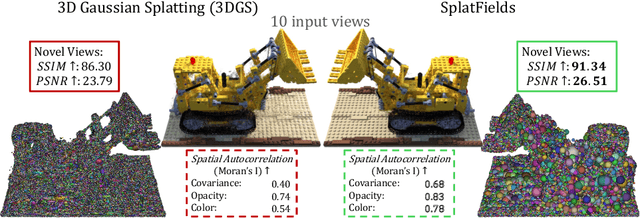

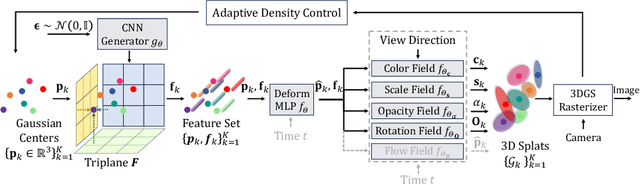
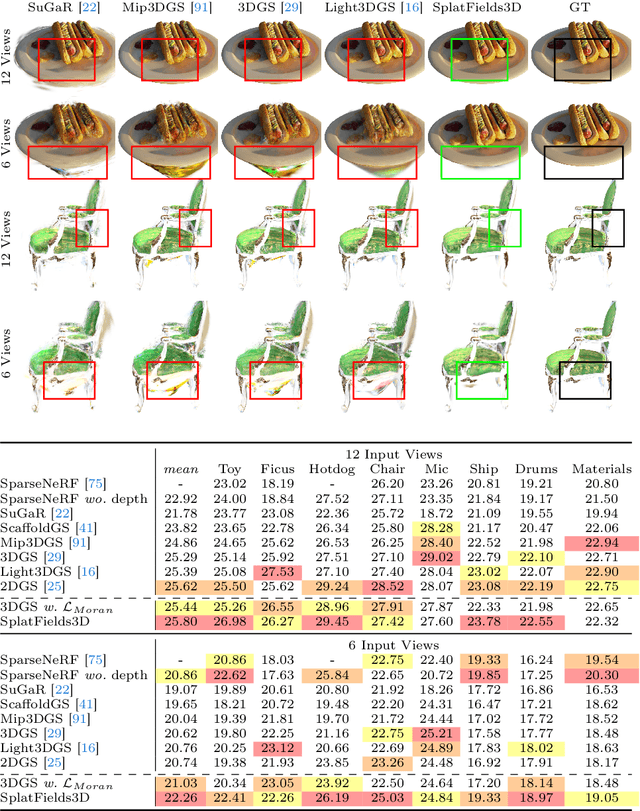
Digitizing 3D static scenes and 4D dynamic events from multi-view images has long been a challenge in computer vision and graphics. Recently, 3D Gaussian Splatting (3DGS) has emerged as a practical and scalable reconstruction method, gaining popularity due to its impressive reconstruction quality, real-time rendering capabilities, and compatibility with widely used visualization tools. However, the method requires a substantial number of input views to achieve high-quality scene reconstruction, introducing a significant practical bottleneck. This challenge is especially severe in capturing dynamic scenes, where deploying an extensive camera array can be prohibitively costly. In this work, we identify the lack of spatial autocorrelation of splat features as one of the factors contributing to the suboptimal performance of the 3DGS technique in sparse reconstruction settings. To address the issue, we propose an optimization strategy that effectively regularizes splat features by modeling them as the outputs of a corresponding implicit neural field. This results in a consistent enhancement of reconstruction quality across various scenarios. Our approach effectively handles static and dynamic cases, as demonstrated by extensive testing across different setups and scene complexities.
RoHM: Robust Human Motion Reconstruction via Diffusion
Jan 16, 2024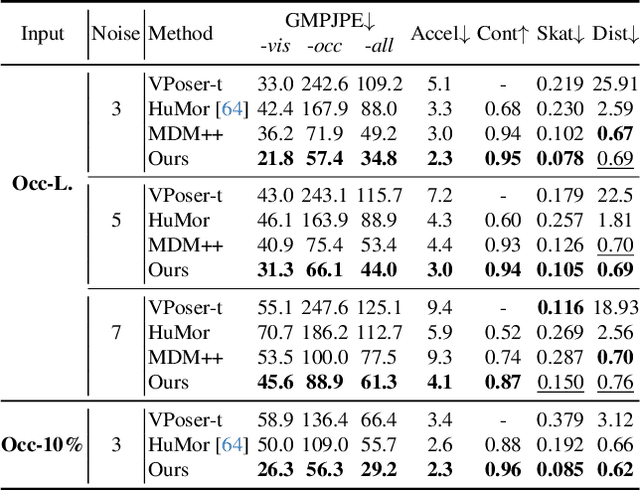

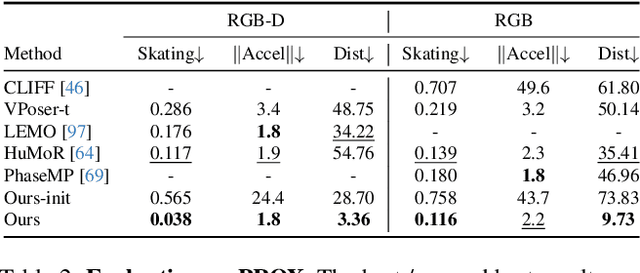

We propose RoHM, an approach for robust 3D human motion reconstruction from monocular RGB(-D) videos in the presence of noise and occlusions. Most previous approaches either train neural networks to directly regress motion in 3D or learn data-driven motion priors and combine them with optimization at test time. The former do not recover globally coherent motion and fail under occlusions; the latter are time-consuming, prone to local minima, and require manual tuning. To overcome these shortcomings, we exploit the iterative, denoising nature of diffusion models. RoHM is a novel diffusion-based motion model that, conditioned on noisy and occluded input data, reconstructs complete, plausible motions in consistent global coordinates. Given the complexity of the problem -- requiring one to address different tasks (denoising and infilling) in different solution spaces (local and global motion) -- we decompose it into two sub-tasks and learn two models, one for global trajectory and one for local motion. To capture the correlations between the two, we then introduce a novel conditioning module, combining it with an iterative inference scheme. We apply RoHM to a variety of tasks -- from motion reconstruction and denoising to spatial and temporal infilling. Extensive experiments on three popular datasets show that our method outperforms state-of-the-art approaches qualitatively and quantitatively, while being faster at test time. The code will be available at https://sanweiliti.github.io/ROHM/ROHM.html.
FLAG: Flow-based 3D Avatar Generation from Sparse Observations
Mar 11, 2022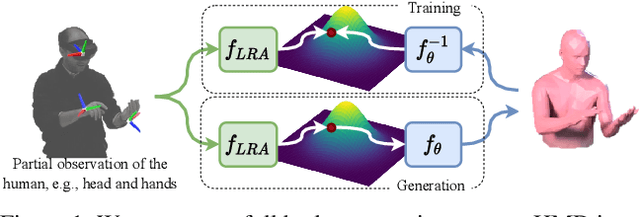
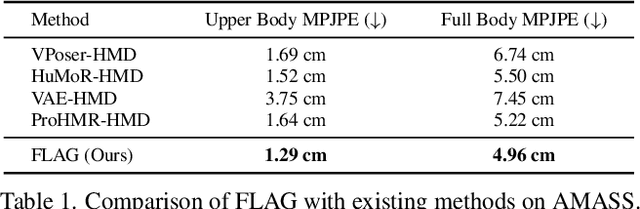
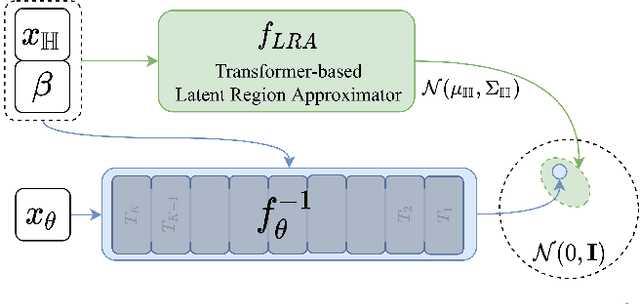
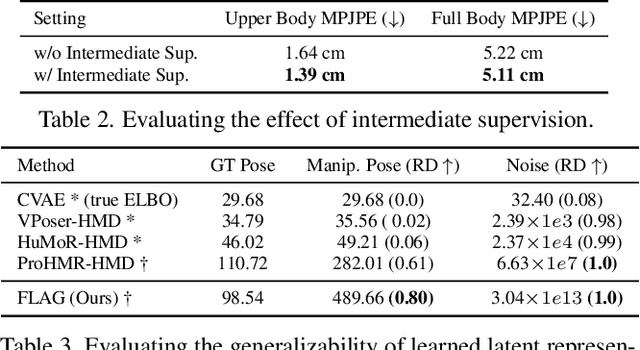
To represent people in mixed reality applications for collaboration and communication, we need to generate realistic and faithful avatar poses. However, the signal streams that can be applied for this task from head-mounted devices (HMDs) are typically limited to head pose and hand pose estimates. While these signals are valuable, they are an incomplete representation of the human body, making it challenging to generate a faithful full-body avatar. We address this challenge by developing a flow-based generative model of the 3D human body from sparse observations, wherein we learn not only a conditional distribution of 3D human pose, but also a probabilistic mapping from observations to the latent space from which we can generate a plausible pose along with uncertainty estimates for the joints. We show that our approach is not only a strong predictive model, but can also act as an efficient pose prior in different optimization settings where a good initial latent code plays a major role.
Spatial Computing and Intuitive Interaction: Bringing Mixed Reality and Robotics Together
Feb 03, 2022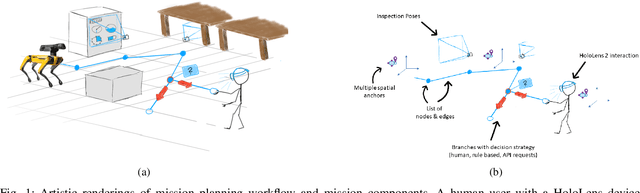
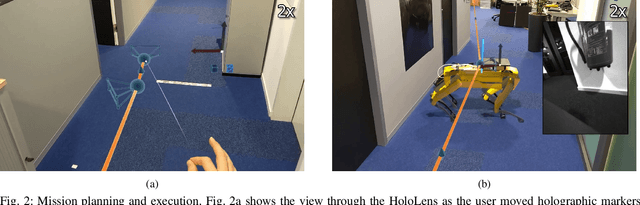
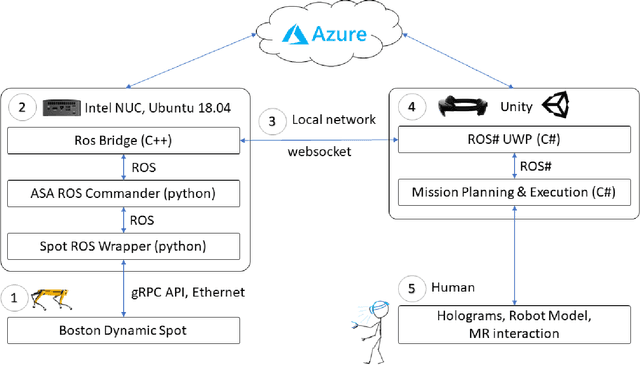
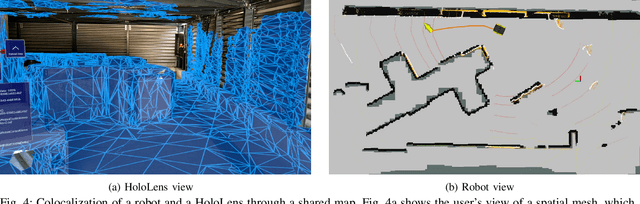
Spatial computing -- the ability of devices to be aware of their surroundings and to represent this digitally -- offers novel capabilities in human-robot interaction. In particular, the combination of spatial computing and egocentric sensing on mixed reality devices enables them to capture and understand human actions and translate these to actions with spatial meaning, which offers exciting new possibilities for collaboration between humans and robots. This paper presents several human-robot systems that utilize these capabilities to enable novel robot use cases: mission planning for inspection, gesture-based control, and immersive teleoperation. These works demonstrate the power of mixed reality as a tool for human-robot interaction, and the potential of spatial computing and mixed reality to drive the future of human-robot interaction.