 Add to Chrome
 Add to Firefox
 Add to Edge
SuperFlex: Deformable Superquadrics for Point Cloud Decomposition
Jul 01, 2026
Superquadrics have proven to provide a compact, geometrically meaningful representation for 3D objects. However, existing methods suffer from limited reconstruction accuracy, are restricted to rigid primitives, and lack robustness to partial point clouds. In this work, we present SuperFlex, an enhanced framework that expands the expressive power and applicability of superquadric decompositions. First, we introduce a novel loss formulation which significantly improves reconstruction accuracy. Second, we include bending and tapering deformations, enabling high-fidelity representation of curved and asymmetric geometries. Finally, we leverage these high-quality decompositions as supervision to train a model that is robust to partial real-world point clouds. Experiments demonstrate substantial improvements in reconstruction accuracy over both optimization- and learning-based baselines while maintaining a highly compact primitive representation.

FunRec: Reconstructing Functional 3D Scenes from Egocentric Interaction Videos
Apr 07, 2026We present FunRec, a method for reconstructing functional 3D digital twins of indoor scenes directly from egocentric RGB-D interaction videos. Unlike existing methods on articulated reconstruction, which rely on controlled setups, multi-state captures, or CAD priors, FunRec operates directly on in-the-wild human interaction sequences to recover interactable 3D scenes. It automatically discovers articulated parts, estimates their kinematic parameters, tracks their 3D motion, and reconstructs static and moving geometry in canonical space, yielding simulation-compatible meshes. Across new real and simulated benchmarks, FunRec surpasses prior work by a large margin, achieving up to +50 mIoU improvement in part segmentation, 5-10 times lower articulation and pose errors, and significantly higher reconstruction accuracy. We further demonstrate applications on URDF/USD export for simulation, hand-guided affordance mapping and robot-scene interaction.
SceneTeract: Agentic Functional Affordances and VLM Grounding in 3D Scenes
Mar 31, 2026Embodied AI depends on interactive 3D environments that support meaningful activities for diverse users, yet assessing their functional affordances remains a core challenge. We introduce SceneTeract, a framework that verifies 3D scene functionality under agent-specific constraints. Our core contribution is a grounded verification engine that couples high-level semantic reasoning with low-level geometric checks. SceneTeract decomposes complex activities into sequences of atomic actions and validates each step against accessibility requirements (e.g., reachability, clearance, and navigability) conditioned on an embodied agent profile, using explicit physical and geometric simulations. We deploy SceneTeract to perform an in-depth evaluation of (i) synthetic indoor environments, uncovering frequent functional failures that prevent basic interactions, and (ii) the ability of frontier Vision-Language Models (VLMs) to reason about and predict functional affordances, revealing systematic mismatches between semantic confidence and physical feasibility even for the strongest current models. Finally, we leverage SceneTeract as a reward engine for VLM post-training, enabling scalable distillation of geometric constraints into reasoning models. We release the SceneTeract verification suite and data to bridge perception and physical reality in embodied 3D scene understanding.
Video Perception Models for 3D Scene Synthesis
Jun 25, 2025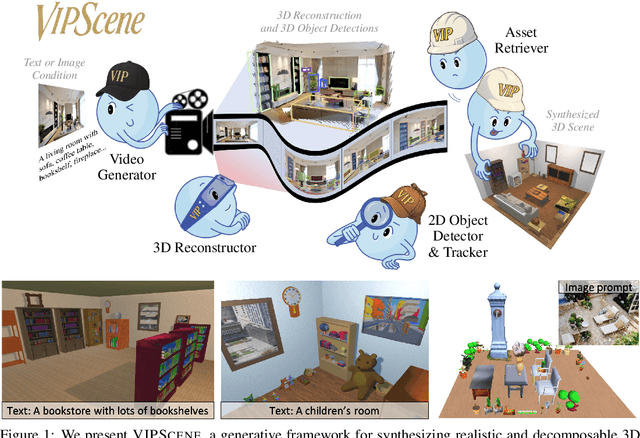
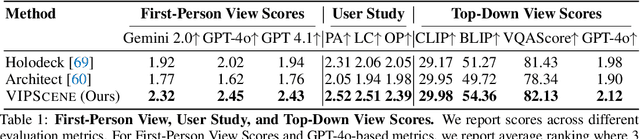
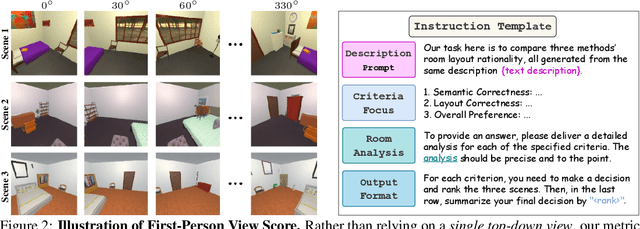
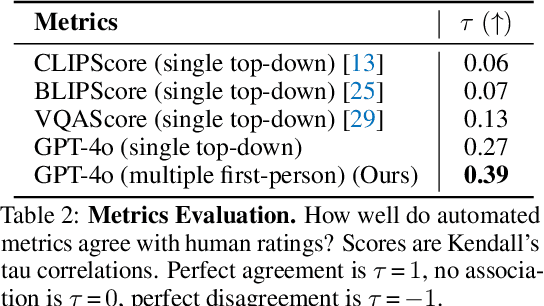
Traditionally, 3D scene synthesis requires expert knowledge and significant manual effort. Automating this process could greatly benefit fields such as architectural design, robotics simulation, virtual reality, and gaming. Recent approaches to 3D scene synthesis often rely on the commonsense reasoning of large language models (LLMs) or strong visual priors of modern image generation models. However, current LLMs demonstrate limited 3D spatial reasoning ability, which restricts their ability to generate realistic and coherent 3D scenes. Meanwhile, image generation-based methods often suffer from constraints in viewpoint selection and multi-view inconsistencies. In this work, we present Video Perception models for 3D Scene synthesis (VIPScene), a novel framework that exploits the encoded commonsense knowledge of the 3D physical world in video generation models to ensure coherent scene layouts and consistent object placements across views. VIPScene accepts both text and image prompts and seamlessly integrates video generation, feedforward 3D reconstruction, and open-vocabulary perception models to semantically and geometrically analyze each object in a scene. This enables flexible scene synthesis with high realism and structural consistency. For more precise analysis, we further introduce First-Person View Score (FPVScore) for coherence and plausibility evaluation, utilizing continuous first-person perspective to capitalize on the reasoning ability of multimodal large language models. Extensive experiments show that VIPScene significantly outperforms existing methods and generalizes well across diverse scenarios. The code will be released.
SLAG: Scalable Language-Augmented Gaussian Splatting
May 12, 2025Language-augmented scene representations hold great promise for large-scale robotics applications such as search-and-rescue, smart cities, and mining. Many of these scenarios are time-sensitive, requiring rapid scene encoding while also being data-intensive, necessitating scalable solutions. Deploying these representations on robots with limited computational resources further adds to the challenge. To address this, we introduce SLAG, a multi-GPU framework for language-augmented Gaussian splatting that enhances the speed and scalability of embedding large scenes. Our method integrates 2D visual-language model features into 3D scenes using SAM and CLIP. Unlike prior approaches, SLAG eliminates the need for a loss function to compute per-Gaussian language embeddings. Instead, it derives embeddings from 3D Gaussian scene parameters via a normalized weighted average, enabling highly parallelized scene encoding. Additionally, we introduce a vector database for efficient embedding storage and retrieval. Our experiments show that SLAG achieves an 18 times speedup in embedding computation on a 16-GPU setup compared to OpenGaussian, while preserving embedding quality on the ScanNet and LERF datasets. For more details, visit our project website: https://slag-project.github.io/.
Robust Human Registration with Body Part Segmentation on Noisy Point Clouds
Apr 04, 2025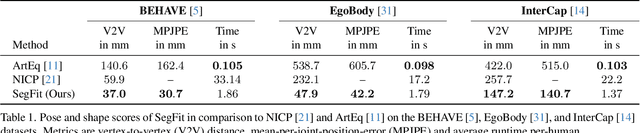
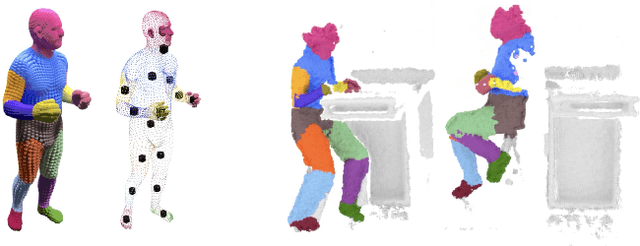
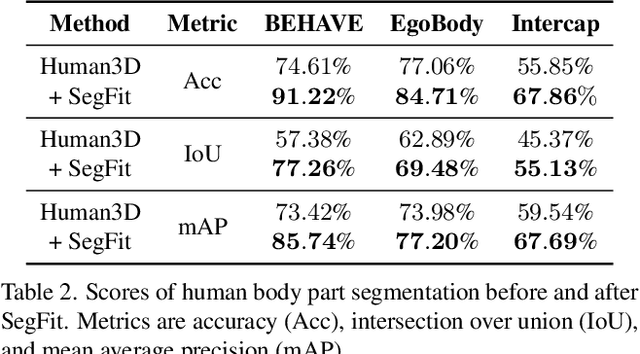
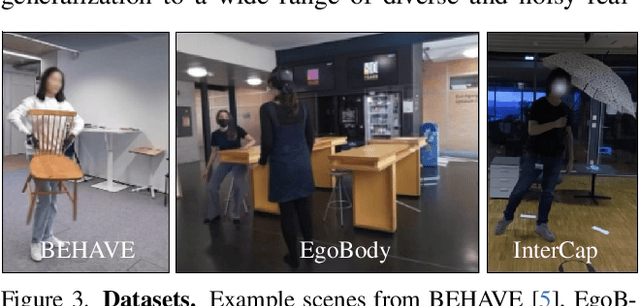
Registering human meshes to 3D point clouds is essential for applications such as augmented reality and human-robot interaction but often yields imprecise results due to noise and background clutter in real-world data. We introduce a hybrid approach that incorporates body-part segmentation into the mesh fitting process, enhancing both human pose estimation and segmentation accuracy. Our method first assigns body part labels to individual points, which then guide a two-step SMPL-X fitting: initial pose and orientation estimation using body part centroids, followed by global refinement of the point cloud alignment. Additionally, we demonstrate that the fitted human mesh can refine body part labels, leading to improved segmentation. Evaluations on the cluttered and noisy real-world datasets InterCap, EgoBody, and BEHAVE show that our approach significantly outperforms prior methods in both pose estimation and segmentation accuracy. Code and results are available on our project website: https://segfit.github.io
SuperDec: 3D Scene Decomposition with Superquadric Primitives
Apr 01, 2025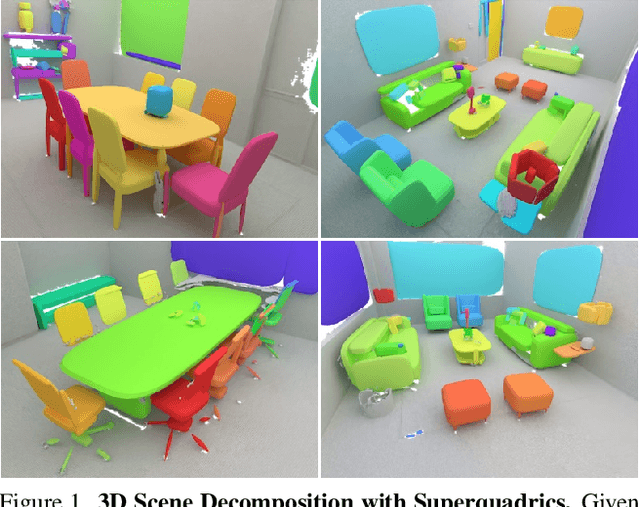
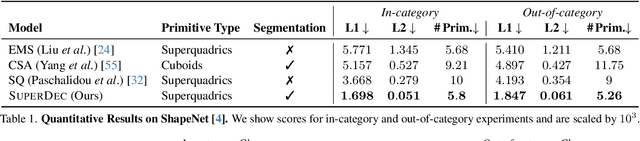
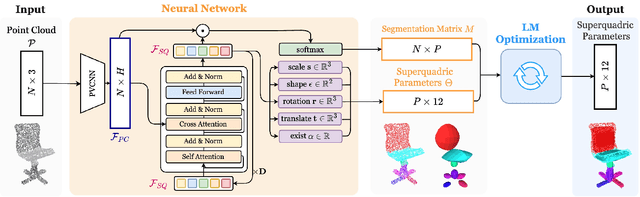
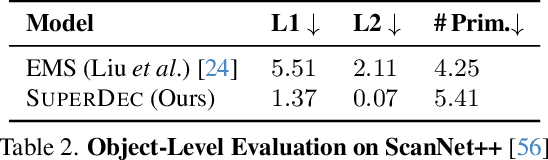
We present SuperDec, an approach for creating compact 3D scene representations via decomposition into superquadric primitives. While most recent works leverage geometric primitives to obtain photorealistic 3D scene representations, we propose to leverage them to obtain a compact yet expressive representation. We propose to solve the problem locally on individual objects and leverage the capabilities of instance segmentation methods to scale our solution to full 3D scenes. In doing that, we design a new architecture which efficiently decompose point clouds of arbitrary objects in a compact set of superquadrics. We train our architecture on ShapeNet and we prove its generalization capabilities on object instances extracted from the ScanNet++ dataset as well as on full Replica scenes. Finally, we show how a compact representation based on superquadrics can be useful for a diverse range of downstream applications, including robotic tasks and controllable visual content generation and editing.
Open-Vocabulary Functional 3D Scene Graphs for Real-World Indoor Spaces
Mar 24, 2025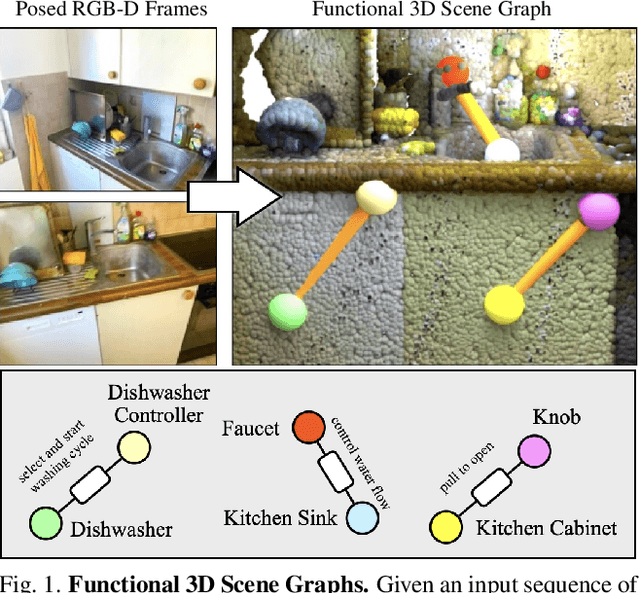
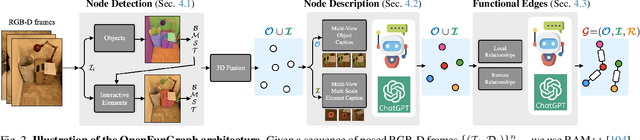
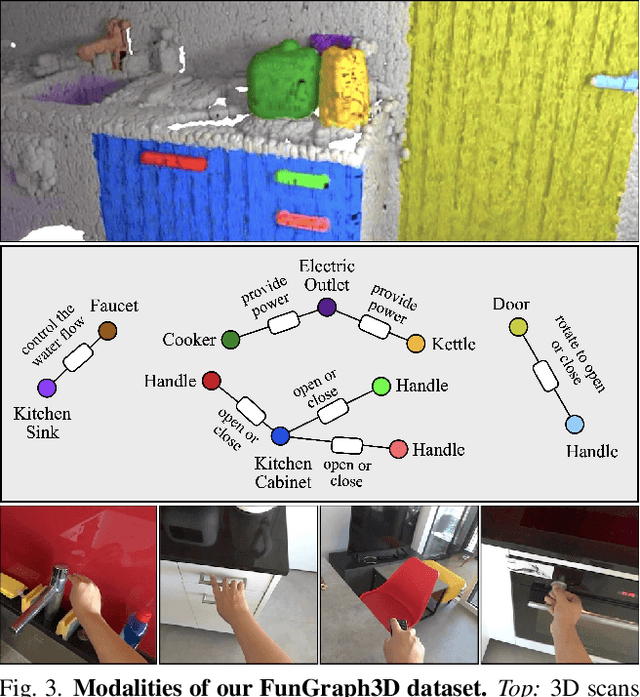
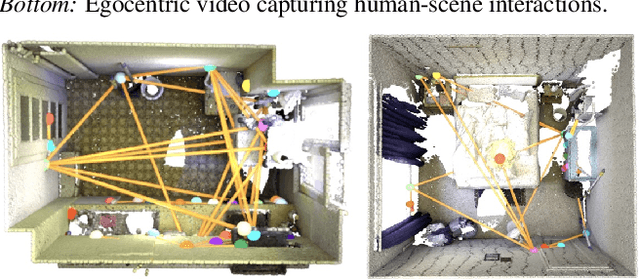
We introduce the task of predicting functional 3D scene graphs for real-world indoor environments from posed RGB-D images. Unlike traditional 3D scene graphs that focus on spatial relationships of objects, functional 3D scene graphs capture objects, interactive elements, and their functional relationships. Due to the lack of training data, we leverage foundation models, including visual language models (VLMs) and large language models (LLMs), to encode functional knowledge. We evaluate our approach on an extended SceneFun3D dataset and a newly collected dataset, FunGraph3D, both annotated with functional 3D scene graphs. Our method significantly outperforms adapted baselines, including Open3DSG and ConceptGraph, demonstrating its effectiveness in modeling complex scene functionalities. We also demonstrate downstream applications such as 3D question answering and robotic manipulation using functional 3D scene graphs. See our project page at https://openfungraph.github.io
OpenCity3D: What do Vision-Language Models know about Urban Environments?
Mar 21, 2025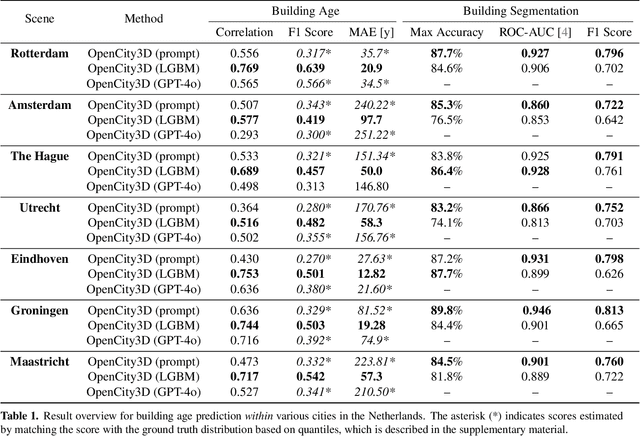

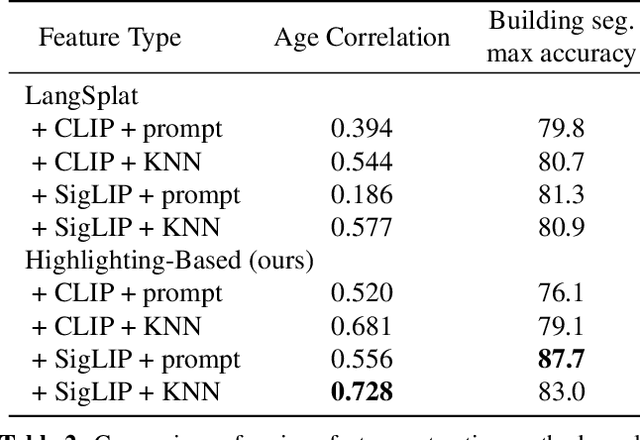
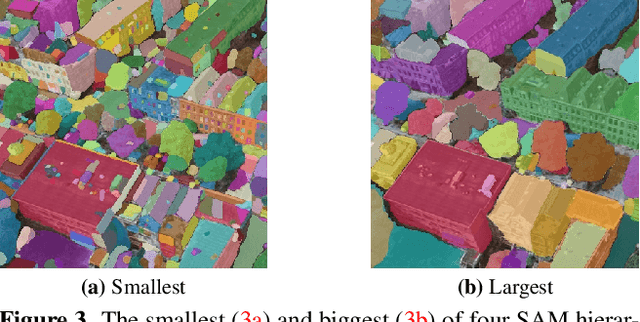
Vision-language models (VLMs) show great promise for 3D scene understanding but are mainly applied to indoor spaces or autonomous driving, focusing on low-level tasks like segmentation. This work expands their use to urban-scale environments by leveraging 3D reconstructions from multi-view aerial imagery. We propose OpenCity3D, an approach that addresses high-level tasks, such as population density estimation, building age classification, property price prediction, crime rate assessment, and noise pollution evaluation. Our findings highlight OpenCity3D's impressive zero-shot and few-shot capabilities, showcasing adaptability to new contexts. This research establishes a new paradigm for language-driven urban analytics, enabling applications in planning, policy, and environmental monitoring. See our project page: opencity3d.github.io
ARKit LabelMaker: A New Scale for Indoor 3D Scene Understanding
Oct 17, 2024
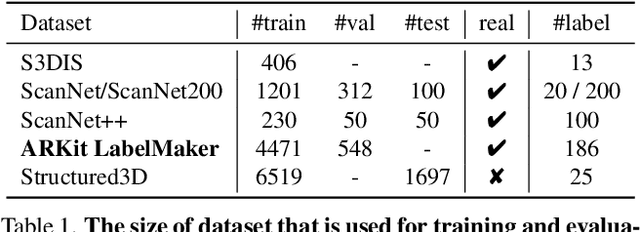
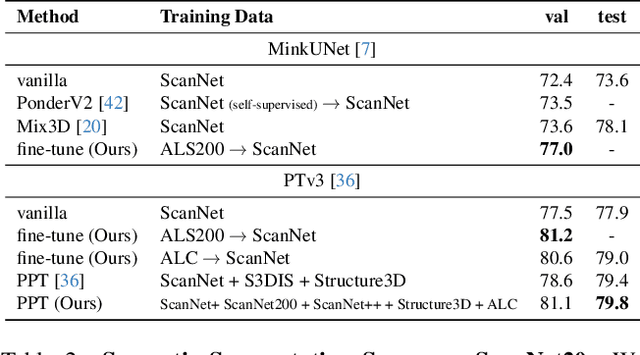

The performance of neural networks scales with both their size and the amount of data they have been trained on. This is shown in both language and image generation. However, this requires scaling-friendly network architectures as well as large-scale datasets. Even though scaling-friendly architectures like transformers have emerged for 3D vision tasks, the GPT-moment of 3D vision remains distant due to the lack of training data. In this paper, we introduce ARKit LabelMaker, the first large-scale, real-world 3D dataset with dense semantic annotations. Specifically, we complement ARKitScenes dataset with dense semantic annotations that are automatically generated at scale. To this end, we extend LabelMaker, a recent automatic annotation pipeline, to serve the needs of large-scale pre-training. This involves extending the pipeline with cutting-edge segmentation models as well as making it robust to the challenges of large-scale processing. Further, we push forward the state-of-the-art performance on ScanNet and ScanNet200 dataset with prevalent 3D semantic segmentation models, demonstrating the efficacy of our generated dataset.