 Add to Chrome
 Add to Firefox
 Add to Edge
AHAP: Reconstructing Arbitrary Humans from Arbitrary Perspectives with Geometric Priors
Feb 27, 2026
Reconstructing 3D humans from images captured at multiple perspectives typically requires pre-calibration, like using checkerboards or MVS algorithms, which limits scalability and applicability in diverse real-world scenarios. In this work, we present \textbf{AHAP} (Reconstructing \textbf{A}rbitrary \textbf{H}umans from \textbf{A}rbitrary \textbf{P}erspectives), a feed-forward framework for reconstructing arbitrary humans from arbitrary camera perspectives without requiring camera calibration. Our core lies in the effective fusion of multi-view geometry to assist human association, reconstruction and localization. Specifically, we use a Cross-View Identity Association module through learnable person queries and soft assignment, supervised by contrastive learning to resolve cross-view human identity association. A Human Head fuses cross-view features and scene context for SMPL prediction, guided by cross-view reprojection losses to enforce body pose consistency. Additionally, multi-view geometry eliminates the depth ambiguity inherent in monocular methods, providing more precise 3D human localization through multi-view triangulation. Experiments on EgoHumans and EgoExo4D demonstrate that AHAP achieves competitive performance on both world-space human reconstruction and camera pose estimation, while being 180$\times$ faster than optimization-based approaches.

EmbodMocap: In-the-Wild 4D Human-Scene Reconstruction for Embodied Agents
Feb 26, 2026Human behaviors in the real world naturally encode rich, long-term contextual information that can be leveraged to train embodied agents for perception, understanding, and acting. However, existing capture systems typically rely on costly studio setups and wearable devices, limiting the large-scale collection of scene-conditioned human motion data in the wild. To address this, we propose EmbodMocap, a portable and affordable data collection pipeline using two moving iPhones. Our key idea is to jointly calibrate dual RGB-D sequences to reconstruct both humans and scenes within a unified metric world coordinate frame. The proposed method allows metric-scale and scene-consistent capture in everyday environments without static cameras or markers, bridging human motion and scene geometry seamlessly. Compared with optical capture ground truth, we demonstrate that the dual-view setting exhibits a remarkable ability to mitigate depth ambiguity, achieving superior alignment and reconstruction performance over single iphone or monocular models. Based on the collected data, we empower three embodied AI tasks: monocular human-scene-reconstruction, where we fine-tune on feedforward models that output metric-scale, world-space aligned humans and scenes; physics-based character animation, where we prove our data could be used to scale human-object interaction skills and scene-aware motion tracking; and robot motion control, where we train a humanoid robot via sim-to-real RL to replicate human motions depicted in videos. Experimental results validate the effectiveness of our pipeline and its contributions towards advancing embodied AI research.
Attack-Resistant Uniform Fairness for Linear and Smooth Contextual Bandits
Feb 04, 2026Modern systems, such as digital platforms and service systems, increasingly rely on contextual bandits for online decision-making; however, their deployment can inadvertently create unfair exposure among arms, undermining long-term platform sustainability and supplier trust. This paper studies the contextual bandit problem under a uniform $(1-δ)$-fairness constraint, and addresses its unique vulnerabilities to strategic manipulation. The fairness constraint ensures that preferential treatment is strictly justified by an arm's actual reward across all contexts and time horizons, using uniformity to prevent statistical loopholes. We develop novel algorithms that achieve (nearly) minimax-optimal regret for both linear and smooth reward functions, while maintaining strong $(1-\tilde{O}(1/T))$-fairness guarantees, and further characterize the theoretically inherent yet asymptotically marginal "price of fairness". However, we reveal that such merit-based fairness becomes uniquely susceptible to signal manipulation. We show that an adversary with a minimal $\tilde{O}(1)$ budget can not only degrade overall performance as in traditional attacks, but also selectively induce insidious fairness-specific failures while leaving conspicuous regret measures largely unaffected. To counter this, we design robust variants incorporating corruption-adaptive exploration and error-compensated thresholding. Our approach yields the first minimax-optimal regret bounds under $C$-budgeted attack while preserving $(1-\tilde{O}(1/T))$-fairness. Numerical experiments and a real-world case demonstrate that our algorithms sustain both fairness and efficiency.
LingLanMiDian: Systematic Evaluation of LLMs on TCM Knowledge and Clinical Reasoning
Feb 02, 2026Large language models (LLMs) are advancing rapidly in medical NLP, yet Traditional Chinese Medicine (TCM) with its distinctive ontology, terminology, and reasoning patterns requires domain-faithful evaluation. Existing TCM benchmarks are fragmented in coverage and scale and rely on non-unified or generation-heavy scoring that hinders fair comparison. We present the LingLanMiDian (LingLan) benchmark, a large-scale, expert-curated, multi-task suite that unifies evaluation across knowledge recall, multi-hop reasoning, information extraction, and real-world clinical decision-making. LingLan introduces a consistent metric design, a synonym-tolerant protocol for clinical labels, a per-dataset 400-item Hard subset, and a reframing of diagnosis and treatment recommendation into single-choice decision recognition. We conduct comprehensive, zero-shot evaluations on 14 leading open-source and proprietary LLMs, providing a unified perspective on their strengths and limitations in TCM commonsense knowledge understanding, reasoning, and clinical decision support; critically, the evaluation on Hard subset reveals a substantial gap between current models and human experts in TCM-specialized reasoning. By bridging fundamental knowledge and applied reasoning through standardized evaluation, LingLan establishes a unified, quantitative, and extensible foundation for advancing TCM LLMs and domain-specific medical AI research. All evaluation data and code are available at https://github.com/TCMAI-BJTU/LingLan and http://tcmnlp.com.
EgoGrasp: World-Space Hand-Object Interaction Estimation from Egocentric Videos
Jan 03, 2026We propose EgoGrasp, the first method to reconstruct world-space hand-object interactions (W-HOI) from egocentric monocular videos with dynamic cameras in the wild. Accurate W-HOI reconstruction is critical for understanding human behavior and enabling applications in embodied intelligence and virtual reality. However, existing hand-object interactions (HOI) methods are limited to single images or camera coordinates, failing to model temporal dynamics or consistent global trajectories. Some recent approaches attempt world-space hand estimation but overlook object poses and HOI constraints. Their performance also suffers under severe camera motion and frequent occlusions common in egocentric in-the-wild videos. To address these challenges, we introduce a multi-stage framework with a robust pre-process pipeline built on newly developed spatial intelligence models, a whole-body HOI prior model based on decoupled diffusion models, and a multi-objective test-time optimization paradigm. Our HOI prior model is template-free and scalable to multiple objects. In experiments, we prove our method achieving state-of-the-art performance in W-HOI reconstruction.
EgoReAct: Egocentric Video-Driven 3D Human Reaction Generation
Dec 28, 2025Humans exhibit adaptive, context-sensitive responses to egocentric visual input. However, faithfully modeling such reactions from egocentric video remains challenging due to the dual requirements of strictly causal generation and precise 3D spatial alignment. To tackle this problem, we first construct the Human Reaction Dataset (HRD) to address data scarcity and misalignment by building a spatially aligned egocentric video-reaction dataset, as existing datasets (e.g., ViMo) suffer from significant spatial inconsistency between the egocentric video and reaction motion, e.g., dynamically moving motions are always paired with fixed-camera videos. Leveraging HRD, we present EgoReAct, the first autoregressive framework that generates 3D-aligned human reaction motions from egocentric video streams in real-time. We first compress the reaction motion into a compact yet expressive latent space via a Vector Quantised-Variational AutoEncoder and then train a Generative Pre-trained Transformer for reaction generation from the visual input. EgoReAct incorporates 3D dynamic features, i.e., metric depth, and head dynamics during the generation, which effectively enhance spatial grounding. Extensive experiments demonstrate that EgoReAct achieves remarkably higher realism, spatial consistency, and generation efficiency compared with prior methods, while maintaining strict causality during generation. We will release code, models, and data upon acceptance.
KP-PINNs: Kernel Packet Accelerated Physics Informed Neural Networks
Jun 11, 2025Differential equations are involved in modeling many engineering problems. Many efforts have been devoted to solving differential equations. Due to the flexibility of neural networks, Physics Informed Neural Networks (PINNs) have recently been proposed to solve complex differential equations and have demonstrated superior performance in many applications. While the L2 loss function is usually a default choice in PINNs, it has been shown that the corresponding numerical solution is incorrect and unstable for some complex equations. In this work, we propose a new PINNs framework named Kernel Packet accelerated PINNs (KP-PINNs), which gives a new expression of the loss function using the reproducing kernel Hilbert space (RKHS) norm and uses the Kernel Packet (KP) method to accelerate the computation. Theoretical results show that KP-PINNs can be stable across various differential equations. Numerical experiments illustrate that KP-PINNs can solve differential equations effectively and efficiently. This framework provides a promising direction for improving the stability and accuracy of PINNs-based solvers in scientific computing.
Zero-Shot Human-Object Interaction Synthesis with Multimodal Priors
Mar 25, 2025Human-object interaction (HOI) synthesis is important for various applications, ranging from virtual reality to robotics. However, acquiring 3D HOI data is challenging due to its complexity and high cost, limiting existing methods to the narrow diversity of object types and interaction patterns in training datasets. This paper proposes a novel zero-shot HOI synthesis framework without relying on end-to-end training on currently limited 3D HOI datasets. The core idea of our method lies in leveraging extensive HOI knowledge from pre-trained Multimodal Models. Given a text description, our system first obtains temporally consistent 2D HOI image sequences using image or video generation models, which are then uplifted to 3D HOI milestones of human and object poses. We employ pre-trained human pose estimation models to extract human poses and introduce a generalizable category-level 6-DoF estimation method to obtain the object poses from 2D HOI images. Our estimation method is adaptive to various object templates obtained from text-to-3D models or online retrieval. A physics-based tracking of the 3D HOI kinematic milestone is further applied to refine both body motions and object poses, yielding more physically plausible HOI generation results. The experimental results demonstrate that our method is capable of generating open-vocabulary HOIs with physical realism and semantic diversity.
TokenHSI: Unified Synthesis of Physical Human-Scene Interactions through Task Tokenization
Mar 25, 2025Synthesizing diverse and physically plausible Human-Scene Interactions (HSI) is pivotal for both computer animation and embodied AI. Despite encouraging progress, current methods mainly focus on developing separate controllers, each specialized for a specific interaction task. This significantly hinders the ability to tackle a wide variety of challenging HSI tasks that require the integration of multiple skills, e.g., sitting down while carrying an object. To address this issue, we present TokenHSI, a single, unified transformer-based policy capable of multi-skill unification and flexible adaptation. The key insight is to model the humanoid proprioception as a separate shared token and combine it with distinct task tokens via a masking mechanism. Such a unified policy enables effective knowledge sharing across skills, thereby facilitating the multi-task training. Moreover, our policy architecture supports variable length inputs, enabling flexible adaptation of learned skills to new scenarios. By training additional task tokenizers, we can not only modify the geometries of interaction targets but also coordinate multiple skills to address complex tasks. The experiments demonstrate that our approach can significantly improve versatility, adaptability, and extensibility in various HSI tasks. Website: https://liangpan99.github.io/TokenHSI/
Beyond Non-Degeneracy: Revisiting Certainty Equivalent Heuristic for Online Linear Programming
Jan 03, 2025
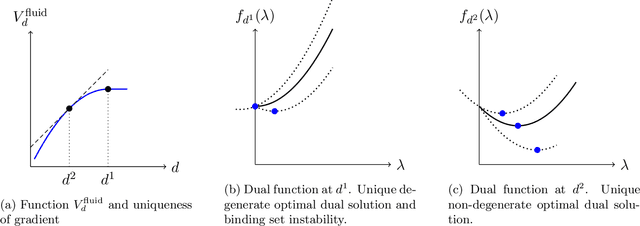

The Certainty Equivalent heuristic (CE) is a widely-used algorithm for various dynamic resource allocation problems in OR and OM. Despite its popularity, existing theoretical guarantees of CE are limited to settings satisfying restrictive fluid regularity conditions, particularly, the non-degeneracy conditions, under the widely held belief that the violation of such conditions leads to performance deterioration and necessitates algorithmic innovation beyond CE. In this work, we conduct a refined performance analysis of CE within the general framework of online linear programming. We show that CE achieves uniformly near-optimal regret (up to a polylogarithmic factor in $T$) under only mild assumptions on the underlying distribution, without relying on any fluid regularity conditions. Our result implies that, contrary to prior belief, CE effectively beats the curse of degeneracy for a wide range of problem instances with continuous conditional reward distributions, highlighting the distinction of the problem's structure between discrete and non-discrete settings. Our explicit regret bound interpolates between the mild $(\log T)^2$ regime and the worst-case $\sqrt{T}$ regime with a parameter $\beta$ quantifying the minimal rate of probability accumulation of the conditional reward distributions, generalizing prior findings in the multisecretary setting. To achieve these results, we develop novel algorithmic analytical techniques. Drawing tools from the empirical processes theory, we establish strong concentration analysis of the solutions to random linear programs, leading to improved regret analysis under significantly relaxed assumptions. These techniques may find potential applications in broader online decision-making contexts.