 Add to Chrome
 Add to Firefox
 Add to Edge
Cvr
Papers and Code
MI-DPG: Decomposable Parameter Generation Network Based on Mutual Information for Multi-Scenario Recommendation
Mar 22, 2026
Conversion rate (CVR) prediction models play a vital role in recommendation and advertising systems. Recent research on multi-scenario recommendation shows that learning a unified model to serve multiple scenarios is effective for improving overall performance. However, it remains challenging to improve model prediction performance across scenarios at low model parameter cost, and current solutions are hard to robustly model multi-scenario diversity. In this paper, we propose MI-DPG for the multi-scenario CVR prediction, which learns scenario-conditioned dynamic model parameters for each scenario in a more efficient and effective manner. Specifically, we introduce an auxiliary network to generate scenario-conditioned dynamic weighting matrices, which are obtained by combining decomposed scenario-specific and scenario-shared low-rank matrices with parameter efficiency. For each scene, weighting the backbone model parameters by the weighting matrix helps to specialize the model parameters for different scenarios. It can not only modulate the complete parameter space of the backbone model but also improve the model effectiveness. Furthermore, we design a mutual information regularization to enhance the diversity of model parameters across different scenarios by maximizing the mutual information between the scenario-aware input and the scene-conditioned dynamic weighting matrix. Experiments from three real-world datasets show that MI-DPG significantly outperforms previous multi-scenario recommendation models.
* Accepted by CIKM 2023

CAST: Modeling Visual State Transitions for Consistent Video Retrieval
Mar 09, 2026As video content creation shifts toward long-form narratives, composing short clips into coherent storylines becomes increasingly important. However, prevailing retrieval formulations remain context-agnostic at inference time, prioritizing local semantic alignment while neglecting state and identity consistency. To address this structural limitation, we formalize the task of Consistent Video Retrieval (CVR) and introduce a diagnostic benchmark spanning YouCook2, COIN, and CrossTask. We propose CAST (Context-Aware State Transition), a lightweight, plug-and-play adapter compatible with diverse frozen vision-language embedding spaces. By predicting a state-conditioned residual update ($Δ$) from visual history, CAST introduces an explicit inductive bias for latent state evolution. Extensive experiments show that CAST improves performance on YouCook2 and CrossTask, remains competitive on COIN, and consistently outperforms zero-shot baselines across diverse foundation backbones. Furthermore, CAST provides a useful reranking signal for black-box video generation candidates (e.g., from Veo), promoting more temporally coherent continuations.
MAC: A Conversion Rate Prediction Benchmark Featuring Labels Under Multiple Attribution Mechanisms
Mar 02, 2026Multi-attribution learning (MAL), which enhances model performance by learning from conversion labels yielded by multiple attribution mechanisms, has emerged as a promising learning paradigm for conversion rate (CVR) prediction. However, the conversion labels in public CVR datasets are generated by a single attribution mechanism, hindering the development of MAL approaches. To address this data gap, we establish the Multi-Attribution Benchmark (MAC), the first public CVR dataset featuring labels from multiple attribution mechanisms. Besides, to promote reproducible research on MAL, we develop PyMAL, an open-source library covering a wide array of baseline methods. We conduct comprehensive experimental analyses on MAC and reveal three key insights: (1) MAL brings consistent performance gains across different attribution settings, especially for users featuring long conversion paths. (2) The performance growth scales up with objective complexity in most settings; however, when predicting first-click conversion targets, simply adding auxiliary objectives is counterproductive, underscoring the necessity of careful selection of auxiliary objectives. (3) Two architectural design principles are paramount: first, to fully learn the multi-attribution knowledge, and second, to fully leverage this knowledge to serve the main task. Motivated by these findings, we propose Mixture of Asymmetric Experts (MoAE), an effective MAL approach incorporating multi-attribution knowledge learning and main task-centric knowledge utilization. Experiments on MAC show that MoAE substantially surpasses the existing state-of-the-art MAL method. We believe that our benchmark and insights will foster future research in the MAL field. Our MAC benchmark and the PyMAL algorithm library are publicly available at https://github.com/alimama-tech/PyMAL.
Uncertainty Quantification of Click and Conversion Estimates for the Autobidding
Mar 02, 2026Modern e-commerce platforms employ various auction mechanisms to allocate paid slots for a given item. To scale this approach to the millions of auctions, the platforms suggest promotion tools based on the autobidding algorithms. These algorithms typically depend on the Click-Through-Rate (CTR) and Conversion-Rate (CVR) estimates provided by a pre-trained machine learning model. However, the predictions of such models are uncertain and can significantly affect the performance of the autobidding algorithm. To address this issue, we propose the DenoiseBid method, which corrects the generated CTRs and CVRs to make the resulting bids more efficient in auctions. The underlying idea of our method is to employ a Bayesian approach and replace noisy CTR or CVR estimates with those from recovered distributions. To demonstrate the performance of the proposed approach, we perform extensive experiments on the synthetic, iPinYou, and BAT datasets. To evaluate the robustness of our approach to the noise scale, we use synthetic noise and noise estimated from the predictions of the pre-trained machine learning model.
Predictive Reasoning with Augmented Anomaly Contrastive Learning for Compositional Visual Relations
Mar 01, 2026While visual reasoning for simple analogies has received significant attention, compositional visual relations (CVR) remain relatively unexplored due to their greater complexity. To solve CVR tasks, we propose Predictive Reasoning with Augmented Anomaly Contrastive Learning (PR-A$^2$CL), \ie, to identify an outlier image given three other images that follow the same compositional rules. To address the challenge of modelling abundant compositional rules, an Augmented Anomaly Contrastive Learning is designed to distil discriminative and generalizable features by maximizing similarity among normal instances while minimizing similarity between normal and anomalous outliers. More importantly, a predict-and-verify paradigm is introduced for rule-based reasoning, in which a series of Predictive Anomaly Reasoning Blocks (PARBs) iteratively leverage features from three out of the four images to predict those of the remaining one. Throughout the subsequent verification stage, the PARBs progressively pinpoint the specific discrepancies attributable to the underlying rules. Experimental results on SVRT, CVR and MC$^2$R datasets show that PR-A$^2$CL significantly outperforms state-of-the-art reasoning models.
Query-Mixed Interest Extraction and Heterogeneous Interaction: A Scalable CTR Model for Industrial Recommender Systems
Feb 12, 2026Learning effective feature interactions is central to modern recommender systems, yet remains challenging in industrial settings due to sparse multi-field inputs and ultra-long user behavior sequences. While recent scaling efforts have improved model capacity, they often fail to construct both context-aware and context-independent user intent from the long-term and real-time behavior sequence. Meanwhile, recent work also suffers from inefficient and homogeneous interaction mechanisms, leading to suboptimal prediction performance. To address these limitations, we propose HeMix, a scalable ranking model that unifies adaptive sequence tokenization and heterogeneous interaction structure. Specifically, HeMix introduces a Query-Mixed Interest Extraction module that jointly models context-aware and context-independent user interests via dynamic and fixed queries over global and real-time behavior sequences. For interaction, we replace self-attention with the HeteroMixer block, enabling efficient, multi-granularity cross-feature interactions that adopt the multi-head token fusion, heterogeneous interaction and group-aligned reconstruction pipelines. HeMix demonstrates favorable scaling behavior, driven by the HeteroMixer block, where increasing model scale via parameter expansion leads to steady improvements in recommendation accuracy. Experiments on industrial-scale datasets show that HeMix scales effectively and consistently outperforms strong baselines. Most importantly, HeMix has been deployed on the AMAP platform, delivering significant online gains over DLRM: +3.61\% GMV, +2.78\% PV\_CTR, and +2.12\% UV\_CVR.
Modeling Cascaded Delay Feedback for Online Net Conversion Rate Prediction: Benchmark, Insights and Solutions
Jan 29, 2026In industrial recommender systems, conversion rate (CVR) is widely used for traffic allocation, but it fails to fully reflect recommendation effectiveness because it ignores refund behavior. To better capture true user satisfaction and business value, net conversion rate (NetCVR), defined as the probability that a clicked item is purchased and not refunded, has been proposed.Unlike CVR, NetCVR prediction involves a more complex multi-stage cascaded delayed feedback process. The two cascaded delays from click to conversion and from conversion to refund have opposite effects, making traditional CVR modeling methods inapplicable. Moreover, the lack of open-source datasets and online continuous training schemes further hinders progress in this area.To address these challenges, we introduce CASCADE (Cascaded Sequences of Conversion and Delayed Refund), the first large-scale open dataset derived from the Taobao app for online continuous NetCVR prediction. Through an in-depth analysis of CASCADE, we identify three key insights: (1) NetCVR exhibits strong temporal dynamics, necessitating online continuous modeling; (2) cascaded modeling of CVR and refund rate outperforms direct NetCVR modeling; and (3) delay time, which correlates with both CVR and refund rate, is an important feature for NetCVR prediction.Based on these insights, we propose TESLA, a continuous NetCVR modeling framework featuring a CVR-refund-rate cascaded architecture, stage-wise debiasing, and a delay-time-aware ranking loss. Extensive experiments demonstrate that TESLA consistently outperforms state-of-the-art methods on CASCADE, achieving absolute improvements of 12.41 percent in RI-AUC and 14.94 percent in RI-PRAUC on NetCVR prediction. The code and dataset are publicly available at https://github.com/alimama-tech/NetCVR.
Delayed Feedback Modeling for Post-Click Gross Merchandise Volume Prediction: Benchmark, Insights and Approaches
Jan 28, 2026The prediction objectives of online advertisement ranking models are evolving from probabilistic metrics like conversion rate (CVR) to numerical business metrics like post-click gross merchandise volume (GMV). Unlike the well-studied delayed feedback problem in CVR prediction, delayed feedback modeling for GMV prediction remains unexplored and poses greater challenges, as GMV is a continuous target, and a single click can lead to multiple purchases that cumulatively form the label. To bridge the research gap, we establish TRACE, a GMV prediction benchmark containing complete transaction sequences rising from each user click, which supports delayed feedback modeling in an online streaming manner. Our analysis and exploratory experiments on TRACE reveal two key insights: (1) the rapid evolution of the GMV label distribution necessitates modeling delayed feedback under online streaming training; (2) the label distribution of repurchase samples substantially differs from that of single-purchase samples, highlighting the need for separate modeling. Motivated by these findings, we propose RepurchasE-Aware Dual-branch prEdictoR (READER), a novel GMV modeling paradigm that selectively activates expert parameters according to repurchase predictions produced by a router. Moreover, READER dynamically calibrates the regression target to mitigate under-estimation caused by incomplete labels. Experimental results show that READER yields superior performance on TRACE over baselines, achieving a 2.19% improvement in terms of accuracy. We believe that our study will open up a new avenue for studying online delayed feedback modeling for GMV prediction, and our TRACE benchmark with the gathered insights will facilitate future research and application in this promising direction. Our code and dataset are available at https://github.com/alimama-tech/OnlineGMV .
No One Left Behind: How to Exploit the Incomplete and Skewed Multi-Label Data for Conversion Rate Prediction
Dec 15, 2025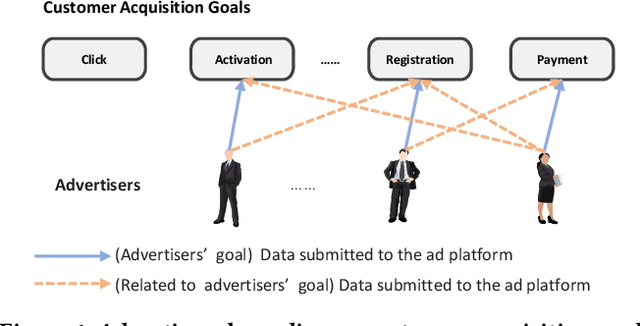

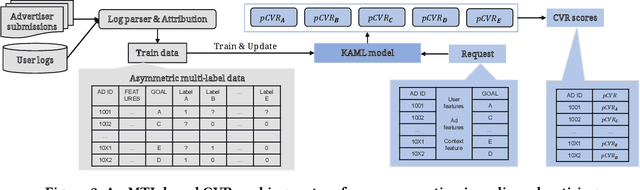
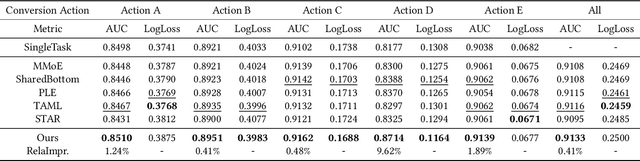
In most real-world online advertising systems, advertisers typically have diverse customer acquisition goals. A common solution is to use multi-task learning (MTL) to train a unified model on post-click data to estimate the conversion rate (CVR) for these diverse targets. In practice, CVR prediction often encounters missing conversion data as many advertisers submit only a subset of user conversion actions due to privacy or other constraints, making the labels of multi-task data incomplete. If the model is trained on all available samples where advertisers submit user conversion actions, it may struggle when deployed to serve a subset of advertisers targeting specific conversion actions, as the training and deployment data distributions are mismatched. While considerable MTL efforts have been made, a long-standing challenge is how to effectively train a unified model with the incomplete and skewed multi-label data. In this paper, we propose a fine-grained Knowledge transfer framework for Asymmetric Multi-Label data (KAML). We introduce an attribution-driven masking strategy (ADM) to better utilize data with asymmetric multi-label data in training. However, the more relaxed masking in ADM is a double-edged sword: it provides additional training signals but also introduces noise due to skewed data. To address this, we propose a hierarchical knowledge extraction mechanism (HKE) to model the sample discrepancy within the target task tower. Finally, to maximize the utility of unlabeled samples, we incorporate ranking loss strategy to further enhance our model. The effectiveness of KAML has been demonstrated through comprehensive evaluations on offline industry datasets and online A/B tests, which show significant performance improvements over existing MTL baselines.
CrossVid: A Comprehensive Benchmark for Evaluating Cross-Video Reasoning in Multimodal Large Language Models
Nov 15, 2025Cross-Video Reasoning (CVR) presents a significant challenge in video understanding, which requires simultaneous understanding of multiple videos to aggregate and compare information across groups of videos. Most existing video understanding benchmarks focus on single-video analysis, failing to assess the ability of multimodal large language models (MLLMs) to simultaneously reason over various videos. Recent benchmarks evaluate MLLMs' capabilities on multi-view videos that capture different perspectives of the same scene. However, their limited tasks hinder a thorough assessment of MLLMs in diverse real-world CVR scenarios. To this end, we introduce CrossVid, the first benchmark designed to comprehensively evaluate MLLMs' spatial-temporal reasoning ability in cross-video contexts. Firstly, CrossVid encompasses a wide spectrum of hierarchical tasks, comprising four high-level dimensions and ten specific tasks, thereby closely reflecting the complex and varied nature of real-world video understanding. Secondly, CrossVid provides 5,331 videos, along with 9,015 challenging question-answering pairs, spanning single-choice, multiple-choice, and open-ended question formats. Through extensive experiments on various open-source and closed-source MLLMs, we observe that Gemini-2.5-Pro performs best on CrossVid, achieving an average accuracy of 50.4%. Notably, our in-depth case study demonstrates that most current MLLMs struggle with CVR tasks, primarily due to their inability to integrate or compare evidence distributed across multiple videos for reasoning. These insights highlight the potential of CrossVid to guide future advancements in enhancing MLLMs' CVR capabilities.