 Add to Chrome
 Add to Firefox
 Add to Edge
RadioMaster: Multi-Agent System for Autonomous Radio Signal Generation
Jun 01, 2026
Translating user intents into physical radio signals represents the critical yet notoriously tedious final step in wireless prototyping, as it requires intricate knowledge of physical layer details and presents immense implementation challenges. Large Language Models (LLMs) and multi-agent systems have revolutionized conventional software engineering, raising the compelling question of whether they can resolve these formidable difficulties. However, our investigations reveal that current models experience significant limitations and fail to accomplish this task when applied to radio signal generation. This performance degradation primarily stems from severe domain ignorance and a fundamental insensitivity to physical hardware constraints. To bridge this gap, we introduce RadioMaster, a fully autonomous multi-agent framework designed to seamlessly translate user input into real-world wireless emissions. RadioMaster operates on three synergistic pillars: RadioWiki for domain-specific knowledge retrieval, RadioAgent for collaborative I/Q sample generation alongside hardware configuration, and RadioEmulator for closed-loop physical layer verification. Furthermore, we construct RadioBench, the first comprehensive benchmark tailored specifically for the radio signal generation domain. Extensive real-world evaluations demonstrate that RadioMaster significantly outperforms state-of-the-art (SOTA) baselines regarding configuration viability and signal fidelity.

Fine-Tuned LLM as a Complementary Predictor Improving Ads System
May 27, 2026Recommendation systems power engagement and monetization across feeds, ads, and short-video platforms, but translating the latest advances in Large Language Models into Recommendation Systems (RecSys) gains remains rare, particularly in advertising and production-scale real-world industry setups. Prior real-world LLM successes typically fall into three buckets: (a) generative retrieval that directly predicts the next items for candidate generation, (b) late-stage re-ranking that uses LLMs, and (c) auxiliary signal enrichment with LLMs. We introduce a complementary paradigm for ads: a fine-tuned open-source LLM used not as a ranker, but as an ads-specific ancillary predictor, forecasting likely advertisers from user profiles and histories. This LLM-driven advertiser prediction augments conventional candidate generation and provides informative priors to downstream ranking. Developed in a large-scale production advertising system, our approach produces substantial offline improvements and measurable online business impact, demonstrating that LLM world knowledge and predictive capacity can be efficiently harnessed. Beyond validating LLMs for ads applications, our results show that targeted ancillary predictions can unlock end-to-end gains across both retrieval and late-stage ranking, offering a practical path to LLM-enhanced recommendation at scale.
DV-World: Benchmarking Data Visualization Agents in Real-World Scenarios
Apr 28, 2026Real-world data visualization (DV) requires native environmental grounding, cross-platform evolution, and proactive intent alignment. Yet, existing benchmarks often suffer from code-sandbox confinement, single-language creation-only tasks, and assumption of perfect intent. To bridge these gaps, we introduce DV-World, a benchmark of 260 tasks designed to evaluate DV agents across real-world professional lifecycles. DV-World spans three domains: DV-Sheet for native spreadsheet manipulation including chart and dashboard creation as well as diagnostic repair; DV-Evolution for adapting and restructuring reference visual artifacts to fit new data across diverse programming paradigms and DV-Interact for proactive intent alignment with a user simulator that mimics real-world ambiguous requirements. Our hybrid evaluation framework integrates Table-value Alignment for numerical precision and MLLM-as-a-Judge with rubrics for semantic-visual assessment. Experiments reveal that state-of-the-art models achieve less than 50% overall performance, exposing critical deficits in handling the complex challenges of real-world data visualization. DV-World provides a realistic testbed to steer development toward the versatile expertise required in enterprise workflows. Our data and code are available at \href{https://github.com/DA-Open/DV-World}{this project page}.
Decoupled Entity Representation Learning for Pinterest Ads Ranking
Sep 04, 2025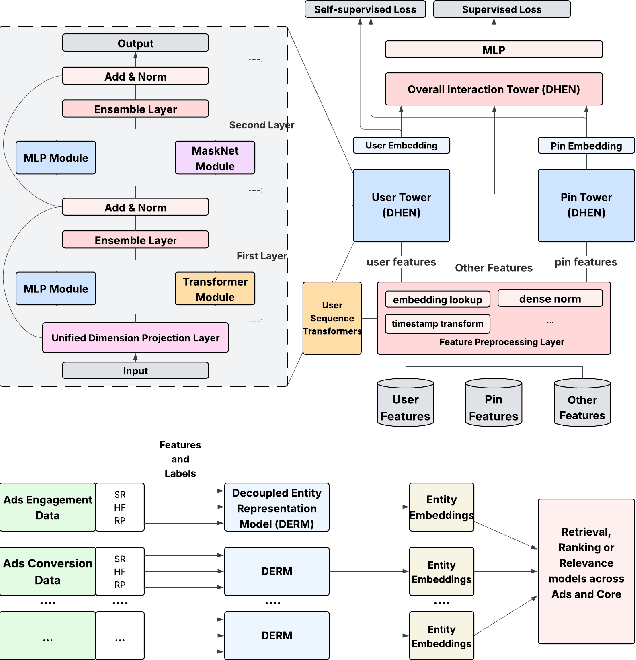

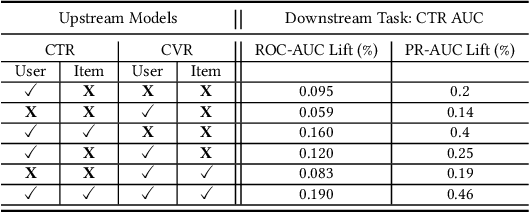

In this paper, we introduce a novel framework following an upstream-downstream paradigm to construct user and item (Pin) embeddings from diverse data sources, which are essential for Pinterest to deliver personalized Pins and ads effectively. Our upstream models are trained on extensive data sources featuring varied signals, utilizing complex architectures to capture intricate relationships between users and Pins on Pinterest. To ensure scalability of the upstream models, entity embeddings are learned, and regularly refreshed, rather than real-time computation, allowing for asynchronous interaction between the upstream and downstream models. These embeddings are then integrated as input features in numerous downstream tasks, including ad retrieval and ranking models for CTR and CVR predictions. We demonstrate that our framework achieves notable performance improvements in both offline and online settings across various downstream tasks. This framework has been deployed in Pinterest's production ad ranking systems, resulting in significant gains in online metrics.
Decoupled Functional Evaluation of Autonomous Driving Models via Feature Map Quality Scoring
Aug 12, 2025End-to-end models are emerging as the mainstream in autonomous driving perception and planning. However, the lack of explicit supervision signals for intermediate functional modules leads to opaque operational mechanisms and limited interpretability, making it challenging for traditional methods to independently evaluate and train these modules. Pioneering in the issue, this study builds upon the feature map-truth representation similarity-based evaluation framework and proposes an independent evaluation method based on Feature Map Convergence Score (FMCS). A Dual-Granularity Dynamic Weighted Scoring System (DG-DWSS) is constructed, formulating a unified quantitative metric - Feature Map Quality Score - to enable comprehensive evaluation of the quality of feature maps generated by functional modules. A CLIP-based Feature Map Quality Evaluation Network (CLIP-FMQE-Net) is further developed, combining feature-truth encoders and quality score prediction heads to enable real-time quality analysis of feature maps generated by functional modules. Experimental results on the NuScenes dataset demonstrate that integrating our evaluation module into the training improves 3D object detection performance, achieving a 3.89 percent gain in NDS. These results verify the effectiveness of our method in enhancing feature representation quality and overall model performance.
CineMyoPS: Segmenting Myocardial Pathologies from Cine Cardiac MR
Jul 03, 2025
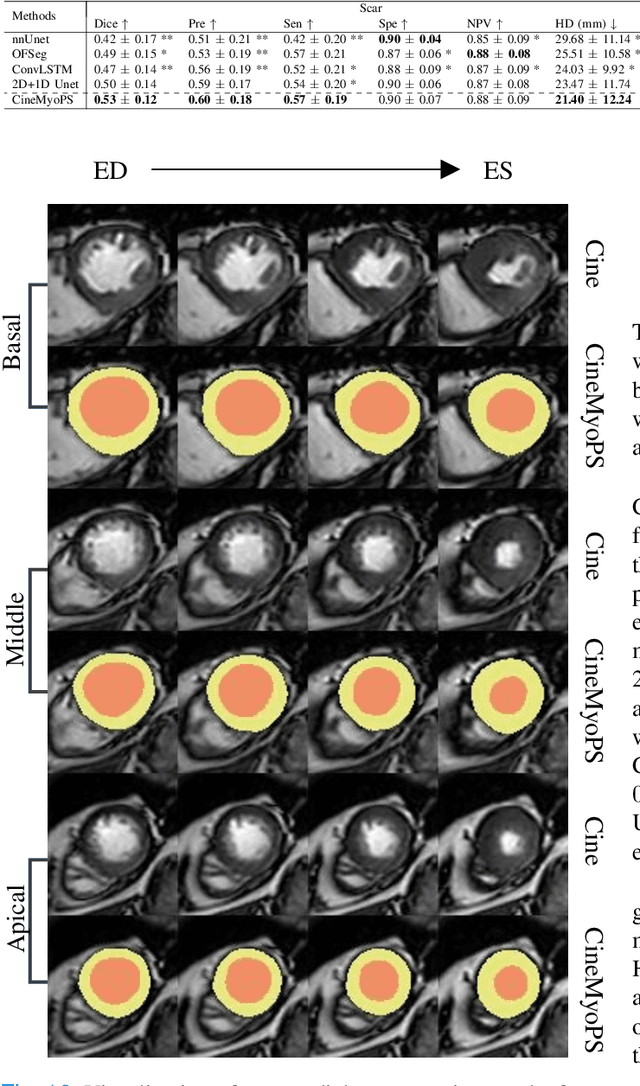
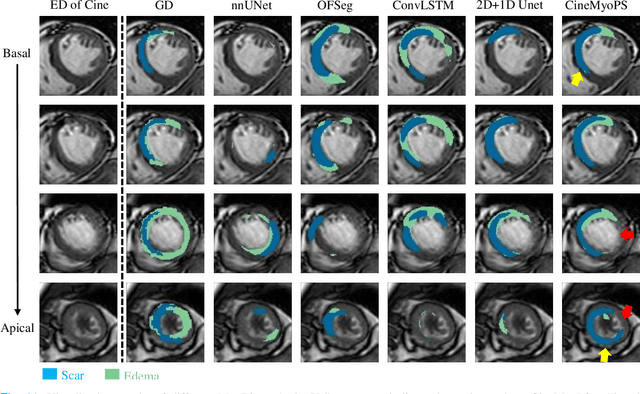
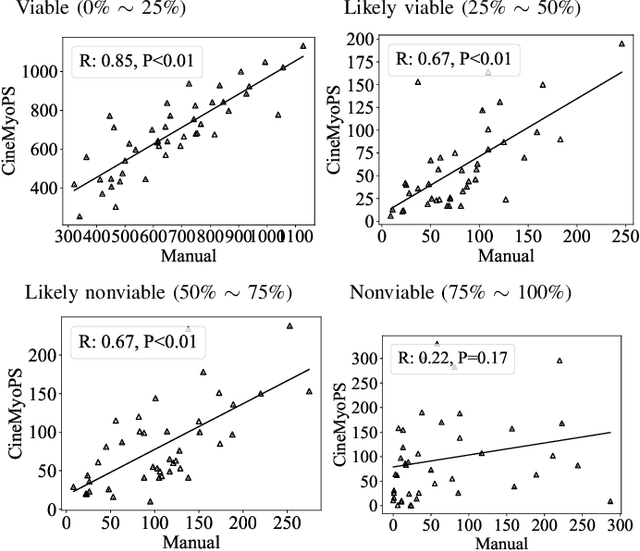
Myocardial infarction (MI) is a leading cause of death worldwide. Late gadolinium enhancement (LGE) and T2-weighted cardiac magnetic resonance (CMR) imaging can respectively identify scarring and edema areas, both of which are essential for MI risk stratification and prognosis assessment. Although combining complementary information from multi-sequence CMR is useful, acquiring these sequences can be time-consuming and prohibitive, e.g., due to the administration of contrast agents. Cine CMR is a rapid and contrast-free imaging technique that can visualize both motion and structural abnormalities of the myocardium induced by acute MI. Therefore, we present a new end-to-end deep neural network, referred to as CineMyoPS, to segment myocardial pathologies, \ie scars and edema, solely from cine CMR images. Specifically, CineMyoPS extracts both motion and anatomy features associated with MI. Given the interdependence between these features, we design a consistency loss (resembling the co-training strategy) to facilitate their joint learning. Furthermore, we propose a time-series aggregation strategy to integrate MI-related features across the cardiac cycle, thereby enhancing segmentation accuracy for myocardial pathologies. Experimental results on a multi-center dataset demonstrate that CineMyoPS achieves promising performance in myocardial pathology segmentation, motion estimation, and anatomy segmentation.
Learning Concept-Driven Logical Rules for Interpretable and Generalizable Medical Image Classification
May 20, 2025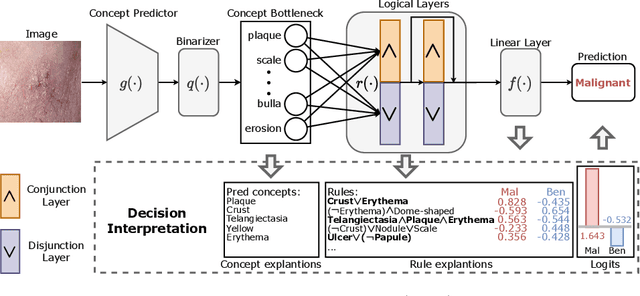
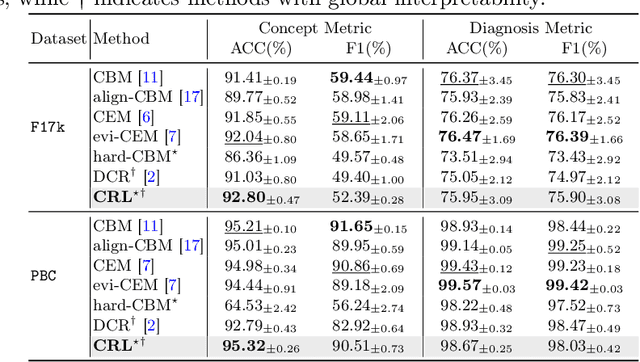
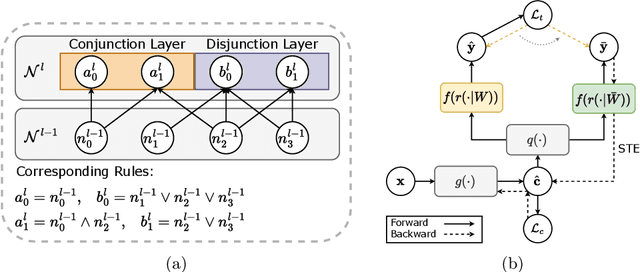
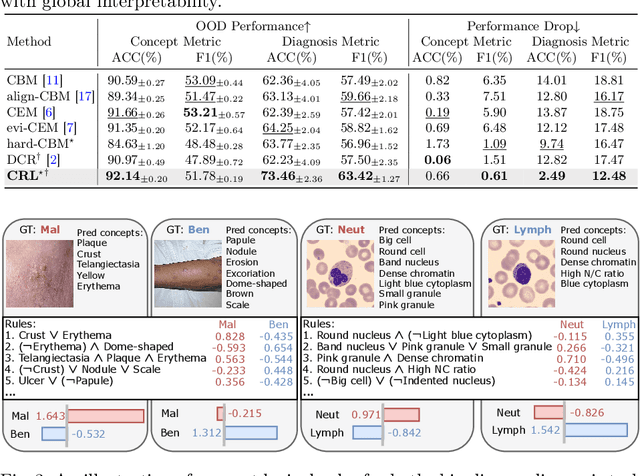
The pursuit of decision safety in clinical applications highlights the potential of concept-based methods in medical imaging. While these models offer active interpretability, they often suffer from concept leakages, where unintended information within soft concept representations undermines both interpretability and generalizability. Moreover, most concept-based models focus solely on local explanations (instance-level), neglecting the global decision logic (dataset-level). To address these limitations, we propose Concept Rule Learner (CRL), a novel framework to learn Boolean logical rules from binarized visual concepts. CRL employs logical layers to capture concept correlations and extract clinically meaningful rules, thereby providing both local and global interpretability. Experiments on two medical image classification tasks show that CRL achieves competitive performance with existing methods while significantly improving generalizability to out-of-distribution data. The code of our work is available at https://github.com/obiyoag/crl.
Empowering Medical Multi-Agents with Clinical Consultation Flow for Dynamic Diagnosis
Mar 19, 2025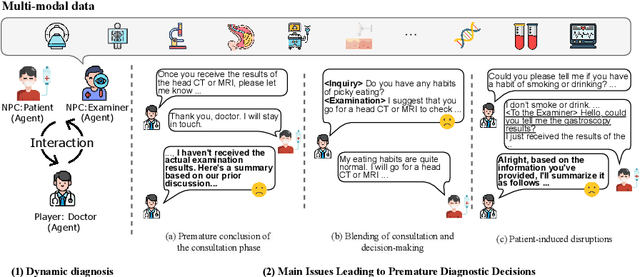
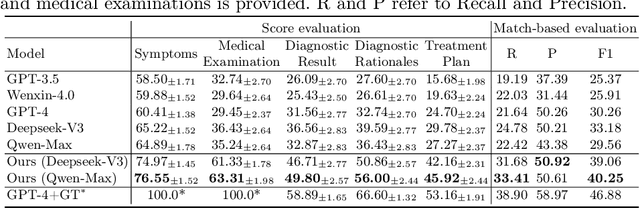
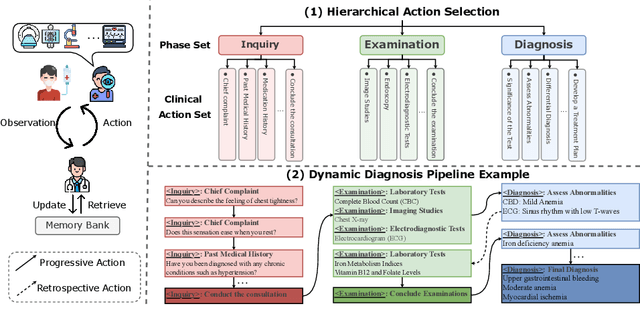
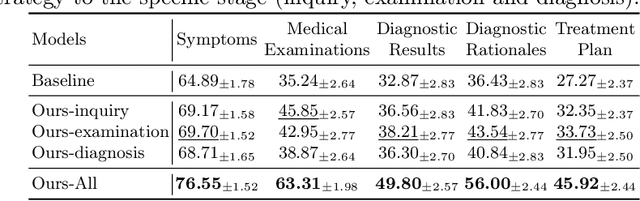
Traditional AI-based healthcare systems often rely on single-modal data, limiting diagnostic accuracy due to incomplete information. However, recent advancements in foundation models show promising potential for enhancing diagnosis combining multi-modal information. While these models excel in static tasks, they struggle with dynamic diagnosis, failing to manage multi-turn interactions and often making premature diagnostic decisions due to insufficient persistence in information collection.To address this, we propose a multi-agent framework inspired by consultation flow and reinforcement learning (RL) to simulate the entire consultation process, integrating multiple clinical information for effective diagnosis. Our approach incorporates a hierarchical action set, structured from clinic consultation flow and medical textbook, to effectively guide the decision-making process. This strategy improves agent interactions, enabling them to adapt and optimize actions based on the dynamic state. We evaluated our framework on a public dynamic diagnosis benchmark. The proposed framework evidentially improves the baseline methods and achieves state-of-the-art performance compared to existing foundation model-based methods.
InDeed: Interpretable image deep decomposition with guaranteed generalizability
Jan 02, 2025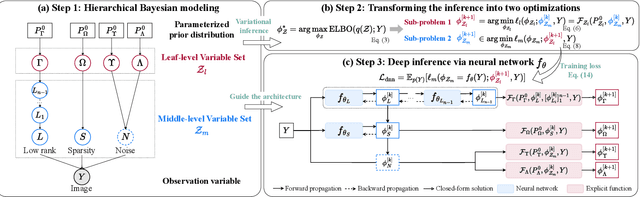


Image decomposition aims to analyze an image into elementary components, which is essential for numerous downstream tasks and also by nature provides certain interpretability to the analysis. Deep learning can be powerful for such tasks, but surprisingly their combination with a focus on interpretability and generalizability is rarely explored. In this work, we introduce a novel framework for interpretable deep image decomposition, combining hierarchical Bayesian modeling and deep learning to create an architecture-modularized and model-generalizable deep neural network (DNN). The proposed framework includes three steps: (1) hierarchical Bayesian modeling of image decomposition, (2) transforming the inference problem into optimization tasks, and (3) deep inference via a modularized Bayesian DNN. We further establish a theoretical connection between the loss function and the generalization error bound, which inspires a new test-time adaptation approach for out-of-distribution scenarios. We instantiated the application using two downstream tasks, \textit{i.e.}, image denoising, and unsupervised anomaly detection, and the results demonstrated improved generalizability as well as interpretability of our methods. The source code will be released upon the acceptance of this paper.
Prototyping and Experimental Results for Environment-Aware Millimeter Wave Beam Alignment via Channel Knowledge Map
Mar 13, 2024Channel knowledge map (CKM), which aims to directly reflect the intrinsic channel properties of the local wireless environment, is a novel technique for achieving environmentaware communication. In this paper, to alleviate the large training overhead in millimeter wave (mmWave) beam alignment, an environment-aware and training-free beam alignment prototype is established based on a typical CKM, termed beam index map (BIM). To this end, a general CKM construction method is first presented, and an indoor BIM is constructed offline to learn the candidate transmit and receive beam index pairs for each grid in the experimental area. Furthermore, based on the location information of the receiver (or the dynamic obstacles) from the ultra-wide band (UWB) positioning system, the established BIM is used to achieve training-free beam alignment by directly providing the beam indexes for the transmitter and receiver. Three typical scenarios are considered in the experiment, including quasi-static environment with line-of-sight (LoS) link, quasistatic environment without LoS link and dynamic environment. Besides, the receiver orientation measured from the gyroscope is also used to help CKM predict more accurate beam indexes. The experiment results show that compared with the benchmark location-based beam alignment strategy, the CKM-based beam alignment strategy can achieve much higher received power, which is close to that achieved by exhaustive beam search, but with significantly reduced training overhead.