 Add to Chrome
 Add to Firefox
 Add to Edge
No One Left Behind: How to Exploit the Incomplete and Skewed Multi-Label Data for Conversion Rate Prediction
Dec 15, 2025
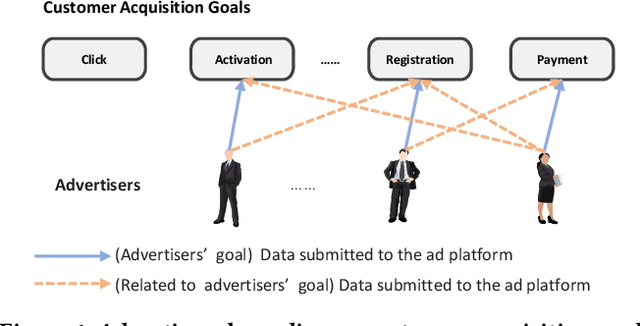

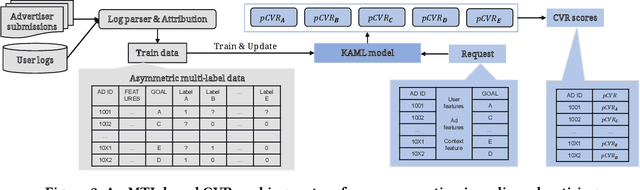
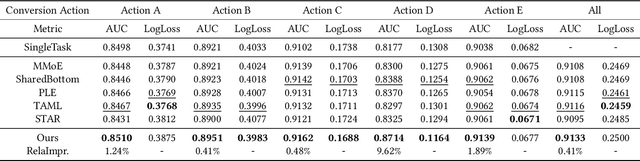
In most real-world online advertising systems, advertisers typically have diverse customer acquisition goals. A common solution is to use multi-task learning (MTL) to train a unified model on post-click data to estimate the conversion rate (CVR) for these diverse targets. In practice, CVR prediction often encounters missing conversion data as many advertisers submit only a subset of user conversion actions due to privacy or other constraints, making the labels of multi-task data incomplete. If the model is trained on all available samples where advertisers submit user conversion actions, it may struggle when deployed to serve a subset of advertisers targeting specific conversion actions, as the training and deployment data distributions are mismatched. While considerable MTL efforts have been made, a long-standing challenge is how to effectively train a unified model with the incomplete and skewed multi-label data. In this paper, we propose a fine-grained Knowledge transfer framework for Asymmetric Multi-Label data (KAML). We introduce an attribution-driven masking strategy (ADM) to better utilize data with asymmetric multi-label data in training. However, the more relaxed masking in ADM is a double-edged sword: it provides additional training signals but also introduces noise due to skewed data. To address this, we propose a hierarchical knowledge extraction mechanism (HKE) to model the sample discrepancy within the target task tower. Finally, to maximize the utility of unlabeled samples, we incorporate ranking loss strategy to further enhance our model. The effectiveness of KAML has been demonstrated through comprehensive evaluations on offline industry datasets and online A/B tests, which show significant performance improvements over existing MTL baselines.

AIE: Auction Information Enhanced Framework for CTR Prediction in Online Advertising
Aug 15, 2024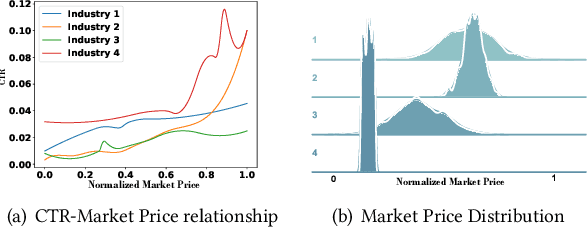
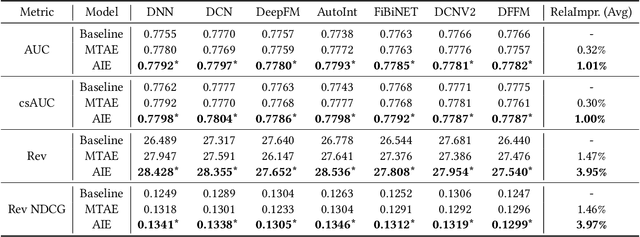
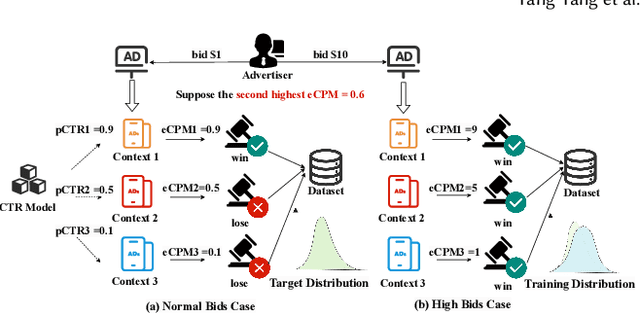
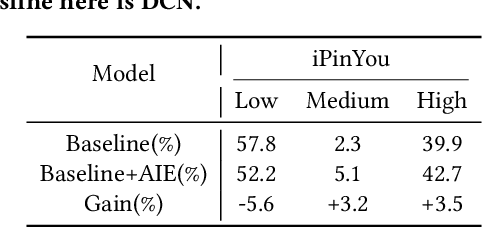
Click-Through Rate (CTR) prediction is a fundamental technique for online advertising recommendation and the complex online competitive auction process also brings many difficulties to CTR optimization. Recent studies have shown that introducing posterior auction information contributes to the performance of CTR prediction. However, existing work doesn't fully capitalize on the benefits of auction information and overlooks the data bias brought by the auction, leading to biased and suboptimal results. To address these limitations, we propose Auction Information Enhanced Framework (AIE) for CTR prediction in online advertising, which delves into the problem of insufficient utilization of auction signals and first reveals the auction bias. Specifically, AIE introduces two pluggable modules, namely Adaptive Market-price Auxiliary Module (AM2) and Bid Calibration Module (BCM), which work collaboratively to excavate the posterior auction signals better and enhance the performance of CTR prediction. Furthermore, the two proposed modules are lightweight, model-agnostic, and friendly to inference latency. Extensive experiments are conducted on a public dataset and an industrial dataset to demonstrate the effectiveness and compatibility of AIE. Besides, a one-month online A/B test in a large-scale advertising platform shows that AIE improves the base model by 5.76% and 2.44% in terms of eCPM and CTR, respectively.
Confidence-Aware Multi-Field Model Calibration
Feb 27, 2024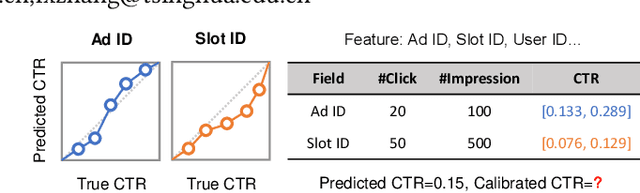
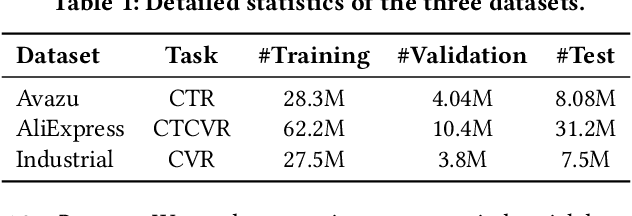

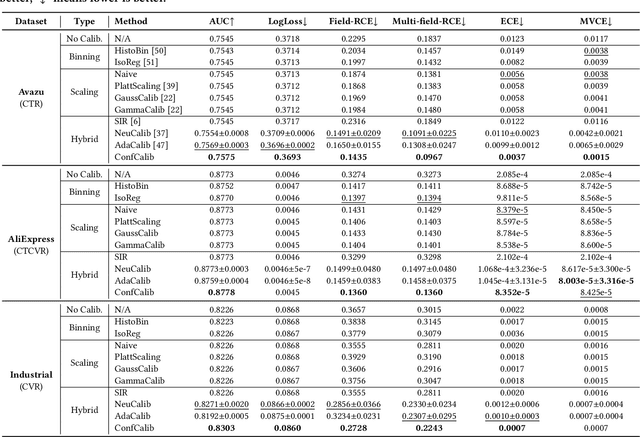
Accurately predicting the probabilities of user feedback, such as clicks and conversions, is critical for ad ranking and bidding. However, there often exist unwanted mismatches between predicted probabilities and true likelihoods due to the shift of data distributions and intrinsic model biases. Calibration aims to address this issue by post-processing model predictions, and field-aware calibration can adjust model output on different feature field values to satisfy fine-grained advertising demands. Unfortunately, the observed samples corresponding to certain field values can be too limited to make confident calibrations, which may yield bias amplification and online disturbance. In this paper, we propose a confidence-aware multi-field calibration method, which adaptively adjusts the calibration intensity based on the confidence levels derived from sample statistics. It also utilizes multiple feature fields for joint model calibration with awareness of their importance to mitigate the data sparsity effect of a single field. Extensive offline and online experiments show the superiority of our method in boosting advertising performance and reducing prediction deviations.