 Add to Chrome
 Add to Firefox
 Add to Edge
GRASP: GRanularity-Aware Search Policy for Agentic RAG
Jul 11, 2026
Agentic retrieval-augmented generation (RAG) extends static RAG by allowing language models to iteratively reason, generate search queries, retrieve evidence, and predict answers. However, it remains challenging for models to decide when to retrieve, whether to use lexical matching or semantic similarity, and how to control context granularity to prevent irrelevant tokens from interfering with agent reasoning. In this paper, we introduce GRASP, a reinforcement learning (RL) framework for training agents to adaptively coordinate complementary retrieval tools during multi-step reasoning. GRASP provides the agent with semantic search, keyword search, and paragraph-reading actions, enabling it to retrieve sentence-level evidence and expand further context only when needed. We train the policy with a reward that jointly accounts for answer accuracy, grounded reading, complementary search, and turn efficiency. Experiments on multi-hop reasoning benchmarks show that GRASP improves both retrieval recall and downstream question answering performance compared with single-step retrieval, prompting-based agentic RAG, and RL-based retrieval baselines. Qualitative and ablation analyses show that the learned policy develops interpretable skimming and scanning behavior: it uses semantic search for broad exploration, paragraph reading for local verification, and keyword search for entity-specific evidence. These results suggest that learning to coordinate retrieval signals and context granularity is critical for agent's correct reasoning.

Spinning Straw into Gold: Relabeling LLM Agent Trajectories in Hindsight for Successful Demonstrations
Jul 05, 2026Large language model agents operate in partially observable, long-horizon settings where obtaining supervision remains a major bottleneck. We address this by utilizing a source of supervision overlooked in existing post-training methods: unintended yet successful goals embedded within agent rollouts. Specifically, we introduce Hindsight Supervised Learning (HSL), where an auxiliary LLM reviews each completed trajectory and relabels it with all of the natural-language goals the agent actually achieved. HSL then pairs the trajectory with its relabeled goals and uses these pairs for additional fine-tuning. To mitigate suboptimality in the relabeled data, we propose two learning techniques for HSL, irrelevant-action masking and sample reweighting. Our experiments show that HSL is flexible and compatible with existing post-training pipelines. It improves both SFT and DPO, with larger gains on long-horizon tasks with more diverse goal spaces. Moreover, HSL is sample-efficient: on ALFWorld, it surpasses baselines trained on the full dataset while using only one quarter of the ground-truth demonstrations.
A Survey on LLM-based Conversational User Simulation
Apr 27, 2026User simulation has long played a vital role in computer science due to its potential to support a wide range of applications. Language, as the primary medium of human communication, forms the foundation of social interaction and behavior. Consequently, simulating conversational behavior has become a key area of study. Recent advancements in large language models (LLMs) have significantly catalyzed progress in this domain by enabling high-fidelity generation of synthetic user conversation. In this paper, we survey recent advancements in LLM-based conversational user simulation. We introduce a novel taxonomy covering user granularity and simulation objectives. Additionally, we systematically analyze core techniques and evaluation methodologies. We aim to keep the research community informed of the latest advancements in conversational user simulation and to further facilitate future research by identifying open challenges and organizing existing work under a unified framework.
OIDA-QA: A Multimodal Benchmark for Analyzing the Opioid Industry Documents Archive
Nov 14, 2025The opioid crisis represents a significant moment in public health that reveals systemic shortcomings across regulatory systems, healthcare practices, corporate governance, and public policy. Analyzing how these interconnected systems simultaneously failed to protect public health requires innovative analytic approaches for exploring the vast amounts of data and documents disclosed in the UCSF-JHU Opioid Industry Documents Archive (OIDA). The complexity, multimodal nature, and specialized characteristics of these healthcare-related legal and corporate documents necessitate more advanced methods and models tailored to specific data types and detailed annotations, ensuring the precision and professionalism in the analysis. In this paper, we tackle this challenge by organizing the original dataset according to document attributes and constructing a benchmark with 400k training documents and 10k for testing. From each document, we extract rich multimodal information-including textual content, visual elements, and layout structures-to capture a comprehensive range of features. Using multiple AI models, we then generate a large-scale dataset comprising 360k training QA pairs and 10k testing QA pairs. Building on this foundation, we develop domain-specific multimodal Large Language Models (LLMs) and explore the impact of multimodal inputs on task performance. To further enhance response accuracy, we incorporate historical QA pairs as contextual grounding for answering current queries. Additionally, we incorporate page references within the answers and introduce an importance-based page classifier, further improving the precision and relevance of the information provided. Preliminary results indicate the improvements with our AI assistant in document information extraction and question-answering tasks. The dataset is available at: https://huggingface.co/datasets/opioidarchive/oida-qa
Principled Content Selection to Generate Diverse and Personalized Multi-Document Summaries
May 28, 2025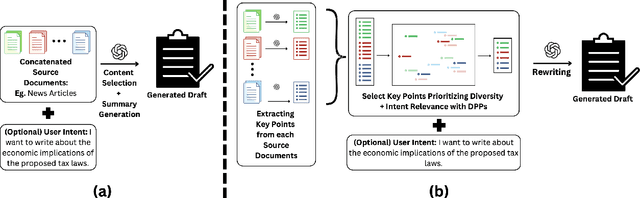
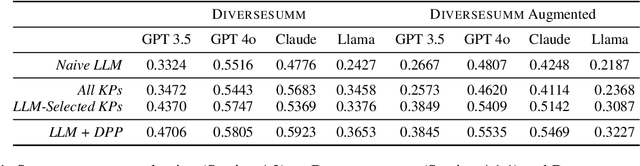
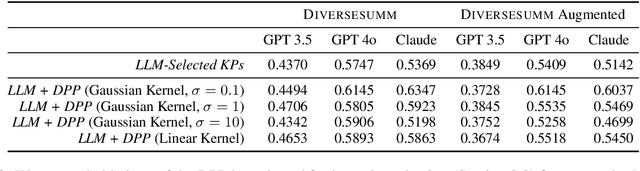
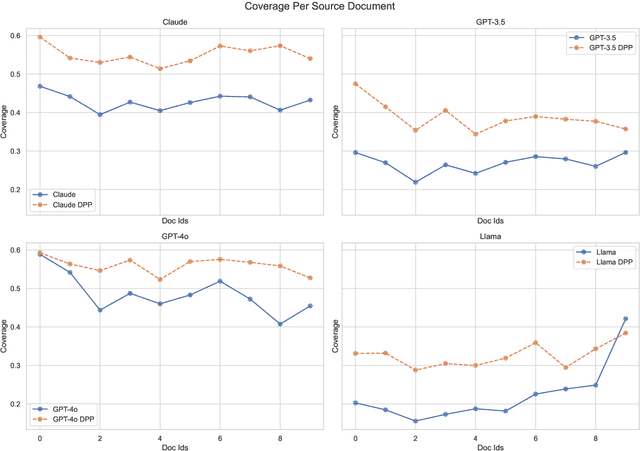
While large language models (LLMs) are increasingly capable of handling longer contexts, recent work has demonstrated that they exhibit the "lost in the middle" phenomenon (Liu et al., 2024) of unevenly attending to different parts of the provided context. This hinders their ability to cover diverse source material in multi-document summarization, as noted in the DiverseSumm benchmark (Huang et al., 2024). In this work, we contend that principled content selection is a simple way to increase source coverage on this task. As opposed to prompting an LLM to perform the summarization in a single step, we explicitly divide the task into three steps -- (1) reducing document collections to atomic key points, (2) using determinantal point processes (DPP) to perform select key points that prioritize diverse content, and (3) rewriting to the final summary. By combining prompting steps, for extraction and rewriting, with principled techniques, for content selection, we consistently improve source coverage on the DiverseSumm benchmark across various LLMs. Finally, we also show that by incorporating relevance to a provided user intent into the DPP kernel, we can generate personalized summaries that cover relevant source information while retaining coverage.
A Personalized Conversational Benchmark: Towards Simulating Personalized Conversations
May 20, 2025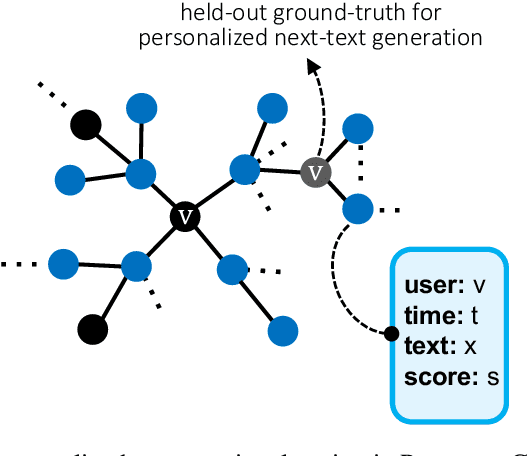
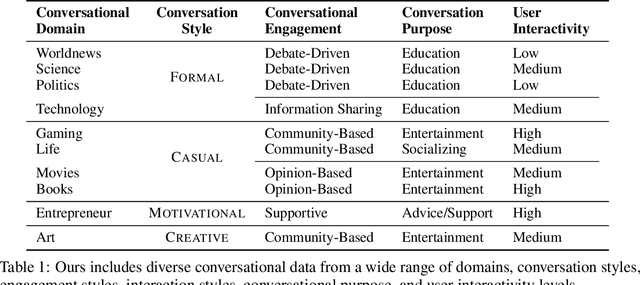
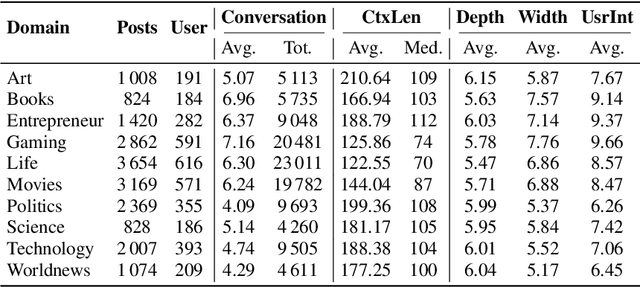
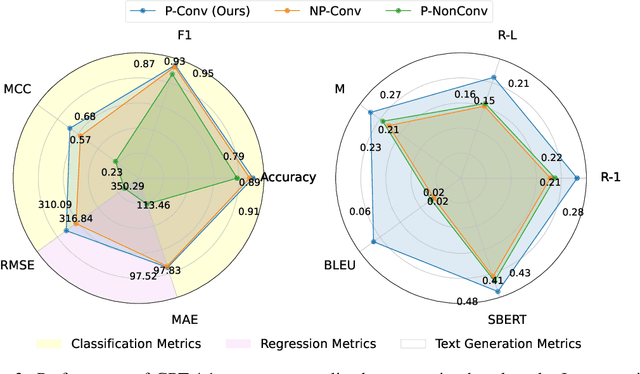
We present PersonaConvBench, a large-scale benchmark for evaluating personalized reasoning and generation in multi-turn conversations with large language models (LLMs). Unlike existing work that focuses on either personalization or conversational structure in isolation, PersonaConvBench integrates both, offering three core tasks: sentence classification, impact regression, and user-centric text generation across ten diverse Reddit-based domains. This design enables systematic analysis of how personalized conversational context shapes LLM outputs in realistic multi-user scenarios. We benchmark several commercial and open-source LLMs under a unified prompting setup and observe that incorporating personalized history yields substantial performance improvements, including a 198 percent relative gain over the best non-conversational baseline in sentiment classification. By releasing PersonaConvBench with evaluations and code, we aim to support research on LLMs that adapt to individual styles, track long-term context, and produce contextually rich, engaging responses.
UniEDU: A Unified Language and Vision Assistant for Education Applications
Mar 26, 2025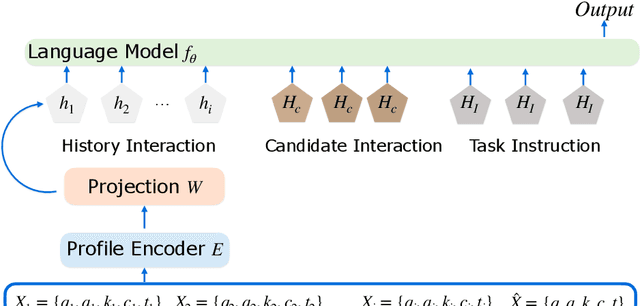
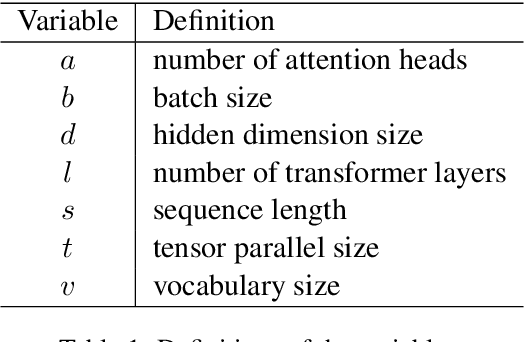
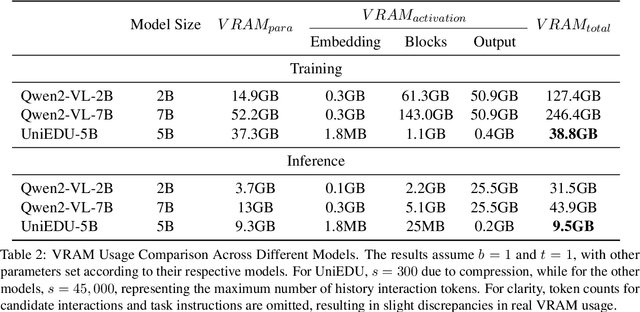
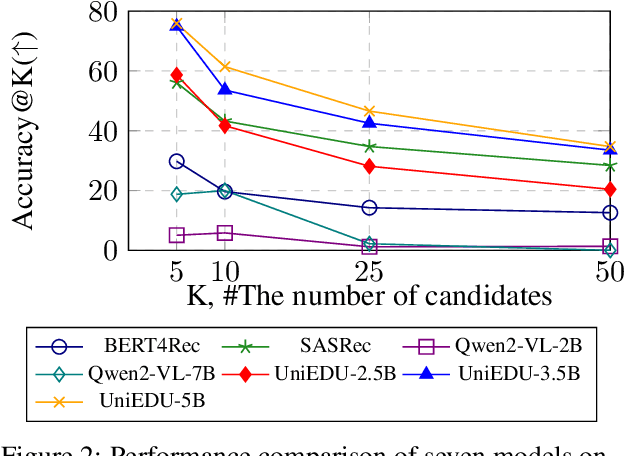
Education materials for K-12 students often consist of multiple modalities, such as text and images, posing challenges for models to fully understand nuanced information in these materials. In this paper, we propose a unified language and vision assistant UniEDU designed for various educational applications, including knowledge recommendation, knowledge tracing, time cost prediction, and user answer prediction, all within a single model. Unlike conventional task-specific models, UniEDU offers a unified solution that excels across multiple educational tasks while maintaining strong generalization capabilities. Its adaptability makes it well-suited for real-world deployment in diverse learning environments. Furthermore, UniEDU is optimized for industry-scale deployment by significantly reducing computational overhead-achieving approximately a 300\% increase in efficiency-while maintaining competitive performance with minimal degradation compared to fully fine-tuned models. This work represents a significant step toward creating versatile AI systems tailored to the evolving demands of education.
A Survey on Mechanistic Interpretability for Multi-Modal Foundation Models
Feb 22, 2025
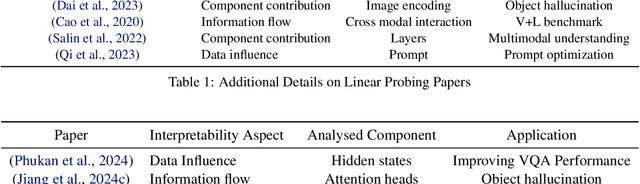


The rise of foundation models has transformed machine learning research, prompting efforts to uncover their inner workings and develop more efficient and reliable applications for better control. While significant progress has been made in interpreting Large Language Models (LLMs), multimodal foundation models (MMFMs) - such as contrastive vision-language models, generative vision-language models, and text-to-image models - pose unique interpretability challenges beyond unimodal frameworks. Despite initial studies, a substantial gap remains between the interpretability of LLMs and MMFMs. This survey explores two key aspects: (1) the adaptation of LLM interpretability methods to multimodal models and (2) understanding the mechanistic differences between unimodal language models and crossmodal systems. By systematically reviewing current MMFM analysis techniques, we propose a structured taxonomy of interpretability methods, compare insights across unimodal and multimodal architectures, and highlight critical research gaps.
From Selection to Generation: A Survey of LLM-based Active Learning
Feb 17, 2025Active Learning (AL) has been a powerful paradigm for improving model efficiency and performance by selecting the most informative data points for labeling and training. In recent active learning frameworks, Large Language Models (LLMs) have been employed not only for selection but also for generating entirely new data instances and providing more cost-effective annotations. Motivated by the increasing importance of high-quality data and efficient model training in the era of LLMs, we present a comprehensive survey on LLM-based Active Learning. We introduce an intuitive taxonomy that categorizes these techniques and discuss the transformative roles LLMs can play in the active learning loop. We further examine the impact of AL on LLM learning paradigms and its applications across various domains. Finally, we identify open challenges and propose future research directions. This survey aims to serve as an up-to-date resource for researchers and practitioners seeking to gain an intuitive understanding of LLM-based AL techniques and deploy them to new applications.
On Mechanistic Circuits for Extractive Question-Answering
Feb 12, 2025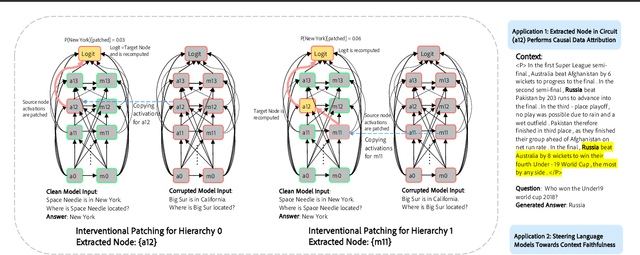
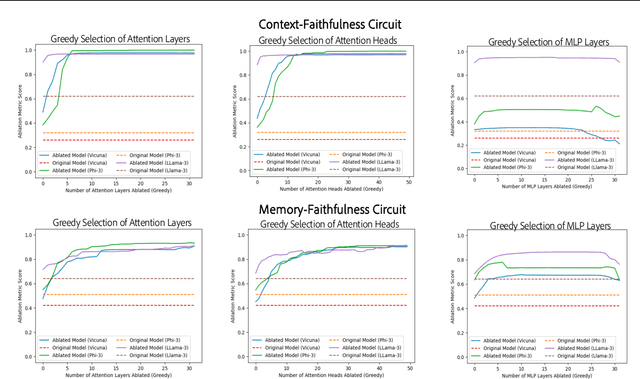
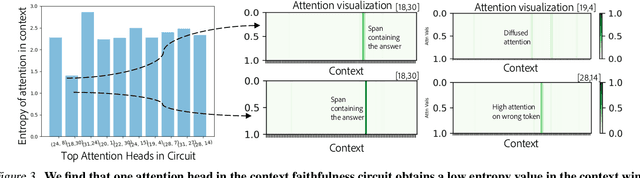
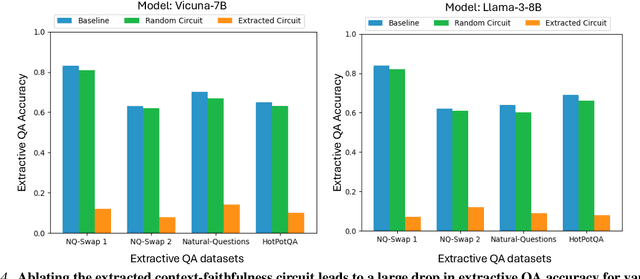
Large language models are increasingly used to process documents and facilitate question-answering on them. In our paper, we extract mechanistic circuits for this real-world language modeling task: context-augmented language modeling for extractive question-answering (QA) tasks and understand the potential benefits of circuits towards downstream applications such as data attribution to context information. We extract circuits as a function of internal model components (e.g., attention heads, MLPs) using causal mediation analysis techniques. Leveraging the extracted circuits, we first understand the interplay between the model's usage of parametric memory and retrieved context towards a better mechanistic understanding of context-augmented language models. We then identify a small set of attention heads in our circuit which performs reliable data attribution by default, thereby obtaining attribution for free in just the model's forward pass. Using this insight, we then introduce ATTNATTRIB, a fast data attribution algorithm which obtains state-of-the-art attribution results across various extractive QA benchmarks. Finally, we show the possibility to steer the language model towards answering from the context, instead of the parametric memory by using the attribution from ATTNATTRIB as an additional signal during the forward pass. Beyond mechanistic understanding, our paper provides tangible applications of circuits in the form of reliable data attribution and model steering.