 Add to Chrome
 Add to Firefox
 Add to Edge
Audio-Omni: Extending Multi-modal Understanding to Versatile Audio Generation and Editing
Apr 12, 2026
Recent progress in multimodal models has spurred rapid advances in audio understanding, generation, and editing. However, these capabilities are typically addressed by specialized models, leaving the development of a truly unified framework that can seamlessly integrate all three tasks underexplored. While some pioneering works have explored unifying audio understanding and generation, they often remain confined to specific domains. To address this, we introduce Audio-Omni, the first end-to-end framework to unify generation and editing across general sound, music, and speech domains, with integrated multi-modal understanding capabilities. Our architecture synergizes a frozen Multimodal Large Language Model for high-level reasoning with a trainable Diffusion Transformer for high-fidelity synthesis. To overcome the critical data scarcity in audio editing, we construct AudioEdit, a new large-scale dataset comprising over one million meticulously curated editing pairs. Extensive experiments demonstrate that Audio-Omni achieves state-of-the-art performance across a suite of benchmarks, outperforming prior unified approaches while achieving performance on par with or superior to specialized expert models. Beyond its core capabilities, Audio-Omni exhibits remarkable inherited capabilities, including knowledge-augmented reasoning generation, in-context generation, and zero-shot cross-lingual control for audio generation, highlighting a promising direction toward universal generative audio intelligence. The code, model, and dataset will be publicly released on https://zeyuet.github.io/Audio-Omni.

Self Adaptive Threshold Pseudo-labeling and Unreliable Sample Contrastive Loss for Semi-supervised Image Classification
Jul 04, 2024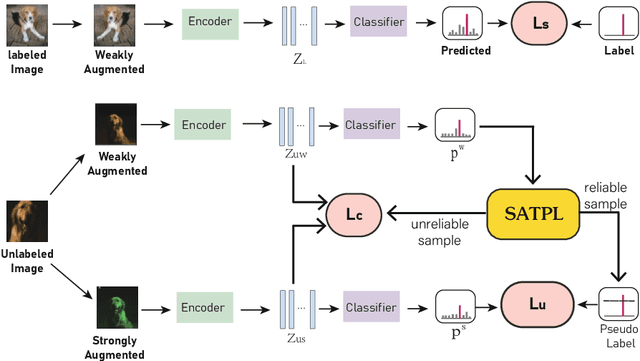
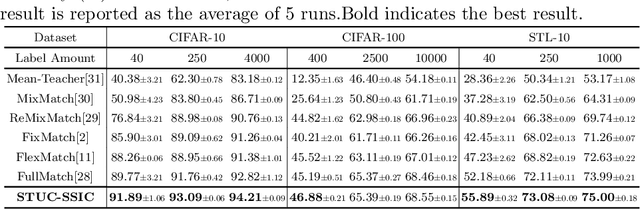
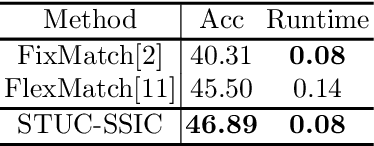
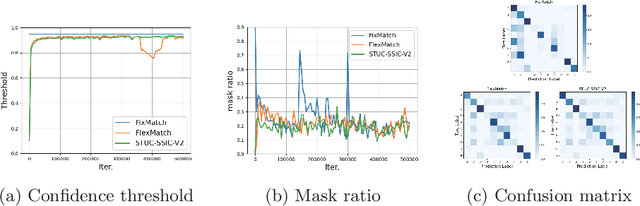
Semi-supervised learning is attracting blooming attention, due to its success in combining unlabeled data. However, pseudo-labeling-based semi-supervised approaches suffer from two problems in image classification: (1) Existing methods might fail to adopt suitable thresholds since they either use a pre-defined/fixed threshold or an ad-hoc threshold adjusting scheme, resulting in inferior performance and slow convergence. (2) Discarding unlabeled data with confidence below the thresholds results in the loss of discriminating information. To solve these issues, we develop an effective method to make sufficient use of unlabeled data. Specifically, we design a self adaptive threshold pseudo-labeling strategy, which thresholds for each class can be dynamically adjusted to increase the number of reliable samples. Meanwhile, in order to effectively utilise unlabeled data with confidence below the thresholds, we propose an unreliable sample contrastive loss to mine the discriminative information in low-confidence samples by learning the similarities and differences between sample features. We evaluate our method on several classification benchmarks under partially labeled settings and demonstrate its superiority over the other approaches.