 Add to Chrome
 Add to Firefox
 Add to Edge
dots.tts.edit: Precisely Controlled Speech Editing with a Continuous Autoregressive Model
Aug 11, 2026
Speech editing for content creation requires precise control over both what an edit should do and where it should apply. Free-form natural language provides a flexible interface for expressing edit requests, but its ambiguity may leave the intended operation, parameters, or target region underspecified. We study a precise and explicit interface for speech editing: a transcript-grounded structural edit instruction with XML-style tags explicitly specifies typed operations and localizes them to transcript spans or boundaries. This semantic timeline avoids explicit timestamp alignment and provides an externally inspectable contract for compositional edits. We instantiate the interface in dots$.$tts$.$edit, an editor adapted from the continuous autoregressive dots$.$tts foundation model. Four representative speech-creation controls cover lexical content, affective expression, pitch and speaking-rate delivery, and temporal phrasing through text, emotion, prosody, and pause editing. Task-specific data pipelines construct operation- and scope-controlled pairs while retaining source-derived context outside each target region. We further introduce doteBench, a bilingual evaluation suite that measures precise instruction following, local preservation, and audio quality across the four controls and their composition. Experiments show leading overall instruction following and local preservation across its five editing categories, while audio quality remains comparable to existing open-source systems. Across three Seed-TTS-Eval shards, the model shows negligible differences from the base model in zero-shot TTS recognition error rate and speaker similarity.

Read What You Hear: Reference-Free Hypotheses Evaluation with Acoustic Discrepancy
Jun 03, 2026Automatic speech recognition systems commonly rely on reference transcriptions for evaluation, while reference-free approaches often depend on internal confidence estimation or auxiliary language models. We propose READ (Reference-free Hypothesis Evaluation with Acoustic Discrepancy), a novel metric that evaluates ASR hypotheses directly from the speech signal. READ emphasizes the acoustic grounding of hypotheses. It uses a pretrained auto-regressive TTS model to compute the conditional likelihood of speech tokens given a text hypothesis, to measure fine-grained acoustic discrepancy between speech and text. Without additional training, READ can be applied for hypothesis refinement. Experiments show that READ correlates with specific recognition errors and improves ASR outputs, achieving up to 20\% relative error rate reduction, with particularly strong gains under noisy conditions.
HoliTok:A Coutinuous Holistic Tokenization with Robust Dual Capabilities of Speech Generation and Understanding
May 28, 2026Unified speech foundation models require a holistic tokenization space that is both learnable by language models and decodable into high-quality waveforms. Existing speech tokenizers, however, often fail to satisfy these requirements simultaneously, leading to increased architectural complexity and more involved training designs. We propose HoliTok, a continuous Holistic speech Tokenization model designed for unified generation-understanding modeling. HoliTok encodes 48~kHz speech into a compact 25~Hz sequence of 128-dimensional latents. It is trained with a progressive strategy that jointly preserves signal-level fidelity, incorporates semantic information, and maintains strong latent learnability. Based on this tokenization, we build a unified AR+DiT model for speech synthesis and recognition, where the same latent sequence supports both generation-specific and unified generation-understanding tasks. Experiments show that HoliTok achieves competitive reconstruction fidelity, improves generative learnability for high-quality and controllable synthesis, and, among the evaluated representations, is the only one that operates robustly in our unified generation-understanding architecture without additional optimization tricks. These results suggest that HoliTok serves as an effective speech tokenizer and a foundational representation interface for unified spoken language modeling. The code is available at: https://github.com/bovod-sjtu/HoliTok.
RAS: a Reliability Oriented Metric for Automatic Speech Recognition
Apr 28, 2026Automatic speech recognition systems often produce confident yet incorrect transcriptions under noisy or ambiguous conditions, which can be misleading for both users and downstream applications. Standard evaluation based on Word Error Rate focuses solely on accuracy and fails to capture transcription reliability. We introduce an abstention-aware transcription framework that enables ASR models to explicitly abstain from uncertain segments. To evaluate reliability under abstention, we propose RAS, a reliability-oriented metric that balances transcription informativeness and error aversion, with its trade-off parameter calibrated by human preference. We then train an abstention-aware ASR model through supervised bootstrapping followed by reinforcement learning. Our experiments demonstrate substantial improvements in transcription reliability while maintaining competitive accuracy.
WeTok: Powerful Discrete Tokenization for High-Fidelity Visual Reconstruction
Aug 07, 2025Visual tokenizer is a critical component for vision generation. However, the existing tokenizers often face unsatisfactory trade-off between compression ratios and reconstruction fidelity. To fill this gap, we introduce a powerful and concise WeTok tokenizer, which surpasses the previous leading tokenizers via two core innovations. (1) Group-wise lookup-free Quantization (GQ). We partition the latent features into groups, and perform lookup-free quantization for each group. As a result, GQ can efficiently overcome memory and computation limitations of prior tokenizers, while achieving a reconstruction breakthrough with more scalable codebooks. (2) Generative Decoding (GD). Different from prior tokenizers, we introduce a generative decoder with a prior of extra noise variable. In this case, GD can probabilistically model the distribution of visual data conditioned on discrete tokens, allowing WeTok to reconstruct visual details, especially at high compression ratios. Extensive experiments on mainstream benchmarks show superior performance of our WeTok. On the ImageNet 50k validation set, WeTok achieves a record-low zero-shot rFID (WeTok: 0.12 vs. FLUX-VAE: 0.18 vs. SD-VAE 3.5: 0.19). Furthermore, our highest compression model achieves a zero-shot rFID of 3.49 with a compression ratio of 768, outperforming Cosmos (384) 4.57 which has only 50% compression rate of ours. Code and models are available: https://github.com/zhuangshaobin/WeTok.
Towards General Discrete Speech Codec for Complex Acoustic Environments: A Study of Reconstruction and Downstream Task Consistency
May 28, 2025Neural speech codecs excel in reconstructing clean speech signals; however, their efficacy in complex acoustic environments and downstream signal processing tasks remains underexplored. In this study, we introduce a novel benchmark named Environment-Resilient Speech Codec Benchmark (ERSB) to systematically evaluate whether neural speech codecs are environment-resilient. Specifically, we assess two key capabilities: (1) robust reconstruction, which measures the preservation of both speech and non-speech acoustic details, and (2) downstream task consistency, which ensures minimal deviation in downstream signal processing tasks when using reconstructed speech instead of the original. Our comprehensive experiments reveal that complex acoustic environments significantly degrade signal reconstruction and downstream task consistency. This work highlights the limitations of current speech codecs and raises a future direction that improves them for greater environmental resilience.
Unlocking Temporal Flexibility: Neural Speech Codec with Variable Frame Rate
May 22, 2025Most neural speech codecs achieve bitrate adjustment through intra-frame mechanisms, such as codebook dropout, at a Constant Frame Rate (CFR). However, speech segments inherently have time-varying information density (e.g., silent intervals versus voiced regions). This property makes CFR not optimal in terms of bitrate and token sequence length, hindering efficiency in real-time applications. In this work, we propose a Temporally Flexible Coding (TFC) technique, introducing variable frame rate (VFR) into neural speech codecs for the first time. TFC enables seamlessly tunable average frame rates and dynamically allocates frame rates based on temporal entropy. Experimental results show that a codec with TFC achieves optimal reconstruction quality with high flexibility, and maintains competitive performance even at lower frame rates. Our approach is promising for the integration with other efforts to develop low-frame-rate neural speech codecs for more efficient downstream tasks.
TimeStep Master: Asymmetrical Mixture of Timestep LoRA Experts for Versatile and Efficient Diffusion Models in Vision
Mar 10, 2025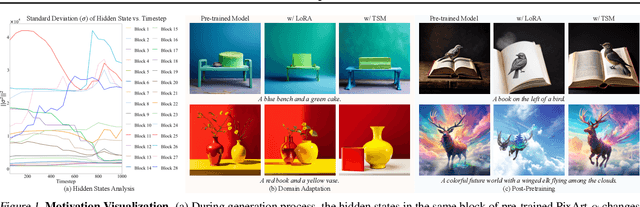
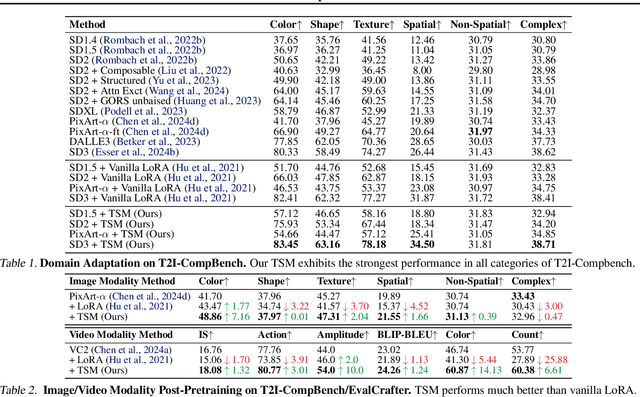
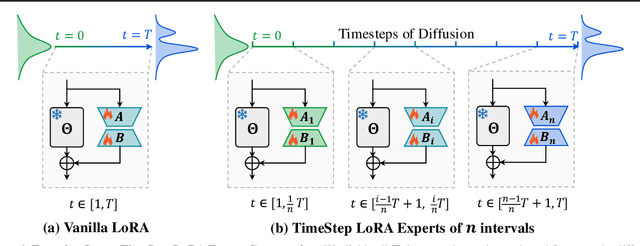
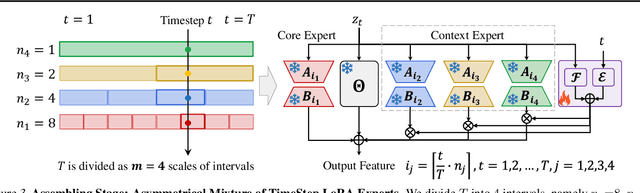
Diffusion models have driven the advancement of vision generation over the past years. However, it is often difficult to apply these large models in downstream tasks, due to massive fine-tuning cost. Recently, Low-Rank Adaptation (LoRA) has been applied for efficient tuning of diffusion models. Unfortunately, the capabilities of LoRA-tuned diffusion models are limited, since the same LoRA is used for different timesteps of the diffusion process. To tackle this problem, we introduce a general and concise TimeStep Master (TSM) paradigm with two key fine-tuning stages. In the fostering stage (1-stage), we apply different LoRAs to fine-tune the diffusion model at different timestep intervals. This results in different TimeStep LoRA experts that can effectively capture different noise levels. In the assembling stage (2-stage), we design a novel asymmetrical mixture of TimeStep LoRA experts, via core-context collaboration of experts at multi-scale intervals. For each timestep, we leverage TimeStep LoRA expert within the smallest interval as the core expert without gating, and use experts within the bigger intervals as the context experts with time-dependent gating. Consequently, our TSM can effectively model the noise level via the expert in the finest interval, and adaptively integrate contexts from the experts of other scales, boosting the versatility of diffusion models. To show the effectiveness of our TSM paradigm, we conduct extensive experiments on three typical and popular LoRA-related tasks of diffusion models, including domain adaptation, post-pretraining, and model distillation. Our TSM achieves the state-of-the-art results on all these tasks, throughout various model structures (UNet, DiT and MM-DiT) and visual data modalities (Image, Video), showing its remarkable generalization capacity.
Recent Advances in Discrete Speech Tokens: A Review
Feb 10, 2025


The rapid advancement of speech generation technologies in the era of large language models (LLMs) has established discrete speech tokens as a foundational paradigm for speech representation. These tokens, characterized by their discrete, compact, and concise nature, are not only advantageous for efficient transmission and storage, but also inherently compatible with the language modeling framework, enabling seamless integration of speech into text-dominated LLM architectures. Current research categorizes discrete speech tokens into two principal classes: acoustic tokens and semantic tokens, each of which has evolved into a rich research domain characterized by unique design philosophies and methodological approaches. This survey systematically synthesizes the existing taxonomy and recent innovations in discrete speech tokenization, conducts a critical examination of the strengths and limitations of each paradigm, and presents systematic experimental comparisons across token types. Furthermore, we identify persistent challenges in the field and propose potential research directions, aiming to offer actionable insights to inspire future advancements in the development and application of discrete speech tokens.
Why Do Speech Language Models Fail to Generate Semantically Coherent Outputs? A Modality Evolving Perspective
Dec 22, 2024

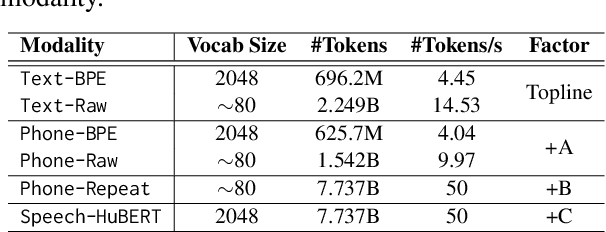
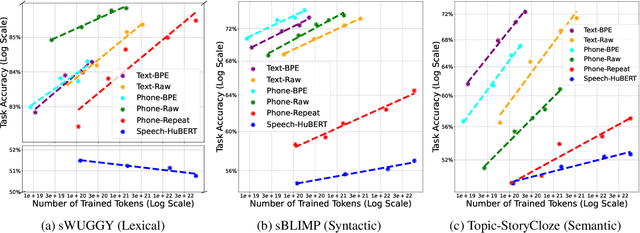
Although text-based large language models exhibit human-level writing ability and remarkable intelligence, speech language models (SLMs) still struggle to generate semantically coherent outputs. There are several potential reasons for this performance degradation: (A) speech tokens mainly provide phonetic information rather than semantic information, (B) the length of speech sequences is much longer than that of text sequences, and (C) paralinguistic information, such as prosody, introduces additional complexity and variability. In this paper, we explore the influence of three key factors separately by transiting the modality from text to speech in an evolving manner. Our findings reveal that the impact of the three factors varies. Factor A has a relatively minor impact, factor B influences syntactical and semantic modeling more obviously, and factor C exerts the most significant impact, particularly in the basic lexical modeling. Based on these findings, we provide insights into the unique challenges of training SLMs and highlight pathways to develop more effective end-to-end SLMs.