 Add to Chrome
 Add to Firefox
 Add to Edge
HALOMI: Learning Humanoid Loco-Manipulation with Active Perception from Human Demonstrations
Jun 17, 2026
Human demonstrations, which can be collected at scale and naturally capture active hand-eye coordination, are a promising data source for learning humanoid loco-manipulation. However, directly transferring human demonstrations to humanoids requires a precise world-frame tracking controller, which is often brittle under Out-of-Distribution(OOD) targets, while human-to-humanoid gaps persist in both egocentric observation and action execution. To address these challenges, we present HALOMI, a scalable framework for learning humanoid loco-manipulation with active perception from human demonstrations. HALOMI extends Universal Manipulation Interface (UMI) with egocentric sensing to collect ego-view and wrist-view observations along with head-hand trajectories at scale. We further propose a manifold-constrained controller that plans in a learned latent behavior manifold to enable precise and robust head-hand tracking in the world frame. To bridge the human-to-humanoid gap, we perform ego-view alignment and introduce a controller-aware reference trajectory adaptation to reduce mismatch in both observation and action execution. We validate HALOMI on a Unitree G1 humanoid robot with an actuated neck across five real-world tasks involving navigation, grasping, bimanual manipulation, whole-body coordination, and dynamic behaviors. Across the three quantitatively evaluated tasks, HALOMI achieves an average success rate of 85\%, while additional qualitative demonstrations show its ability to support dynamic tossing and deep-squat grasping.

MaineCoon: Pursuing A Real-Time Audio-Visual Social World Model
Jun 16, 2026As an increasing majority of global video content is consumed on social platforms for interactive social purposes, video generation models built for social worlds are important but largely overlooked by previous studies. In this work, we define the position of social world models and build a prototype model as the first step towards this goal. While previous world models successfully simulate physical environments or gaming world exploration, they remain fundamentally detached from human-centric social dynamics. To bridge this gap as the first step to social world models, we present MaineCoon, the first real-time audio-visual autoregressive model that has 22B parameters and is capable of real-time streaming generation and sub-second interaction, with a record-breaking frame rate of up to 47.5 FPS, on a single GPU. To the best of our knowledge, MaineCoon is also the first real-time audio-visual generation model specifically optimized for social-interactive applications. To enable efficient and stable training, we introduce several novel techniques into MaineCoon, including self-resampling, cross-modal representation alignment, domain-aware preference optimization, and reinforced online-policy distillation (ROPD). We also design the first agentic streaming inference framework that supports thousand-second-scale or even longer generation while mitigating drift with agentic cache management and prompt planing. These innovations significantly accelerate training while optimizing real-time inference performance. We believe this work not only sets a new state-of-the-art (SOTA) performance benchmark for high-quality, low-latency, and long-horizon audio-visual autoregressive models, but also points out the paradigm shift desired for next-generation AI-native social platforms.
PortBench: A Correlation-Aware, Full-Pipeline Benchmark for LLM-Driven Portfolio Management
May 27, 2026LLMs have shown strong performance across diverse financial tasks, yet portfolio management (PM), a critical financial decision-making task, remains poorly benchmarked. Existing benchmarks exhibit two main gaps: they ignore cross-asset correlation structures, thereby failing to distinguish genuinely diversified portfolios from concentrated ones, and fail to evaluate the complete PM decision pipeline in real-world scenarios. We introduce PortBench, a benchmark spanning six heterogeneous asset classes over ten years. PortBench consists of two complementary layers: a static QA dataset of 6,269 correlation-based questions across seven task templates, and a dynamic five-stage allocation pipeline that mirrors the full PM decision cycle. To evaluate these layers, we introduce two dedicated metrics: a dual-layer correlation score that measures whether proposed portfolios exploit inter-class hedging and avoid intra-class concentration, and CEPS, a metric that quantifies how reasoning errors compound across pipeline stages. We further assess strategy robustness and investor alignment under three historical stress regimes and risk profiles. Evaluating ten frontier LLMs, we find that despite strong performance on static financial QA, 90\% of model-profile combinations fail to outperform a basic equal-weight allocation, and models that satisfy every procedural constraint still suffer catastrophic drawdowns under stress. Our source code is available at \href{https://github.com/AgenticFinLab/portbench}{this https URL}.
DexHiL: A Human-in-the-Loop Framework for Vision-Language-Action Model Post-Training in Dexterous Manipulation
Mar 10, 2026While Vision-Language-Action (VLA) models have demonstrated promising generalization capabilities in robotic manipulation, deploying them on specific and complex downstream tasks still demands effective post-training. In parallel, Human-in-the-Loop (HiL) learning has proven to be a powerful mechanism for refining robot policies. However, extending this paradigm to dexterous manipulation remains challenging: multi-finger control is high-dimensional, contact-intensive, and exhibits execution distributions that differ markedly from standard arm motions, leaving existing dexterous VLA systems limited in reliability and adaptability. We present DexHiL, the first integrated arm-hand human-in-the-loop framework for dexterous VLA models, enabling coordinated interventions over the arm and the dexterous hand within a single system. DexHiL introduces an intervention-aware data sampling strategy that prioritizes corrective segments for post-training, alongside a lightweight teleoperation interface that supports instantaneous human corrections during execution. Real-robot experiments demonstrate that DexHiL serves as an effective post-training framework, yielding a substantial performance leap, outperforming standard offline-only fine-tuning baselines by an average of 25% in success rates across distinct tasks. Project page: https://chenzhongxi-sjtu.github.io/dexhil/
Early and Prediagnostic Detection of Pancreatic Cancer from Computed Tomography
Jan 29, 2026Pancreatic ductal adenocarcinoma (PDAC), one of the deadliest solid malignancies, is often detected at a late and inoperable stage. Retrospective reviews of prediagnostic CT scans, when conducted by expert radiologists aware that the patient later developed PDAC, frequently reveal lesions that were previously overlooked. To help detecting these lesions earlier, we developed an automated system named ePAI (early Pancreatic cancer detection with Artificial Intelligence). It was trained on data from 1,598 patients from a single medical center. In the internal test involving 1,009 patients, ePAI achieved an area under the receiver operating characteristic curve (AUC) of 0.939-0.999, a sensitivity of 95.3%, and a specificity of 98.7% for detecting small PDAC less than 2 cm in diameter, precisely localizing PDAC as small as 2 mm. In an external test involving 7,158 patients across 6 centers, ePAI achieved an AUC of 0.918-0.945, a sensitivity of 91.5%, and a specificity of 88.0%, precisely localizing PDAC as small as 5 mm. Importantly, ePAI detected PDACs on prediagnostic CT scans obtained 3 to 36 months before clinical diagnosis that had originally been overlooked by radiologists. It successfully detected and localized PDACs in 75 of 159 patients, with a median lead time of 347 days before clinical diagnosis. Our multi-reader study showed that ePAI significantly outperformed 30 board-certified radiologists by 50.3% (P < 0.05) in sensitivity while maintaining a comparable specificity of 95.4% in detecting PDACs early and prediagnostic. These findings suggest its potential of ePAI as an assistive tool to improve early detection of pancreatic cancer.
PyFi: Toward Pyramid-like Financial Image Understanding for VLMs via Adversarial Agents
Dec 11, 2025This paper proposes PyFi, a novel framework for pyramid-like financial image understanding that enables vision language models (VLMs) to reason through question chains in a progressive, simple-to-complex manner. At the core of PyFi is PyFi-600K, a dataset comprising 600K financial question-answer pairs organized into a reasoning pyramid: questions at the base require only basic perception, while those toward the apex demand increasing levels of capability in financial visual understanding and expertise. This data is scalable because it is synthesized without human annotations, using PyFi-adv, a multi-agent adversarial mechanism under the Monte Carlo Tree Search (MCTS) paradigm, in which, for each image, a challenger agent competes with a solver agent by generating question chains that progressively probe deeper capability levels in financial visual reasoning. Leveraging this dataset, we present fine-grained, hierarchical, and comprehensive evaluations of advanced VLMs in the financial domain. Moreover, fine-tuning Qwen2.5-VL-3B and Qwen2.5-VL-7B on the pyramid-structured question chains enables these models to answer complex financial questions by decomposing them into sub-questions with gradually increasing reasoning demands, yielding average accuracy improvements of 19.52% and 8.06%, respectively, on the dataset. All resources of code, dataset and models are available at: https://github.com/AgenticFinLab/PyFi .
A QP Framework for Improving Data Collection: Quantifying Device-Controller Performance in Robot Teleoperation
Nov 11, 2025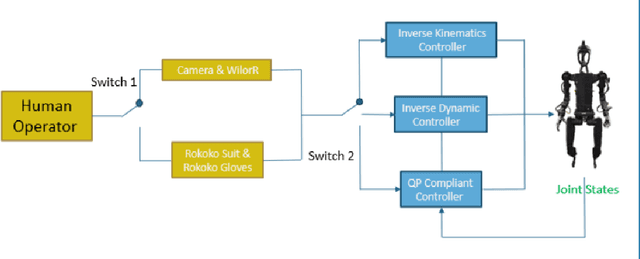
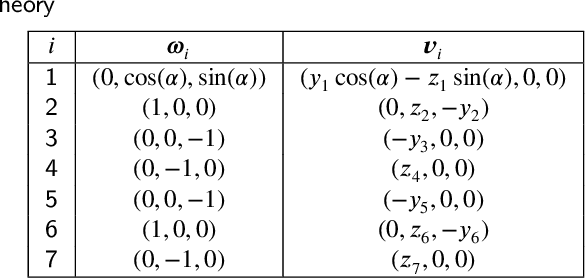
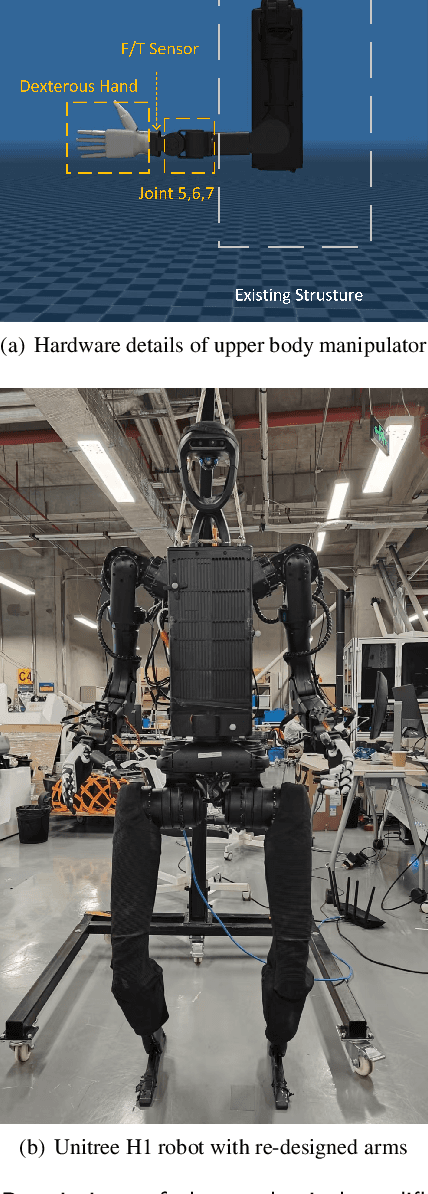
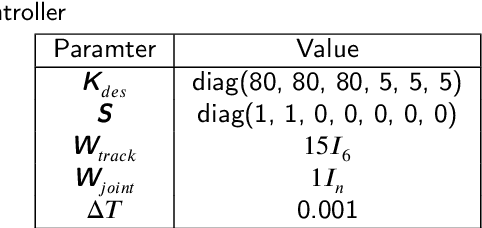
Robot learning empowers the robot system with human brain-like intelligence to autonomously acquire and adapt skills through experience, enhancing flexibility and adaptability in various environments. Aimed at achieving a similar level of capability in large language models (LLMs) for embodied intelligence, data quality plays a crucial role in training a foundational model with diverse robot skills. In this study, we investigate the collection of data for manipulation tasks using teleoperation devices. Different devices yield varying effects when paired with corresponding controller strategies, including position-based inverse kinematics (IK) control, torque-based inverse dynamics (ID) control, and optimization-based compliance control. In this paper, we develop a teleoperation pipeline that is compatible with different teleoperation devices and manipulator controllers. Within the pipeline, we construct the optimal QP formulation with the dynamic nullspace and the impedance tracking as the novel optimal controller to achieve compliant pose tracking and singularity avoidance. Regarding the optimal controller, it adaptively adjusts the weights assignment depending on the robot joint manipulability that reflects the state of joint configuration for the pose tracking in the form of impedance control and singularity avoidance with nullspace tracking. Analysis of quantitative experimental results suggests the quality of the teleoperated trajectory data, including tracking error, occurrence of singularity, and the smoothness of the joints' trajectory, with different combinations of teleoperation interface and the motion controller.
Evolution of Optimization Algorithms for Global Placement via Large Language Models
Apr 18, 2025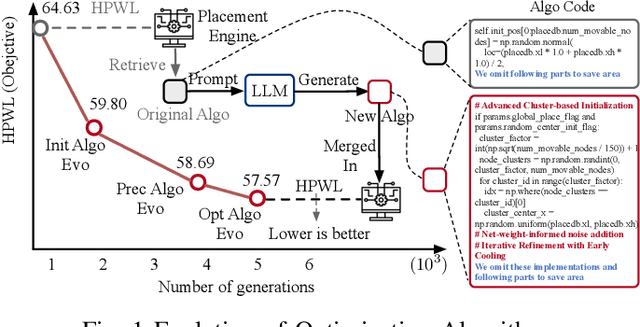
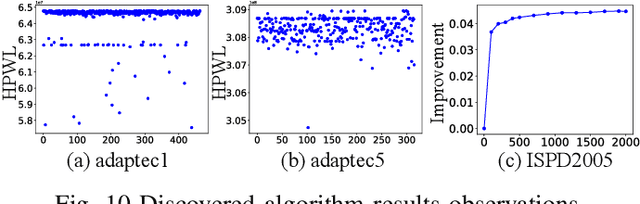

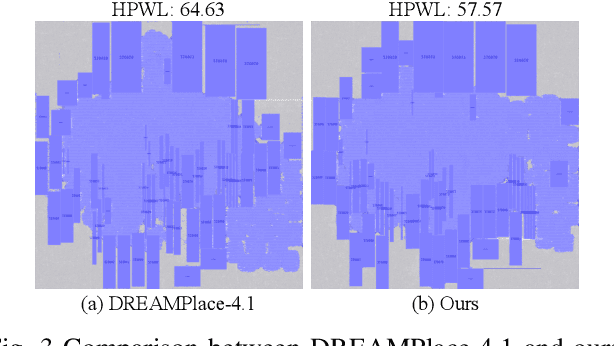
Optimization algorithms are widely employed to tackle complex problems, but designing them manually is often labor-intensive and requires significant expertise. Global placement is a fundamental step in electronic design automation (EDA). While analytical approaches represent the state-of-the-art (SOTA) in global placement, their core optimization algorithms remain heavily dependent on heuristics and customized components, such as initialization strategies, preconditioning methods, and line search techniques. This paper presents an automated framework that leverages large language models (LLM) to evolve optimization algorithms for global placement. We first generate diverse candidate algorithms using LLM through carefully crafted prompts. Then we introduce an LLM-based genetic flow to evolve selected candidate algorithms. The discovered optimization algorithms exhibit substantial performance improvements across many benchmarks. Specifically, Our design-case-specific discovered algorithms achieve average HPWL improvements of \textbf{5.05\%}, \text{5.29\%} and \textbf{8.30\%} on MMS, ISPD2005 and ISPD2019 benchmarks, and up to \textbf{17\%} improvements on individual cases. Additionally, the discovered algorithms demonstrate good generalization ability and are complementary to existing parameter-tuning methods.
In-Context Learning of Linear Dynamical Systems with Transformers: Error Bounds and Depth-Separation
Feb 12, 2025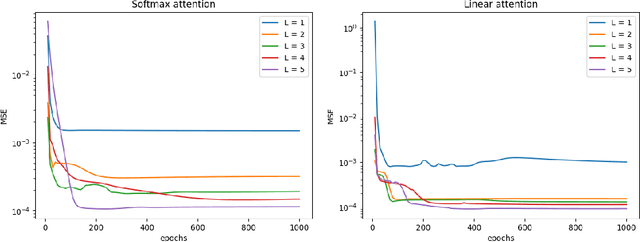
This paper investigates approximation-theoretic aspects of the in-context learning capability of the transformers in representing a family of noisy linear dynamical systems. Our first theoretical result establishes an upper bound on the approximation error of multi-layer transformers with respect to an $L^2$-testing loss uniformly defined across tasks. This result demonstrates that transformers with logarithmic depth can achieve error bounds comparable with those of the least-squares estimator. In contrast, our second result establishes a non-diminishing lower bound on the approximation error for a class of single-layer linear transformers, which suggests a depth-separation phenomenon for transformers in the in-context learning of dynamical systems. Moreover, this second result uncovers a critical distinction in the approximation power of single-layer linear transformers when learning from IID versus non-IID data.
ScaleMAI: Accelerating the Development of Trusted Datasets and AI Models
Jan 06, 2025


Building trusted datasets is critical for transparent and responsible Medical AI (MAI) research, but creating even small, high-quality datasets can take years of effort from multidisciplinary teams. This process often delays AI benefits, as human-centric data creation and AI-centric model development are treated as separate, sequential steps. To overcome this, we propose ScaleMAI, an agent of AI-integrated data curation and annotation, allowing data quality and AI performance to improve in a self-reinforcing cycle and reducing development time from years to months. We adopt pancreatic tumor detection as an example. First, ScaleMAI progressively creates a dataset of 25,362 CT scans, including per-voxel annotations for benign/malignant tumors and 24 anatomical structures. Second, through progressive human-in-the-loop iterations, ScaleMAI provides Flagship AI Model that can approach the proficiency of expert annotators (30-year experience) in detecting pancreatic tumors. Flagship Model significantly outperforms models developed from smaller, fixed-quality datasets, with substantial gains in tumor detection (+14%), segmentation (+5%), and classification (72%) on three prestigious benchmarks. In summary, ScaleMAI transforms the speed, scale, and reliability of medical dataset creation, paving the way for a variety of impactful, data-driven applications.