 Add to Chrome
 Add to Firefox
 Add to Edge
Semantic Search At LinkedIn
Feb 07, 2026
Semantic search with large language models (LLMs) enables retrieval by meaning rather than keyword overlap, but scaling it requires major inference efficiency advances. We present LinkedIn's LLM-based semantic search framework for AI Job Search and AI People Search, combining an LLM relevance judge, embedding-based retrieval, and a compact Small Language Model trained via multi-teacher distillation to jointly optimize relevance and engagement. A prefill-oriented inference architecture co-designed with model pruning, context compression, and text-embedding hybrid interactions boosts ranking throughput by over 75x under a fixed latency constraint while preserving near-teacher-level NDCG, enabling one of the first production LLM-based ranking systems with efficiency comparable to traditional approaches and delivering significant gains in quality and user engagement.

When RL Meets Adaptive Speculative Training: A Unified Training-Serving System
Feb 06, 2026Speculative decoding can significantly accelerate LLM serving, yet most deployments today disentangle speculator training from serving, treating speculator training as a standalone offline modeling problem. We show that this decoupled formulation introduces substantial deployment and adaptation lag: (1) high time-to-serve, since a speculator must be trained offline for a considerable period before deployment; (2) delayed utility feedback, since the true end-to-end decoding speedup is only known after training and cannot be inferred reliably from acceptance rate alone due to model-architecture and system-level overheads; and (3) domain-drift degradation, as the target model is repurposed to new domains and the speculator becomes stale and less effective. To address these issues, we present Aurora, a unified training-serving system that closes the loop by continuously learning a speculator directly from live inference traces. Aurora reframes online speculator learning as an asynchronous reinforcement-learning problem: accepted tokens provide positive feedback, while rejected speculator proposals provide implicit negative feedback that we exploit to improve sample efficiency. Our design integrates an SGLang-based inference server with an asynchronous training server, enabling hot-swapped speculator updates without service interruption. Crucially, Aurora supports day-0 deployment: a speculator can be served immediately and rapidly adapted to live traffic, improving system performance while providing immediate utility feedback. Across experiments, Aurora achieves a 1.5x day-0 speedup on recently released frontier models (e.g., MiniMax M2.1 229B and Qwen3-Coder-Next 80B). Aurora also adapts effectively to distribution shifts in user traffic, delivering an additional 1.25x speedup over a well-trained but static speculator on widely used models (e.g., Qwen3 and Llama3).
Co-Channel Interference Mitigation Using Deep Learning for Drone-Based Large-Scale Antenna Measurements
Jan 19, 2026Unmanned aerial vehicles (UAVs) enable efficient in-situ radiation characterization of large-aperture antennas directly in their deployment environments. In such measurements, a continuous-wave (CW) probe tone is commonly transmitted to characterize the antenna response. However, active co-channel emissions from neighboring antennas often introduce severe in-band interference, where classical FFT-based estimators fail to accurately estimate the CW tone amplitude when the signal-to-interference ratios (SIR) falls below -10 dB. This paper proposes a lightweight deep convolutional neural network (DC-CNN) that estimates the amplitude of the CW tone. The model is trained and evaluated on real 5~GHz measurement bursts spanning an effective SIR range of --33.3 dB to +46.7 dB. Despite its compact size (<20k parameters), the proposed DC-CNN achieves a mean absolute error (MAE) of 7% over the full range, with <1 dB error for SIR >= -30 dB. This robustness and efficiency make DC-CNN suitable for deployment on embedded UAV platforms for interference-resilient antenna pattern characterization.
Forest Before Trees: Latent Superposition for Efficient Visual Reasoning
Jan 11, 2026While Chain-of-Thought empowers Large Vision-Language Models with multi-step reasoning, explicit textual rationales suffer from an information bandwidth bottleneck, where continuous visual details are discarded during discrete tokenization. Recent latent reasoning methods attempt to address this challenge, but often fall prey to premature semantic collapse due to rigid autoregressive objectives. In this paper, we propose Laser, a novel paradigm that reformulates visual deduction via Dynamic Windowed Alignment Learning (DWAL). Instead of forcing a point-wise prediction, Laser aligns the latent state with a dynamic validity window of future semantics. This mechanism enforces a "Forest-before-Trees" cognitive hierarchy, enabling the model to maintain a probabilistic superposition of global features before narrowing down to local details. Crucially, Laser maintains interpretability via decodable trajectories while stabilizing unconstrained learning via Self-Refined Superposition. Extensive experiments on 6 benchmarks demonstrate that Laser achieves state-of-the-art performance among latent reasoning methods, surpassing the strong baseline Monet by 5.03% on average. Notably, it achieves these gains with extreme efficiency, reducing inference tokens by more than 97%, while demonstrating robust generalization to out-of-distribution domains.
Scaling Spatial Intelligence with Multimodal Foundation Models
Nov 17, 2025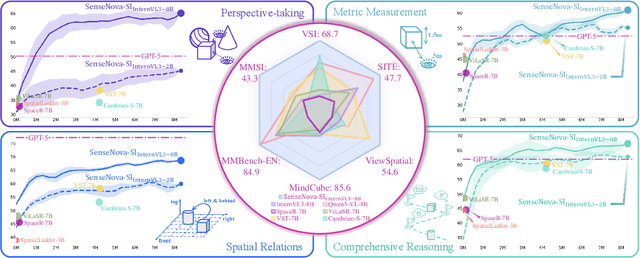
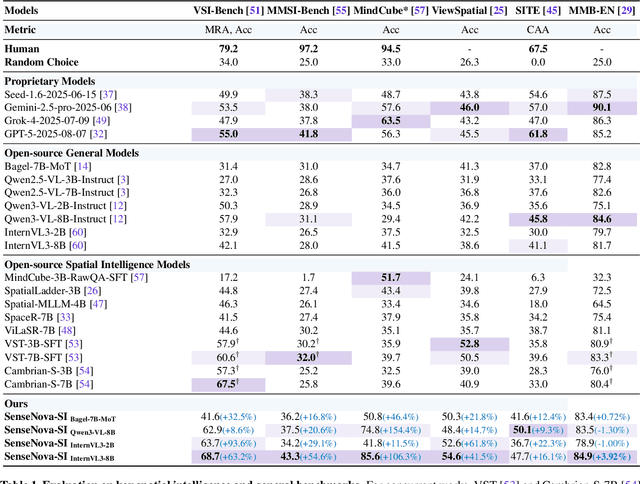
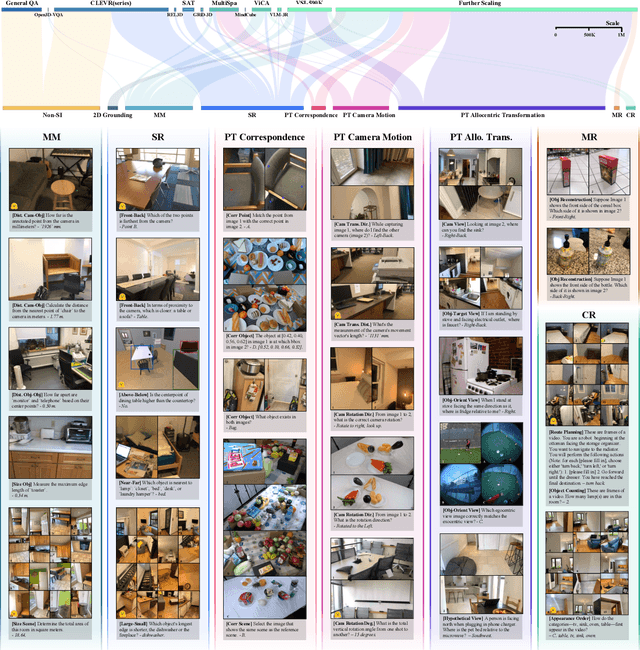
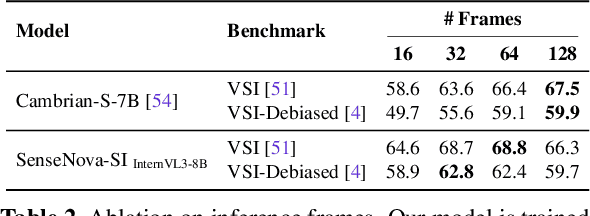
Despite remarkable progress, multimodal foundation models still exhibit surprising deficiencies in spatial intelligence. In this work, we explore scaling up multimodal foundation models to cultivate spatial intelligence within the SenseNova-SI family, built upon established multimodal foundations including visual understanding models (i.e., Qwen3-VL and InternVL3) and unified understanding and generation models (i.e., Bagel). We take a principled approach to constructing high-performing and robust spatial intelligence by systematically curating SenseNova-SI-8M: eight million diverse data samples under a rigorous taxonomy of spatial capabilities. SenseNova-SI demonstrates unprecedented performance across a broad range of spatial intelligence benchmarks: 68.7% on VSI-Bench, 43.3% on MMSI, 85.6% on MindCube, 54.6% on ViewSpatial, and 50.1% on SITE, while maintaining strong general multimodal understanding (e.g., 84.9% on MMBench-En). More importantly, we analyze the impact of data scaling, discuss early signs of emergent generalization capabilities enabled by diverse data training, analyze the risk of overfitting and language shortcuts, present a preliminary study on spatial chain-of-thought reasoning, and validate the potential downstream application. SenseNova-SI is an ongoing project, and this report will be updated continuously. All newly trained multimodal foundation models are publicly released to facilitate further research in this direction.
AudioMarathon: A Comprehensive Benchmark for Long-Context Audio Understanding and Efficiency in Audio LLMs
Oct 08, 2025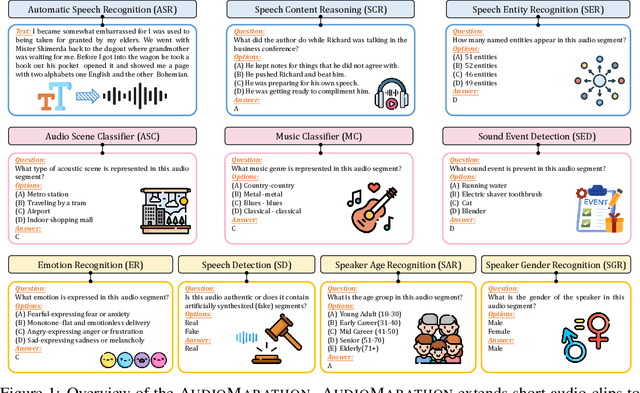
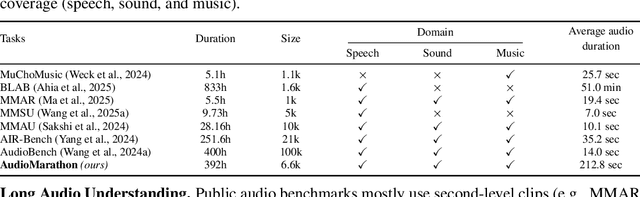
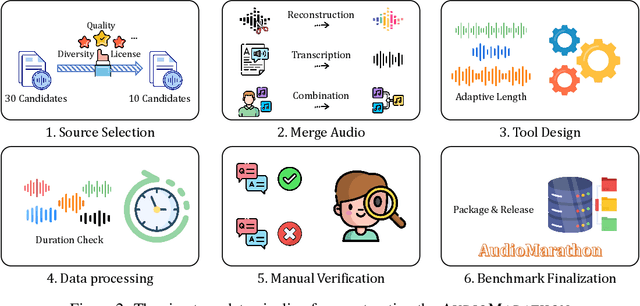

Processing long-form audio is a major challenge for Large Audio Language models (LALMs). These models struggle with the quadratic cost of attention ($O(N^2)$) and with modeling long-range temporal dependencies. Existing audio benchmarks are built mostly from short clips and do not evaluate models in realistic long context settings. To address this gap, we introduce AudioMarathon, a benchmark designed to evaluate both understanding and inference efficiency on long-form audio. AudioMarathon provides a diverse set of tasks built upon three pillars: long-context audio inputs with durations ranging from 90.0 to 300.0 seconds, which correspond to encoded sequences of 2,250 to 7,500 audio tokens, respectively, full domain coverage across speech, sound, and music, and complex reasoning that requires multi-hop inference. We evaluate state-of-the-art LALMs and observe clear performance drops as audio length grows. We also study acceleration techniques and analyze the trade-offs of token pruning and KV cache eviction. The results show large gaps across current LALMs and highlight the need for better temporal reasoning and memory-efficient architectures. We believe AudioMarathon will drive the audio and multimodal research community to develop more advanced audio understanding models capable of solving complex audio tasks.
Has GPT-5 Achieved Spatial Intelligence? An Empirical Study
Aug 18, 2025Multi-modal models have achieved remarkable progress in recent years. Nevertheless, they continue to exhibit notable limitations in spatial understanding and reasoning, which are fundamental capabilities to achieving artificial general intelligence. With the recent release of GPT-5, allegedly the most powerful AI model to date, it is timely to examine where the leading models stand on the path toward spatial intelligence. First, we propose a comprehensive taxonomy of spatial tasks that unifies existing benchmarks and discuss the challenges in ensuring fair evaluation. We then evaluate state-of-the-art proprietary and open-source models on eight key benchmarks, at a cost exceeding one billion total tokens. Our empirical study reveals that (1) GPT-5 demonstrates unprecedented strength in spatial intelligence, yet (2) still falls short of human performance across a broad spectrum of tasks. Moreover, we (3) identify the more challenging spatial intelligence problems for multi-modal models, and (4) proprietary models do not exhibit a decisive advantage when facing the most difficult problems. In addition, we conduct a qualitative evaluation across a diverse set of scenarios that are intuitive for humans yet fail even the most advanced multi-modal models.
CROP: Integrating Topological and Spatial Structures via Cross-View Prefixes for Molecular LLMs
Aug 09, 2025Recent advances in molecular science have been propelled significantly by large language models (LLMs). However, their effectiveness is limited when relying solely on molecular sequences, which fail to capture the complex structures of molecules. Beyond sequence representation, molecules exhibit two complementary structural views: the first focuses on the topological relationships between atoms, as exemplified by the graph view; and the second emphasizes the spatial configuration of molecules, as represented by the image view. The two types of views provide unique insights into molecular structures. To leverage these views collaboratively, we propose the CROss-view Prefixes (CROP) to enhance LLMs' molecular understanding through efficient multi-view integration. CROP possesses two advantages: (i) efficiency: by jointly resampling multiple structural views into fixed-length prefixes, it avoids excessive consumption of the LLM's limited context length and allows easy expansion to more views; (ii) effectiveness: by utilizing the LLM's self-encoded molecular sequences to guide the resampling process, it boosts the quality of the generated prefixes. Specifically, our framework features a carefully designed SMILES Guided Resampler for view resampling, and a Structural Embedding Gate for converting the resulting embeddings into LLM's prefixes. Extensive experiments demonstrate the superiority of CROP in tasks including molecule captioning, IUPAC name prediction and molecule property prediction.
BASIC: Boosting Visual Alignment with Intrinsic Refined Embeddings in Multimodal Large Language Models
Aug 09, 2025Mainstream Multimodal Large Language Models (MLLMs) achieve visual understanding by using a vision projector to bridge well-pretrained vision encoders and large language models (LLMs). The inherent gap between visual and textual modalities makes the embeddings from the vision projector critical for visual comprehension. However, current alignment approaches treat visual embeddings as contextual cues and merely apply auto-regressive supervision to textual outputs, neglecting the necessity of introducing equivalent direct visual supervision, which hinders the potential finer alignment of visual embeddings. In this paper, based on our analysis of the refinement process of visual embeddings in the LLM's shallow layers, we propose BASIC, a method that utilizes refined visual embeddings within the LLM as supervision to directly guide the projector in generating initial visual embeddings. Specifically, the guidance is conducted from two perspectives: (i) optimizing embedding directions by reducing angles between initial and supervisory embeddings in semantic space; (ii) improving semantic matching by minimizing disparities between the logit distributions of both visual embeddings. Without additional supervisory models or artificial annotations, BASIC significantly improves the performance of MLLMs across a wide range of benchmarks, demonstrating the effectiveness of our introduced direct visual supervision.
C-TLSAN: Content-Enhanced Time-Aware Long- and Short-Term Attention Network for Personalized Recommendation
Jun 16, 2025Sequential recommender systems aim to model users' evolving preferences by capturing patterns in their historical interactions. Recent advances in this area have leveraged deep neural networks and attention mechanisms to effectively represent sequential behaviors and time-sensitive interests. In this work, we propose C-TLSAN (Content-Enhanced Time-Aware Long- and Short-Term Attention Network), an extension of the TLSAN architecture that jointly models long- and short-term user preferences while incorporating semantic content associated with items, such as product descriptions. C-TLSAN enriches the recommendation pipeline by embedding textual content linked to users' historical interactions directly into both long-term and short-term attention layers. This allows the model to learn from both behavioral patterns and rich item content, enhancing user and item representations across temporal dimensions. By fusing sequential signals with textual semantics, our approach improves the expressiveness and personalization capacity of recommendation systems. We conduct extensive experiments on large-scale Amazon datasets, benchmarking C-TLSAN against state-of-the-art baselines, including recent sequential recommenders based on Large Language Models (LLMs), which represent interaction history and predictions in text form. Empirical results demonstrate that C-TLSAN consistently outperforms strong baselines in next-item prediction tasks. Notably, it improves AUC by 1.66%, Recall@10 by 93.99%, and Precision@10 by 94.80% on average over the best-performing baseline (TLSAN) across 10 Amazon product categories. These results highlight the value of integrating content-aware enhancements into temporal modeling frameworks for sequential recommendation. Our code is available at https://github.com/booml247/cTLSAN.