 Add to Chrome
 Add to Firefox
 Add to Edge
Dynamic Token Compression for Efficient Video Understanding through Reinforcement Learning
Mar 27, 2026
Multimodal Large Language Models have demonstrated remarkable capabilities in video understanding, yet face prohibitive computational costs and performance degradation from ''context rot'' due to massive visual token redundancy. Existing compression strategies typically rely on heuristics or fixed transformations that are often decoupled from the downstream task objectives, limiting their adaptability and effectiveness. To address this, we propose SCORE (Surprise-augmented token COmpression via REinforcement learning), a unified framework that learns an adaptive token compression policy. SCORE introduces a lightweight policy network conditioned on a surprise-augmented state representation that incorporates inter-frame residuals to explicitly capture temporal dynamics and motion saliency. We optimize this policy using a group-wise reinforcement learning scheme with a split-advantage estimator, stabilized by a two-stage curriculum transferring from static pseudo-videos to real dynamic videos. Extensive experiments on diverse video understanding benchmarks demonstrate that SCORE significantly outperforms state-of-the-art baselines. Notably, SCORE achieves a 16x prefill speedup while preserving 99.5% of original performance at a 10% retention ratio, offering a scalable solution for efficient long-form video understanding.

When Thinking Hurts: Mitigating Visual Forgetting in Video Reasoning via Frame Repetition
Mar 17, 2026Recently, Multimodal Large Language Models (MLLMs) have demonstrated significant potential in complex visual tasks through the integration of Chain-of-Thought (CoT) reasoning. However, in Video Question Answering, extended thinking processes do not consistently yield performance gains and may even lead to degradation due to ``visual anchor drifting'', where models increasingly rely on self-generated text, sidelining visual inputs and causing hallucinations. While existing mitigations typically introduce specific mechanisms for the model to re-attend to visual inputs during inference, these approaches often incur prohibitive training costs and suffer from poor generalizability across different architectures. To address this, we propose FrameRepeat, an automated enhancement framework which features a lightweight repeat scoring module that enables Video-LLMs to autonomously identify which frames should be reinforced. We introduce a novel training strategy, Add-One-In (AOI), that uses MLLM output probabilities to generate supervision signals representing repeat gain. This can be used to train a frame scoring network, which guides the frame repetition behavior. Experimental results across multiple models and datasets demonstrate that FrameRepeat is both effective and generalizable in strengthening important visual cues during the reasoning process.
MVP: Enhancing Video Large Language Models via Self-supervised Masked Video Prediction
Jan 07, 2026Reinforcement learning based post-training paradigms for Video Large Language Models (VideoLLMs) have achieved significant success by optimizing for visual-semantic tasks such as captioning or VideoQA. However, while these approaches effectively enhance perception abilities, they primarily target holistic content understanding, often lacking explicit supervision for intrinsic temporal coherence and inter-frame correlations. This tendency limits the models' ability to capture intricate dynamics and fine-grained visual causality. To explicitly bridge this gap, we propose a novel post-training objective: Masked Video Prediction (MVP). By requiring the model to reconstruct a masked continuous segment from a set of challenging distractors, MVP forces the model to attend to the sequential logic and temporal context of events. To support scalable training, we introduce a scalable data synthesis pipeline capable of transforming arbitrary video corpora into MVP training samples, and further employ Group Relative Policy Optimization (GRPO) with a fine-grained reward function to enhance the model's understanding of video context and temporal properties. Comprehensive evaluations demonstrate that MVP enhances video reasoning capabilities by directly reinforcing temporal reasoning and causal understanding.
DiG: Differential Grounding for Enhancing Fine-Grained Perception in Multimodal Large Language Model
Dec 14, 2025Multimodal Large Language Models have achieved impressive performance on a variety of vision-language tasks, yet their fine-grained visual perception and precise spatial reasoning remain limited. In this work, we introduce DiG (Differential Grounding), a novel proxy task framework where MLLMs learn fine-grained perception by identifying and localizing all differences between similar image pairs without prior knowledge of their number. To support scalable training, we develop an automated 3D rendering-based data generation pipeline that produces high-quality paired images with fully controllable discrepancies. To address the sparsity of difference signals, we further employ curriculum learning that progressively increases complexity from single to multiple differences, enabling stable optimization. Extensive experiments demonstrate that DiG significantly improves model performance across a variety of visual perception benchmarks and that the learned fine-grained perception skills transfer effectively to standard downstream tasks, including RefCOCO, RefCOCO+, RefCOCOg, and general multimodal perception benchmarks. Our results highlight differential grounding as a scalable and robust approach for advancing fine-grained visual reasoning in MLLMs.
Large Reasoning Embedding Models: Towards Next-Generation Dense Retrieval Paradigm
Oct 16, 2025In modern e-commerce search systems, dense retrieval has become an indispensable component. By computing similarities between query and item (product) embeddings, it efficiently selects candidate products from large-scale repositories. With the breakthroughs in large language models (LLMs), mainstream embedding models have gradually shifted from BERT to LLMs for more accurate text modeling. However, these models still adopt direct-embedding methods, and the semantic accuracy of embeddings remains inadequate. Therefore, contrastive learning is heavily employed to achieve tight semantic alignment between positive pairs. Consequently, such models tend to capture statistical co-occurrence patterns in the training data, biasing them toward shallow lexical and semantic matches. For difficult queries exhibiting notable lexical disparity from target items, the performance degrades significantly. In this work, we propose the Large Reasoning Embedding Model (LREM), which novelly integrates reasoning processes into representation learning. For difficult queries, LREM first conducts reasoning to achieve a deep understanding of the original query, and then produces a reasoning-augmented query embedding for retrieval. This reasoning process effectively bridges the semantic gap between original queries and target items, significantly improving retrieval accuracy. Specifically, we adopt a two-stage training process: the first stage optimizes the LLM on carefully curated Query-CoT-Item triplets with SFT and InfoNCE losses to establish preliminary reasoning and embedding capabilities, and the second stage further refines the reasoning trajectories via reinforcement learning (RL). Extensive offline and online experiments validate the effectiveness of LREM, leading to its deployment on China's largest e-commerce platform since August 2025.
BASIC: Boosting Visual Alignment with Intrinsic Refined Embeddings in Multimodal Large Language Models
Aug 09, 2025Mainstream Multimodal Large Language Models (MLLMs) achieve visual understanding by using a vision projector to bridge well-pretrained vision encoders and large language models (LLMs). The inherent gap between visual and textual modalities makes the embeddings from the vision projector critical for visual comprehension. However, current alignment approaches treat visual embeddings as contextual cues and merely apply auto-regressive supervision to textual outputs, neglecting the necessity of introducing equivalent direct visual supervision, which hinders the potential finer alignment of visual embeddings. In this paper, based on our analysis of the refinement process of visual embeddings in the LLM's shallow layers, we propose BASIC, a method that utilizes refined visual embeddings within the LLM as supervision to directly guide the projector in generating initial visual embeddings. Specifically, the guidance is conducted from two perspectives: (i) optimizing embedding directions by reducing angles between initial and supervisory embeddings in semantic space; (ii) improving semantic matching by minimizing disparities between the logit distributions of both visual embeddings. Without additional supervisory models or artificial annotations, BASIC significantly improves the performance of MLLMs across a wide range of benchmarks, demonstrating the effectiveness of our introduced direct visual supervision.
CROP: Integrating Topological and Spatial Structures via Cross-View Prefixes for Molecular LLMs
Aug 09, 2025Recent advances in molecular science have been propelled significantly by large language models (LLMs). However, their effectiveness is limited when relying solely on molecular sequences, which fail to capture the complex structures of molecules. Beyond sequence representation, molecules exhibit two complementary structural views: the first focuses on the topological relationships between atoms, as exemplified by the graph view; and the second emphasizes the spatial configuration of molecules, as represented by the image view. The two types of views provide unique insights into molecular structures. To leverage these views collaboratively, we propose the CROss-view Prefixes (CROP) to enhance LLMs' molecular understanding through efficient multi-view integration. CROP possesses two advantages: (i) efficiency: by jointly resampling multiple structural views into fixed-length prefixes, it avoids excessive consumption of the LLM's limited context length and allows easy expansion to more views; (ii) effectiveness: by utilizing the LLM's self-encoded molecular sequences to guide the resampling process, it boosts the quality of the generated prefixes. Specifically, our framework features a carefully designed SMILES Guided Resampler for view resampling, and a Structural Embedding Gate for converting the resulting embeddings into LLM's prefixes. Extensive experiments demonstrate the superiority of CROP in tasks including molecule captioning, IUPAC name prediction and molecule property prediction.
Unifying Continuous and Discrete Text Diffusion with Non-simultaneous Diffusion Processes
May 28, 2025Diffusion models have emerged as a promising approach for text generation, with recent works falling into two main categories: discrete and continuous diffusion models. Discrete diffusion models apply token corruption independently using categorical distributions, allowing for different diffusion progress across tokens but lacking fine-grained control. Continuous diffusion models map tokens to continuous spaces and apply fine-grained noise, but the diffusion progress is uniform across tokens, limiting their ability to capture semantic nuances. To address these limitations, we propose \textbf{\underline{N}}on-simultan\textbf{\underline{e}}ous C\textbf{\underline{o}}ntinuous \textbf{\underline{Diff}}usion Models (NeoDiff), a novel diffusion model that integrates the strengths of both discrete and continuous approaches. NeoDiff introduces a Poisson diffusion process for the forward process, enabling a flexible and fine-grained noising paradigm, and employs a time predictor for the reverse process to adaptively modulate the denoising progress based on token semantics. Furthermore, NeoDiff utilizes an optimized schedule for inference to ensure more precise noise control and improved performance. Our approach unifies the theories of discrete and continuous diffusion models, offering a more principled and effective framework for text generation. Experimental results on several text generation tasks demonstrate NeoDiff's superior performance compared to baselines of non-autoregressive continuous and discrete diffusion models, iterative-based methods and autoregressive diffusion-based methods. These results highlight NeoDiff's potential as a powerful tool for generating high-quality text and advancing the field of diffusion-based text generation.
AdPO: Enhancing the Adversarial Robustness of Large Vision-Language Models with Preference Optimization
Apr 02, 2025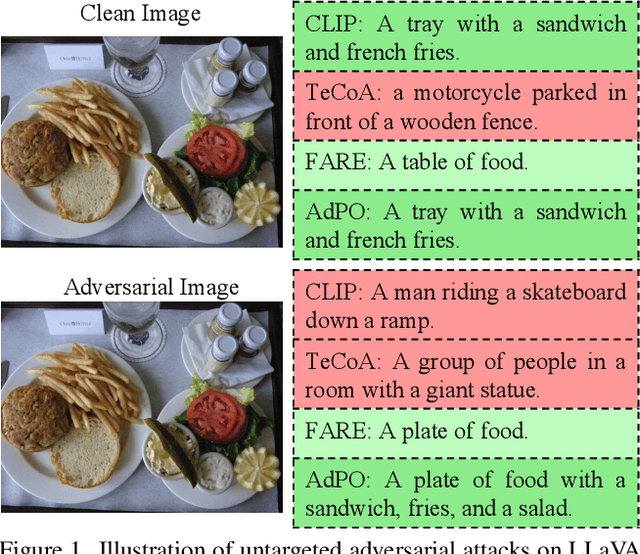
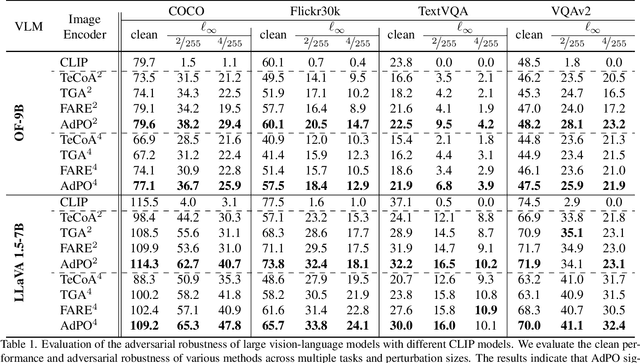
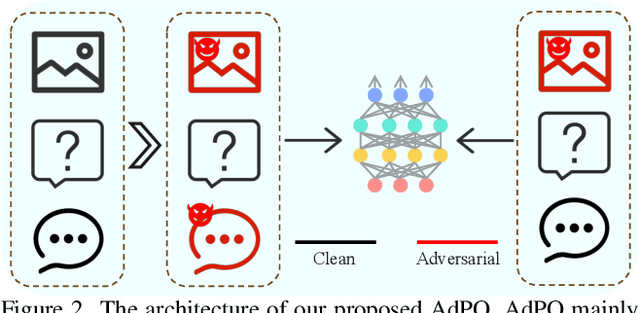
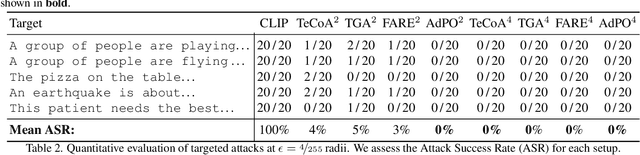
Large Vision-Language Models (LVLMs), such as GPT-4o and LLaVA, have recently witnessed remarkable advancements and are increasingly being deployed in real-world applications. However, inheriting the sensitivity of visual neural networks, LVLMs remain vulnerable to adversarial attacks, which can result in erroneous or malicious outputs. While existing efforts utilize adversarial fine-tuning to enhance robustness, they often suffer from performance degradation on clean inputs. In this paper, we proposes AdPO, a novel adversarial defense strategy for LVLMs based on preference optimization. For the first time, we reframe adversarial training as a preference optimization problem, aiming to enhance the model's preference for generating normal outputs on clean inputs while rejecting the potential misleading outputs for adversarial examples. Notably, AdPO achieves this by solely modifying the image encoder, e.g., CLIP ViT, resulting in superior clean and adversarial performance in a variety of downsream tasks. Considering that training involves large language models (LLMs), the computational cost increases significantly. We validate that training on smaller LVLMs and subsequently transferring to larger models can achieve competitive performance while maintaining efficiency comparable to baseline methods. Our comprehensive experiments confirm the effectiveness of the proposed AdPO, which provides a novel perspective for future adversarial defense research.
ImageScope: Unifying Language-Guided Image Retrieval via Large Multimodal Model Collective Reasoning
Mar 13, 2025
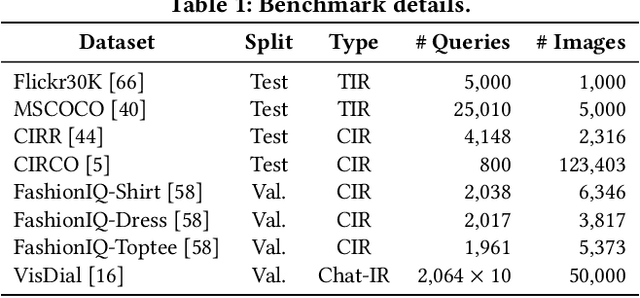
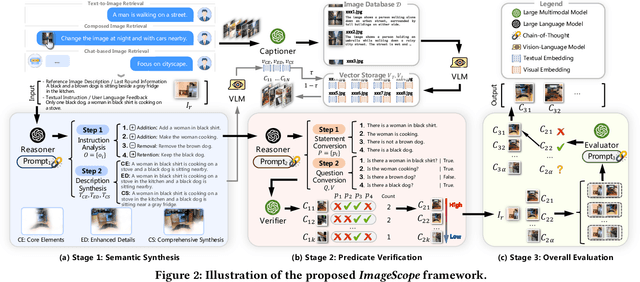
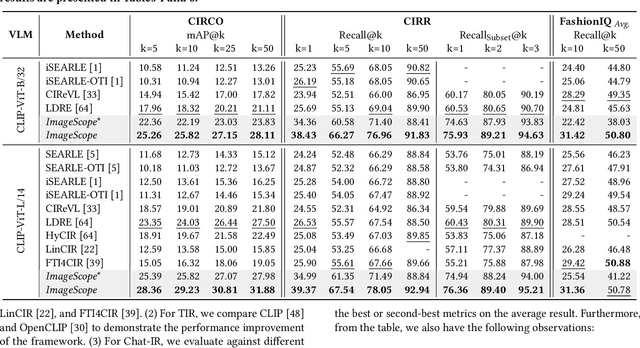
With the proliferation of images in online content, language-guided image retrieval (LGIR) has emerged as a research hotspot over the past decade, encompassing a variety of subtasks with diverse input forms. While the development of large multimodal models (LMMs) has significantly facilitated these tasks, existing approaches often address them in isolation, requiring the construction of separate systems for each task. This not only increases system complexity and maintenance costs, but also exacerbates challenges stemming from language ambiguity and complex image content, making it difficult for retrieval systems to provide accurate and reliable results. To this end, we propose ImageScope, a training-free, three-stage framework that leverages collective reasoning to unify LGIR tasks. The key insight behind the unification lies in the compositional nature of language, which transforms diverse LGIR tasks into a generalized text-to-image retrieval process, along with the reasoning of LMMs serving as a universal verification to refine the results. To be specific, in the first stage, we improve the robustness of the framework by synthesizing search intents across varying levels of semantic granularity using chain-of-thought (CoT) reasoning. In the second and third stages, we then reflect on retrieval results by verifying predicate propositions locally, and performing pairwise evaluations globally. Experiments conducted on six LGIR datasets demonstrate that ImageScope outperforms competitive baselines. Comprehensive evaluations and ablation studies further confirm the effectiveness of our design.