 Add to Chrome
 Add to Firefox
 Add to Edge
When RL Meets Adaptive Speculative Training: A Unified Training-Serving System
Feb 06, 2026
Speculative decoding can significantly accelerate LLM serving, yet most deployments today disentangle speculator training from serving, treating speculator training as a standalone offline modeling problem. We show that this decoupled formulation introduces substantial deployment and adaptation lag: (1) high time-to-serve, since a speculator must be trained offline for a considerable period before deployment; (2) delayed utility feedback, since the true end-to-end decoding speedup is only known after training and cannot be inferred reliably from acceptance rate alone due to model-architecture and system-level overheads; and (3) domain-drift degradation, as the target model is repurposed to new domains and the speculator becomes stale and less effective. To address these issues, we present Aurora, a unified training-serving system that closes the loop by continuously learning a speculator directly from live inference traces. Aurora reframes online speculator learning as an asynchronous reinforcement-learning problem: accepted tokens provide positive feedback, while rejected speculator proposals provide implicit negative feedback that we exploit to improve sample efficiency. Our design integrates an SGLang-based inference server with an asynchronous training server, enabling hot-swapped speculator updates without service interruption. Crucially, Aurora supports day-0 deployment: a speculator can be served immediately and rapidly adapted to live traffic, improving system performance while providing immediate utility feedback. Across experiments, Aurora achieves a 1.5x day-0 speedup on recently released frontier models (e.g., MiniMax M2.1 229B and Qwen3-Coder-Next 80B). Aurora also adapts effectively to distribution shifts in user traffic, delivering an additional 1.25x speedup over a well-trained but static speculator on widely used models (e.g., Qwen3 and Llama3).

Revisiting and Advancing Chinese Natural Language Understanding with Accelerated Heterogeneous Knowledge Pre-training
Oct 12, 2022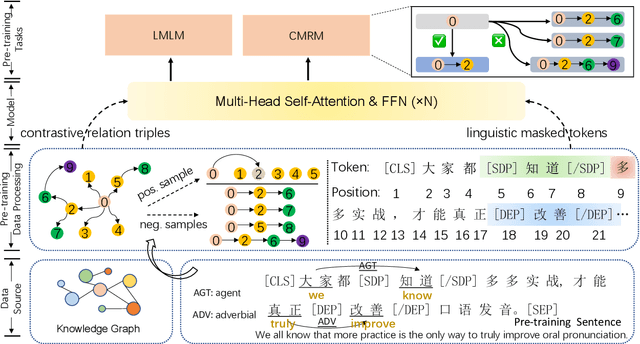
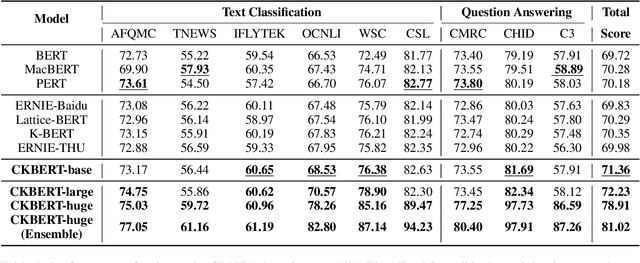
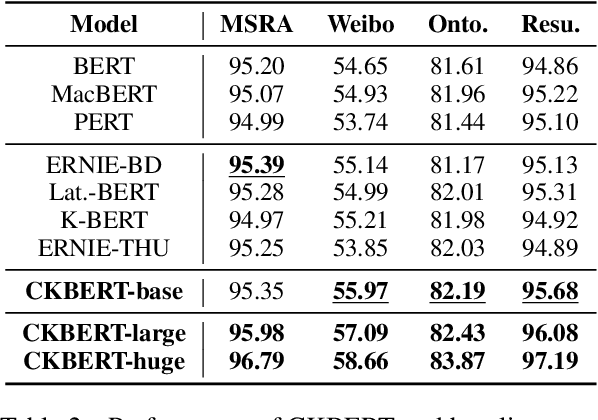
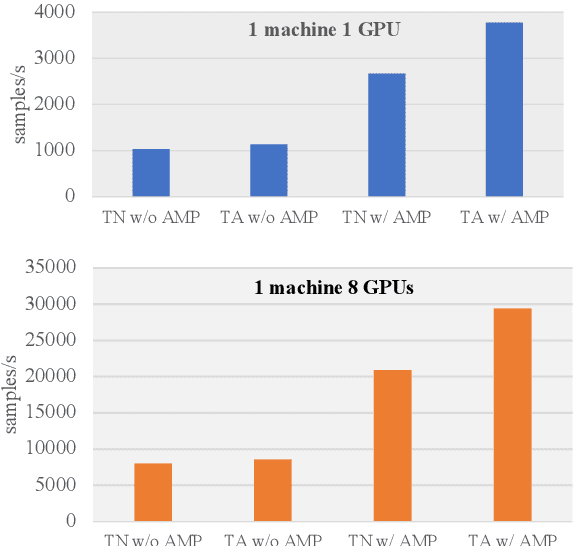
Recently, knowledge-enhanced pre-trained language models (KEPLMs) improve context-aware representations via learning from structured relations in knowledge graphs, and/or linguistic knowledge from syntactic or dependency analysis. Unlike English, there is a lack of high-performing open-source Chinese KEPLMs in the natural language processing (NLP) community to support various language understanding applications. In this paper, we revisit and advance the development of Chinese natural language understanding with a series of novel Chinese KEPLMs released in various parameter sizes, namely CKBERT (Chinese knowledge-enhanced BERT).Specifically, both relational and linguistic knowledge is effectively injected into CKBERT based on two novel pre-training tasks, i.e., linguistic-aware masked language modeling and contrastive multi-hop relation modeling. Based on the above two pre-training paradigms and our in-house implemented TorchAccelerator, we have pre-trained base (110M), large (345M) and huge (1.3B) versions of CKBERT efficiently on GPU clusters. Experiments demonstrate that CKBERT outperforms strong baselines for Chinese over various benchmark NLP tasks and in terms of different model sizes.