 Add to Chrome
 Add to Firefox
 Add to Edge
Semantic Search At LinkedIn
Feb 07, 2026
Semantic search with large language models (LLMs) enables retrieval by meaning rather than keyword overlap, but scaling it requires major inference efficiency advances. We present LinkedIn's LLM-based semantic search framework for AI Job Search and AI People Search, combining an LLM relevance judge, embedding-based retrieval, and a compact Small Language Model trained via multi-teacher distillation to jointly optimize relevance and engagement. A prefill-oriented inference architecture co-designed with model pruning, context compression, and text-embedding hybrid interactions boosts ranking throughput by over 75x under a fixed latency constraint while preserving near-teacher-level NDCG, enabling one of the first production LLM-based ranking systems with efficiency comparable to traditional approaches and delivering significant gains in quality and user engagement.

High Fidelity Textual User Representation over Heterogeneous Sources via Reinforcement Learning
Feb 07, 2026Effective personalization on large-scale job platforms requires modeling members based on heterogeneous textual sources, including profiles, professional data, and search activity logs. As recommender systems increasingly adopt Large Language Models (LLMs), creating unified, interpretable, and concise representations from heterogeneous sources becomes critical, especially for latency-sensitive online environments. In this work, we propose a novel Reinforcement Learning (RL) framework to synthesize a unified textual representation for each member. Our approach leverages implicit user engagement signals (e.g., clicks, applies) as the primary reward to distill salient information. Additionally, the framework is complemented by rule-based rewards that enforce formatting and length constraints. Extensive offline experiments across multiple LinkedIn products, one of the world's largest job platforms, demonstrate significant improvements in key downstream business metrics. This work provides a practical, labeling-free, and scalable solution for constructing interpretable user representations that are directly compatible with LLM-based systems.
Learning to Retrieve for Job Matching
Feb 21, 2024
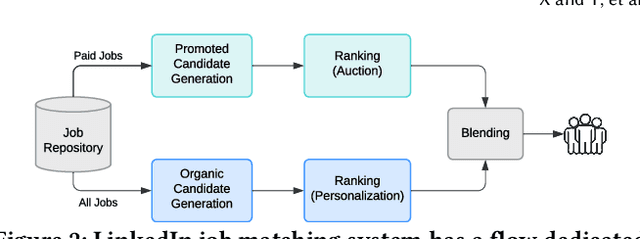
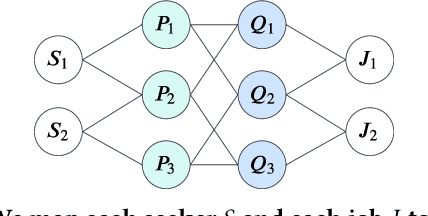
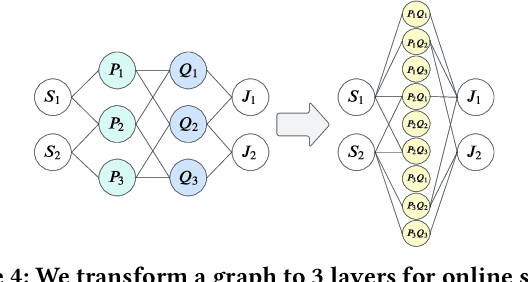
Web-scale search systems typically tackle the scalability challenge with a two-step paradigm: retrieval and ranking. The retrieval step, also known as candidate selection, often involves extracting standardized entities, creating an inverted index, and performing term matching for retrieval. Such traditional methods require manual and time-consuming development of query models. In this paper, we discuss applying learning-to-retrieve technology to enhance LinkedIns job search and recommendation systems. In the realm of promoted jobs, the key objective is to improve the quality of applicants, thereby delivering value to recruiter customers. To achieve this, we leverage confirmed hire data to construct a graph that evaluates a seeker's qualification for a job, and utilize learned links for retrieval. Our learned model is easy to explain, debug, and adjust. On the other hand, the focus for organic jobs is to optimize seeker engagement. We accomplished this by training embeddings for personalized retrieval, fortified by a set of rules derived from the categorization of member feedback. In addition to a solution based on a conventional inverted index, we developed an on-GPU solution capable of supporting both KNN and term matching efficiently.