 Add to Chrome
 Add to Firefox
 Add to Edge
When RL Meets Adaptive Speculative Training: A Unified Training-Serving System
Feb 06, 2026
Speculative decoding can significantly accelerate LLM serving, yet most deployments today disentangle speculator training from serving, treating speculator training as a standalone offline modeling problem. We show that this decoupled formulation introduces substantial deployment and adaptation lag: (1) high time-to-serve, since a speculator must be trained offline for a considerable period before deployment; (2) delayed utility feedback, since the true end-to-end decoding speedup is only known after training and cannot be inferred reliably from acceptance rate alone due to model-architecture and system-level overheads; and (3) domain-drift degradation, as the target model is repurposed to new domains and the speculator becomes stale and less effective. To address these issues, we present Aurora, a unified training-serving system that closes the loop by continuously learning a speculator directly from live inference traces. Aurora reframes online speculator learning as an asynchronous reinforcement-learning problem: accepted tokens provide positive feedback, while rejected speculator proposals provide implicit negative feedback that we exploit to improve sample efficiency. Our design integrates an SGLang-based inference server with an asynchronous training server, enabling hot-swapped speculator updates without service interruption. Crucially, Aurora supports day-0 deployment: a speculator can be served immediately and rapidly adapted to live traffic, improving system performance while providing immediate utility feedback. Across experiments, Aurora achieves a 1.5x day-0 speedup on recently released frontier models (e.g., MiniMax M2.1 229B and Qwen3-Coder-Next 80B). Aurora also adapts effectively to distribution shifts in user traffic, delivering an additional 1.25x speedup over a well-trained but static speculator on widely used models (e.g., Qwen3 and Llama3).

Beat the long tail: Distribution-Aware Speculative Decoding for RL Training
Nov 17, 2025Reinforcement learning(RL) post-training has become essential for aligning large language models (LLMs), yet its efficiency is increasingly constrained by the rollout phase, where long trajectories are generated token by token. We identify a major bottleneck:the long-tail distribution of rollout lengths, where a small fraction of long generations dominates wall clock time and a complementary opportunity; the availability of historical rollouts that reveal stable prompt level patterns across training epochs. Motivated by these observations, we propose DAS, a Distribution Aware Speculative decoding framework that accelerates RL rollouts without altering model outputs. DAS integrates two key ideas: an adaptive, nonparametric drafter built from recent rollouts using an incrementally maintained suffix tree, and a length aware speculation policy that allocates more aggressive draft budgets to long trajectories that dominate makespan. This design exploits rollout history to sustain acceptance while balancing base and token level costs during decoding. Experiments on math and code reasoning tasks show that DAS reduces rollout time up to 50% while preserving identical training curves, demonstrating that distribution-aware speculative decoding can significantly accelerate RL post training without compromising learning quality.
Scaling Speculative Decoding with Lookahead Reasoning
Jun 24, 2025Reasoning models excel by generating long chain-of-thoughts, but decoding the resulting thousands of tokens is slow. Token-level speculative decoding (SD) helps, but its benefit is capped, because the chance that an entire $\gamma$-token guess is correct falls exponentially as $\gamma$ grows. This means allocating more compute for longer token drafts faces an algorithmic ceiling -- making the speedup modest and hardware-agnostic. We raise this ceiling with Lookahead Reasoning, which exploits a second, step-level layer of parallelism. Our key insight is that reasoning models generate step-by-step, and each step needs only to be semantically correct, not exact token matching. In Lookahead Reasoning, a lightweight draft model proposes several future steps; the target model expands each proposal in one batched pass, and a verifier keeps semantically correct steps while letting the target regenerate any that fail. Token-level SD still operates within each reasoning step, so the two layers of parallelism multiply. We show Lookahead Reasoning lifts the peak speedup of SD both theoretically and empirically. Across GSM8K, AIME, and other benchmarks, Lookahead Reasoning improves the speedup of SD from 1.4x to 2.1x while preserving answer quality, and its speedup scales better with additional GPU throughput. Our code is available at https://github.com/hao-ai-lab/LookaheadReasoning
MiLo: Efficient Quantized MoE Inference with Mixture of Low-Rank Compensators
Apr 03, 2025
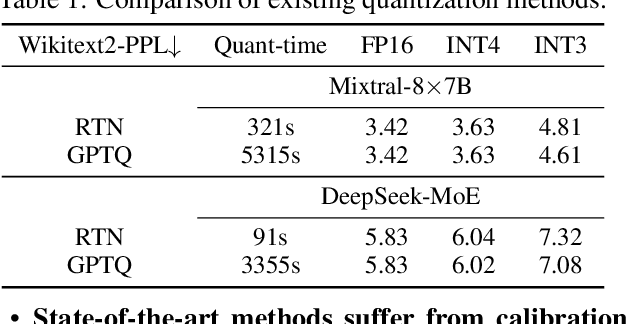
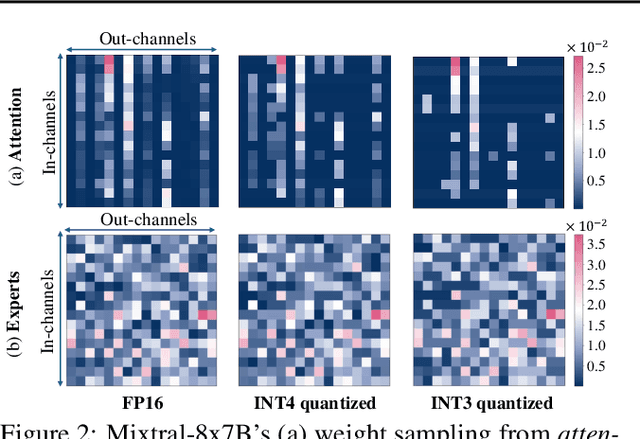
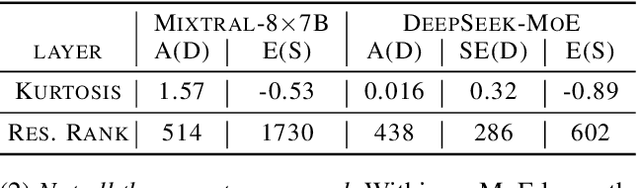
A critical approach for efficiently deploying Mixture-of-Experts (MoE) models with massive parameters is quantization. However, state-of-the-art MoE models suffer from non-negligible accuracy loss with extreme quantization, such as under 4 bits. To address this, we introduce MiLo, a novel method that augments highly quantized MoEs with a mixture of low-rank compensators. These compensators consume only a small amount of additional memory but significantly recover accuracy loss from extreme quantization. MiLo also identifies that MoEmodels exhibit distinctive characteristics across weights due to their hybrid dense-sparse architectures, and employs adaptive rank selection policies along with iterative optimizations to close the accuracy gap. MiLo does not rely on calibration data, allowing it to generalize to different MoE models and datasets without overfitting to a calibration set. To avoid the hardware inefficiencies of extreme quantization, such as 3-bit, MiLo develops Tensor Core-friendly 3-bit kernels, enabling measured latency speedups on 3-bit quantized MoE models. Our evaluation shows that MiLo outperforms existing methods on SoTA MoE models across various tasks.