 Add to Chrome
 Add to Firefox
 Add to Edge
CARE: Covariance-Aware and Rank-Enhanced Decomposition for Enabling Multi-Head Latent Attention
Mar 18, 2026
Converting pretrained attention modules such as grouped-query attention (GQA) into multi-head latent attention (MLA) can improve expressivity without increasing KV-cache cost, making it attractive for efficient inference. However, many practical conversion baselines rely on weight-only low-rank approximations (e.g., SVD-style initializations) and uniform rank allocation. They focus on minimizing the difference between weight matrices rather than on how those weights affect input activations, ignore the covariance structure of activations, and enforce uniform rank across layers, causing activation drift and degraded attention fidelity. To address these issues, we propose CARE, a Covariance-Aware, Rank-Enhanced MLA conversion pipeline under a fixed KV width. CARE introduces three key steps: (i) activation-preserving factorization, which aligns the approximation with the actual input activations rather than just the weights; (ii) adjusted-rank allocation, which spreads a fixed KV budget across layers by giving more capacity to layers that need it most; and (iii) KV-parity mapping, which reparameterizes the converted K and V to fit the MLA format while keeping the KV-cache size unchanged. Our method outperforms a uniform-rank SVD baseline on Qwen3-4B/30B-A3B-Instruct-2507 and Llama-3.1-8B/70B-Instruct, reducing one-shot perplexity by up to 215x and improving mean accuracy by up to 1.70x at matched KV budgets. With a brief post-SVD healing fine-tune, we fully recover the original model's accuracy.

When RL Meets Adaptive Speculative Training: A Unified Training-Serving System
Feb 06, 2026Speculative decoding can significantly accelerate LLM serving, yet most deployments today disentangle speculator training from serving, treating speculator training as a standalone offline modeling problem. We show that this decoupled formulation introduces substantial deployment and adaptation lag: (1) high time-to-serve, since a speculator must be trained offline for a considerable period before deployment; (2) delayed utility feedback, since the true end-to-end decoding speedup is only known after training and cannot be inferred reliably from acceptance rate alone due to model-architecture and system-level overheads; and (3) domain-drift degradation, as the target model is repurposed to new domains and the speculator becomes stale and less effective. To address these issues, we present Aurora, a unified training-serving system that closes the loop by continuously learning a speculator directly from live inference traces. Aurora reframes online speculator learning as an asynchronous reinforcement-learning problem: accepted tokens provide positive feedback, while rejected speculator proposals provide implicit negative feedback that we exploit to improve sample efficiency. Our design integrates an SGLang-based inference server with an asynchronous training server, enabling hot-swapped speculator updates without service interruption. Crucially, Aurora supports day-0 deployment: a speculator can be served immediately and rapidly adapted to live traffic, improving system performance while providing immediate utility feedback. Across experiments, Aurora achieves a 1.5x day-0 speedup on recently released frontier models (e.g., MiniMax M2.1 229B and Qwen3-Coder-Next 80B). Aurora also adapts effectively to distribution shifts in user traffic, delivering an additional 1.25x speedup over a well-trained but static speculator on widely used models (e.g., Qwen3 and Llama3).
RenAIssance: A Survey into AI Text-to-Image Generation in the Era of Large Model
Sep 02, 2023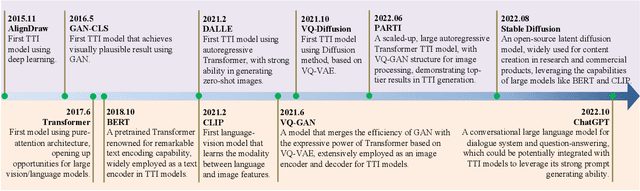
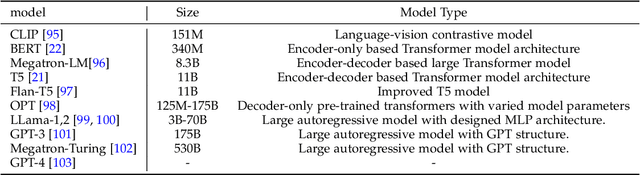
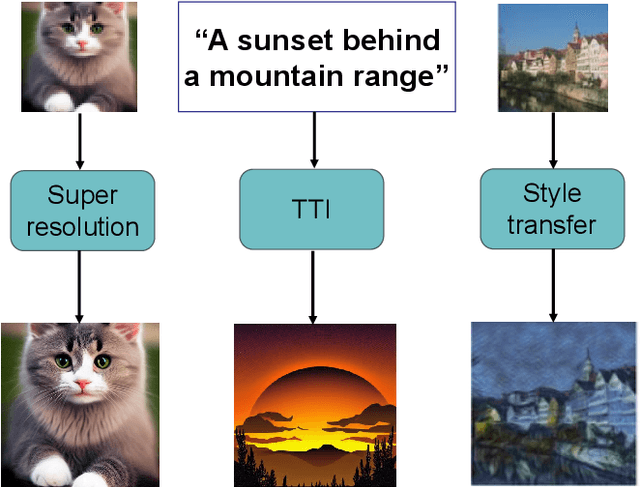
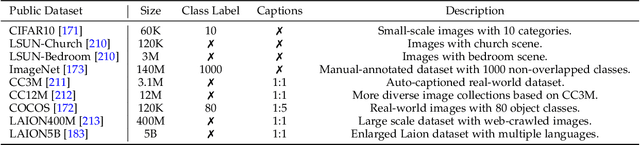
Text-to-image generation (TTI) refers to the usage of models that could process text input and generate high fidelity images based on text descriptions. Text-to-image generation using neural networks could be traced back to the emergence of Generative Adversial Network (GAN), followed by the autoregressive Transformer. Diffusion models are one prominent type of generative model used for the generation of images through the systematic introduction of noises with repeating steps. As an effect of the impressive results of diffusion models on image synthesis, it has been cemented as the major image decoder used by text-to-image models and brought text-to-image generation to the forefront of machine-learning (ML) research. In the era of large models, scaling up model size and the integration with large language models have further improved the performance of TTI models, resulting the generation result nearly indistinguishable from real-world images, revolutionizing the way we retrieval images. Our explorative study has incentivised us to think that there are further ways of scaling text-to-image models with the combination of innovative model architectures and prediction enhancement techniques. We have divided the work of this survey into five main sections wherein we detail the frameworks of major literature in order to delve into the different types of text-to-image generation methods. Following this we provide a detailed comparison and critique of these methods and offer possible pathways of improvement for future work. In the future work, we argue that TTI development could yield impressive productivity improvements for creation, particularly in the context of the AIGC era, and could be extended to more complex tasks such as video generation and 3D generation.